Imposter Syndrome: Practical Strategies for Women Entrepreneurs

TL;DR:
- 70% of women experience imposter syndrome at work, especially in male-dominated industries.
- Imposter syndrome persists even after success and intensifies with career progression.
- Overcoming it requires both mindset strategies and addressing systemic structural inequalities.
70% of women experience imposter syndrome at work, and for women entrepreneurs, the stakes are even higher. You’ve built something real. Revenue is coming in. And yet, a quiet voice keeps asking whether you actually deserve it. That voice is not a character flaw. It is one of the most documented psychological patterns among high-achieving women in business. This article breaks down why imposter syndrome is so persistent, what it actually costs you financially and strategically, and what you can do right now to stop letting self-doubt make your business decisions for you.
Table of Contents
- What imposter syndrome looks like for women entrepreneurs
- Why imposter syndrome persists even after success
- The hidden costs: How self-doubt impacts business and financial confidence
- Proven strategies to overcome imposter feelings and break the cycle
- Contrary to popular belief: It’s not all ‘mindset’, the power of structural change
- Next steps for sustainable confidence and growth
- Frequently asked questions
Key Takeaways
| Point | Details |
|---|---|
| Imposter syndrome is common | A majority of women entrepreneurs, even successful ones, struggle with imposter feelings at some point. |
| Self-doubt affects business decisions | Unchecked imposter syndrome can stall growth, financial confidence, and entrepreneurial identity. |
| Actionable strategies work | Tracking wins, reframing thoughts, mentorship, and celebrating milestones help break the cycle. |
| Support systems and role models matter | Community, mentorship, and challenging structural barriers are as critical as personal mindset work. |
What imposter syndrome looks like for women entrepreneurs
Imposter syndrome is the persistent feeling that your success is luck, timing, or a mistake waiting to be corrected. It shows up as a fear of being “found out,” a habit of discounting your own wins, and a tendency to attribute results to anything but your own skill. For women entrepreneurs, this is not a fringe experience. It is the norm.
The pattern gets sharper in industries shaped by masculine norms. Research shows that imposter fears hinder growth for women entrepreneurs specifically because of the mismatch between how entrepreneurship is culturally coded and how women are socialized to see themselves. When the dominant image of a “successful founder” does not look like you, your brain starts questioning whether you belong.
Here is what that looks like in practice:
- Hesitating to raise your prices even when your results justify it
- Avoiding press, speaking opportunities, or visibility because you feel “not ready yet”
- Over-preparing for meetings to compensate for feeling like a fraud
- Dismissing client compliments or attributing wins to luck
- Shrinking in rooms where you are the only woman or the youngest person
And the numbers back this up. A striking 37% of women business owners report that self-doubt has directly prevented their business growth. That is not a mindset quirk. That is a measurable drag on revenue, decisions, and momentum.
| Factor | Women entrepreneurs | Men entrepreneurs |
|---|---|---|
| Frequency of imposter feelings | High and persistent | Lower and situational |
| Triggered by visibility | Yes, often intensified | Less commonly reported |
| Linked to identity threat | Strongly linked | Weakly linked |
| Impact on financial decisions | Significant | Moderate |
The triggers are predictable: hitting a new revenue milestone, entering a market where you are a “first,” stepping into a leadership role, or simply becoming more visible. Building financial resilience for entrepreneurs is harder when your own mind is working against your next move. Recognizing the pattern is the first step. Understanding why it persists is the next.
Why imposter syndrome persists even after success
Here is the uncomfortable truth: success does not cure imposter syndrome. For many women entrepreneurs, it makes it worse.
The logic seems backward. You close a big deal, and instead of feeling confident, you feel more exposed. You land a feature in a major publication, and your first thought is whether people will realize you do not know as much as they think. This is not irrational. It is a predictable response to environments that were not built with you in mind.

Imposter syndrome intensifies with progression and is amplified when women lack visible role models or operate in male-dominated spaces. The higher you climb, the fewer people who look like you, and the louder the internal questioning becomes.
Here is how this plays out across different business stages:
- Early-stage entrepreneurs feel like they are faking expertise they have not yet fully claimed.
- Growth-phase entrepreneurs fear that scaling will expose gaps they have been able to hide at smaller volume.
- Established entrepreneurs worry that their past success was a streak, not a pattern, and that the next move will reveal the truth.
The common thread is social comparison. When you scroll through curated highlight reels of other founders, your brain fills in the gaps with worst-case assumptions about yourself. You see their wins. You feel your doubts. The comparison is never fair.
Structural factors also play a significant role. Fewer women in senior positions means fewer mirrors. Fewer mirrors means fewer moments where you see someone like you succeeding and think, “That is possible for me too.” This is not a personal failure. It is a design problem.
“The higher the stakes, the louder the doubt. Not because you are less capable, but because the environment was built to make you question yourself.”
Building strong financial wellness for entrepreneurs requires psychological safety alongside strategy. When imposter syndrome goes unaddressed, it does not just affect how you feel. It affects what you do, and more importantly, what you do not do.
The hidden costs: How self-doubt impacts business and financial confidence
Now that you know why imposter syndrome lingers, look at what it actually costs you when it goes unchecked.
Low financial confidence is both a symptom and a driver of imposter syndrome. When you do not trust your own judgment, you delay decisions. You wait for more data, more certainty, more permission. And while you wait, competitors move, opportunities close, and your business plateaus.
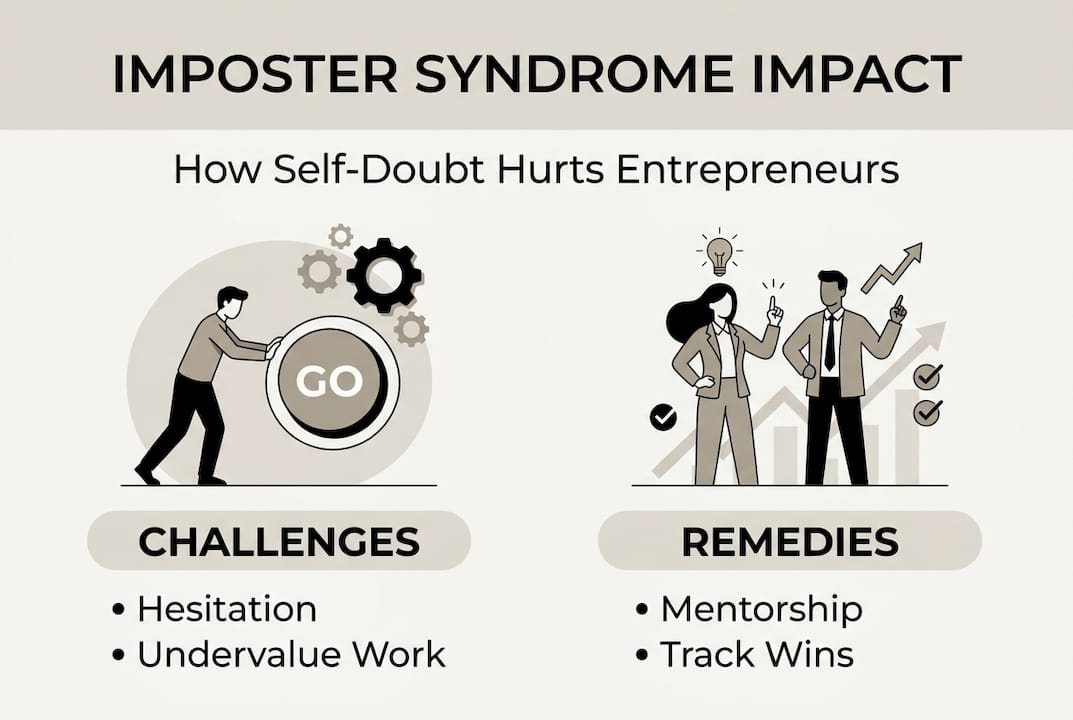
Only 18% of female business leaders report low financial confidence, but the impact of that group is outsized. Low confidence in financial decisions ripples into pricing, hiring, investment, and negotiation. Every one of those is a wealth-building lever you are leaving untouched.
Here is where the real cost shows up:
- Undercharging: You price based on fear of rejection, not on the value you deliver.
- Delayed hiring: You hold off on bringing in support because you are not sure the business can sustain it, even when the numbers say otherwise.
- Avoided risk: You pass on partnerships, markets, or investments that would accelerate growth because doubt makes the downside feel certain and the upside feel unlikely.
- Weak negotiation: You accept the first offer, discount before being asked, or apologize for your rates.
- Leadership erosion: Your team picks up on your hesitation, and it affects their confidence in the business too.
Pro Tip: Start tracking your decisions alongside your doubts. When you notice yourself hesitating on a financial move, write down what the fear is. Then look at your actual data. More often than not, the numbers support the move your doubt is blocking.
Building financial sovereignty for entrepreneurs means making decisions from your results, not your fears. And developing financial empowerment for leaders starts with recognizing how much self-doubt is quietly shaping your business strategy.
Proven strategies to overcome imposter feelings and break the cycle
With the problem clear, it is time to shift into action with practical tactics that actually move the needle.
Research on how women entrepreneurs manage self-doubt identifies two effective paths: elevation and experimentation. Elevation and experimentation involve cultivating positive emotions and actively seeking support, while entrenchment, which means doubling down on avoidance, is identified as the highest-risk response. The goal is to keep moving, not to wait until you feel ready.
Here are the strategies that work:
- Track your wins systematically. Keep a running document of client results, revenue milestones, and decisions that paid off. When doubt hits, you have evidence to counter it. This is not journaling for feelings. It is building a business case for your own capability.
- Reframe the inner critic. When the voice says “you are not qualified,” ask what evidence actually supports that claim. Usually, there is none. Replace the thought with a specific result: “I helped a client grow revenue by 40% last quarter.”
- Build a support system that challenges you. Mentors, masterminds, and peer networks are not just for strategy. They normalize the experience of doubt and give you real-time evidence that other capable women feel the same way.
- Celebrate small wins deliberately. Do not wait for the big milestone. Acknowledge the proposal you sent, the boundary you held, the conversation you initiated. Each small win reinforces your entrepreneurial identity.
- Adopt a growth orientation toward setbacks. Mistakes are data. When something does not work, extract the lesson and move. Imposter syndrome feeds on perfectionism. Consistent forward motion starves it.
Pro Tip: Pair your financial tracking with a weekly mindset check-in. Note one money move you made and one fear you pushed through. Over time, this practice builds the neural evidence your brain needs to trust you.
Working with financial coaching for founders can accelerate this process significantly. And deepening your financial literacy for founders gives you the concrete knowledge base that makes confidence feel earned, not performed.
Contrary to popular belief: It’s not all ‘mindset’, the power of structural change
Every article on imposter syndrome eventually tells you to journal more, reframe your thoughts, and find a mentor. That advice is not wrong. But it is incomplete.
Research is clear that imposter syndrome is tied to structural inequalities and gender stereotypes, and that diversity management and visible female role models actively moderate its impact. That means your individual mindset work is operating inside a system that is still producing the conditions that create self-doubt in the first place.
This matters because it reframes what “solving” imposter syndrome actually looks like. It is not just about feeling better. It is about changing the environment you and other women are operating in.
You can do both. Work on your inner patterns and actively build diverse networks. Become the visible role model you did not have. Advocate for structural changes in your industry. Mentor the woman behind you. Every time a woman with real authority shows up visibly and unapologetically, she makes the path easier for the next one.
The most powerful coaching business strategies are not just about individual performance. They are about building ecosystems where women can succeed without constantly fighting their own nervous systems to do it.
Next steps for sustainable confidence and growth
You have done the work to understand what imposter syndrome is, why it persists, and what it costs. Now the question is: what comes next?
At Freedom Sun, we work with women entrepreneurs who are already generating revenue and ready to stop letting self-doubt run the show. The gap between what you are capable of and what you are actually building is not a strategy problem. It is a nervous system problem. And it is solvable.
If you want to practice selling and receiving without the freeze, the Practice Room is a real place to start. Alongside that, explore our resources on financial wellness for entrepreneurs to build the financial confidence that makes your mindset shifts stick. Your next level does not require you to feel ready. It requires you to move anyway.
Frequently asked questions
What triggers imposter syndrome most for women entrepreneurs?
Triggers include entering new markets, hitting business milestones, working in male-dominated industries, and increased visibility or responsibility. Research confirms that imposter fears are amplified by masculine stereotypes and the absence of visible role models in your space.
Does imposter syndrome ever go away for entrepreneurs?
Imposter feelings can decrease with intentional work, but they often persist even in successful, established women entrepreneurs. Studies show that imposter syndrome intensifies with career progression rather than fading with success.
How can I build financial confidence alongside mindset shifts?
Combine tracking wins, seeking mentorship, and improving financial literacy to strengthen both confidence and wealth-building habits. Remember that 18% of female leaders report low financial confidence, which means this is a shared challenge with real, learnable solutions.
Is imposter syndrome mainly a personal issue or a structural one?
It is both. Structural inequalities and stereotypes sustain imposter feelings, so solutions need to address individual mindset and systemic barriers together. Treating it as purely personal means missing half the problem and half the solution.