Money Mindset: Unlocking Entrepreneurial Wealth

Raising venture capital and building the next big thing often stirs up more than late nights and product launches. For many American tech founders, the real challenge hides in a silent driver: your money mindset. Far from just spreadsheets and profit margins, your beliefs and emotions about money shape how you scale, lead, and avoid burnout. This article breaks down common money myths, reveals how your financial attitude impacts daily decisions, and offers practical ways to build a system that sustains both growth and well-being.
Table of Contents
- Money Mindset Defined And Common Myths
- Core Beliefs That Shape Your Financial Outcomes
- Entrepreneur, Investor, And Hybrid Mindsets
- Integrating Money Mindset With Financial Systems
- Risk, Burnout, And Costly Money Mindset Mistakes
Key Takeaways
| Point | Details |
|---|---|
| Understanding Money Mindset | A money mindset shapes how entrepreneurs perceive and engage with financial resources, significantly impacting their success. |
| Core Beliefs Matter | Core money beliefs influence financial outcomes and can be reshaped to enhance financial decision-making and entrepreneurial growth. |
| Mindset Types | Successful entrepreneurs leverage different mindsets—entrepreneurial, investor, or hybrid—to adapt their financial strategies effectively. |
| Cognitive Biases Impact Decisions | Recognizing and addressing cognitive biases can prevent costly mistakes and promote healthier financial management practices. |
Money Mindset Defined and Common Myths
A money mindset represents the unique psychological framework through which entrepreneurs perceive, interact with, and make decisions about financial resources. Unlike simplistic views that reduce money to mere numerical transactions, contemporary research reveals money as a complex emotional and symbolic construct that profoundly shapes business behavior and personal success.
Traditional perspectives often mischaracterize money as an objective, neutral resource. However, systematic research demonstrates that individual attitudes toward money are deeply rooted in psychological, cultural, and personal experiences. These attitudes manifest through deeply ingrained beliefs that can either propel entrepreneurial growth or create significant mental barriers.
Some prevalent myths about money mindset include:
- Money is inherently good or evil
- Wealth accumulation requires sacrificing personal relationships
- Financial success is purely about technical skills
- Investing is only for wealthy individuals
Entrepreneurs frequently struggle with these misconceptions, which can limit their financial potential. Financial literacy experts consistently argue that understanding money as a neutral tool for creating value is crucial for sustainable business growth. The key is developing a balanced perspective that views money as a strategic resource for generating opportunities and solving problems.
Pro tip: Conduct a monthly self-audit of your money beliefs, challenging assumptions and reframing financial narratives that might be holding you back from entrepreneurial success.
Core Beliefs That Shape Your Financial Outcomes
Entrepreneurs’ financial trajectories are fundamentally shaped by their core money beliefs - intricate psychological frameworks that silently guide financial decision-making. Understanding individual attitudes toward money reveals a complex landscape of cognitive, emotional, and behavioral patterns that profoundly influence financial outcomes.

These core beliefs manifest through several critical perspectives that determine an entrepreneur’s financial approach. Some key dimensions include viewing money as a tool for security, a measure of personal worth, a mechanism for achieving freedom, or a means of creating social connections. Individuals who perceive money primarily as a source of security tend to be more conservative in their investments, while those who see money as a pathway to freedom might take more calculated risks in their business strategies.
Research demonstrates that financial literacy significantly impacts financial behaviors and overall entrepreneurial success. Core financial beliefs are not static but dynamically shaped by multiple factors including:
Here’s how core influences shape your financial beliefs and actions:
| Influence Type | Description | Example of Impact |
|---|---|---|
| Personal Experiences | Past events with money | Risk appetite formed by early loss |
| Cultural Background | Social and family money attitudes | Views on saving vs. spending |
| Financial Education | Knowledge gained through learning | Confident decision-making ability |
| Personality Traits | Individual tendencies and behaviors | Impulse control in spending |
- Personal life experiences
- Cultural background
- Socioeconomic influences
- Early financial education
- Personality traits
- Previous financial successes and failures
Understanding and consciously reshaping these underlying beliefs can dramatically transform an entrepreneur’s financial trajectory, enabling more strategic, confident, and intentional financial management.
Pro tip: Conduct a quarterly personal financial belief audit, challenging and reframing any limiting narratives that might be unconsciously restricting your financial potential.
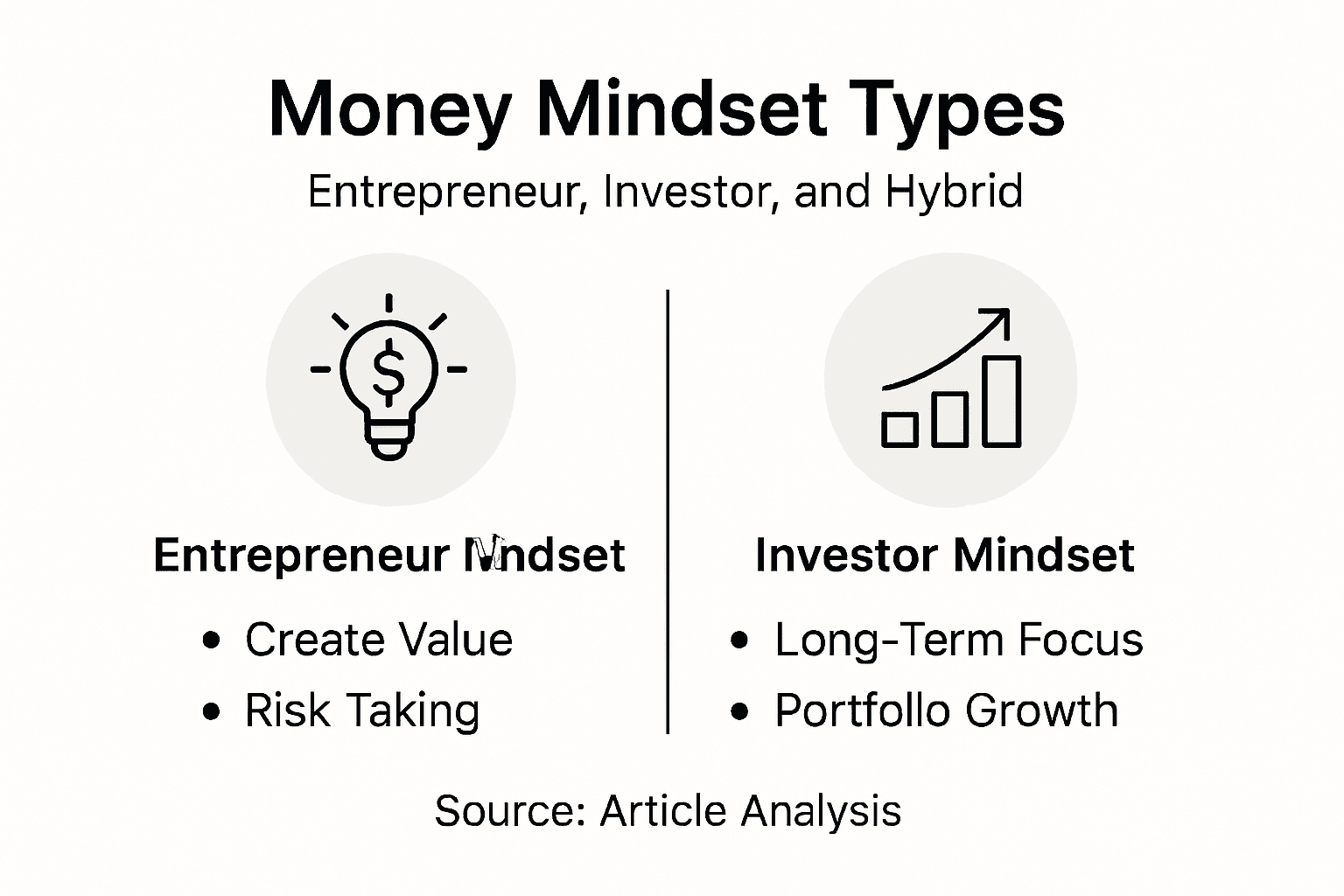
Entrepreneur, Investor, and Hybrid Mindsets
Entrepreneurial success hinges on understanding the nuanced psychological frameworks that drive financial decision-making. Entrepreneurial mindsets demonstrate unique cognitive orientations that distinguish how individuals approach wealth creation, risk, and opportunity across different business contexts.
Three primary mindset archetypes emerge in entrepreneurial ecosystems: the pure entrepreneurial mindset, the investor mindset, and the hybrid mindset. Entrepreneurs fundamentally focus on opportunity recognition and solution implementation, continuously learning and iterating through dynamic business cycles. In contrast, investors prioritize risk assessment, capital allocation, and strategic financial management. The hybrid mindset represents a sophisticated approach that integrates innovative thinking with calculated financial strategy.
Cognitive flexibility characterizes successful entrepreneurial approaches. Key distinguishing characteristics of these mindsets include:
Compare the three primary entrepreneurial mindsets:
| Mindset Type | Key Focus Area | Risk Orientation | Typical Business Approach |
|---|---|---|---|
| Entrepreneur | Innovation, growth | High, embraces uncertainty | Quick adaptation, scaling |
| Investor | Preservation, returns | Moderate, calculated moves | Portfolio building, due diligence |
| Hybrid | Balanced integration | Adaptive, situation-based | Mixes creativity with analytics |
- Entrepreneur Mindset: Innovation-driven, opportunity-focused, high risk tolerance
- Investor Mindset: Capital-preservation oriented, systematic risk management, portfolio diversification
- Hybrid Mindset: Balanced approach combining innovation with strategic financial planning
Successful entrepreneurs recognize that mindset is not static but a dynamic skill that can be developed and refined through intentional practice, continuous learning, and strategic self-reflection.
Pro tip: Conduct a monthly self-assessment to identify which mindset traits you currently embody and consciously develop skills from other mindset archetypes to enhance your entrepreneurial adaptability.
Integrating Money Mindset With Financial Systems
Successful entrepreneurs understand that financial systems are more than spreadsheets and calculations. Psychological determinants profoundly influence money management behaviors, creating a complex interplay between mindset and practical financial infrastructure.
The integration process involves aligning emotional and cognitive perspectives with structured financial approaches. Your money mindset acts as the internal operating system that determines how you interact with financial tools, making it crucial to develop awareness of underlying beliefs and patterns that drive financial decision-making. This means moving beyond traditional financial planning to incorporate psychological insights that reveal deeper motivations and potential blockages.
Financial literacy programs now recognize emotional barriers in money management. Key strategies for integration include:
- Identifying personal money narratives
- Challenging limiting financial beliefs
- Developing emotional regulation around finances
- Creating systems that align with personal values
- Implementing feedback loops for continuous financial learning
Transforming your financial approach requires consistent self-reflection and intentional system design that supports your entrepreneurial goals while addressing psychological patterns that might unconsciously sabotage financial progress.
Pro tip: Conduct a quarterly financial mindset audit, mapping your emotional responses to financial decisions and systematically redesigning your financial systems to support your evolving entrepreneurial vision.
Risk, Burnout, and Costly Money Mindset Mistakes
Entrepreneurial success hinges not just on strategic planning, but on understanding the psychological landmines that can derail financial progress. Chronic stress and unaddressed psychological strain create complex risk factors that transform money management from a rational process into an emotional minefield.
Cognitive biases represent significant hidden risks in financial decision-making. These mental shortcuts unconsciously distort risk perception, leading entrepreneurs into costly mistakes that can accelerate burnout and financial instability. Different cognitive biases manifest uniquely, but they share a common thread: they bypass rational analysis and trigger emotional, often destructive financial responses.
Cognitive biases significantly distort financial decision-making, creating predictable patterns of costly mistakes:
- Loss aversion leading to missed opportunities
- Anchoring to past financial experiences
- Overconfidence in investment strategies
- Emotional attachment to failing ventures
- Resistance to adapting financial approaches
Mitigating these risks requires developing metacognitive awareness, creating systematic checks and balances, and cultivating emotional resilience that allows for objective financial analysis.
Pro tip: Implement a weekly financial decision review process, documenting your choices, analyzing potential cognitive biases, and creating accountability mechanisms to interrupt impulsive financial behaviors.
Unlock Your Entrepreneurial Wealth with a Transformative Money Mindset
Understanding that your money mindset deeply influences your financial outcomes is the first step toward sustainable entrepreneurial success. This article highlights common misconceptions, cognitive biases, and the critical need to integrate your emotional relationship with money into practical financial systems. If you find yourself struggling with limiting beliefs, risk-related stress, or burnout as you navigate growth and investment decisions, you are not alone.
At Freedom Sun, we specialize in empowering high-growth entrepreneurs with an innovative Operating System that aligns your MIND (mental resilience), MATH (financial clarity), and MECHANICS (systems infrastructure). Our platform helps you break free from destructive financial narratives and build robust, burnout-proof business operations modeled after Fortune 500 CFO practices. Experience interactive training, diagnostic assessments, and a supportive community designed to boost your financial literacy and leadership skills.
Ready to shift from reactive money management to strategic wealth creation? Explore how you can reframe your financial beliefs while designing automated systems that protect your peace and accelerate growth. Take control of your entrepreneurial journey today with Freedom Sun. Begin your transformation now to unlock profitable peace and scalable leadership.
Frequently Asked Questions
What is a money mindset?
A money mindset refers to the unique psychological framework that influences how entrepreneurs perceive, interact with, and make decisions regarding financial resources. It encompasses emotional, cultural, and personal beliefs about money, impacting business behavior and personal success.
How do core beliefs affect my financial outcomes as an entrepreneur?
Core beliefs shape financial decisions by determining whether you view money as a tool for security, self-worth, freedom, or social connections. These perspectives influence how you approach investments, risks, and financial growth strategies.
What are some common myths about money mindset?
Common myths include the belief that money is inherently good or evil, that wealth requires sacrificing personal relationships, and that only technical skills lead to financial success. These misconceptions can hinder financial potential.
How can I improve my money mindset?
Improving your money mindset involves conducting regular self-audits of your financial beliefs, challenging limiting narratives, integrating emotional awareness into financial decisions, and developing systems that align with your personal values and entrepreneurial goals.