Self-Leadership: Unlocking Sustainable Success for Founders

Most American founders underestimate the internal discipline needed for true business success. Research shows over 60 percent of entrepreneurs struggle to maintain strategic focus without strong self-leadership. For growth-driven leaders in North America, mastering self-leadership is not just theory but the backbone of operational stability and financial clarity. This guide reveals practical mindsets and strategies that empower founders to take control and drive their ventures forward with confidence.
Table of Contents
- Defining Self-Leadership for Entrepreneurs
- Core Competencies and Pillars of Self-Leadership
- Types of Self-Leadership Strategies and Approaches
- Role of Self-Leadership in Financial and Operational Health
- Common Challenges and Mistakes in Self-Leadership Practice
Key Takeaways
| Point | Details |
|---|---|
| Self-Leadership Importance | Entrepreneurs must actively shape their internal systems of motivation and strategy to enhance personal and business growth. |
| Core Competencies | Mastery of self-awareness, goal setting, and self-regulation is essential for navigating complex challenges. |
| Behavioral Strategies | Utilizing focused behavioral approaches alongside cognitive techniques fosters sustainable performance and resilience. |
| Continuous Learning | Self-leadership should be viewed as a dynamic, ongoing process that requires regular assessment and adaptive strategies. |
Defining Self-Leadership for Entrepreneurs
Self-leadership represents a transformative approach where entrepreneurs deliberately architect their internal systems of motivation, behavior, and strategic thinking. At its core, self-leadership is about becoming the primary architect of your professional trajectory, designing intentional processes that drive personal and business growth.
Research reveals that self-leadership is a sophisticated self-influencing process crucial for entrepreneurs. It enables founders to set ambitious goals, create compelling visions, and organize complex operational strategies through intrinsic motivation. The concept goes beyond traditional leadership models by placing ultimate accountability directly in the hands of the entrepreneur.
Effective self-leadership involves mastering both behavioral and cognitive strategies. Entrepreneurs who excel in self-leadership demonstrate remarkable abilities to control their actions, redirect negative thought patterns, and maintain unwavering focus on their strategic objectives. Entrepreneurial success fundamentally depends on an individual’s capacity to influence their own mindset and performance consistently.
Pro tip: Start developing your self-leadership muscle by creating a daily reflection ritual where you honestly assess your progress, challenges, and strategic alignment with your core business objectives.
Core Competencies and Pillars of Self-Leadership
Self-leadership is a multifaceted discipline that demands entrepreneurs develop sophisticated internal capabilities across multiple dimensions. The framework encompasses four critical pillars that form the foundation of effective personal leadership: cognitive, emotional, behavioral, and physical strategies that work synergistically to drive professional success.

At the core of self-leadership are key competencies that enable strategic self-management. These include essential skills like self-awareness, goal setting, self-regulation, and intrinsic motivation. Entrepreneurs who master these competencies can consistently navigate complex business challenges by maintaining laser-focused control over their thoughts, actions, and emotional responses.
Behavioral strategies play a crucial role in self-leadership development. Focused strategies that promote positive behaviors help founders create sustainable performance patterns. These include techniques like natural reward strategies that generate positive emotional experiences, constructive thought pattern approaches that reframe challenges, and deliberate self-influence methods that enhance overall effectiveness and emotional intelligence.
Successful self-leadership requires integrating cognitive understanding with practical application. This means not just knowing the strategies but consistently practicing them, creating neural pathways that support resilience, strategic thinking, and personal accountability. The most effective entrepreneurs treat self-leadership as a continuous learning process, constantly refining their internal systems and mental frameworks.
Pro tip: Develop a weekly self-leadership audit where you systematically review your behavioral patterns, emotional responses, and progress toward strategic objectives.
Here’s a summary of the four pillars of self-leadership and how each impacts entrepreneurial success:
| Pillar | Focus Area | Main Benefit | Example Impact |
|---|---|---|---|
| Cognitive | Strategic thinking and mindset | Improved decision-making | Better risk assessment |
| Emotional | Emotional intelligence | Enhanced resilience | Decreased burnout |
| Behavioral | Consistent action and routines | Sustainable performance | Increased productivity |
| Physical | Energy and health management | Greater stamina and focus | Improved work-life balance |
Types of Self-Leadership Strategies and Approaches
Self-leadership is a dynamic process that requires entrepreneurs to deploy sophisticated strategies across multiple dimensions of personal performance. Three primary strategy categories form the foundation of effective self-management: behavior-focused approaches, natural reward strategies, and constructive thought pattern techniques.
Behavior-focused strategies represent the first critical approach to self-leadership. These include systematic techniques like self-goal setting, self-observation, and performance tracking. Entrepreneurs utilize these methods to create structured accountability mechanisms that transform aspirational goals into tangible, executable actions. By meticulously monitoring their own performance and establishing clear benchmarks, founders can systematically deconstruct complex objectives into manageable steps.
Cognitive reframing and strategic self-regulation emerge as powerful tools for navigating complex business challenges. These approaches enable entrepreneurs to consciously reshape their mental narratives, transforming potential obstacles into opportunities for growth. Natural reward strategies complement these cognitive techniques by generating intrinsic motivation, helping founders create positive emotional experiences that reinforce productive behaviors and maintain high performance levels.
The most effective self-leadership practitioners integrate these strategies holistically, recognizing that sustainable success emerges from a comprehensive approach to personal development. This means continuously adapting strategies, maintaining emotional flexibility, and developing a growth mindset that views challenges as opportunities for systemic improvement and personal transformation.
Pro tip: Create a monthly self-leadership strategy review where you critically assess the effectiveness of your current approaches and intentionally experiment with new techniques.
This table compares three core self-leadership strategy types entrepreneurs can use and their business advantages:
| Strategy Type | Core Technique | Business Advantage |
|---|---|---|
| Behavior-Focused | Goal-setting, tracking | More operational efficiency |
| Natural Reward | Intrinsic motivation | Higher job satisfaction |
| Constructive Thought | Reframing, self-regulation | Improved adaptability |
Role of Self-Leadership in Financial and Operational Health
Self-leadership serves as a critical catalyst for transforming organizational performance, directly influencing financial stability and operational effectiveness. Health-promoting self-leadership practices play a pivotal role in creating resilient business infrastructures that can withstand complex market challenges.
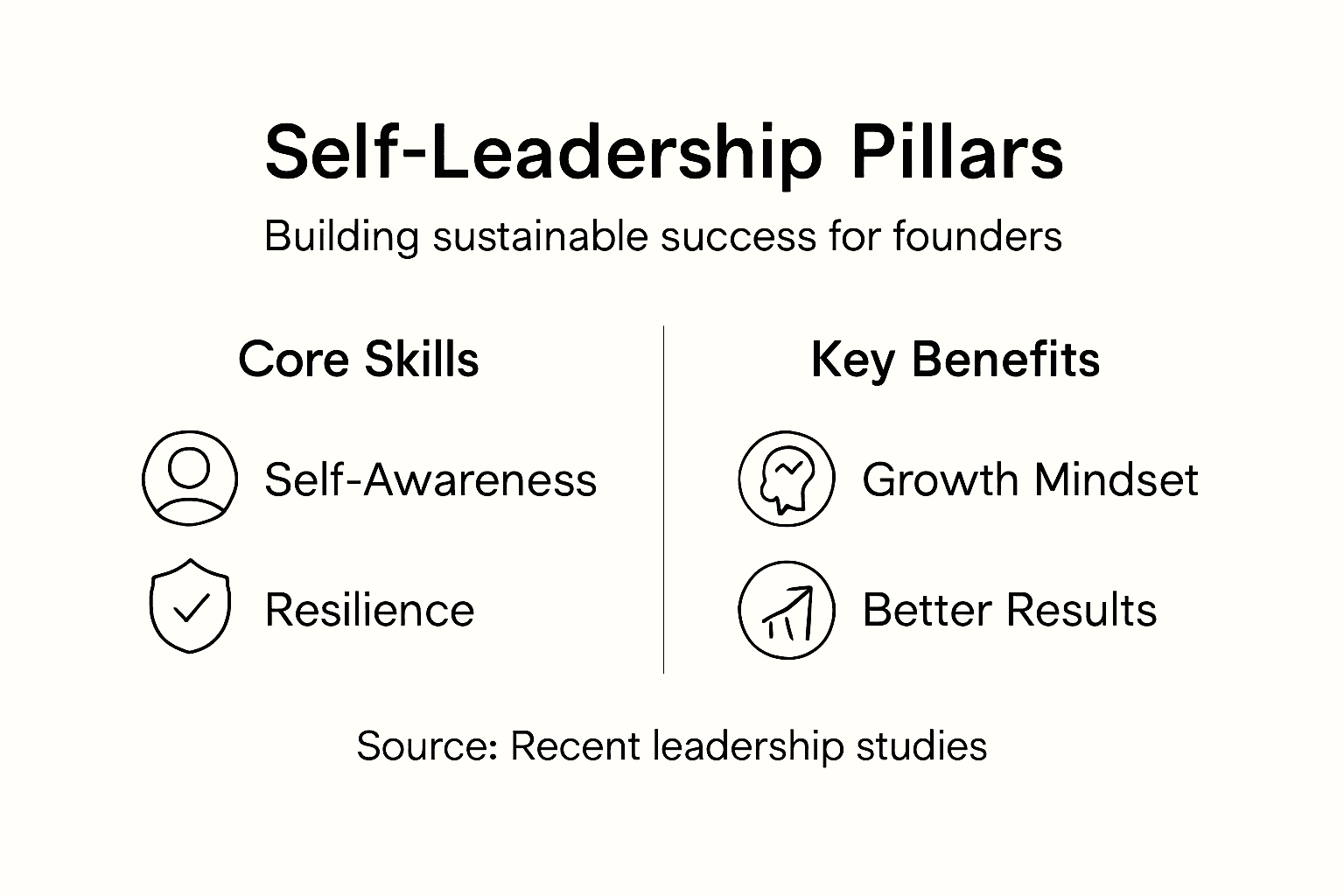
At the core of financial and operational health, self-leadership drives individual and systemic performance through strategic mental and behavioral management. Entrepreneurs who master self-leadership techniques can systematically improve their decision-making processes, energy management, and productivity. By implementing routines that enhance mental fitness and self-efficacy, founders create robust mechanisms for maintaining consistent operational excellence and financial discipline.
Individual work outcomes dramatically improve when self-leadership principles are intentionally integrated into daily business practices. These practices include developing precise self-monitoring techniques, creating intrinsic reward systems, and cultivating a mindset of continuous personal and professional growth. Successful founders recognize that operational health is not just about external systems, but about developing internal capacities that enable strategic thinking and resilient performance.
The interconnection between self-leadership and organizational performance is profound. By focusing on personal development, entrepreneurs create a ripple effect that enhances team dynamics, operational efficiency, and ultimately, financial sustainability. This holistic approach transforms traditional leadership models, positioning self-leadership as a fundamental driver of business success.
Pro tip: Implement a weekly self-leadership audit that systematically evaluates your mental strategies, behavioral patterns, and their direct correlation to your business’s financial and operational metrics.
Common Challenges and Mistakes in Self-Leadership Practice
Self-leadership is a sophisticated skill that demands continuous refinement and strategic self-awareness. Entrepreneurs frequently encounter significant challenges in maintaining consistent motivation, managing stress, and practicing effective self-regulation, particularly during high-pressure business scenarios.
One of the most critical mistakes founders make is neglecting the development of constructive thought patterns. This oversight can dramatically impede personal and professional growth. Many entrepreneurs struggle with inadequate application of behavioral and cognitive strategies, often failing to recognize that self-leadership requires intentional, systematic approach that goes beyond sporadic motivation techniques.
Professional development programs offer crucial insights into overcoming self-leadership challenges. The most significant pitfalls include lack of self-awareness, rigid thinking patterns, and an inability to adapt strategies to changing business contexts. Successful founders understand that self-leadership is not a static skill but a dynamic practice that requires continuous learning, flexibility, and honest self-assessment.
Transforming these challenges requires a multifaceted approach. Entrepreneurs must cultivate resilience, develop nuanced self-monitoring techniques, and create personalized strategies that align with their unique psychological and professional landscape. This means moving beyond generic productivity advice and designing deeply personalized self-leadership frameworks that resonate with individual strengths and growth opportunities.
Pro tip: Create a quarterly self-leadership diagnostic that objectively evaluates your cognitive strategies, behavioral patterns, and areas requiring targeted personal development.
Elevate Your Entrepreneurial Journey with Proven Self-Leadership Systems
The challenges of mastering self-leadership often stem from inconsistent motivation, fragmented strategies, and a lack of integrative approaches that connect mindset, behavior, and operational systems. This article highlights the vital need for founders to develop cognitive, behavioral, and emotional competencies to unlock sustainable success without burnout. If you are striving to move beyond trial and error and want deeper mastery over your internal systems while preserving your well-being, then specialized support is critical.
At Freedom Sun, we understand that entrepreneurial self-leadership is not just about mindset shifts but embedding those changes into a robust Operating System designed to foster financial clarity, systems infrastructure, and mental resilience. Our proprietary OS framework connects the dots between the MATH of your financial health, the MECHANICS of your business systems, and the MINDset needed to lead with scalable confidence. By integrating these pillars, founders overcome common pitfalls like inconsistent self-regulation and emotional burnout to build lasting operational stability and personal freedom.
Are you ready to stop spinning your wheels and start architecting your sustainable success with expert-guided strategies? Discover how to transform scattered self-leadership practices into a cohesive framework by exploring the Freedom Sun platform. Take control today and propel your leadership, financial literacy, and operational effectiveness forward with actionable tools built for founders who demand profitable peace now.
Frequently Asked Questions
What is self-leadership in the context of entrepreneurship?
Self-leadership in entrepreneurship refers to the intentional process where founders design their internal systems of motivation, behavior, and strategic thinking to take accountability for their professional growth and business success.
How can entrepreneurs develop their self-leadership skills?
Entrepreneurs can develop self-leadership skills by mastering core competencies such as self-awareness, goal setting, and self-regulation. Engaging in daily and weekly reflection rituals, audits, and strategy reviews are effective practices to cultivate these skills.
What are the key pillars of self-leadership for business success?
The key pillars of self-leadership include cognitive strategies (strategic thinking), emotional intelligence (resilience), behavioral strategies (consistent action), and physical management (energy and health). These pillars work together to enhance overall performance and decision-making.
What common challenges do entrepreneurs face in practicing self-leadership?
Common challenges include maintaining consistent motivation, managing stress, and developing constructive thought patterns. Many entrepreneurs struggle with ineffective application of self-leadership strategies, resulting in stagnation in personal and professional growth.