Financial Empowerment: Unlocking Leadership and Clarity

Most American business leaders underestimate how deeply financial challenges shape their leadership effectiveness. Research shows that financial stress can erode both decision-making skills and professional confidence. In a competitive landscape where every choice matters, understanding financial empowerment becomes more than personal growth, it becomes essential for organizational impact. This guide uncovers how American leaders can build financial clarity, overcome hidden barriers, and transform monetary intelligence into stronger, more adaptive leadership.
Table of Contents
- Defining Financial Empowerment For Leaders
- Types Of Financial Empowerment In Business
- How Financial Empowerment Drives Leadership Mastery
- Strategies For Building Sustainable Financial Clarity
- Overcoming Barriers To Financial Empowerment
Key Takeaways
| Point | Details |
|---|---|
| Financial Empowerment Enhances Leadership | Leaders who master financial empowerment improve their decision-making, organizational resilience, and strategic vision by viewing finances as dynamic tools for transformation. |
| Develop Collaborative Models | Implement community-based financing and collaborative strategies to address traditional economic constraints and promote funding access. |
| Continuous Learning is Essential | Schedule regular financial education sessions and reflection practices to bridge knowledge gaps and refine strategic financial approaches. |
| Identify and Overcome Barriers | Conduct personal financial assessments to confront psychological and skill-based barriers to achieve true financial autonomy. |
Defining Financial Empowerment for Leaders
Financial empowerment represents more than just accumulating wealth - it’s a strategic approach to understanding, managing, and leveraging financial resources that transforms leadership potential. Leaders who master financial empowerment recognize that monetary intelligence goes far beyond basic accounting. They develop a holistic perspective that integrates financial knowledge with psychological insights and strategic thinking.
Research highlights the profound connection between financial clarity and leadership effectiveness. In a groundbreaking study examining leadership behaviors, researchers discovered that personal financial stress significantly impacts supervisory practices and sense of control. When leaders experience financial uncertainty, their decision-making capabilities and professional confidence can become compromised. This underscores why financial empowerment is not just a personal skill, but a critical leadership competency.
At its core, financial empowerment for leaders involves several key dimensions. These include developing robust financial literacy, creating strategic monetary frameworks, understanding investment principles, and cultivating a growth-oriented money mindset. Leaders must move beyond viewing finances as a transactional element and instead see them as a dynamic tool for organizational and personal transformation. This requires continuous learning, strategic planning, and a willingness to challenge traditional financial paradigms.
Pro Leadership Financial Insight: Develop a quarterly financial review process that goes beyond traditional accounting - analyze not just numbers, but the strategic implications of your financial decisions and their potential long-term impact on your leadership vision.
Pro Tip for Financial Mastery: Schedule monthly financial education sessions where you deliberately expand your understanding of complex financial concepts, investment strategies, and economic trends that could influence your business and leadership approach.
Types of Financial Empowerment in Business
Financial empowerment in business is not a monolithic concept, but a dynamic spectrum of strategies that enable leaders to transform monetary resources into strategic advantages. Each type of financial empowerment represents a unique approach to leveraging capital, knowledge, and organizational capabilities to drive sustainable growth and innovation.
One critical dimension of financial empowerment emerges through collaborative financial models. Community-based financing schemes demonstrate how social ties and collective financial resources can create powerful funding opportunities, particularly for entrepreneurs in challenging economic environments. These models move beyond traditional banking, emphasizing trust, shared risk, and mutual support as fundamental financial mechanisms.
Research highlights multiple dimensions of financial empowerment, including the Financial Maturity Model, which provides a structured framework for understanding organizational financial capabilities. This model goes beyond simple accounting, developing interventions that enhance loan management skills and stakeholder support. The key types of financial empowerment include strategic capital allocation, risk management, financial literacy development, investment optimization, and creating resilient monetary ecosystems within organizations.
Additionally, financial empowerment encompasses psychological and strategic elements. Leaders must cultivate a money mindset that views finances not as a constraint, but as a dynamic tool for organizational transformation. Strategic money mindset principles can fundamentally reshape how businesses approach financial decision-making, moving from reactive accounting to proactive financial strategy.
Pro Leadership Financial Strategy: Create a comprehensive financial empowerment roadmap that integrates personal financial growth with organizational financial objectives, ensuring alignment between individual capabilities and broader business goals.
Pro Tip for Financial Mastery: Develop a quarterly financial skills audit that identifies knowledge gaps and creates targeted learning plans to continuously enhance your financial leadership capabilities.
Here’s a summary comparing key types of financial empowerment in business:
| Dimension | Main Focus | Strategic Benefit |
|---|---|---|
| Collaborative Financial Models | Shared capital, social trust | Enhanced funding access |
| Strategic Capital Allocation | Targeted investment in growth | Boosted organizational resilience |
| Risk Management | Identifying and mitigating risks | Greater business stability |
| Financial Literacy Development | Broadening financial knowledge | Informed decision-making |
| Investment Optimization | Maximizing ROI | Accelerated business expansion |
| Money Mindset Cultivation | Positive financial psychology | Proactive resource management |
How Financial Empowerment Drives Leadership Mastery
Leadership mastery emerges when financial understanding transcends traditional number-crunching and becomes a strategic psychological framework. Financial empowerment is not merely about managing money, but about developing a sophisticated cognitive approach that transforms fiscal challenges into opportunities for organizational growth and personal development.
Personal financial stress profoundly impacts leadership behavior and supervisory practices, revealing a critical connection between monetary confidence and executive performance. When leaders develop robust financial literacy, they dramatically improve their decision-making capabilities, organizational resilience, and strategic vision. This transformation occurs through developing a multidimensional understanding that integrates emotional intelligence, strategic thinking, and financial acumen.

The pathway to leadership mastery through financial empowerment involves several interconnected dimensions. These include developing a growth-oriented money mindset, creating adaptive financial strategies, understanding complex economic ecosystems, and cultivating psychological resilience around monetary challenges. Leadership mindset principles suggest that financial empowerment is fundamentally about expanding one’s perspective from reactive financial management to proactive strategic leadership.
Moreover, financial empowerment drives leadership mastery by enabling executives to view monetary resources as dynamic tools for organizational transformation. This approach moves beyond traditional financial planning, encouraging leaders to see financial systems as living, interconnected networks that can be strategically navigated and optimized. The most successful leaders understand that financial mastery is not about controlling money, but about developing a fluid, intelligent relationship with organizational resources.
Pro Leadership Financial Insight: Create a personal financial growth dashboard that tracks not just monetary metrics, but your evolving financial decision-making skills and strategic thinking capabilities.
Pro Tip for Financial Mastery: Implement a monthly financial reflection practice where you critically analyze your monetary decisions, identifying growth opportunities and refining your strategic financial approach.
Strategies for Building Sustainable Financial Clarity
Sustainable financial clarity represents a holistic approach to understanding and managing monetary resources that goes beyond traditional accounting practices. It is a dynamic process of developing strategic financial awareness, integrating psychological insights with practical financial management techniques to create a comprehensive framework for long-term economic success.
The Financial Maturity Model provides a structured approach to monitoring and designing effective financial interventions, highlighting the critical importance of developing robust loan management skills and comprehensive stakeholder support. This model emphasizes that financial clarity is not a static achievement, but a continuous process of learning, adaptation, and strategic refinement.
Building sustainable financial clarity requires leaders to develop a multifaceted approach that integrates several key strategies. These include creating transparent financial systems, developing advanced financial literacy, implementing rigorous monitoring mechanisms, and cultivating a proactive money mindset. Entrepreneurs can leverage strategic money mindset principles to transform their approach from reactive financial management to a more intentional, growth-oriented perspective that views financial systems as dynamic, interconnected networks.
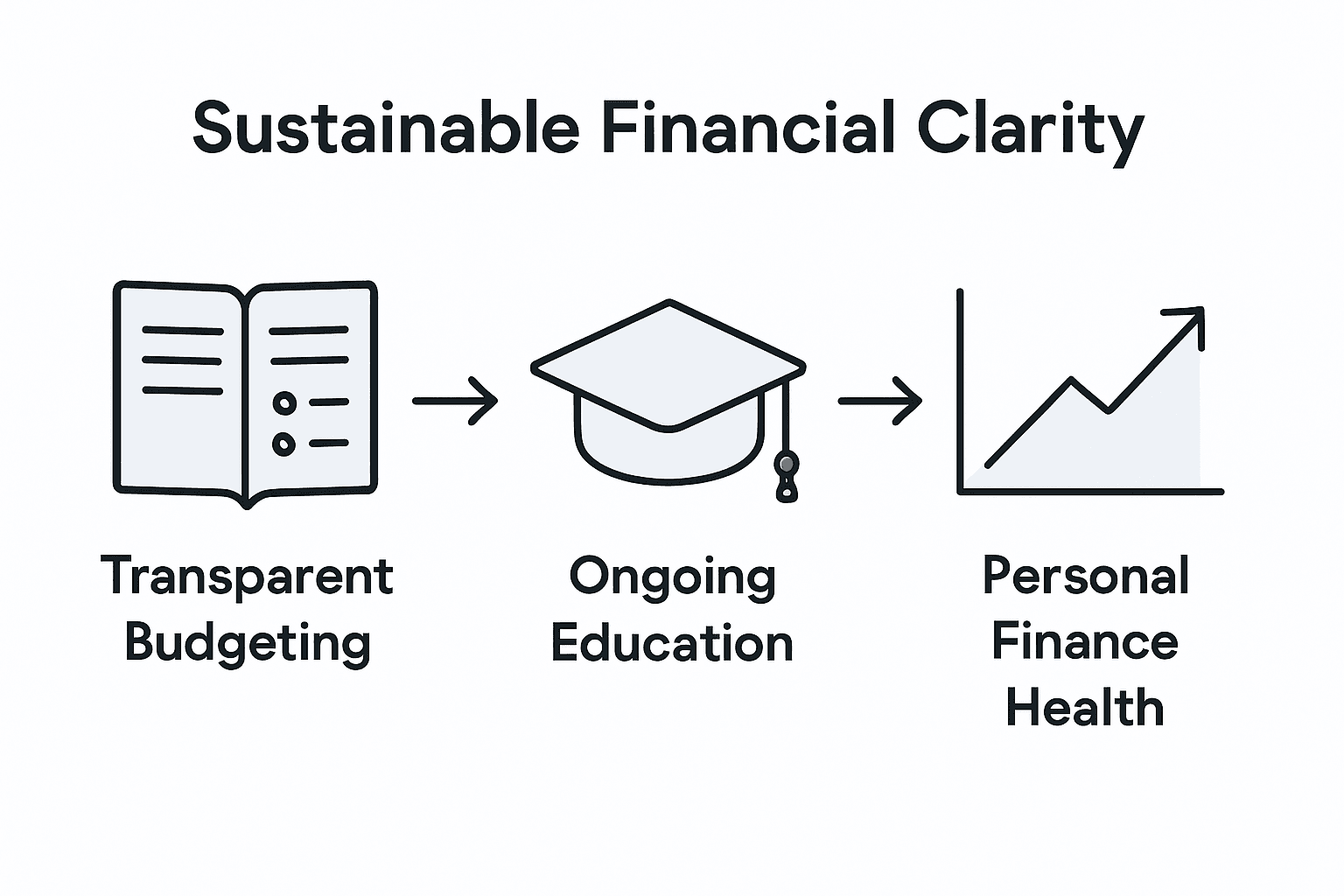
Successful financial clarity strategies also demand psychological resilience and continuous learning. Leaders must develop the ability to analyze financial data critically, understand complex economic ecosystems, and make strategic decisions that balance short-term needs with long-term organizational goals. This requires a combination of technical financial skills, emotional intelligence, and a willingness to challenge existing financial paradigms.
Pro Leadership Financial Strategy: Develop a comprehensive financial clarity dashboard that tracks not just monetary metrics, but your evolving financial decision-making capabilities and strategic thinking skills.
Pro Tip for Financial Mastery: Create a monthly financial reflection practice that goes beyond traditional financial review, focusing on analyzing your monetary decisions, identifying growth opportunities, and continuously refining your strategic financial approach.
Overcoming Barriers to Financial Empowerment
Financial empowerment requires confronting and dismantling complex psychological and systemic barriers that prevent leaders from achieving true monetary autonomy. These obstacles are rarely simple financial challenges, but intricate combinations of personal beliefs, historical constraints, and deeply ingrained cognitive patterns that limit strategic thinking and resource management.
Community-based financing schemes demonstrate innovative approaches to overcoming traditional financial barriers, revealing how collective financial strategies can transform individual limitations. Such models highlight the power of social networks and collaborative financial approaches in breaking down traditional economic constraints, particularly for entrepreneurs facing systemic challenges in accessing capital and resources.
The primary barriers to financial empowerment typically manifest in three critical dimensions: psychological resistance, skill gaps, and limited access to strategic financial knowledge. Developing a comprehensive Financial Maturity Model provides a structured framework for identifying and addressing these obstacles. Leaders must cultivate a growth-oriented money mindset that challenges existing financial beliefs, develops advanced financial literacy, and creates adaptive strategies for navigating complex economic landscapes.
Successful financial empowerment requires a holistic approach that combines personal development, strategic learning, and systemic understanding. By implementing targeted money mindset workflow techniques, entrepreneurs can systematically deconstruct limiting financial beliefs, develop more sophisticated financial thinking, and create robust strategies for sustainable economic growth. This process demands continuous learning, psychological resilience, and a commitment to challenging existing financial paradigms.
Pro Leadership Financial Strategy: Create a quarterly personal financial barrier assessment that critically examines your current financial beliefs, identifies limiting patterns, and develops targeted strategies for overcoming psychological and skill-based obstacles.
Pro Tip for Financial Breakthrough: Design a structured learning plan that includes monthly deep dives into specific financial skills, deliberately targeting and eliminating your most significant financial knowledge gaps.
The table below outlines strategies to overcome common barriers to financial empowerment:
| Barrier Type | Example Challenge | Effective Solution |
|---|---|---|
| Psychological Resistance | Fear of financial failure | Mindset coaching and reframing |
| Skill Gaps | Lack of investment knowledge | Targeted financial education |
| Limited Access | Difficulty securing capital | Community-based funding models |
| Strategic Knowledge Gaps | Unfamiliarity with ecosystems | Cross-functional financial training |
Elevate Your Leadership Through Financial Empowerment
Financial uncertainty and limited financial clarity can stall even the most seasoned leaders. This article highlights the challenge of transforming financial stress and skill gaps into strategic advantages that fuel sustainable business growth. If you are ready to move beyond reactive money management and develop a growth-oriented money mindset that integrates financial mastery with psychological resilience, you are not alone.
At SimoneCR.com, we specialize in guiding entrepreneurs and business leaders like you toward unlocking true financial empowerment through strategic mentorship, transformative workshops, and tailored leadership systems. By mastering financial clarity and building robust operational frameworks, you gain the confidence to make decisions with precision and vision. Explore our CEO mentorship programs to start bridging the gap between your financial knowledge and leadership psychology today.
Are you prepared to break through your financial barriers and achieve sustainable leadership mastery now? Discover how our holistic approach equips you with the tools and mindset to elevate your business. Visit SimoneCR.com and take the first step toward a future of empowered financial leadership.
Frequently Asked Questions
What is financial empowerment for leaders?
Financial empowerment for leaders refers to a strategic approach to understanding, managing, and leveraging financial resources, enhancing leadership potential through robust financial literacy and psychological insights.
How does personal financial stress impact leadership effectiveness?
Research indicates that personal financial stress significantly affects decision-making capabilities and professional confidence, highlighting the importance of financial empowerment as a leadership competency.
What are some strategies for building sustainable financial clarity?
Strategies for building sustainable financial clarity include creating transparent financial systems, developing advanced financial literacy, and implementing rigorous monitoring mechanisms while cultivating a proactive money mindset.
What are common barriers to achieving financial empowerment?
Common barriers to financial empowerment include psychological resistance, skill gaps, and limited access to strategic financial knowledge that can hinder effective financial management.