Financial Sovereignty: Path to Entrepreneurial Freedom

Most American founders in high-growth startups face intense financial pressures that restrict true entrepreneurial independence. Studies show over 65 percent of leaders cite external financial constraints as a top barrier to strategic growth. For those seeking financial sovereignty, mastering control over business systems means protecting your vision and reducing burnout. This guide highlights actionable strategies to help North American executives build resilient financial infrastructures while enhancing operational clarity for long-term success.
Table of Contents
- Defining Financial Sovereignty For Founders
- Types Of Financial Sovereignty In Business
- How Financial Sovereignty Transforms Operations
- Key Risks And Challenges Faced
- Strategies To Achieve And Sustain Sovereignty
Key Takeaways
| Point | Details |
|---|---|
| Financial sovereignty empowers founders | It enables independent financial decision-making through strategic control and innovation, enhancing business resilience. |
| Three pillars support financial sovereignty | Autonomy, control, and innovation are essential for fostering strategic flexibility and risk management in business operations. |
| Understanding types of financial sovereignty is crucial | Data, monetary, and regulatory sovereignty each play a vital role in enhancing a business’s financial independence and operational strength. |
| Proactive strategies are key to sustaining sovereignty | Entrepreneurs should invest in technological diversification, cybersecurity measures, and adaptive compliance frameworks to navigate financial complexities effectively. |
Defining Financial Sovereignty for Founders
Financial sovereignty represents the strategic cornerstone of entrepreneurial independence, enabling founders to make autonomous financial decisions without external constraints. At its core, financial sovereignty is about controlling your economic destiny, crafting financial systems that protect and empower your business vision. Financial independence requires strategic mechanisms that shield entrepreneurs from unpredictable market influences.
For high-growth founders, financial sovereignty transcends simple cash management. It involves building robust financial infrastructures that provide strategic flexibility, risk mitigation, and the ability to make long-term decisions unencumbered by short-term financial pressures. This means developing comprehensive financial strategies that integrate multiple layers of protection - from diversified revenue streams to intelligent cash reserve management and adaptive financial planning.
The framework of financial sovereignty rests on three critical pillars: autonomy, control, and innovation. Autonomy allows founders to chart independent financial paths without being overly dependent on external funding or restrictive financial policies. Control ensures comprehensive oversight of financial resources, enabling precise resource allocation and risk management. Innovation demands continuous adaptation of financial strategies to emerging market dynamics, technological shifts, and competitive landscapes.
Here is a summary of the three pillars of financial sovereignty and their influence on founders:
| Pillar | Description | Business Impact |
|---|---|---|
| Autonomy | Independent decision-making without reliance | Enables unique strategies and funding |
| Control | Detailed oversight of financial resources | Improves risk management and allocation |
| Innovation | Continual adaptation to market changes | Drives long-term growth and flexibility |
Pro tip: Conduct a quarterly financial sovereignty audit, reviewing your business’s financial independence metrics, external dependencies, and strategic financial flexibility to ensure ongoing economic resilience.
Types of Financial Sovereignty in Business
Financial sovereignty in business is not a monolithic concept but a nuanced framework comprising multiple interconnected types. Businesses can achieve comprehensive financial independence by understanding and strategically implementing different sovereignty models, each addressing distinct operational and strategic dimensions.
Three primary types of financial sovereignty emerge as critical for modern entrepreneurial success: data sovereignty, monetary sovereignty, and regulatory sovereignty. Data sovereignty involves comprehensive control and protection of financial information, ensuring founders maintain strict governance over sensitive financial data and comply with local and international privacy regulations. Monetary sovereignty focuses on strategic financial management, including currency control, investment strategies, and independent monetary decision making that reduces reliance on external financial institutions.

Regulatory sovereignty represents the ability to navigate and strategically respond to complex financial compliance landscapes. This type of sovereignty demands founders develop adaptable financial systems that can seamlessly adjust to changing regulatory environments while maintaining operational integrity. By integrating these sovereignty types, entrepreneurs create robust financial architectures that provide strategic flexibility, risk mitigation, and long-term economic resilience.
This table compares three types of financial sovereignty and their focus areas:
| Sovereignty Type | Primary Focus | Example Business Benefit |
|---|---|---|
| Data Sovereignty | Protection of financial data | Avoid regulatory fines and data breaches |
| Monetary Sovereignty | Control of financial operations | Optimize investments and currency choices |
| Regulatory Sovereignty | Compliance system adaptability | Operate smoothly under regulation changes |
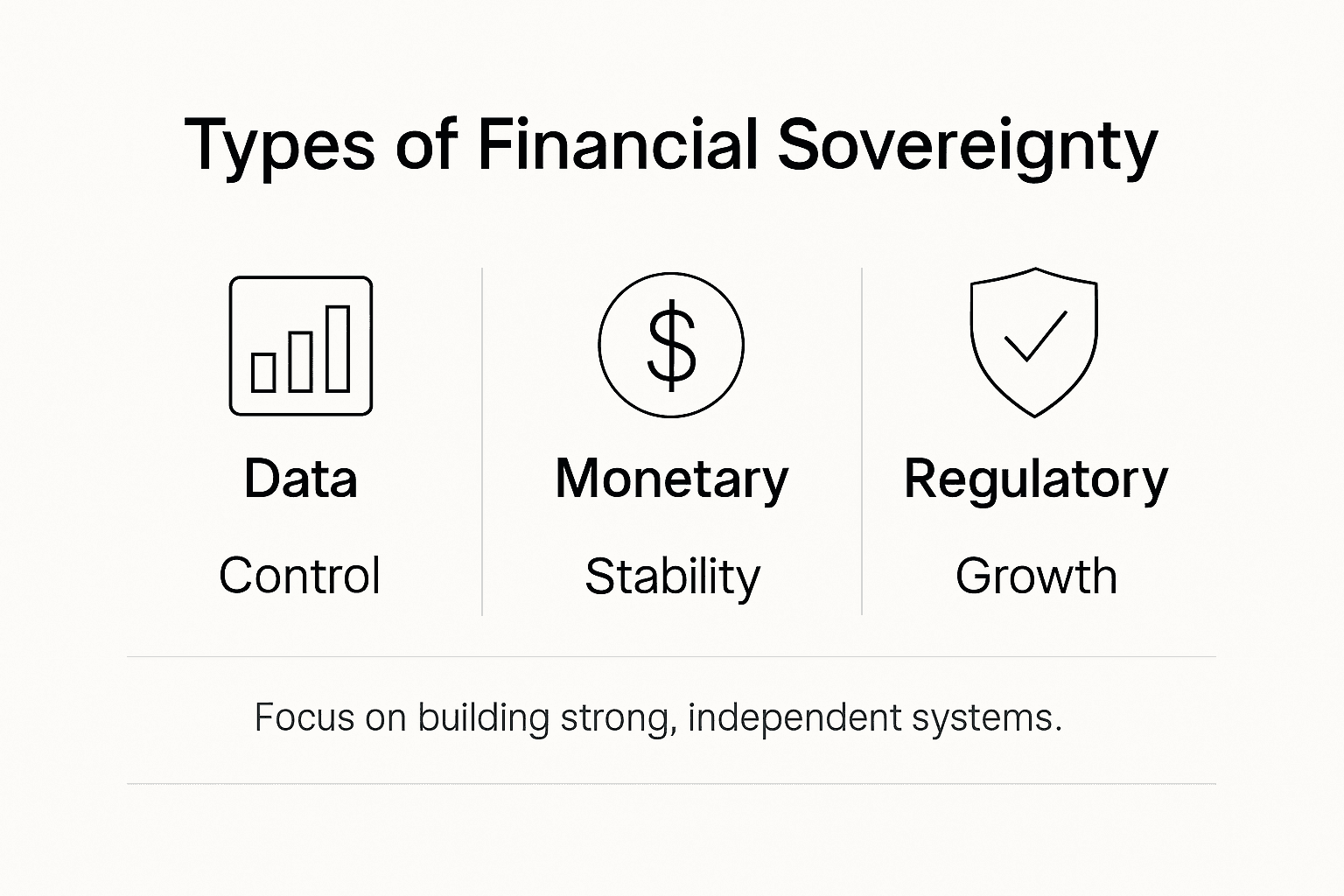
Pro tip: Develop a comprehensive financial sovereignty dashboard that tracks key metrics across data, monetary, and regulatory domains to continuously assess and enhance your business’s financial independence.
How Financial Sovereignty Transforms Operations
Financial sovereignty fundamentally reshapes business operations by enabling organizations to create more adaptive and independent financial infrastructures. This transformation goes beyond traditional financial management, representing a strategic shift that empowers founders to design more resilient and agile operational frameworks that are less dependent on external financial systems.
The operational transformation driven by financial sovereignty manifests through several critical mechanisms. Decentralized financial processes allow businesses to reduce vulnerability to external market disruptions, creating more robust decision-making frameworks. By developing internal financial technologies and governance models, entrepreneurs can create custom financial ecosystems that respond precisely to their unique organizational needs, rather than conforming to generic, one-size-fits-all financial solutions.
Moreover, financial sovereignty enables businesses to implement more sophisticated risk management strategies. This approach allows founders to develop proactive financial controls that anticipate potential market challenges, rather than merely reacting to them. By maintaining greater autonomy over financial systems, organizations can more effectively allocate resources, optimize investment strategies, and create more predictable revenue streams that support long-term strategic objectives.
Pro tip: Conduct a quarterly audit of your financial infrastructure to identify and eliminate dependencies that compromise your operational sovereignty.
Key Risks and Challenges Faced
Financial sovereignty introduces complex challenges that demand strategic navigation through intricate technological and regulatory landscapes. These risks extend beyond traditional financial management, presenting multifaceted obstacles that require sophisticated understanding and proactive mitigation strategies for modern entrepreneurs.
The primary risks to financial sovereignty emerge from three critical domains: technological vulnerability, regulatory complexity, and systemic dependencies. Technological vulnerability includes exposure to cybersecurity threats, potential data breaches, and the rapid obsolescence of financial technologies. Entrepreneurs must continuously invest in robust digital infrastructures that can adapt to emerging technological shifts while maintaining stringent security protocols. Regulatory complexity further compounds these challenges, with international financial regulations creating intricate compliance requirements that can potentially undermine operational autonomy.
Systemic dependencies represent another significant risk, where businesses become overly reliant on external financial platforms and infrastructure providers. These dependencies can create strategic weaknesses, limiting an organization’s ability to make independent financial decisions. By understanding and systematically reducing these external dependencies, founders can build more resilient financial ecosystems that provide greater strategic flexibility and reduce potential points of systemic vulnerability.
Pro tip: Develop a comprehensive risk assessment matrix that tracks technological, regulatory, and infrastructural dependencies quarterly to proactively identify and mitigate potential sovereignty challenges.
Strategies to Achieve and Sustain Sovereignty
Modern financial sovereignty demands sophisticated strategies that integrate technological innovation, regulatory compliance, and strategic independence. Entrepreneurs must develop comprehensive approaches that transcend traditional financial management, creating adaptive frameworks capable of navigating complex global economic landscapes.
Three fundamental strategies emerge as critical for sustaining financial sovereignty. First, technological diversification involves developing multiple independent technological infrastructures that reduce systemic dependencies. This means building custom financial technologies, creating redundant systems, and maintaining flexibility to switch between platforms without operational disruption. Second, implementing advanced cybersecurity protocols becomes essential, requiring continuous investment in machine learning and artificial intelligence driven security frameworks that anticipate and neutralize potential technological vulnerabilities.
The third strategic dimension focuses on regulatory resilience. Founders must proactively develop adaptive compliance mechanisms that can rapidly adjust to evolving international financial regulations. This involves creating flexible governance models, maintaining comprehensive documentation of financial processes, and developing robust internal audit capabilities. By building organizations that can seamlessly navigate regulatory complexities, entrepreneurs transform potential compliance challenges into strategic advantages that enhance overall financial sovereignty.
Pro tip: Create a quarterly sovereignty scorecard that tracks technological independence, cybersecurity readiness, and regulatory adaptability to systematically measure and improve your financial autonomy.
Achieve True Financial Sovereignty With Strategic Systems
The article highlights the critical challenge founders face in gaining autonomy, control, and innovation over their financial systems to secure entrepreneurial freedom. You may feel overwhelmed managing complex financial infrastructures, navigating regulatory changes, or protecting sensitive financial data. These pain points directly threaten the independence and long-term stability your business needs to thrive. Concepts like quarterly audits and comprehensive dashboards show how important ongoing strategic oversight is for lasting economic resilience.
At Freedom Sun, we understand these challenges and offer you a transformative Operating System (OS) framework designed specifically for high-growth entrepreneurs aiming to reclaim control over their financial sovereignty. Our approach strengthens your financial clarity with MATH, builds resilient system infrastructure with MECHANICS, and fosters leadership resilience with MIND. This empowers you to shift from reactive management to proactive strategic independence without burnout.
Ready to break free from limiting dependencies and build scalable leadership and operational stability? Explore how our interactive training and community support can elevate your financial and systemic autonomy today. Discover your path to profitable peace and unstoppable growth at Freedom Sun. Begin your journey now by visiting Freedom Sun and take the first step to design your business for true sovereignty.
Frequently Asked Questions
What is financial sovereignty for entrepreneurs?
Financial sovereignty refers to the ability of founders to make independent financial decisions without external constraints, enabling them to control their economic destiny and craft supportive financial systems for their business.
What are the three pillars of financial sovereignty?
The three pillars of financial sovereignty are autonomy, control, and innovation. Autonomy allows independent decision-making, control involves oversight of financial resources, and innovation requires adapting financial strategies to evolving market conditions.
How can financial sovereignty transform business operations?
Financial sovereignty transforms business operations by fostering decentralized financial processes, enhancing risk management strategies, and enabling founders to develop tailored financial infrastructures that reduce dependency on external systems.
What are the main risks associated with financial sovereignty?
Key risks include technological vulnerabilities, regulatory complexities, and systemic dependencies. These risks demand careful management and proactive strategies to ensure a resilient financial ecosystem.