Mental Resilience for Entrepreneurs: Sustainable Success

Nearly 75 percent of American entrepreneurs face burnout at some point when scaling their companies into global ventures. The pressure to balance growth, operational stability, and profitability pushes leaders into long hours and constant decision making. Without strong mental resilience, setbacks become overwhelming and productivity drops fast. Discover practical ways to strengthen your mindset, manage stress, and thrive as an American founder in an unpredictable business world.
Table of Contents
- Defining Mental Resilience For Entrepreneurs
- Major Stressors In Entrepreneurial Life
- Core Characteristics Of A Resilient Founder
- Strategies To Build And Maintain Resilience
- Common Traps And How To Avoid Burnout
- Leveraging Support Networks And Resources
Key Takeaways
| Point | Details |
|---|---|
| Mental Resilience is Developable | Resilience is a skill set that entrepreneurs can systematically cultivate through practices such as emotional regulation and cognitive reframing. |
| Understanding Major Stressors is Crucial | Entrepreneurs face various stressors including financial uncertainty and time management pressure, which can significantly impact decision-making and business stability. |
| Core Traits of Resilient Founders | Successful entrepreneurs possess characteristics such as adaptability and a growth mindset that allow them to view challenges as opportunities for improvement. |
| Importance of Support Networks | Building robust support networks is vital for entrepreneurs, offering essential knowledge and resources to enhance both psychological resilience and operational effectiveness. |
Defining Mental Resilience for Entrepreneurs
Mental resilience in entrepreneurship represents the psychological capacity to navigate complex business challenges while maintaining personal stability and strategic effectiveness. Psychological resilience processes enable entrepreneurs to adapt and recover from substantial adversities, transforming potential setbacks into opportunities for growth.
At its core, entrepreneurial resilience involves three critical dimensions: adaptive capabilities, stress management, and persistent problem solving. Entrepreneurs do not simply endure challenges they strategically respond to them. This means developing mental frameworks that convert obstacles into strategic pivot points, maintaining emotional equilibrium during uncertainty, and cultivating a growth mindset that views difficulties as learning experiences rather than insurmountable barriers.
Research highlights that resilience is not an innate trait but a skill set that can be systematically developed. Entrepreneurial adaptation capabilities demonstrate that successful founders actively build psychological mechanisms to manage stress, recover from setbacks, and maintain forward momentum. These mechanisms include emotional regulation, cognitive reframing, strategic networking, and continuous personal development.
Pro Tip: Develop a daily mental resilience practice by dedicating 15 minutes each morning to journaling your challenges, potential solutions, and personal growth reflections.
Major Stressors in Entrepreneurial Life
Entrepreneurs navigate a complex landscape of psychological and professional challenges that consistently test their mental resilience. Significant work stressors range from daily operational disruptions to major systemic challenges like economic instability and global pandemic uncertainties. These persistent pressures create a high-stakes environment where mental fortitude becomes as critical as strategic planning.
The primary stressors entrepreneurs encounter can be categorized into four critical domains: financial uncertainty, time management pressure, administrative complexity, and emotional volatility. Financial instability emerges as the most potent stress generator, with founders constantly balancing investment risks, cash flow management, and revenue generation. Entrepreneurial stress management research indicates that these financial pressures directly correlate with psychological strain, potentially undermining decision-making capabilities and overall venture sustainability.
Beyond financial challenges, entrepreneurs face intense psychological demands including persistent workload, continuous strategic pivoting, and the emotional rollercoaster of building something from scratch. The lack of structured work boundaries, constant performance expectations, and the inherent isolation of leadership positions compound these stressors. Successful entrepreneurs develop sophisticated coping mechanisms that transform these challenges from potential breaking points into opportunities for personal and professional growth.
Here is a summary of major entrepreneurial stressors and their business impact:
| Stressor Domain | Description | Potential Impact on Business |
|---|---|---|
| Financial Uncertainty | Unpredictable income and high risks | Impaired decision-making, instability |
| Time Management Pressure | Competing priorities and long hours | Missed deadlines, reduced efficiency |
| Administrative Complexity | Overwhelming tasks and procedures | Operational bottlenecks, slow growth |
| Emotional Volatility | Intense emotional highs and lows | Team morale issues, poor leadership |
Pro Tip: Create a weekly stress audit where you systematically document your major stressors, rate their emotional impact, and develop targeted mitigation strategies.
Core Characteristics of a Resilient Founder
Mental resilience transcends simple survival skills for entrepreneurs. Psychological adaptability in entrepreneurship reveals a complex set of characteristics that distinguish truly successful founders from those who struggle. These core traits represent a sophisticated psychological toolkit that enables navigating the unpredictable terrain of business creation and growth.
The foundational characteristics of resilient founders include exceptional adaptability, persistent learning orientation, and a unique ability to reframe challenges as opportunities. High tolerance for ambiguity stands out as a critical skill, allowing entrepreneurs to operate effectively in uncertain environments. Entrepreneurial crisis management capabilities demonstrate that successful founders don’t just endure challenges – they strategically transform them into strategic advantages. This means maintaining emotional equilibrium while simultaneously developing innovative solutions under pressure.

Resilient entrepreneurs possess a distinctive cognitive framework characterized by continuous improvement, strategic risk assessment, and emotional intelligence. They view failures not as terminal events but as valuable data points for future strategy refinement. Key attributes include rapid pattern recognition, swift decision-making under uncertainty, the capacity to maintain personal motivation during setbacks, and an unwavering commitment to long-term vision despite short-term obstacles.
Pro Tip: Develop a monthly personal performance review where you objectively assess your responses to challenges, documenting lessons learned and specific growth strategies.
Strategies to Build and Maintain Resilience
Entrepreneurs require a comprehensive approach to building mental resilience that goes beyond traditional stress management techniques. Dynamic resilience development strategies emphasize proactive psychological preparation and continuous personal growth. This approach transforms resilience from a passive survival mechanism into an active leadership skill that drives strategic innovation and personal effectiveness.
The core strategies for developing entrepreneurial resilience center on three fundamental domains: cognitive reframing, emotional regulation, and strategic support systems. Psychological adaptation techniques reveal that successful founders cultivate a mindset of continuous learning, where challenges are viewed as opportunities for growth rather than insurmountable obstacles. This involves developing advanced emotional intelligence, practicing deliberate cognitive reappraisal, and creating structured mechanisms for processing professional setbacks.
Practical resilience building requires a multifaceted approach that integrates personal development, professional networking, and systematic self reflection. Entrepreneurs should implement deliberate practices such as maintaining a growth journal, developing a supportive professional network, engaging in regular mental health check-ins, and creating structured stress management routines. The most effective resilience strategies are those that are personalized, flexible, and consistently practiced, transforming mental toughness from a theoretical concept into a lived operational strategy.
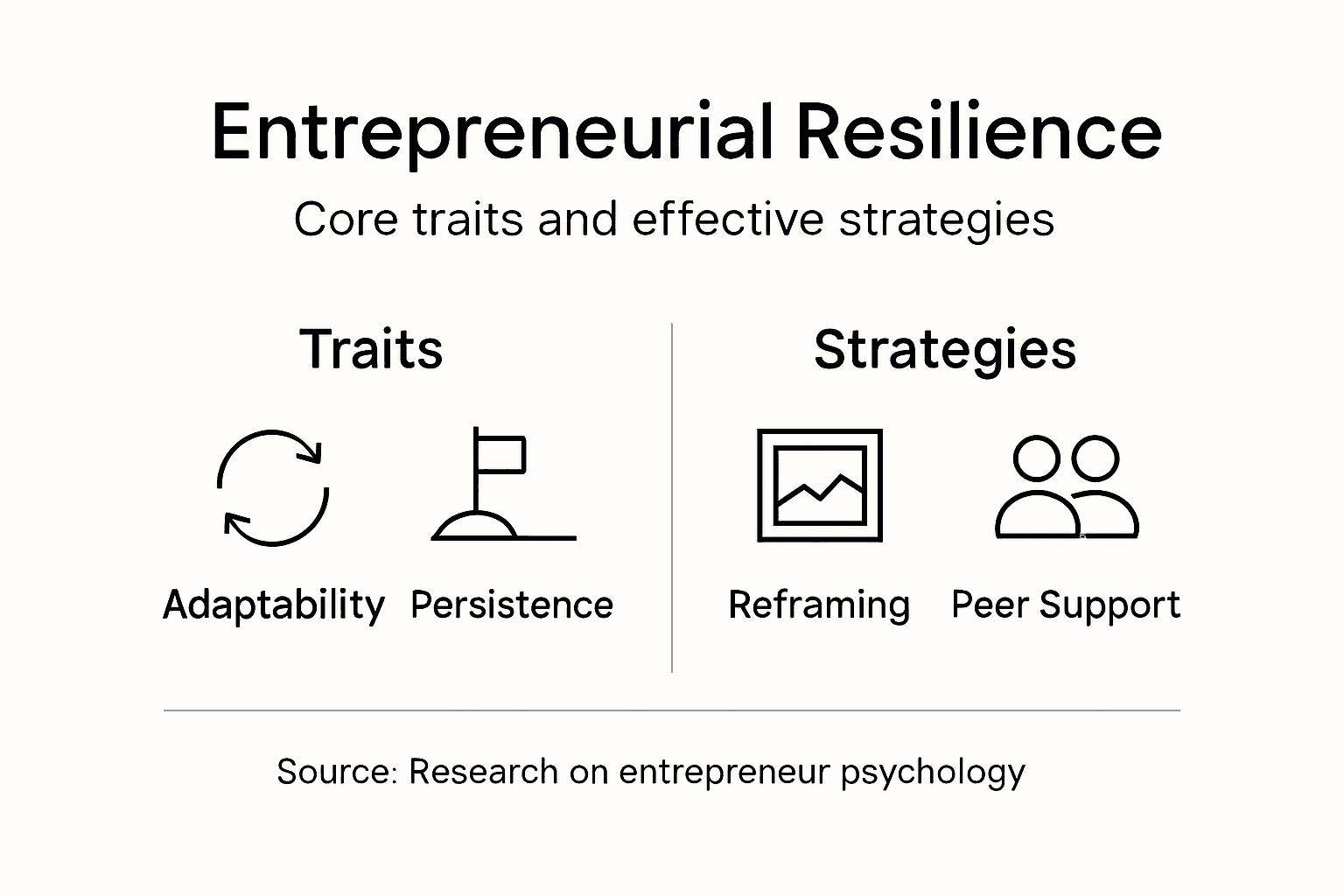
Below is a comparison of key resilience-building strategies and their practical benefits:
| Strategy | Core Focus | Practical Benefit |
|---|---|---|
| Cognitive Reframing | Shifting perspectives | Faster recovery from setbacks |
| Emotional Regulation | Managing responses | Improved clarity in high-stress moments |
| Strategic Support Systems | Building strong networks | Access to advice and new solutions |
| Personal Development | Continuous learning | Greater adaptability and innovation |
Pro Tip: Create a monthly resilience scorecard where you objectively track your emotional responses, learning from challenges, and psychological adaptation strategies.
Common Traps and How to Avoid Burnout
Entrepreneurial burnout represents a complex psychological phenomenon that emerges from sustained high-stress environments and systemic operational challenges. Entrepreneurial stress management insights reveal that founders are uniquely positioned both to experience and mitigate potential burnout through strategic self-awareness and proactive boundary setting.
The most prevalent burnout traps for entrepreneurs include rapid uncontrolled business expansion, chronic work overcommitment, inadequate personal recovery systems, and persistent performance pressure. These traps often manifest through symptoms like persistent exhaustion, diminished professional enthusiasm, reduced cognitive flexibility, and emotional detachment. Successful founders recognize these warning signs early and implement targeted interventions that restore psychological equilibrium, such as implementing strict work-life boundaries, developing systematic stress management protocols, and creating robust personal support networks.
Mitigating entrepreneurial burnout requires a holistic approach that balances professional ambition with personal sustainability. This means developing sophisticated self-monitoring mechanisms, practicing intentional stress reduction techniques, and creating flexible operational systems that allow for periodic recalibration. Entrepreneurs must view their mental health as a critical business asset, investing time and resources into understanding their unique stress triggers, developing personalized resilience strategies, and maintaining consistent emotional and psychological maintenance.
Pro Tip: Create a weekly personal performance and wellness audit that objectively tracks your energy levels, stress indicators, and psychological well-being.
Leveraging Support Networks and Resources
Successful entrepreneurs recognize that building robust support networks is not just a social strategy, but a critical business survival mechanism. Strategic entrepreneurial network development involves creating multilayered ecosystems that provide knowledge, resources, and adaptive capacities essential for sustainable venture growth. These networks transcend traditional networking, functioning as dynamic infrastructure that supports psychological resilience and operational effectiveness.
Entrepreneurial support networks can be strategically categorized into four key domains: professional associations, academic connections, peer entrepreneur groups, and industry-specific communities. Social network collaboration strategies emphasize the importance of building high-quality, reciprocal relationships rather than simply expanding contact lists. This means prioritizing depth of connection over quantity, focusing on relationships that offer genuine knowledge exchange, mutual support, and strategic insights.
Effective network leveraging requires a proactive and intentional approach. Entrepreneurs should develop a systematic framework for network engagement that includes regular knowledge sharing, mentorship participation, collaborative problem solving, and continuous skill development. This involves attending targeted events, participating in specialized forums, engaging in cross-industry collaborations, and maintaining consistent, meaningful interactions that provide tangible value beyond superficial professional courtesies.
Pro Tip: Dedicate one hour weekly to intentional network cultivation by reaching out to one meaningful contact, offering value, and exploring potential collaborative opportunities.
Build Mental Resilience and Operational Strength for Sustainable Success
Entrepreneurship demands exceptional mental resilience to manage financial uncertainty, emotional volatility, and operational complexity. This article highlighted how founders must develop adaptive mindsets and strategic coping mechanisms to avoid burnout and transform challenges into growth opportunities. If you are feeling overwhelmed by stress, struggling with time management, or seeking stability amid uncertainty, it is time to take control of your internal systems.
Freedom Sun offers a proven Operating System framework designed specifically for entrepreneurial leaders who want to build mental toughness along with financial clarity and systematized operations. Our platform emphasizes the MATH (financial clarity), MECHANICS (systems infrastructure), and MIND (leadership and mental resilience) pillars. By shifting from hustle culture to automated, strategic management, you can create profitable peace without sacrificing your wellbeing.
Discover how to manage your stressors effectively, optimize your leadership, and build a business that supports sustainable growth instead of burnout. Take the crucial next step today by exploring the comprehensive tools and community at Freedom Sun. To start transforming your entrepreneurial mindset and systems, visit our Operating System framework and begin building your foundation for scalable success right now.
Frequently Asked Questions
What is mental resilience for entrepreneurs?
Mental resilience for entrepreneurs refers to the psychological capacity to adapt and recover from business challenges while maintaining personal stability and strategic effectiveness. This includes stress management, adaptive capabilities, and persistent problem-solving.
How can I build mental resilience as an entrepreneur?
You can build mental resilience by implementing cognitive reframing to view challenges positively, practicing emotional regulation, and developing strategic support systems like professional networks and mentoring.
What are common stressors faced by entrepreneurs?
Common stressors include financial uncertainty, time management pressures, administrative complexities, and emotional volatility resulting from the demands of entrepreneurship.
What are the signs of entrepreneurial burnout?
Signs of entrepreneurial burnout include persistent exhaustion, diminished enthusiasm for work, reduced cognitive flexibility, and emotional detachment. Recognizing these early signs and implementing interventions is crucial for mental health.