Financial Coaching Business: Building Client Clarity

Building a financial coaching business means guiding clients from confusion to confident action without crossing into giving investment or tax advice. Many aspiring coaches in North America face the challenge of defining what sets their work apart from traditional financial advice. By mastering a client-driven process that emphasizes autonomy, personal strengths, and actionable change, you position your practice for impact and sustainability. Discover how clarity and tailored support drive both your clients’ progress and the future of your coaching business.
Table of Contents
- Defining A Financial Coaching Business
- Types And Models Of Financial Coaching
- Core Responsibilities And Success Factors
- Legal, Compliance, And Ethical Standards
- Common Pitfalls And How To Avoid Them
Key Takeaways
| Point | Details |
|---|---|
| Client Empowerment | Financial coaching emphasizes helping clients make their own informed decisions, focusing on clarity and direction rather than specific investment advice. |
| Coaching Models | Individual, group, and hybrid coaching models offer distinct advantages; select one that aligns with your strengths and clientele for optimal impact. |
| Core Responsibilities | Effective financial coaches assess current situations, diagnose root problems, and help clients set realistic goals, blending education with ongoing support. |
| Ethical Standards | Establishing clear ethical boundaries and adhering to professional standards is critical, as financial coaching operates in an unregulated space. |
Defining a Financial Coaching Business
Financial coaching sits at the intersection of personal development and money management. Unlike financial advisors who recommend specific investments or products, a financial coach focuses on empowering clients to make their own informed decisions about money.
At its core, financial coaching is a client-driven process where you work to understand where your clients stand financially, uncover what matters most to them, set clear goals, and guide them step-by-step toward financial wellness. You’re the accountability partner, educator, and sounding board rolled into one.
The key distinction matters for your business model. You’re not selling investment products or providing tax advice. You’re selling clarity, direction, and the psychological shift that comes from understanding money on a deeper level.
What You Actually Do
Your role involves several core activities:
- Assess current financial situations without judgment
- Explore clients’ values, fears, and money stories
- Set realistic, measurable financial goals together
- Create actionable steps clients can implement independently
- Provide ongoing accountability and support
- Educate on money management fundamentals
Financial coaching emphasizes personal strengths and autonomous decision-making rather than expert-driven solutions. This distinction shapes everything about your coaching approach and how you position yourself in the market.
You’re building a solution-focused business where clients own their progress. They make the decisions. You create the framework and support system.

Why This Matters for Your Business
Clarity is your core product. Clients come to you confused, overwhelmed, or disconnected from their finances. They leave with a clear picture of where they stand and exactly what to do next.
This positioning opens doors. It means you can work with people at any income level. You can build a sustainable, scalable practice without needing massive overhead. And you can charge premium rates because you’re solving an emotional and psychological problem, not just a technical one.
Financial coaching transforms how clients relate to money, not just how much money they have.
Understanding this difference is how you’ll pitch your services, structure your programs, and measure your impact with clients.
Pro tip: Define your specific niche within financial coaching early—whether that’s new entrepreneurs, divorcees, or high-income earners—so you can speak directly to their money pain points and attract ideal clients faster.
Types and Models of Financial Coaching
Financial coaching isn’t one-size-fits-all. You can structure your business around different delivery models, each with distinct advantages for your clients and your bottom line.
The two primary approaches are individual coaching and group coaching. Both build financial capability and drive behavior change, but they serve different business objectives and client needs.
Individual Coaching
Individual coaching provides one-on-one, tailored support for clients. You meet with them regularly, understand their unique money stories, and create a personalized roadmap.
This model works best when:
- Clients need deeply customized solutions
- Issues involve sensitive or complex situations
- High-net-worth clients value exclusive attention
- You’re building premium-priced offerings
Individual coaching commands higher fees and builds strong client relationships. The trade-off is time: you can only serve a limited number of clients per week.
Group Coaching
Group coaching is a cost-effective way to reach more clients while spreading financial capability widely. You facilitate sessions where multiple clients work through similar challenges together.
Group coaching benefits include:
- Lower price point attracts broader audiences
- Peer learning amplifies results
- Clients feel less alone in their struggles
- You serve more people with same time investment
- Higher revenue per hour of your time
The challenge: group work requires skilled facilitation so every person feels heard, not lectured.
Hybrid Models
Many successful financial coaches blend both approaches. You might offer monthly group workshops plus individual sessions for premium clients. Or group intensives with one-on-one follow-ups.
This hybrid approach lets you reach different income levels and attract both community-minded and privacy-focused clients.
Here’s how individual, group, and hybrid coaching models compare for financial coaching businesses:
| Model Type | Client Experience | Business Impact | Practical Challenge |
|---|---|---|---|
| Individual | Fully personalized plans | Higher fees per client | Time limits number served |
| Group | Shared learning dynamics | Scalable and cost-effective | Requires strong facilitation |
| Hybrid | Mix of custom and group | Broad market coverage | Balancing multiple formats |
The Psychology Connection
Financial psychology integrated with coaching enhances behavior change far beyond standard financial education. Your coaching model should include diagnostic assessments that reveal each client’s relationship with money—their fears, beliefs, spending triggers.
This psychological layer is what separates coaching from generic financial literacy classes.
The coaching model you choose shapes your entire business structure, pricing, and growth trajectory.
Start with the model that matches your energy and expertise. Individual coaching builds deep relationships. Group coaching scales faster. Pick one, master it, then expand.
Pro tip: Test both models with a few clients before fully committing—offer one individual package and one group workshop to see which generates the energy and results you want for your business.
Core Responsibilities and Success Factors
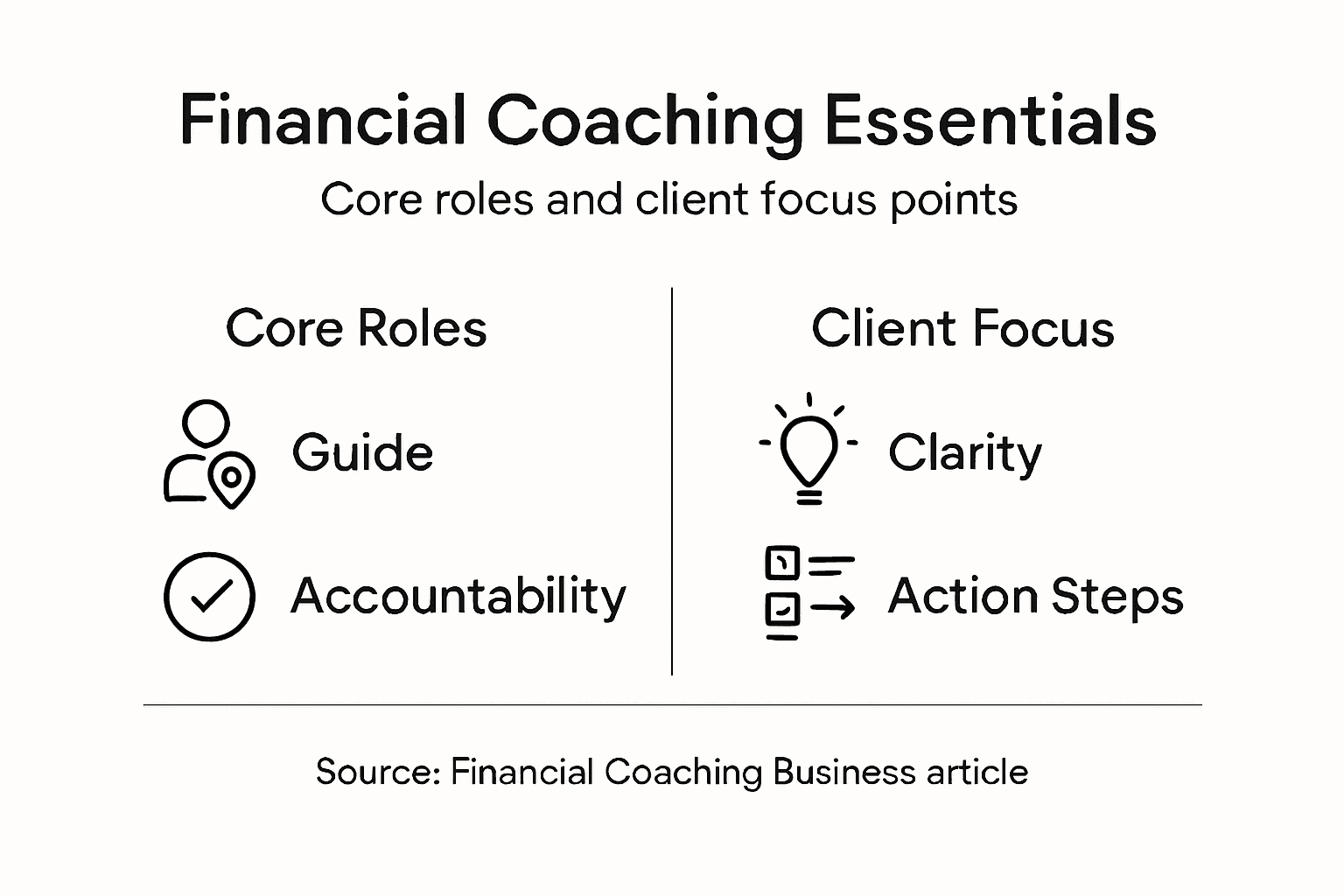
Your job as a financial coach goes beyond crunching numbers. You’re a guide, diagnostician, and accountability partner rolled into one.
Understanding your core responsibilities helps you structure your practice, price your services, and deliver real results. This is what separates good coaches from great ones.
Your Core Responsibilities
Understanding clients’ current financial situations and uncovering their goals are your starting point. But that’s just the beginning.
Your key responsibilities include:
- Assess current finances without judgment
- Diagnose root causes of financial struggles
- Uncover clients’ values and future vision
- Set realistic short, mid, and long-term goals
- Prioritize action steps for maximum impact
- Educate on money management principles
- Provide ongoing support and accountability
Each responsibility builds on the last. You can’t help someone reach a goal until you understand why they’re struggling. You can’t prioritize action steps until you know what matters most to them.
What Separates Strong Coaches
Technical knowledge matters less than you’d think. Research shows effective coaches focus on behavior change, strong relationships, and active listening to tailor coaching to individual client needs.
Success factors include:
- Active listening that uncovers unspoken fears
- Asking informed questions that shift perspectives
- Setting realistic goals clients actually believe in
- Monitoring progress and adjusting when needed
- Providing encouragement that keeps momentum going
- Flexibility to adapt to each client’s unique situation
The coaches who get the best results aren’t the smartest money people. They’re the ones who build genuine relationships and help clients feel heard.
The Accountability Piece
Clients can find financial information anywhere. What they can’t find is someone checking in, asking how things went, and celebrating progress. Accountability transforms knowledge into action.
This is where your value lives.
Your job is to bridge the gap between what clients know they should do and what they actually do.
That bridge is built on trust, clarity, and consistent follow-through. When clients know you’re invested in their success and won’t judge their missteps, they show up differently.
Pro tip: Create a simple progress tracking system for each client—whether spreadsheet or app—so they can visualize wins and you have concrete data to reference during coaching sessions.
Legal, Compliance, and Ethical Standards
Financial coaching operates in a gray zone legally. Unlike financial advisors, you’re not regulated by the Securities and Exchange Commission. But that doesn’t mean you can operate without guidelines.
Your responsibility is to establish clear ethical boundaries and protect both your clients and your business.
The Regulatory Landscape
Financial coaching is unregulated at the federal level in most jurisdictions. This means there’s no licensing requirement to call yourself a coach. That’s both freedom and responsibility.
No regulation means:
- You don’t need a financial license to operate
- You can work with clients across state lines
- You have flexibility in how you structure services
- You must self-regulate with professional standards
The lack of oversight doesn’t give you permission to make investment recommendations or provide tax advice. Those activities require proper licensure. Your job stays in the coaching lane.
Professional Standards Matter
The NFEC Financial Coaching Standards and Code of Conduct provides comprehensive guidelines for ethical practice. Following these standards protects your clients and elevates your credibility.
Key standards include:
- Confidentiality of client financial information
- Fiduciary mindset prioritizing client interests
- Professional conduct and competence
- Clear boundaries about what you do and don’t do
- Ongoing education to stay current
- Conflict of interest disclosure
Adopting professional standards isn’t just good ethics. It’s good business. Clients trust coaches who can articulate their ethical framework.
What You Cannot Do
Be absolutely clear about your boundaries. You cannot give investment advice, recommend specific stocks or funds, provide tax guidance, or suggest insurance products. These require specific licenses.
Instead, you educate clients so they can work with licensed professionals confidently. You might say, “This is a question for your tax advisor,” or “Let’s talk through your options before you meet with a financial advisor.”
This positioning actually strengthens your value. You’re the trusted guide helping clients think clearly, not the technical expert.
Protecting Client Data
Client financial information is sensitive. Create a privacy policy and maintain secure systems. Know what information you’re collecting and how you’ll protect it.
Consider liability insurance designed for coaches. It won’t cover giving illegal advice, but it protects against legitimate claims.
Operating ethically builds client trust and shields your growing business from unnecessary risk.
Start by adopting professional standards. This single decision sets you apart from unethical practitioners and demonstrates commitment to your clients.
Pro tip: Obtain a template client agreement that clearly outlines what coaching includes, what it excludes, confidentiality practices, and your credentials—this single document prevents misunderstandings and protects both parties.
Here’s a quick guide to common legal and ethical boundaries for financial coaches:
| Topic | What You CAN Do | What You CANNOT Do |
|---|---|---|
| Investment Guidance | Help clients clarify priorities | Recommend specific investments |
| Tax Matters | Refer clients to tax pros | Provide tax advice |
| Data Security | Maintain secure records | Disclose without consent |
| Client Agreements | Set clear service boundaries | Promise results you can’t ensure |
Common Pitfalls and How to Avoid Them
Even well-intentioned coaches make mistakes that undermine client progress. Knowing the common traps helps you sidestep them and build a more effective practice.
You’re not alone if you’ve stumbled here. These pitfalls catch most coaches at some point.
Blurring the Line Between Coaching and Advice
This is the biggest mistake. You slip into giving financial advice when you should be asking questions. The line seems thin, but it’s critical.
Coaching asks: “What are your options here?” Advice says: “You should buy this investment.”
Common pitfalls include confusion between financial coaching and financial advice, along with failure to maintain professional boundaries. Stay in your lane. Coach, don’t advise.
Vague Goal-Setting
Clients come to you saying “I want to be better with money.” That’s not a goal. That’s a feeling.
Weak goal-setting looks like:
- “Save more money”
- “Get out of debt”
- “Build better habits”
- “Be financially responsible”
Strong goal-setting is specific and measurable. “Save $500 per month for 12 months” or “Pay off $5,000 in credit card debt by December 31st.”
The difference? Measurable goals create accountability. Vague goals create frustration.
Insufficient Client Engagement
You create a great plan, then your client doesn’t follow through. Often, the problem isn’t the plan. It’s that you didn’t engage deeply enough to uncover what matters.
This happens when you:
- Skip active listening for problem-solving
- Don’t ask follow-up questions
- Assume you understand client motivations
- Provide solutions without exploring underlying issues
Slow down. Ask more questions. Listen for what’s unsaid.
One-Size-Fits-All Coaching
Your program works great for one client and falls flat for another. That’s because people are different. A single mother’s financial journey looks nothing like a married entrepreneur’s.
Successful coaches adapt to individual client needs and focus on behavior change tailored to each person. Your coaching framework provides structure, but your delivery must flex.
Missing the Behavior Change Piece
Financial knowledge without behavior change is useless. A client might understand budgeting perfectly but still overspend.
Your job isn’t to make them smarter about money. It’s to help them change how they act with money.
The gap between knowing and doing is where coaching lives.
Address the psychological, emotional, and habitual barriers. That’s where transformation happens.
Pro tip: Track what works and what doesn’t by asking clients “What’s working?” and “What’s getting in the way?” at every session—this feedback loop prevents you from repeating ineffective approaches.
Transform Your Financial Coaching Business With Strategic Support
Building client clarity is the foundation of a successful financial coaching business. As highlighted in the article, your challenge is to help clients move from confusion and overwhelm to clear, actionable goals while providing accountability without overstepping into advice. Achieving this balance requires more than just coaching skills—it demands a powerful system for managing your business, client relationships, and growth strategy.
At Freedom Sun, we understand these pain points deeply. We empower coaches, consultants, and service-based entrepreneurs to shift from hustle culture to automated, strategic management that nurtures personal well-being and scalable leadership. Our comprehensive training includes sales, communication, financial management, and leadership designed specifically for coaches looking to build clarity and confidence in their business model. Whether you want to master individual or group coaching approaches or implement robust accountability frameworks, our platform offers interactive training, diagnostic assessments, and a supportive community.
Take the next step to build your financial coaching practice on a solid strategic foundation. Explore how Freedom Sun can guide you to create profitable peace through system health and mental resilience. Find out more about our transformative approach by visiting Freedom Sun or discover how to start and grow your coaching business today with Freedom Sun Training. Start creating real client impact while building sustainable success now.
Frequently Asked Questions
What is a financial coaching business?
A financial coaching business focuses on empowering clients to make informed decisions about their money, offering guidance tailored to their unique financial situations and goals.
How does financial coaching differ from financial advising?
Financial coaching emphasizes personal development and decision-making without providing specific investment advice or solutions, while financial advising often involves recommending investment products and financial strategies.
What are the main responsibilities of a financial coach?
A financial coach’s main responsibilities include assessing clients’ current financial situations, uncovering their values and goals, educating them on money management principles, and providing ongoing support and accountability to help them make lasting changes.
What are the potential business models for a financial coaching practice?
Financial coaching can be structured through individual coaching, group coaching, or a hybrid model. Individual coaching offers tailored support, group coaching facilitates shared learning, and a hybrid model combines both for broader market reach.