Financial Literacy for Founders: Keys to Lasting Success

Most startup failures are rooted in financial missteps, with over 80 percent of american and global founders citing cash flow problems as the main culprit. Whether your team operates in San Francisco, Berlin, or Singapore, financial literacy is your strongest advantage in turning uncertainty into growth. Get clear on how mastering your numbers transforms risky guesswork into confident, sustainable strategy—so your business thrives without draining your energy.
Table of Contents
- Defining Financial Literacy for Startup Founders
- Core Components: Systems, Metrics, and Mindset
- Applying Financial Knowledge to Business Growth
- Critical Risks, Common Pitfalls, and Investor Trust
- Elevating Success Through Sustainable Practices
Key Takeaways
| Point | Details |
|---|---|
| Financial Literacy is Crucial | Founders must develop financial literacy to manage their startups effectively and make informed decisions that drive growth. |
| Holistic Approach Required | Successful entrepreneurs integrate financial knowledge with strategic thinking, balancing traditional metrics with sustainability practices. |
| Importance of Risk Management | Understanding and mitigating financial risks is essential for gaining investor trust and ensuring long-term business success. |
| Active Application of Knowledge | Founders should actively apply financial insights to develop strategies that align with their business objectives and market conditions. |
Defining Financial Literacy for Startup Founders
Financial literacy for startup founders represents far more than basic number-crunching. It is a strategic framework that enables entrepreneurs to understand, manage, and optimize their financial ecosystems with precision and confidence. Financial literacy transforms founders from reactive money managers into proactive financial architects who can design sustainable business models.
At its core, financial literacy encompasses several critical dimensions. These include understanding financial statements, managing cash flow, making informed investment decisions, comprehending risk management, and developing strategic financial planning capabilities. Financial literacy for entrepreneurs goes beyond traditional accounting skills - it requires a holistic approach to economic decision-making that integrates individual and organizational financial health.
Research consistently demonstrates that robust financial literacy significantly impacts startup survival and growth. Entrepreneurs who develop sophisticated financial skills are better positioned to access capital, navigate economic uncertainties, and make data-driven strategic choices. Founders must learn to read between the financial lines, understanding not just the numbers themselves, but the stories and potential futures those numbers represent.
Here’s a summary of how financial literacy benefits startup founders:
| Benefit Area | Example Skill | Impact on Startup |
|---|---|---|
| Capital Access | Understanding funding options | Enables better investor pitches |
| Risk Management | Creating contingency plans | Reduces chance of financial crisis |
| Strategic Planning | Building financial models | Guides long-term growth decisions |
| Data-Driven Choices | Analyzing key metrics | Improves resource allocation |
Pro Tip: Invest at least 5 hours per week in systematically improving your financial knowledge through targeted reading, courses, and conversations with financial professionals.
Core Components: Systems, Metrics, and Mindset
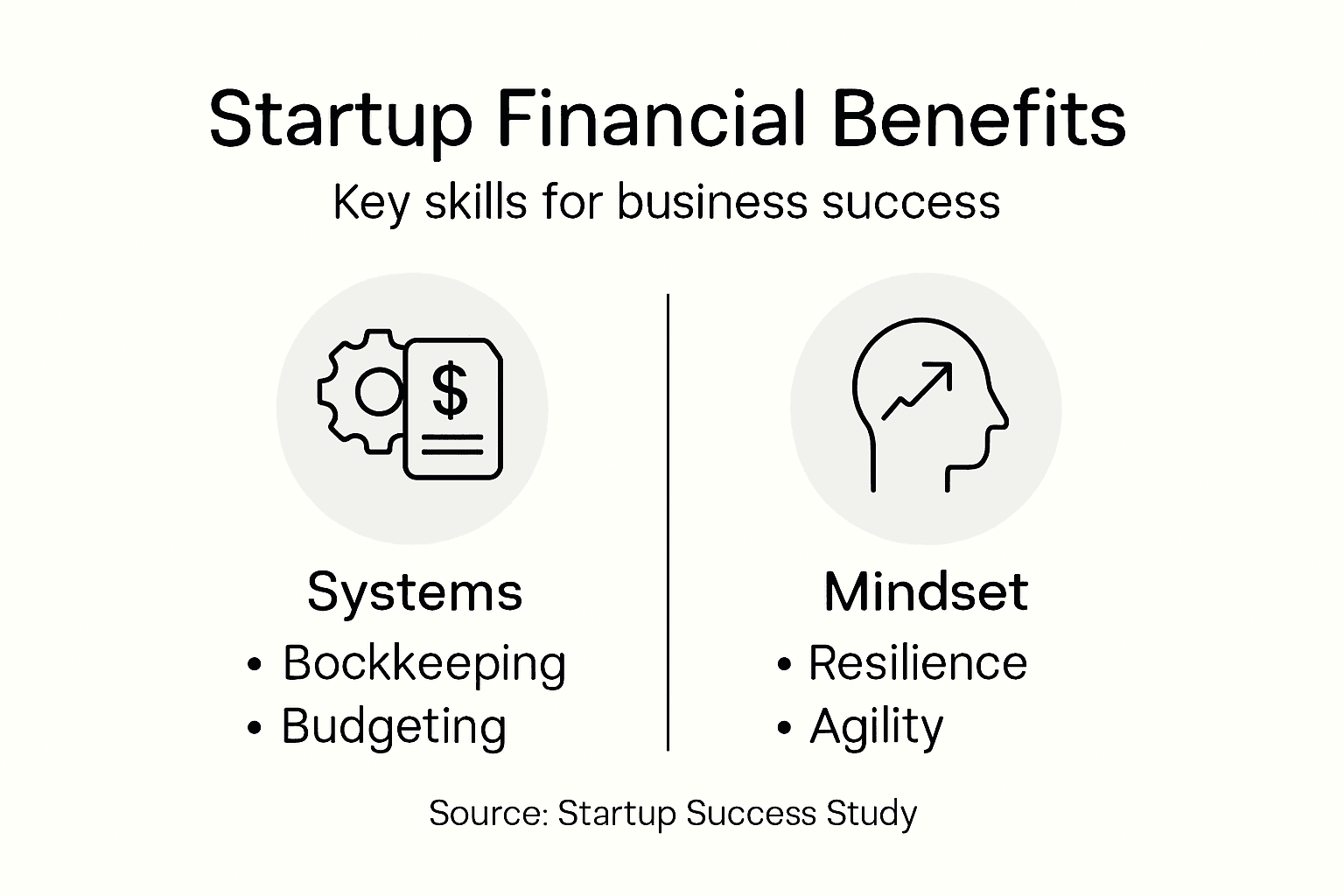
Founders must understand the interconnected triad of financial systems, key performance metrics, and entrepreneurial mindset as the foundational architecture of sustainable business success. These three components work together as a dynamic framework that transforms raw financial data into strategic decision-making capabilities. Startup financial literacy requires founders to develop a comprehensive approach that integrates technical knowledge with strategic thinking.
Financial systems form the infrastructure of business operations. This includes robust accounting frameworks, budgeting processes, financial reporting mechanisms, and technology platforms that track monetary flows. Critical systems enable founders to establish clear financial visibility, monitor resource allocation, and create predictable economic pathways. Key systems include comprehensive bookkeeping, integrated accounting software, cash flow management tools, and structured financial reporting protocols that provide real-time insights into business performance.

Metrics serve as the quantitative language of business performance. Founders must master understanding and tracking essential indicators like customer acquisition cost, lifetime value, burn rate, revenue growth, and profit margins. These metrics are not just numbers but strategic signals that reveal the underlying health and potential trajectory of the business. By developing a nuanced understanding of these financial indicators, entrepreneurs can make data-driven decisions, anticipate potential challenges, and strategically allocate resources for maximum impact.
The entrepreneurial mindset represents the psychological infrastructure that enables founders to interpret and act on financial information effectively. This involves cultivating financial discipline, emotional resilience, strategic risk assessment, and a growth-oriented perspective toward monetary challenges. Successful founders view financial data as a dynamic narrative that can be actively shaped and optimized, rather than a static set of constraints.
Pro Tip: Create a personal financial dashboard that tracks your most critical business metrics weekly, allowing you to develop an intuitive understanding of your company’s financial pulse.
Applying Financial Knowledge to Business Growth
Transforming financial knowledge into tangible business growth requires a strategic and intentional approach. Founders must move beyond passive understanding to active application, using financial insights as powerful leverage for scaling their ventures. Financial literacy drives entrepreneurial success by enabling precise decision-making and resource optimization.
Effective application of financial knowledge begins with developing a comprehensive financial strategy that aligns with the company’s broader objectives. This involves creating detailed financial models that forecast potential scenarios, identify potential risks, and outline clear pathways for resource allocation. Founders should focus on translating financial data into actionable insights, using metrics to guide investment decisions, prioritize growth initiatives, and maintain sustainable cash flow management.
Risk management represents another critical domain where financial knowledge directly impacts business growth. Sophisticated founders use financial literacy to develop robust contingency plans, understand market volatility, and create flexible financial strategies that can adapt to changing economic conditions. This approach goes beyond traditional financial planning, incorporating strategic risk assessment that considers both quantitative metrics and qualitative market dynamics.
Ultimately, applying financial knowledge is about developing a holistic perspective that integrates financial intelligence with entrepreneurial creativity. Successful founders treat financial information as a dynamic tool for innovation, using insights to identify new market opportunities, optimize operational efficiency, and create sustainable competitive advantages.
Pro Tip: Develop a quarterly financial review process that critically analyzes your business metrics, allowing you to proactively adjust your strategy based on emerging financial insights.
Critical Risks, Common Pitfalls, and Investor Trust
Founders navigate a complex landscape of financial risks that can rapidly derail even the most promising startup. Understanding and mitigating these risks is not just about survival, but about building a foundation of sustainable growth and investor confidence. Common startup financial pitfalls represent critical challenges that demand strategic awareness and proactive management.
The most prevalent risks stem from fundamental financial mismanagement. Cash flow volatility, incorrect market sizing, and unrealistic financial projections can destroy investor trust faster than any other factor. Founders must develop a nuanced understanding of their financial ecosystem, including detailed cost structures, revenue models, and potential economic vulnerabilities. This involves creating robust financial models that stress test different scenarios, identifying potential weaknesses before they become critical problems.
Investor trust is built through transparency, predictability, and demonstrated financial acumen. Sophisticated founders communicate financial narratives that go beyond spreadsheets, presenting compelling stories of strategic financial management. This means developing comprehensive reporting mechanisms, maintaining meticulous financial records, and demonstrating a clear understanding of how financial metrics translate into business strategy. Investors are looking for founders who can articulate not just current financial performance, but potential future trajectories with precision and confidence.
Risk management requires a holistic approach that integrates financial literacy with strategic thinking. Founders must continuously educate themselves about emerging financial risks, regulatory changes, and market dynamics. This involves developing adaptive financial systems that can quickly respond to changing economic conditions, maintaining flexible budgeting strategies, and building financial resilience that can withstand unexpected challenges.
Pro Tip: Create a quarterly financial risk assessment document that transparently outlines potential vulnerabilities, mitigation strategies, and contingency plans to demonstrate your strategic financial thinking to potential investors.
Elevating Success Through Sustainable Practices
Sustainable business practices represent a transformative approach to entrepreneurial success that goes far beyond traditional financial management. Founders who integrate holistic financial strategies create resilient organizations capable of navigating complex economic landscapes. Sustainable financial literacy empowers entrepreneurs to build businesses that generate both economic value and broader societal impact.
At the core of sustainable practices lies a comprehensive approach to financial decision-making that considers long-term consequences. This means developing financial models that account for environmental, social, and governance factors alongside traditional financial metrics. Sustainable founders recognize that true success involves creating value ecosystems that balance profitability with responsible resource allocation, ethical investment strategies, and strategic risk management.
The integration of sustainable practices requires a fundamental shift in entrepreneurial mindset. Founders must move beyond short-term profit maximization to develop financial strategies that create lasting value. This involves implementing transparent financial reporting, investing in employee development, supporting local economic ecosystems, and making strategic choices that contribute to broader economic and social resilience. By adopting a forward-thinking approach, entrepreneurs can build businesses that are not just financially successful, but also contribute positively to their communities and global economic systems.
Implementing sustainable practices demands continuous learning and adaptive financial strategies. Successful founders develop robust financial systems that can quickly respond to changing economic conditions while maintaining a commitment to long-term value creation. This requires developing sophisticated financial literacy that goes beyond traditional accounting, integrating insights from multiple disciplines to create more holistic and resilient business models.
Compare the focus of sustainable vs. traditional financial practices:
| Approach | Key Focus | Long-Term Value | Societal Impact |
|---|---|---|---|
| Traditional Finance | Profit maximization | Short-term gains | Limited consideration |
| Sustainable Finance | Holistic strategy | Ongoing resilience | Positive contribution |
Pro Tip: Develop a quarterly sustainability scorecard that tracks not just financial performance, but your business’s broader economic and social impact, helping you align financial success with meaningful progress.
Empower Your Financial Literacy and Build Lasting Business Success
The journey to mastering financial literacy for founders means overcoming challenges like cash flow management, strategic planning, and cultivating a growth-oriented mindset. If you have felt overwhelmed by complex financial metrics or struggled to transform numbers into confident decisions, you are not alone. This article highlights the crucial skills every founder needs to evolve from reactive management to strategic financial architects who achieve sustainable growth.
At Freedom Sun, we understand these exact pain points and have developed an operating system designed to elevate your financial clarity, fortify your business infrastructure, and strengthen your leadership resilience. Our OS framework, built on MATH (financial clarity), MECHANICS (systems infrastructure), and MIND (mental resilience), offers interactive training and diagnostics that transform how you manage your startup’s financial ecosystem without burnout. If you want to break free from hustle culture and lead with scalable peace of mind, explore how our platform can support your journey toward lasting success.
Ready to take control of your financial systems and lead your business confidently into the future Visit Freedom Sun today and discover our unique approach to entrepreneurial development. Start building your profitable peace through stronger financial literacy and operational stability now.
Frequently Asked Questions
What is financial literacy for startup founders?
Financial literacy for startup founders involves understanding, managing, and optimizing financial systems, including financial statements, cash flow, investment decisions, risk management, and strategic planning, enabling entrepreneurs to make informed financial choices.
Why is financial literacy important for startup success?
Financial literacy is crucial for startup success as it enables founders to access capital, navigate economic uncertainties, and make data-driven strategic decisions, ultimately impacting a startup’s survival and growth.
How can founders develop their financial literacy skills?
Founders can develop their financial literacy skills by dedicating time to reading financial literature, taking online courses, engaging with financial professionals, and creating dashboards to track key metrics, leading to improved financial understanding and decision-making.
What are some common financial risks that startup founders face?
Common financial risks that startup founders face include cash flow volatility, inaccurate market sizing, unrealistic financial projections, and mismanagement of resources. Understanding and mitigating these risks is essential for building investor trust and ensuring sustainable growth.