Financial Coaching Services: Transforming Founder Success

Scaling a tech startup brings intense financial pressure and unpredictable obstacles, especially when your focus is divided between rapid innovation and building reliable business systems. For founders aiming to automate financial processes and strengthen personal resilience, understanding the true value of financial coaching can be a turning point. This article clarifies what sets financial coaching apart, revealing practical strategies to help you achieve sustainable operational stability while protecting your well-being from burnout.
Table of Contents
- What Financial Coaching Services Involve
- Types Of Financial Coaching For Founders
- Key Features Of Modern Financial Coaching
- The Role Of Systemic Architecture And Automation
- Risks, Challenges, And Common Pitfalls
- How Financial Coaching Differs From Alternatives
Key Takeaways
| Point | Details |
|---|---|
| Client-Centered Approach | Financial coaching emphasizes a personalized methodology that aligns with the individual goals and aspirations of founders. |
| Behavioral Transformation Focus | The primary objective of financial coaching is to facilitate lasting behavioral changes that foster personal financial management skills. |
| Collaborative Engagement | Unlike traditional advisory services, financial coaching relies on a partnership that promotes accountability and skill development. |
| Sustainable Financial Practices | Coaches help entrepreneurs create effective financial systems, focusing on long-term self-sufficiency rather than immediate solutions. |
What Financial Coaching Services Involve
Financial coaching represents a powerful transformative approach for founders seeking systematic growth and operational clarity. Unlike traditional financial advice, financial coaching focuses on collaborative partnerships that empower entrepreneurs to design robust financial systems and make strategic decisions.
The core of financial coaching involves a personalized, goal-oriented methodology that distinguishes itself from other financial services. Financial coaching supports economically vulnerable entrepreneurs by providing tailored guidance that centers on individual objectives and sustainable management strategies.
Key characteristics of financial coaching include:
- Client-centered approach prioritizing personal goals
- Non-judgmental exploration of financial challenges
- Collaborative problem-solving techniques
- Customized strategy development
- Accountability and progressive skill-building
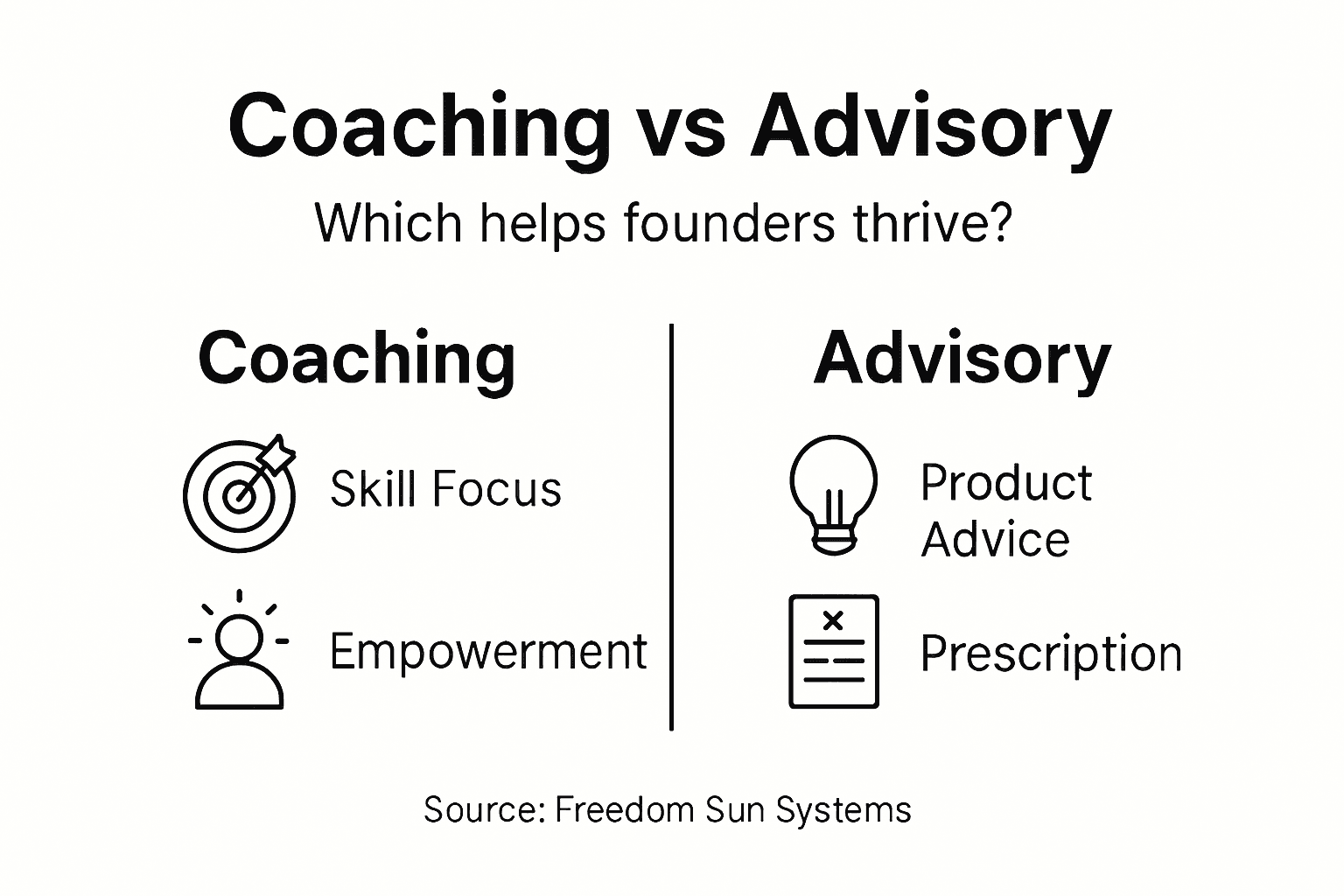
Financial coaches differ significantly from traditional financial advisors by emphasizing empowerment over prescription. They help founders develop financial self-sufficiency through strategic questioning, personalized insights, and actionable frameworks that transform how entrepreneurs understand and manage their financial ecosystems.
Pro tip: Schedule quarterly financial coaching sessions to maintain momentum and continuously refine your business’s financial strategy.
Types Of Financial Coaching For Founders
Financial coaching for founders is a nuanced field with multiple specialized approaches designed to address the unique financial challenges entrepreneurs face. Financial coaching varies strategically to support client goals, creating tailored experiences that help founders develop sustainable financial management skills.
The primary types of financial coaching for founders include:
- Performance-Based Coaching: Focuses on driving measurable financial improvements and goal achievement
- Strategic Systems Coaching: Emphasizes building robust financial infrastructure and operational frameworks
- Behavioral Transformation Coaching: Concentrates on changing financial decision-making patterns and mindsets
- Growth Trajectory Coaching: Aligns financial strategies with long-term business scaling objectives
Each coaching type offers distinct benefits, targeting different aspects of financial leadership. Performance-based coaching helps founders track and accelerate financial performance, while strategic systems coaching develops repeatable processes that create sustainable business growth. Behavioral transformation coaching addresses deeper psychological barriers that might impede financial progress.

Founders should select a coaching approach that matches their current business stage, personal financial literacy, and specific growth objectives. Some coaches specialize in early-stage startup financial management, while others focus on scaling established businesses with complex financial ecosystems.
To better understand which financial coaching style best matches your business needs, consider this comparison:
| Coaching Type | Ideal For | Distinct Advantage |
|---|---|---|
| Performance-Based Coaching | Results-driven founders | Maximizes measurable outcomes |
| Strategic Systems Coaching | Process-focused leaders | Builds scalable frameworks |
| Behavioral Transformation | Mindset-shifting founders | Alters core financial behaviors |
| Growth Trajectory Coaching | Expansion-minded owners | Aligns strategy to scaling goals |
Pro tip: Assess your specific financial challenges before selecting a coaching approach to ensure maximum alignment and potential for transformative outcomes.
Key Features Of Modern Financial Coaching
Modern financial coaching has evolved beyond traditional advisory services, embracing a holistic approach that empowers entrepreneurs through strategic, personalized guidance. Contemporary coaching prioritizes client-driven behavioral transformation, creating sustainable pathways for financial growth and leadership development.
Key features of contemporary financial coaching include:
- Client-Centered Methodology: Tailoring strategies to individual founder needs
- Behavioral Change Focus: Addressing psychological barriers to financial success
- Continuous Accountability: Providing ongoing support and progress tracking
- Skills-Based Learning: Developing practical financial management capabilities
- Customized Goal Setting: Aligning financial strategies with personal and business objectives
Unlike traditional financial advice, modern coaching emphasizes long-term capability development. Coaches utilize advanced techniques like motivational interviewing and strengths-based approaches to help founders overcome financial challenges. This approach goes beyond simple number-crunching, instead creating comprehensive frameworks for sustainable financial leadership.
The most effective financial coaching integrates deep psychological understanding with practical financial strategies. By combining emotional intelligence, strategic thinking, and targeted skill development, coaches help founders transform their financial mindsets and create robust, scalable business ecosystems.
Pro tip: Select a financial coach who demonstrates a proven track record of helping founders develop both strategic financial skills and personal leadership resilience.
The Role Of Systemic Architecture And Automation
Systemic architecture represents the strategic blueprint that transforms entrepreneurial potential into sustainable, scalable business models. Multi-agent architectures enable complex financial workflows, creating intelligent systems that dramatically enhance founders’ operational capabilities and decision-making precision.
Key components of systemic architecture and automation include:
- Workflow Optimization: Streamlining repetitive business processes
- Intelligent Decision Support: Leveraging AI-driven insights for strategic planning
- Risk Management: Proactively identifying and mitigating potential financial vulnerabilities
- Performance Tracking: Developing real-time monitoring and feedback mechanisms
- Adaptive Infrastructure: Creating flexible systems that evolve with business growth
Automation goes beyond simple task reduction. It represents a fundamental reimagining of how founders interact with their business ecosystems. Intelligent systems enable entrepreneurs to shift from manual management to strategic leadership, creating space for innovation and high-level thinking.
The most effective systemic architectures integrate human creativity with technological precision. By designing frameworks that balance technological efficiency with human intuition, founders can create resilient, adaptive business models that respond dynamically to market challenges and opportunities.
Pro tip: Invest in modular automation systems that allow incremental implementation and can scale alongside your business growth.
Risks, Challenges, And Common Pitfalls
Financial coaching for founders is not a guaranteed path to success, and understanding potential risks is crucial for maximizing its effectiveness. Challenges in financial coaching include complex client engagement dynamics, requiring strategic navigation to prevent potential pitfalls.
Key risks and challenges founders may encounter include:
- Misaligned Expectations: Unclear coaching boundaries and goals
- Dependency Syndrome: Overreliance on coach instead of developing personal skills
- Confidentiality Concerns: Potential breaches of sensitive financial information
- Performance Plateau: Coaching failing to generate meaningful progress
- Emotional Vulnerability: Psychological barriers blocking financial transformation
The most significant challenges emerge when founders approach financial coaching as a passive experience. Effective coaching requires active participation, transparent communication, and a genuine commitment to personal and professional growth. Coaches must maintain professional boundaries while providing nuanced, personalized guidance that respects the unique context of each founder’s business journey.
Successful founders recognize that financial coaching is a collaborative process. By maintaining realistic expectations, selecting coaches with proven expertise, and approaching the relationship as a strategic partnership, entrepreneurs can mitigate risks and maximize the transformative potential of professional financial guidance.
Pro tip: Conduct thorough due diligence and request detailed references before engaging a financial coach to ensure alignment with your specific business needs.
How Financial Coaching Differs From Alternatives
Financial coaching represents a unique approach to financial guidance, distinctly different from traditional advisory services. Coaching focuses on client-driven behavior change, moving beyond product recommendations to empower founders with actionable financial skills and transformative decision-making strategies.
Key differences between financial coaching and alternative services include:
- Approach to Guidance: Client-centered vs. product-driven
- Primary Objective: Behavior transformation vs. investment management
- Interaction Style: Collaborative vs. prescriptive
- Depth of Engagement: Holistic skill development vs. transactional advice
- Long-Term Focus: Sustainable financial habits vs. immediate financial transactions
Unlike financial advisors who primarily recommend investment products, financial coaches work intimately with founders to develop comprehensive financial competencies. The coaching relationship emphasizes personal agency, helping entrepreneurs understand underlying financial behaviors, create sustainable systems, and build long-term financial resilience.
Here’s how financial coaching differs from other financial services in practical terms:
| Aspect | Financial Coaching | Financial Advisory | Financial Counseling |
|---|---|---|---|
| Approach | Collaborative and empowering | Product- or compliance-driven | Problem-focused and remedial |
| Duration | Ongoing, skill-building | Transactional or periodic | Short-term or episodic |
| Focus | Mindset and habits | Investments and portfolios | Debt or crisis management |
| Client Outcome | Long-term self-sufficiency | Optimized assets | Resolved acute financial issue |
Founders seeking true financial transformation recognize that coaching transcends traditional advisory models. By prioritizing skill development, psychological insights, and personalized accountability, financial coaching provides a more comprehensive approach to financial leadership that addresses both practical and emotional dimensions of financial management.
Pro tip: Select a financial coach who demonstrates a proven track record of helping entrepreneurs develop both tactical financial skills and strategic mindset shifts.
Unlock Lasting Financial Mastery With Strategic Systems and Leadership
If you are a founder struggling with the common challenges highlighted in the article such as misaligned expectations, dependency on financial coaches, or stagnant progress in your financial growth, know that true transformation requires building more than temporary fixes. The article emphasizes powerful concepts like financial self-sufficiency, behavioral transformation, and systemic architecture to create sustainable business success without burnout. At Freedom Sun, we understand that founders need an integrated approach that combines financial clarity, automated systems, and resilient leadership to move from manual management to strategic freedom.
Our unique Operating System framework focuses on MATH, MECHANICS, and MIND to help you design robust financial systems and leadership practices modeled after Fortune 500 CFOs. Through interactive training, diagnostic assessments, and community support, you can shift from the limitations of coaching dependency to empowered sovereignty over your financial and operational ecosystems. Experience how tailored strategies and system health can eliminate the emotional vulnerability and performance plateaus many founders face.
Ready to stop hitting roadblocks and start building scalable wealth and peace in your business? Explore how Freedom Sun goes beyond traditional financial coaching to deliver transformational tools and frameworks specifically designed for entrepreneurial leaders. Take the next step and discover practical solutions that align your financial goals with automated, intelligent systems designed for growth and resilience. Visit Freedom Sun today to begin your journey towards financial mastery and leadership excellence.
Frequently Asked Questions
What is financial coaching?
Financial coaching is a collaborative partnership that helps entrepreneurs develop robust financial systems and make strategic decisions tailored to their unique goals, unlike traditional financial advice.
How does financial coaching differ from financial advisory services?
Financial coaching focuses on empowering clients through skill development and behavior transformation, while financial advisory services are more product-driven and emphasize investment management.
What are the main types of financial coaching for founders?
The main types of financial coaching include performance-based coaching, strategic systems coaching, behavioral transformation coaching, and growth trajectory coaching, each targeting different aspects of financial leadership.
What are the key features of modern financial coaching?
Modern financial coaching features a client-centered methodology, a focus on behavioral change, ongoing accountability, skills-based learning, and customized goal setting, leading to sustainable financial growth.