Scale Your Business: Increase Revenue 50% with Systems

Scaling a service business isn’t about grinding harder or working longer hours. It’s about building smart systems that increase capacity, reduce founder dependency, and protect your well-being. When you shift from hustle culture to systemic strategies integrating operations, leadership, finance, and mental resilience, you unlock sustainable growth that actually lasts.
Table of Contents
- Understanding The Systemic Nature Of Scaling In Service Businesses
- Operational Automation And Communication Clarity As Scaling Pillars
- Leadership Development: Building Mental Resilience And Strategic Capacity
- Financial Frameworks For Predictable And Sustainable Scaling
- Debunking Common Misconceptions About Scaling
- Practical Framework: Transitioning From Founder-Dependence To Scalable Systems
- Balancing Scaling With Founder Well-Being For Profitable Peace
- Explore Scalable Coaching Solutions Designed For You
- Frequently Asked Questions
Key Takeaways
| Point | Details |
|---|---|
| Systemic scaling integrates four pillars | Operations, leadership, finance, and well-being work together to create sustainable growth. |
| Automation multiplies capacity efficiently | Automated systems boost capacity by 30 to 40 percent without increasing workload or stress. |
| Leadership skills prevent founder burnout | Mental resilience training reduces burnout risk by up to 45 percent during growth phases. |
| Financial governance increases predictability | Cash flow frameworks improve business survival rates by 25 percent for scaling service firms. |
| Founder independence unlocks revenue growth | Systems that reduce owner dependency increase revenue scalability by 50 percent or more. |
Understanding the Systemic Nature of Scaling in Service Businesses
Most service entrepreneurs mistakenly believe scaling means working harder and longer hours, but research shows it requires smarter systemization. Systemic scaling transforms your entire business across operations, leadership, finance, and founder well-being. It’s not just about getting more clients or hiring more people.
Growth and scalable growth differ fundamentally. Growth happens when revenue increases but requires proportional effort increases. Scalable growth means revenue rises while your time investment stays flat or even decreases. That’s the power of systemic integration.
Hustle culture tells coaches and consultants to push harder, take more calls, deliver more sessions. This approach hits a wall fast. You max out your hours, quality drops, and burnout arrives right when success seems close. Sporadic scaling creates chaos because one area grows while others lag behind, creating bottlenecks and instability.
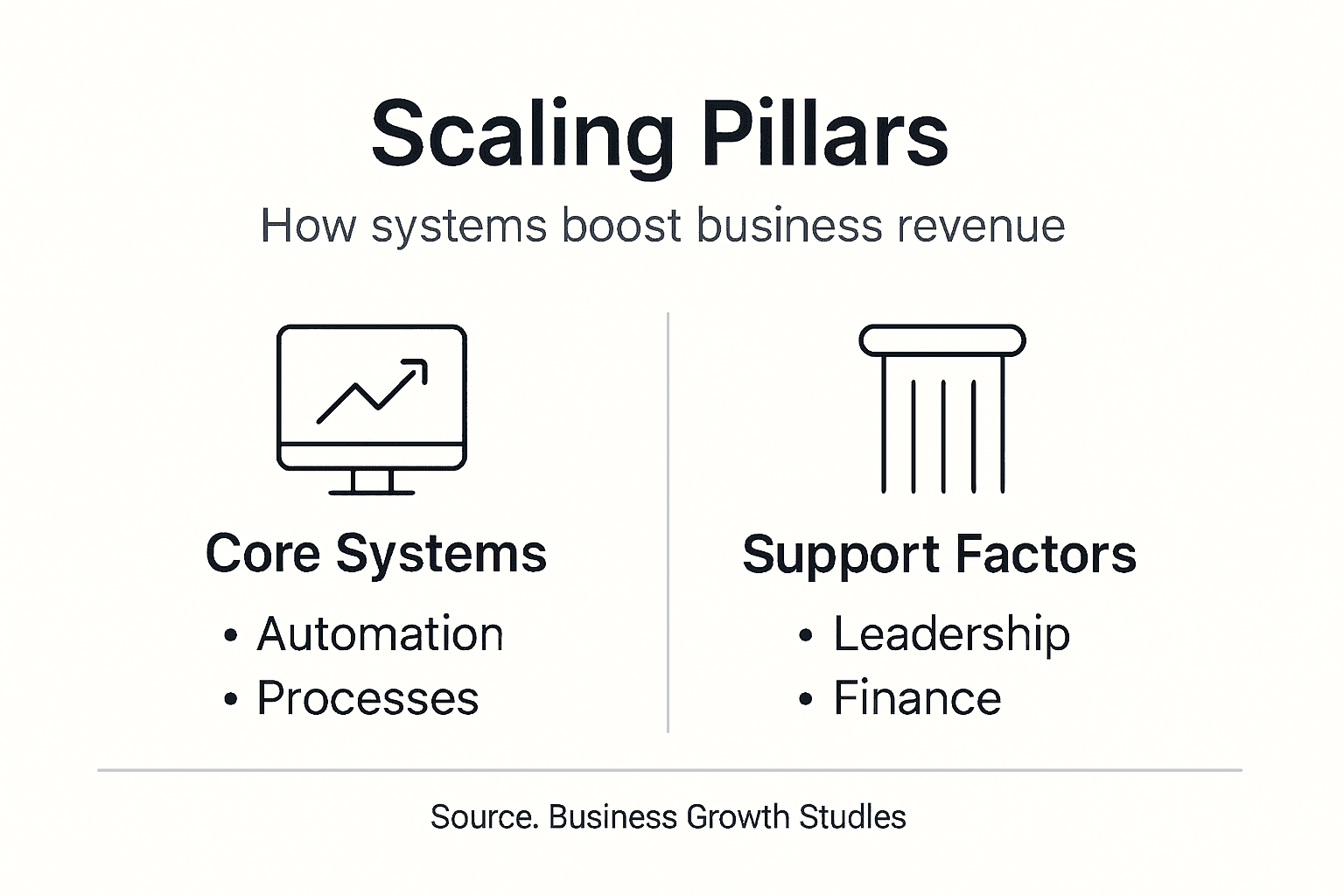
A four-pillar framework guides sustainable scaling:
- Operational automation that handles repetitive tasks
- Leadership development that builds mental resilience
- Financial governance that ensures cash flow predictability
- Well-being practices that sustain founder energy
When these pillars work together, you create a business that grows without consuming your life. Each pillar supports the others, creating stability that traditional growth methods never achieve.
Operational Automation and Communication Clarity as Scaling Pillars
Automation increases capacity by 30 to 40 percent without added workload, and clear communication reduces errors by 60 percent. These aren’t just efficiency gains. They’re transformational shifts that free you from daily operations while improving client experience.
Automating core processes means setting up systems that run without constant supervision. Client onboarding sequences, scheduling workflows, payment processing, and follow-up communications can all operate automatically. Tools like Zapier, Calendly, and CRM platforms create seamless business operating systems that handle routine tasks.

Role clarity matters just as much as automation. When everyone knows exactly what they’re responsible for and how to communicate, coordination becomes effortless. Document your processes, create clear handoff points, and establish communication protocols. This structure prevents the constant interruptions that kill productivity.
Pro tip: Start by automating your most repetitive client onboarding and scheduling tasks first. These typically consume the most time and create the biggest bottlenecks when you try to scale.
Implementing these operational pillars follows a clear sequence:
- Map your current processes and identify repetitive tasks
- Select automation tools that integrate with your existing systems
- Document communication protocols and role responsibilities
- Test automated workflows with a small client subset
- Train team members on new systems and gather feedback
- Refine processes based on real-world performance
These steps stabilize operations and prepare your business for growth. You’re not just working faster. You’re building operating system infrastructure that handles increased volume without breaking.
Leadership Development: Building Mental Resilience and Strategic Capacity
Leadership programs emphasizing emotional resilience reduce founder burnout by up to 45 percent. This statistic reveals why leadership development isn’t optional for scaling. It’s the foundation that makes everything else possible.
Mental resilience determines how well you handle pressure, uncertainty, and rapid change during growth phases. Strategic thinking lets you see patterns, anticipate problems, and make decisions that compound over time. Without these skills, even perfect systems eventually fail because the leader can’t sustain the pace.
Emotional resilience practices include:
- Daily mindfulness or meditation to reduce stress reactivity
- Regular physical exercise to manage cortisol levels
- Peer support networks that provide perspective
- Professional boundaries that protect personal time
Balancing leadership duties with personal well-being sounds impossible when you’re in the thick of scaling. The truth is that neglecting well-being guarantees eventual collapse. You can’t lead effectively when you’re exhausted, stressed, or disconnected from why you started.
Pro tip: Incorporate 10 minutes of daily mindfulness or reflection to boost strategic clarity. This small investment pays massive dividends in decision quality and stress management.
Leadership training for founders focuses on self-awareness, communication skills, and systemic thinking. These capabilities drive change across your entire organization. When you lead from a place of clarity and resilience, your team follows. Systems improve because you’re making better decisions about what to build and when.
The connection between leadership and sustainable coaching growth is direct. Coaches who develop strong leadership skills create businesses that thrive long term. Those who skip this development hit ceiling after ceiling, wondering why growth feels so hard.
Financial Frameworks for Predictable and Sustainable Scaling
Cash flow predictability improves survival rates by 25 percent for scaling service businesses. Financial governance isn’t about restricting growth. It’s about making growth sustainable and protecting your business from the cash crunches that kill promising companies.
Cash flow forecasting means projecting income and expenses 90 days ahead, updating weekly as reality unfolds. Budget controls ensure spending aligns with strategic priorities rather than reactive impulses. Together, these practices create financial visibility that transforms decision making.
Financial planning for scalability differs completely from chasing quick cash. Scalable planning invests in systems, training, and infrastructure that multiply capacity. Quick cash grabs prioritize immediate revenue at the expense of long-term stability. One builds assets. The other creates dependency.
Service businesses face unique financial challenges:
- Irregular cash flow from project-based or seasonal work
- High labor costs as primary expense category
- Difficulty pricing services for true profitability
- Temptation to undercharge to win clients
| Financial Approach | 12-Month Revenue | Cash Reserve | Stress Level | Sustainability |
|---|---|---|---|---|
| Stable Budgeting | Predictable growth | 3 to 6 months | Manageable | High |
| Rapid Unmanaged Scaling | Volatile spikes | 0 to 1 month | Extreme | Low |
Implementing scalable financial wellness frameworks requires specific steps. First, establish baseline metrics for current cash flow, profit margins, and operating expenses. Second, create forecasting templates that track actuals against projections. Third, set financial thresholds that trigger specific actions when cash dips or expenses spike.
Fourth, build cash reserves equal to three months of operating expenses before aggressive scaling. Fifth, review financial performance monthly with your team to maintain alignment. These steps sound basic because they are. The power comes from consistent execution, not complexity.
Debunking Common Misconceptions About Scaling
Myth one claims that hustling harder equals scaling success. Reality shows that systemization determines scalability, not effort intensity. You can work 80 hours weekly and still hit a ceiling if systems don’t multiply your impact. Smart systems let you scale revenue while maintaining reasonable hours.
Myth two suggests faster scaling always yields better financial results. Unmanaged rapid scaling actually increases risk dramatically. When operations, leadership, or finances can’t keep pace with revenue growth, quality suffers and client churn rises. Sustainable pacing protects both profitability and reputation.
Myth three positions scaling as mostly about sales and marketing volume. More leads and more closes matter, but only if your delivery systems can handle increased demand. Systemic integration across operations, leadership, finance, and well-being determines whether growth strengthens or destabilizes your business.
| Misconception | Reality | Impact of Believing Myth |
|---|---|---|
| Hustle harder to scale | Systemization enables scaling | Burnout, revenue ceiling, founder dependency |
| Faster is always better | Sustainable pacing protects quality | Cash crunches, client churn, operational chaos |
| Focus on sales volume | Integration across all pillars required | System breakdowns, delivery failures, team turnover |
| Scaling means complexity | Simplicity and clarity drive scalability | Confusion, inefficiency, decision paralysis |
Adopting holistic systemic thinking means recognizing that every business component connects. When you improve operations, leadership capacity increases. When finances stabilize, stress decreases and strategic thinking improves. When well-being practices become routine, productivity and creativity flourish. This interconnection is why piecemeal improvements fail while integrated approaches transform entire businesses.
Practical Framework: Transitioning from Founder-Dependence to Scalable Systems
Transitioning to founder-independent systems increases revenue scalability by 50 percent and reduces chaos. This framework provides step-by-step guidance for implementing systemic scaling successfully.
The methodology progresses through five phases:
- Assessment: Run diagnostics to identify current bottlenecks, founder dependencies, and system gaps
- Automation: Implement tools and workflows that handle repetitive operational tasks without supervision
- Leadership: Develop mental resilience, strategic thinking, and communication skills through structured training
- Financial governance: Establish cash flow forecasting, budget controls, and financial threshold monitoring
- Well-being integration: Build daily practices for stress management, rest, and sustained energy
Continuous diagnostics matter because your business evolves. What worked at 10 clients breaks at 50 clients. Regular system health checks reveal emerging bottlenecks before they create crises. Monitor capacity utilization, error rates, client satisfaction, and founder time allocation quarterly.
Pro tip: Use diagnostic tools periodically to avoid scaling bottlenecks. Catching issues early costs far less than fixing problems after they’ve caused damage.
A coaching firm case study illustrates this framework’s effectiveness. The founder worked 60 hours weekly, personally handled all client communication, and struggled with cash flow unpredictability. After implementing scalable systems, automation handled onboarding and scheduling. Leadership training reduced stress reactivity. Financial forecasting prevented cash surprises.
Within 12 months, the firm doubled revenue while the founder’s hours dropped to 35 per week. Client satisfaction scores increased because systems delivered consistent quality. Team members took ownership of their domains because roles and communication protocols were crystal clear. The business became genuinely scalable rather than just bigger.
Operating system setup for scaling requires patience and iteration. You won’t get everything right immediately. The goal is continuous improvement toward greater automation, clearer leadership, more predictable finances, and better founder well-being.
Balancing Scaling with Founder Well-being for Profitable Peace
Mental resilience strategies boost founder productivity by 30 percent and improve work-life balance alongside client growth. This connection between well-being and performance isn’t coincidental. Your capacity to scale depends directly on your mental and physical health.
Mindfulness practices create space between stimulus and response. When a crisis hits, mindful leaders pause, assess options, and choose responses rather than react impulsively. This capability alone prevents countless costly mistakes during high-pressure growth phases.
Rest integration means treating recovery as seriously as work. Schedule downtime, take real vacations, and protect sleep like the strategic asset it is. Exhausted founders make poor decisions, miss opportunities, and damage relationships with clients and team members.
Long-term advantages of profitable peace extend beyond avoiding burnout. When you build a business that supports your life rather than consuming it, you create sustainable wealth-building capacity. You make better investments, maintain important relationships, and preserve the creative energy that drove your initial success.
Daily well-being strategies to embed:
- Morning routine that centers you before reactive work begins
- Movement breaks every 90 minutes to reset mental focus
- Clear work boundaries that protect evening and weekend time
- Weekly review session to assess what’s working and what needs adjustment
- Monthly planning that aligns business goals with personal values
Connecting operational and strategic scaling with sustainable founder health completes the systemic approach. You’re not sacrificing well-being for business success. You’re recognizing that self-leadership and business leadership are inseparable. When you lead yourself well, everything else improves naturally.
Explore Scalable Coaching Solutions Designed for You
Ready to implement these systemic strategies in your coaching or consulting business? Freedom Sun provides comprehensive resources for founders committed to sustainable scaling. Learn how to start a coaching business sustainably with integrated systems from day one. Explore business coach leadership training that builds the mental resilience and strategic thinking you need. Discover practical guides to build scalable systems that reduce founder dependency while increasing capacity. Take the next step toward scaling that enhances rather than consumes your life.
Frequently Asked Questions
What is the first step in transitioning from founder-dependent to scalable systems?
Start with a diagnostic assessment that identifies where you’re currently the bottleneck. Map every process where clients, team members, or operations wait on your personal involvement. This visibility reveals which dependencies to address first, typically client onboarding and core service delivery.
How can coaches prevent burnout during rapid business growth?
Build mental resilience practices into your daily routine before growth accelerates. Mindfulness, clear boundaries, and scheduled rest aren’t luxuries during scaling. They’re requirements for sustained performance. Also automate operations so growth doesn’t mean proportionally more hours.
Which financial practices are most critical for scaling service businesses?
Cash flow forecasting and maintaining three to six months of operating reserves matter most. Service businesses face irregular income, so visibility into upcoming cash needs prevents crisis decisions. Budget controls ensure spending aligns with strategic priorities rather than reactive impulses.
How does leadership mindset impact operational stability in scaling?
Leaders who develop strategic thinking and emotional resilience make better decisions under pressure. This capability cascades through the organization, improving communication, reducing errors, and maintaining quality during rapid growth. Poor leadership creates chaos even with perfect systems.
What automation tools offer the best ROI for small consulting firms?
Start with client onboarding automation using tools like Dubsado or HoneyBook, scheduling automation through Calendly or Acuity, and payment processing via Stripe or PayPal. These three categories typically consume the most founder time and create the biggest bottlenecks when scaling begins.