Building Business Operating Systems for Scalable Success

Feeling pulled in every direction while your business grows at breakneck speed is an experience many founders share. Building lasting stability and financial clarity means moving beyond hustle culture into structured systems for sustainable growth. By defining measurable strategic outcomes, leveraging the MATH pillar for financial insight, and constructing modular infrastructure, you set the stage for a clear operational roadmap that adapts as your enterprise evolves. This article guides you through proven steps to transform chaos into scalable success.
Table of Contents
- Step 1: Define Strategic Outcomes For Business Systems
- Step 2: Map Financial Clarity Using The MATH Pillar
- Step 3: Construct Scalable Systems Infrastructure With MECHANICS
- Step 4: Cultivate Resilient Leadership Using MIND Practices
- Step 5: Verify And Optimize System Integration For Lasting Results
Quick Summary
| Key Insight | Explanation |
|---|---|
| 1. Define measurable strategic outcomes | Establish specific targets to clarify what success means for your organization and track progress effectively. |
| 2. Utilize the MATH pillar for financial clarity | Break down financial data into understandable metrics to better inform decision-making and strategy. |
| 3. Build scalable systems with MECHANICS | Create modular infrastructure that can adapt and grow seamlessly with your business’s evolving needs. |
| 4. Foster resilient leadership through MIND practices | Incorporate mindfulness and self-reflection to enhance emotional intelligence and adaptability in leadership roles. |
| 5. Ensure continuous system integration and optimization | Regularly audit and test your systems to identify improvement areas, ensuring seamless operational connectivity. |
Step 1: Define strategic outcomes for business systems
Defining strategic outcomes transforms abstract business goals into concrete, measurable targets that drive organizational performance. This critical step sets the foundation for building a robust business operating system by clarifying exactly what success looks like for your specific enterprise.
Starting with strategic outcomes requires a systematic approach rooted in data-driven insights. Systematic performance management strategies demonstrate that successful businesses align their key performance indicators across design, implementation, operation, and control phases. This means identifying specific, quantifiable metrics that reflect your business model’s core objectives. Common strategic outcomes might include sales growth percentages, customer acquisition rates, profit margins, geographical expansion milestones, or innovation pipeline progression.
The process involves three primary components: establishing clear measurement criteria, setting realistic yet ambitious targets, and creating mechanisms for ongoing tracking and adaptation. Break down broad goals into specific, actionable indicators that provide meaningful insights into your business system’s health and trajectory.
Pro tip: Design strategic outcomes with flexibility built in, allowing periodic reassessment and recalibration as market conditions and organizational capabilities evolve.
Step 2: Map financial clarity using the MATH pillar
Making sense of your business’s financial landscape requires a strategic approach that goes beyond basic number crunching. The MATH pillar provides a structured framework for transforming raw financial data into actionable insights that drive sustainable business growth.

Mathematical foundations of financial literacy reveal that combining numeracy skills with financial knowledge dramatically improves decision making. This means breaking down complex financial information into clear, understandable metrics that reveal your business’s true financial health. Start by identifying key performance indicators that matter most to your specific business model: revenue streams, expense ratios, profit margins, cash flow velocity, and investment return rates. These metrics form the core of your financial mapping process.
The mapping process involves three critical steps: first, gather comprehensive financial data from all business sources. Second, standardize and categorize this data using consistent mathematical frameworks. Third, develop visual representations like dashboards or scorecards that transform complex numerical information into intuitive, actionable insights. This approach allows you to quickly understand your financial ecosystem and make informed strategic decisions.
Pro tip: Create a monthly financial review ritual where you analyze your key metrics, ensuring you consistently track and understand your business’s financial trajectory.
Step 3: Construct scalable systems infrastructure with MECHANICS
Building a robust business infrastructure requires more than just assembling random tools and processes. The MECHANICS pillar provides a strategic blueprint for creating systems that can grow and adapt seamlessly with your business needs.
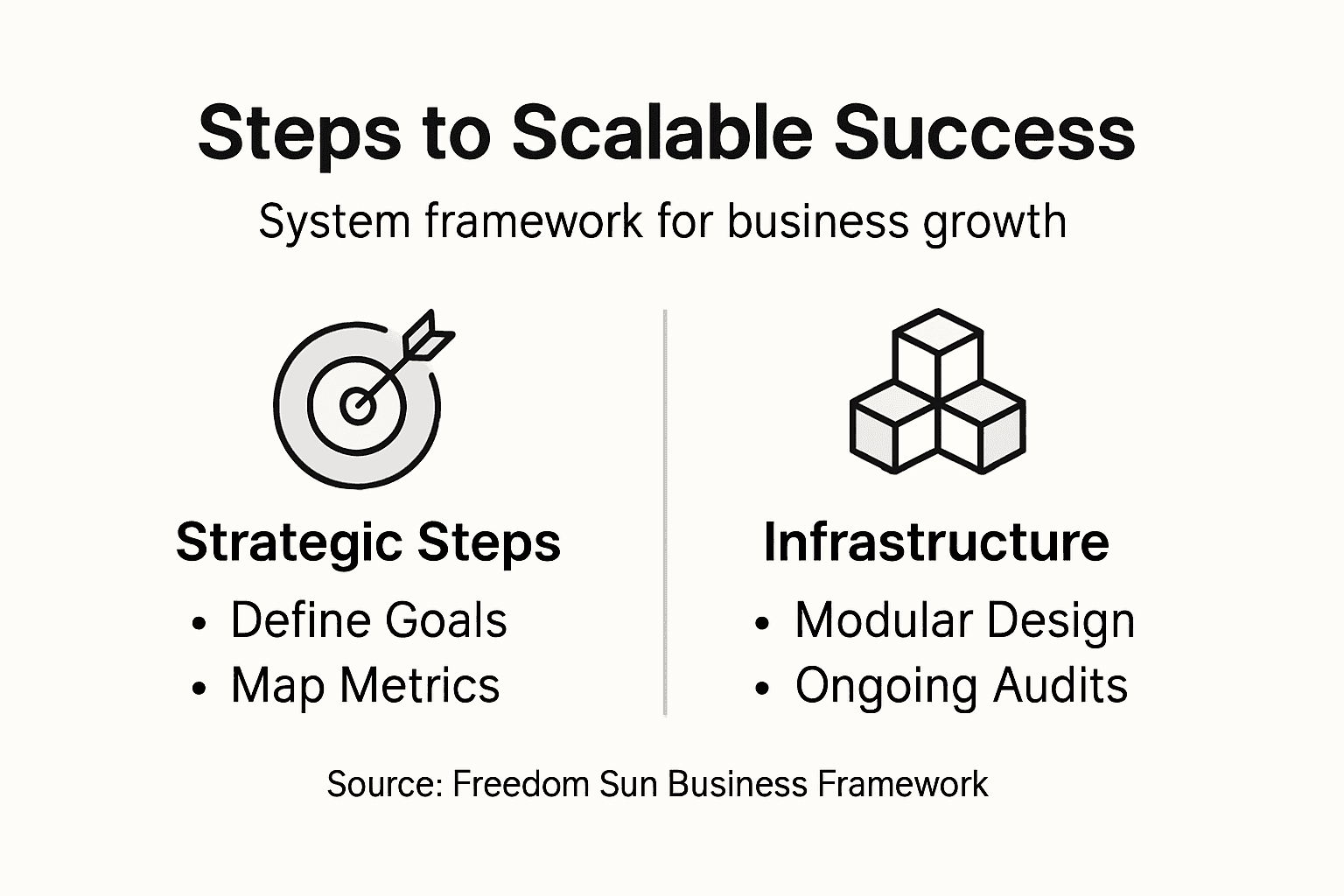
Computational scalability mechanisms demonstrate that effective infrastructure relies on modular design and interconnected systems. This means creating a flexible framework where each component can be upgraded or replaced without disrupting the entire operational ecosystem. Focus on developing core systems that include standardized workflows, integrated communication protocols, automated reporting mechanisms, and adaptable technology platforms that can scale with your business growth.
The construction process involves three fundamental stages: first, audit your current systems and identify bottlenecks or inefficient processes. Second, design modular infrastructure with clear integration points that allow for future expansion. Third, implement scalable technologies that provide real time data insights and enable rapid decision making. This approach transforms your business infrastructure from a static setup to a dynamic, responsive operational engine that can quickly adapt to market changes and organizational growth.
Pro tip: Design your systems with intentional flexibility, treating each infrastructure component as a replaceable module that can evolve without causing systemic disruption.
See how modular infrastructure differs from traditional static systems:
| Aspect | Modular Infrastructure | Static Systems |
|---|---|---|
| Flexibility | Easily adaptable and upgradable | Change is difficult |
| Integration | Clear connection points | Components are isolated |
| Scalability | Grows with business needs | Limited expansion capacity |
| Risk Management | Isolated failures affect less | System-wide disruptions |
Step 4: Cultivate resilient leadership using MIND practices
Developing resilient leadership is about more than survival strategies it is about creating a sustainable approach to personal and professional growth. The MIND pillar offers a comprehensive framework for transforming your leadership capabilities through intentional mental practices.
Self leadership and mindfulness practices demonstrate that strategic mental training can dramatically improve leaders emotional intelligence and stress management capabilities. This means developing a practice of self awareness that goes beyond traditional leadership models by integrating mindfulness techniques that enhance focus emotional regulation and authentic decision making. Key practices include daily meditation structured reflection time intentional breathing exercises and systematic emotional intelligence development.
The cultivation process involves three core stages: first develop a consistent mindfulness practice that grounds you in present moment awareness. Second create structured routines for emotional self regulation that help you maintain composure under pressure. Third build a personal development system that continuously challenges and expands your leadership capacity through deliberate learning and reflection. This approach transforms leadership from a reactive role to a proactive journey of personal and professional growth.
Pro tip: Treat your mental resilience like a muscle build it systematically through daily practice and intentional challenge.
Step 5: Verify and optimize system integration for lasting results
System integration is not a one-time event but an ongoing process of refinement and strategic alignment. Your goal is to create a robust operational ecosystem where every component works seamlessly and efficiently.
System integration development processes reveal critical insights into creating high-quality interconnected systems. This means implementing a continuous verification approach that identifies potential friction points and optimizes interactions between different business components. Focus on establishing clear performance benchmarks comprehensive testing protocols and adaptive feedback mechanisms that allow your system to evolve dynamically with your business needs.
The verification process involves three strategic stages: first conduct a comprehensive system audit to map existing integration points and potential bottlenecks. Second develop rigorous testing protocols that simulate real world scenarios and stress test your system integrations. Third implement a continuous improvement framework that allows for rapid iteration and optimization based on performance data and changing business requirements. This approach transforms system integration from a static infrastructure to a living adaptive mechanism that supports ongoing business growth.
Pro tip: Create a quarterly system integration review ritual where you systematically assess and recalibrate your operational connections.
Here’s a summary comparing the five key pillars discussed in this article:
| Pillar | Main Goal | Key Activities | Business Impact |
|---|---|---|---|
| Strategic Outcomes | Set measurable targets | Define KPIs and track progress | Aligns effort with objectives |
| MATH | Clarify financial insights | Analyze and visualize metrics | Informs sound decisions |
| MECHANICS | Build scalable infrastructure | Modular design, integration | Enables flexible growth |
| MIND | Develop resilient leadership | Mindfulness and self-reflection | Boosts adaptability |
| Integration | Optimize system connections | Continuous testing and audits | Sustains organizational health |
Unlock Scalable Success with a Proven Business Operating System
If you find defining clear strategic outcomes, achieving financial clarity, and building scalable systems infrastructure challenging, you are not alone. Many entrepreneurs struggle to connect these critical pieces into a cohesive operating system that powers sustainable growth. This article outlined how the MATH, MECHANICS, and MIND pillars are essential for transforming your business operations into a flexible, measurable, and resilient engine for success. Ignoring these pillars risks burnout and fragmented progress.
At Freedom Sun, we specialize in helping high-growth entrepreneurs like you master this exact framework. Our professional development platform offers interactive training and diagnostic assessments designed to deepen your financial literacy, optimize your systems infrastructure, and cultivate resilient leadership without the overwhelm. Whether you seek to elevate your personal performance or scale your entire organization, our Operating System methodology equips you with practical tools modeled after Fortune 500 CFOs.
Take control today and shift from hustle to strategic management. Explore how you can solidify your business foundations and lead with confidence by visiting Freedom Sun now.
Frequently Asked Questions
How do I define strategic outcomes for my business systems?
Defining strategic outcomes involves transforming broad business goals into specific, measurable targets. Break down your objectives into key performance indicators, such as sales growth percentages or customer acquisition rates, and regularly track these metrics to assess progress.
What are the key steps to map financial clarity using the MATH pillar?
Mapping financial clarity involves gathering data, standardizing it, and creating visual dashboards. Start by identifying key performance indicators like profit margins or cash flow velocity, and then develop visual representations that transform complex data into clear insights.
How can I build scalable systems infrastructure using the MECHANICS pillar?
To build scalable systems infrastructure, begin by auditing your current processes and identifying inefficiencies. Design a modular infrastructure that allows for easy upgrades, and implement technologies that provide real-time data insights to support your business’s growth.
What practices can help cultivate resilient leadership in my organization?
Cultivating resilient leadership involves integrating mindfulness techniques and structured self-reflection into daily routines. Develop consistent practices such as meditation and emotional self-regulation to enhance your leadership capabilities and adaptability under pressure.
How can I verify and optimize system integration for lasting results?
Establish ongoing verification and optimization processes by conducting regular system audits and implementing rigorous testing protocols. Focus on identifying friction points and creating a continuous improvement framework that allows for rapid adjustments based on performance data.