Start a Coaching Business: Strategies for Sustainable Success

Leaving a structured corporate world for the thriving field of coaching can feel like a leap into the unknown. As ambitious professionals seek greater autonomy and fulfillment, the need for a clear definition and solid foundation in their new coaching ventures grows more urgent. This guide highlights the core principles of client-centered coaching businesses and reveals how strategic systems and purposeful wellbeing practices together provide the blueprint for long-term success in a highly competitive market.
Table of Contents
- Definition And Core Principles Of Coaching Businesses
- Popular Coaching Models And Niches Explained
- Essential Systems And Strategic Foundations
- Legal, Financial, And Certification Requirements
- Common Mistakes And How To Avoid Them
- Scaling Your Coaching Business For Wellbeing
Key Takeaways
| Point | Details |
|---|---|
| Client-Centered Approach | Effective coaching prioritizes the client’s unique goals and strengths for transformative growth. |
| Diverse Coaching Models | Understanding various models like GROW, CLEAR, and OSKAR enhances adaptability and client outcomes. |
| Strategic Business Infrastructure | Successful coaching practices require robust systems for client acquisition, operational frameworks, and performance measurement. |
| Holistic Scaling Strategies | Balancing business growth with personal wellbeing ensures sustainable success and resilience for coaches. |
Definition and Core Principles of Coaching Businesses
A coaching business represents a strategic professional practice dedicated to facilitating individual and organizational transformation through personalized guidance and skill development. Unlike traditional consulting models, coaching focuses on client-driven growth and empowerment, enabling professionals to unlock their inherent potential through systematic personal development processes.
At its core, a coaching business operates on several fundamental principles that distinguish it from other professional service models:
- Client-Centered Approach: Prioritizing the client’s unique goals, strengths, and developmental trajectory
- Solution-Oriented Methodology: Focusing on actionable strategies rather than problem analysis
- Collaborative Partnership: Creating a trust-based relationship between coach and client
- Transformational Learning: Supporting continuous personal and professional growth
Coaching businesses recognize that sustainable success emerges from activating an individual’s intrinsic capabilities. The process involves a structured yet flexible framework where coaches serve as strategic partners, not prescriptive instructors. They employ techniques designed to provoke self-reflection, challenge limiting beliefs, and inspire strategic action.

Professional coaches understand that effective coaching transcends traditional skill transfer. It involves creating psychological safety, encouraging self-discovery, and helping clients develop adaptive leadership competencies. Modern coaching practices integrate emotional intelligence, goal-setting techniques, and performance psychology to support holistic development.
Pro tip: Design your coaching approach around measurable client transformation, not just session completion rates.
Popular Coaching Models and Niches Explained
Coaching has evolved into a diverse professional landscape with multiple specialized models and approaches designed to address unique client needs. Structured coaching frameworks provide systematic methodologies for personal and professional transformation, enabling coaches to deliver targeted, results-oriented interventions across various domains.
Some of the most prominent coaching models include:
- GROW Model: Goal, Reality, Options, Will - focuses on clear objective setting and action planning
- CLEAR Model: Contract, Listen, Explore, Action, Review - emphasizes collaborative problem-solving
- OSKAR Model: Outcome, Scaling, Know-how, Affirm, Review - supports solution-focused strategies
These coaching models serve different professional niches, each with distinct characteristics and client objectives:
Here’s a comparison of the main coaching models and where they fit best:
| Coaching Model | Primary Focus | Ideal Use Case | Unique Advantage |
|---|---|---|---|
| GROW | Goal setting and planning | Career and executive coaching | Simple structure supports measurable change |
| CLEAR | Collaborative problem-solving | Personal and team coaching | Fosters deep trust and ownership |
| OSKAR | Solution-focused strategies | Short-term or performance coaching | Drives quick wins and positivity |
- Executive Coaching: Targets leadership development and organizational performance
- Life Coaching: Supports personal growth, wellness, and holistic life management
- Career Coaching: Helps professionals navigate career transitions and skill development
- Leadership Coaching: Develops strategic leadership competencies and organizational adaptability
Successful coaches understand that no single model fits all scenarios. The art of coaching lies in flexibly adapting frameworks to individual client contexts, combining structured methodologies with intuitive, personalized approaches. Effective coaches blend technical frameworks with emotional intelligence, creating transformative experiences that go beyond standard consulting practices.
Pro tip: Master multiple coaching models to increase your adaptability and client impact.
Essential Systems and Strategic Foundations
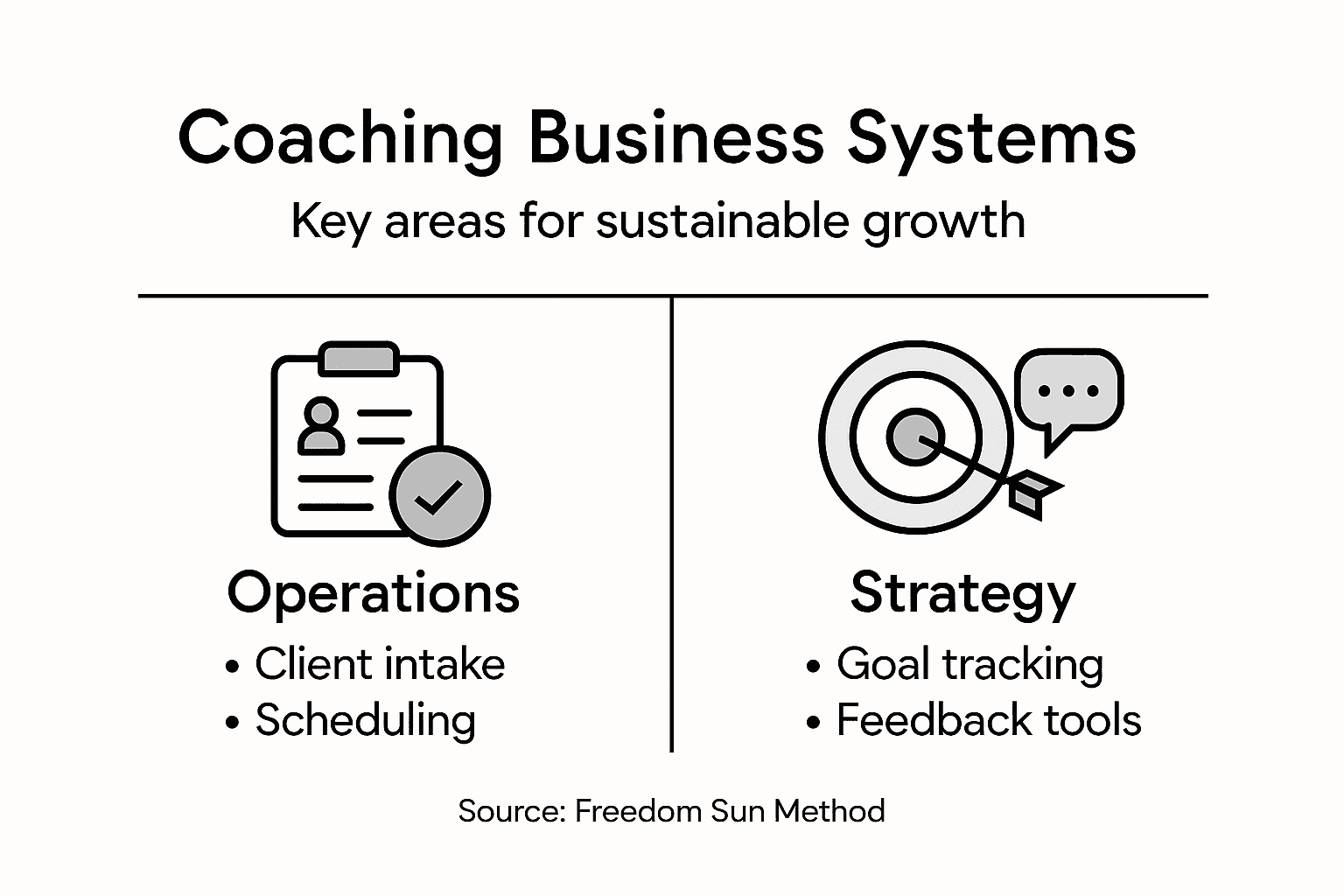
Building a sustainable coaching business requires more than just expertise - it demands robust strategic infrastructure and systematized approaches. Scientific building blocks of coaching methodology provide the critical framework for creating a professional, results-driven coaching practice that delivers consistent value to clients.
Key strategic foundations for a successful coaching business include:
- Client Acquisition Systems: Predictable lead generation and conversion processes
- Operational Frameworks: Standardized client onboarding and engagement protocols
- Performance Measurement: Clear metrics for tracking client progress and business growth
- Ethical Governance: Comprehensive professional standards and accountability mechanisms
Effective coaches recognize that systematic approaches are not restrictive but liberating. By implementing structured methodologies, coaches can:
- Ensure consistent client experiences
- Scale their services more efficiently
- Demonstrate measurable professional value
- Build trust through predictable, professional interactions
The most successful coaching practices integrate technological tools, rigorous assessment frameworks, and adaptive strategies. This approach transforms coaching from an art into a sophisticated, evidence-based professional service that delivers tangible, measurable outcomes for clients across various domains.
Strategic systems are the invisible architecture that transforms individual coaching talent into a sustainable, scalable business.
Pro tip: Invest more time designing your business systems than your marketing materials.
Legal, Financial, and Certification Requirements
Launching a coaching business requires careful navigation of complex legal and professional landscape. Essential legal requirements for coaching businesses encompass multiple critical aspects that protect both the coach and potential clients.
Key legal and financial considerations include:
- Business Structure: Selecting appropriate legal entity (LLC, sole proprietorship)
- Tax Registration: Obtaining necessary federal and state tax identification numbers
- Professional Credentials: Pursuing recognized coaching certifications
- Insurance Coverage: Securing professional liability and business insurance
- Client Contracts: Developing comprehensive service agreements
Certification paths are crucial for establishing professional credibility:
Below is a summary of certification levels for professional coaches:
| Certification Level | Industry Recognition | Client Perception | Typical Requirements |
|---|---|---|---|
| Associate Coach | Entry-level | Foundational, emerging | Basic training, some practice |
| Professional Coach | Well established | Trusted by most clients | Advanced training, experience |
| Master Coach | Highest prestige | Industry expert, sought after | Extensive training, proven results |
- Associate Level Certification: Entry-level professional credentials
- Professional Coach Certification: Advanced professional standing
- Master Coach Certification: Highest level of professional recognition
Understanding professional coaching standards and ethics is fundamental to building a reputable practice. While coaching remains largely unregulated, professional certifications from recognized bodies like the International Coaching Federation (ICF) provide critical validation and trust signals for potential clients.
Professional credentials are not just certificates - they’re your passport to credibility in the coaching marketplace.
Pro tip: Invest in comprehensive professional certification before heavily marketing your coaching services.
Common Mistakes and How to Avoid Them
Starting a coaching business is fraught with potential pitfalls that can derail even the most passionate professionals. Awareness and strategic planning are crucial for navigating the complex entrepreneurial landscape and avoiding common destructive patterns.
Most frequent mistakes aspiring coaches encounter include:
- Undefined Niche: Attempting to serve everyone, which results in serving no one effectively
- Pricing Uncertainty: Undervaluing services or failing to establish clear pricing structures
- Limited Marketing: Relying solely on word-of-mouth instead of developing comprehensive marketing strategies
- Inadequate Systems: Operating without robust client management and business processes
- Continuous Learning Neglect: Failing to invest in personal and professional development
Potential traps for new coaching entrepreneurs can be systematically addressed through proactive strategies:
- Conduct thorough market research before launching
- Develop a clear, targeted service offering
- Create scalable business systems early
- Invest in ongoing professional education
- Build a strong professional network
Successful coaches understand that sustainable growth requires continuous adaptation. Technical skills matter, but emotional intelligence, resilience, and strategic thinking differentiate exceptional coaching practices from mediocre ones.
Mistakes are not failures - they’re tuition paid in the university of entrepreneurship.
Pro tip: Document and analyze every client interaction to continuously refine your coaching methodology.
Scaling Your Coaching Business for Wellbeing
Scaling a coaching business requires strategic planning that balances professional growth with personal sustainability. Holistic business expansion means creating systems that support both financial success and individual wellbeing, ensuring long-term resilience and fulfillment.
Key strategies for sustainable scaling include:
- Strategic Service Diversification: Developing multiple revenue streams
- Automated Business Processes: Implementing technology to reduce manual workload
- Selective Client Engagement: Focusing on high-value, aligned client relationships
- Energy Management: Designing business models that prevent professional burnout
- Continuous Learning Infrastructure: Building systems for ongoing skill development
Successful coaches recognize that scaling isn’t just about increasing client numbers, but about creating intelligent business architectures:
- Develop signature coaching methodologies
- Create digital and passive income products
- Build strategic referral networks
- Implement robust client management systems
- Design flexible work arrangements
Sustainable business scaling requires understanding that personal energy is the most critical business asset. Coaches must design businesses that generate income without constantly sacrificing personal time, health, or mental bandwidth.
True business success emerges when professional growth and personal wellbeing are harmoniously integrated.
Pro tip: Design your coaching business model to generate revenue while protecting your core energy and passion.
Build a Coaching Business That Lasts with Freedom Sun
Starting a coaching business requires more than passion. The article highlights critical challenges like undefined niches, pricing uncertainties, and the need for strategic systems that bring measurable client transformation. If you are ready to move beyond common pitfalls and design a business model focused on sustainable success and personal well-being, the path is clear.
At Freedom Sun, we train coaches, consultants, and service-based entrepreneurs on how to master sales, communication, financial management, and leadership. Our approach centers on strategic implementation and systemic architecture, helping you create a coaching enterprise that generates profitable peace instead of hustle. Discover how to implement scalable business systems and foster mental resilience by exploring our interactive training and community.
Are you prepared to stop guessing and start building a coaching business with clarity and confidence Today visit Freedom Sun to learn how you can transform your coaching practice into a thriving, sustainable venture. Your journey to sovereignty over your systems and success begins now.
Frequently Asked Questions
What are the main principles of a successful coaching business?
A successful coaching business is built on a client-centered approach, solution-oriented methodology, collaborative partnerships, and transformational learning, fostering client empowerment and growth.
How can I choose the right coaching model for my business?
Choosing the right coaching model involves understanding your target audience’s needs and combining methods like GROW for goal setting or CLEAR for collaborative problem-solving to effectively address those needs.
What are essential systems needed for scaling a coaching business?
Key systems include client acquisition processes, operational frameworks for onboarding, performance measurement metrics, and ethical governance to maintain professionalism and accountability.
What common mistakes should I avoid when starting a coaching business?
Common mistakes include having an undefined niche, unclear pricing, inadequate marketing, poor systems management, and neglecting continuous learning—each can hinder your business’s growth and success.