Business Coach Leadership Training: Transforming Founder Success

Bold leadership moves drive results, but more than 60 percent of American tech founders admit to struggling with sustainable growth and team motivation under pressure. For entrepreneurs chasing high-impact success, balancing professional ambition with personal resilience is no small challenge. This overview reveals how focused business coach leadership training empowers founders to build financial clarity, automate systems for efficient performance, and cultivate mastery in leadership across complex markets.
Table of Contents
- Defining Business Coach Leadership Training
- Core Pillars: Financial, Systems, And Mindset
- Strategic Applications For High-Growth Founders
- Key Skills For Sustainable Leadership
- Common Missteps And How To Avoid Burnout
Key Takeaways
| Point | Details |
|---|---|
| Holistic Growth Approach | Business coach leadership training integrates skill development, performance optimization, and personal transformation for comprehensive leader development. |
| Core Pillars for Success | Focus on financial strategy, systems infrastructure, and mindset to achieve sustainable leadership and growth. |
| Adaptive Strategies | High-growth founders must cultivate rapid adaptation and psychological preparedness to navigate complex challenges effectively. |
| Prevention of Burnout | Recognizing early signs of leadership burnout and implementing strategic workload management are essential for maintaining resilience and performance. |
Defining Business Coach Leadership Training
Business coach leadership training represents a strategic approach to developing entrepreneurs and executives through targeted professional development. Professional coaching processes focus on helping leaders transform their current performance capabilities into desired future states by providing structured guidance and skill enhancement.
At its core, business coach leadership training encompasses three critical dimensions: skill development, performance optimization, and personal transformation. These programs are designed to equip founders with comprehensive tools for navigating complex business challenges, including strategic decision making, team management, financial planning, and personal leadership resilience. Unlike traditional management training, these specialized programs concentrate on holistic growth that integrates professional competencies with individual psychological frameworks.
Effective business coach leadership training typically involves customized approaches that address specific organizational and individual needs. Participants engage in diagnostic assessments, one-on-one coaching sessions, peer learning environments, and skill-building workshops that target leadership mindset, communication effectiveness, strategic thinking, and emotional intelligence. Successful programs recognize that leadership development is not a one-size-fits-all methodology, but a nuanced process requiring personalized strategies and ongoing support.
Pro tip: When selecting a business coach leadership training program, prioritize those offering comprehensive diagnostic tools and personalized development plans that align with your specific business context and growth objectives.
Core Pillars: Financial, Systems, and Mindset
Business leadership development is fundamentally anchored in three interconnected pillars: financial strategy, systems infrastructure, and transformative mindset. Holistic leadership development requires entrepreneurs to integrate these domains into a comprehensive approach that enables sustainable business growth and personal effectiveness.
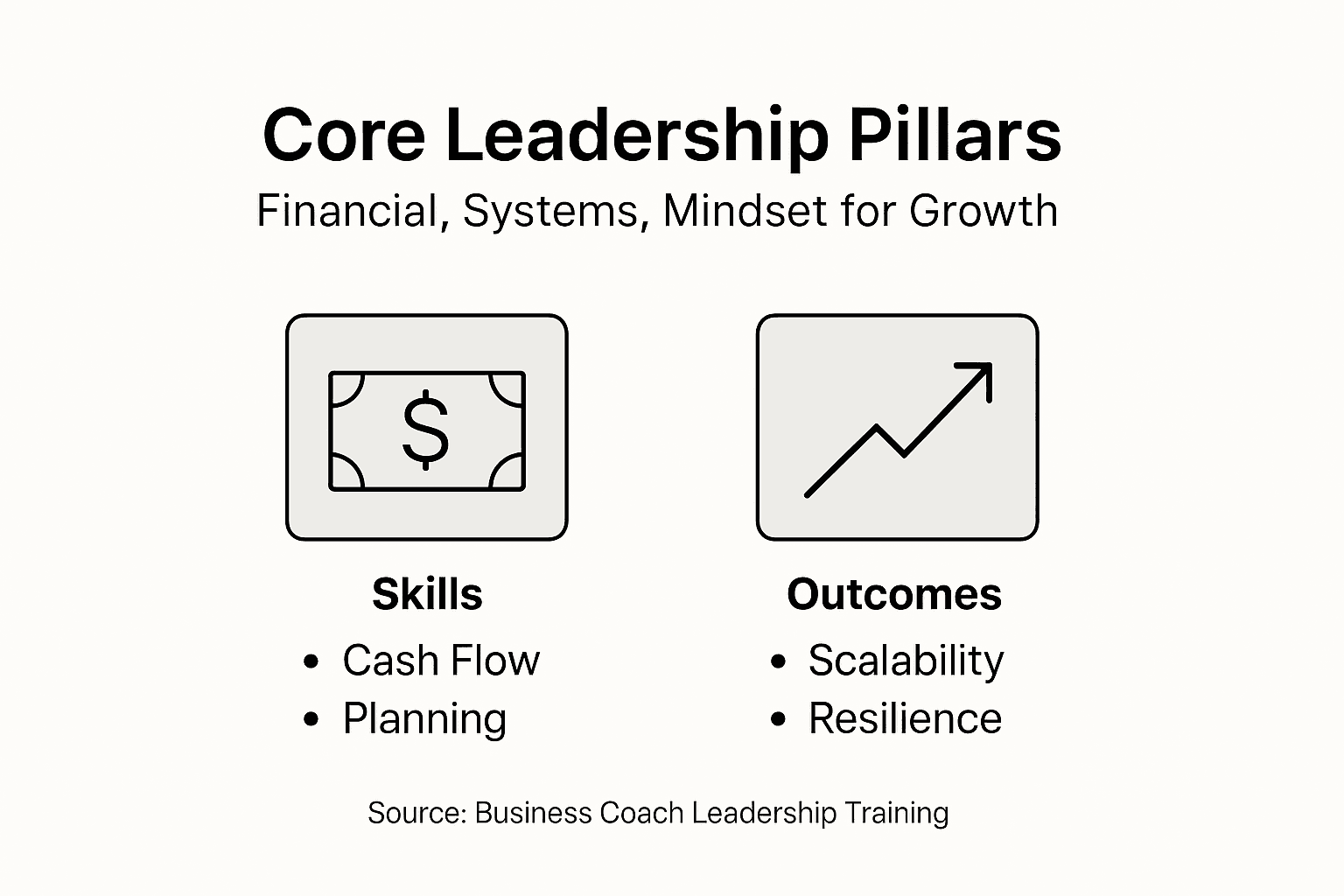
The financial pillar focuses on developing strategic monetary intelligence, helping founders understand cash flow management, investment strategies, and financial forecasting. This dimension goes beyond traditional accounting by teaching leaders to view finances as a dynamic system of value creation and strategic resource allocation. Leaders learn to read financial statements with precision, make data-driven decisions, and develop robust financial models that support long-term business objectives.
The systems pillar emphasizes creating scalable, efficient organizational infrastructures that can adapt to changing business landscapes. This involves designing repeatable processes, implementing strategic technologies, and developing workflows that minimize friction and maximize productivity. Entrepreneurs learn to think systematically, breaking down complex business challenges into manageable components and creating integrated solutions that drive consistent performance.
The mindset pillar represents the psychological foundation that enables sustainable leadership success. This critical dimension focuses on developing mental resilience, emotional intelligence, strategic thinking, and personal growth frameworks. By cultivating a growth-oriented mindset, founders learn to navigate uncertainty, manage stress, and maintain innovative problem-solving capabilities even under significant professional pressure.
Pro tip: Conduct a quarterly self-assessment across these three pillars to identify strengths and development opportunities, ensuring continuous personal and professional evolution.
Here’s a summary of how each leadership pillar supports entrepreneurial growth:
| Pillar | Core Focus | Impact on Business | Key Challenges Addressed |
|---|---|---|---|
| Financial | Strategic monetary intelligence | Enables sustainable growth | Cash flow, resource allocation |
| Systems | Scalable infrastructure | Boosts efficiency, adapts | Complexity, productivity issues |
| Mindset | Psychological resilience | Sustains high performance | Stress, uncertainty management |
Strategic Applications for High-Growth Founders
High-growth founders require specialized leadership approaches that transcend traditional management techniques. Coaching leadership interventions provide critical frameworks for navigating complex entrepreneurial challenges, enabling founders to build sustainable and adaptable organizational structures.
Strategic applications for high-growth founders center on developing rapid adaptation skills that allow entrepreneurs to respond dynamically to market shifts. This involves creating flexible organizational models, implementing agile decision-making processes, and cultivating leadership capabilities that can pivot quickly without losing operational momentum. Successful founders learn to balance strategic planning with the ability to make swift, data-driven adjustments that maintain competitive advantage.
Psychological preparedness becomes a fundamental strategic application for founders operating in volatile business environments. This dimension includes developing emotional resilience, maintaining clear cognitive frameworks during uncertainty, and building robust mental models that support consistent performance under pressure. High-growth entrepreneurs must cultivate psychological skills that enable them to manage stress, make clear decisions, and maintain team motivation even when facing significant operational challenges.
Technology and systematic learning play crucial roles in strategic leadership development. Founders must integrate continuous learning mechanisms, leverage advanced diagnostic tools, and create feedback loops that support ongoing personal and organizational evolution. This approach transforms leadership from a static set of skills into a dynamic, responsive system of continuous improvement and strategic thinking.
Pro tip: Develop a monthly personal leadership audit that objectively evaluates your strategic decision-making processes, psychological resilience, and organizational adaptability.
Key Skills for Sustainable Leadership
Sustainable leadership demands a sophisticated set of integrated skills that extend far beyond traditional management approaches. Personal development frameworks provide crucial insights into the complex competencies required for long-term entrepreneurial success, emphasizing holistic skill development that supports continuous growth and adaptability.

Emotional intelligence emerges as a foundational skill for sustainable leadership, enabling founders to navigate complex interpersonal dynamics with remarkable precision. This skill encompasses self-awareness, emotional regulation, and the ability to read and respond to team dynamics effectively. High-performing leaders learn to transform emotional data into strategic insights, using empathy and understanding to build resilient organizational cultures that can withstand significant operational challenges.
Strategic communication represents another critical skill set for sustainable leadership. This goes beyond simple information transmission, involving nuanced abilities to inspire, align, and motivate teams through clear, purposeful dialogue. Effective leaders develop communication strategies that create psychological safety, encourage innovative thinking, and maintain transparent, trust-based relationships with team members, investors, and stakeholders.
Continuous learning and adaptability form the backbone of sustainable leadership capabilities. Successful founders cultivate a growth mindset that views challenges as opportunities for development, consistently investing in personal skill enhancement and organizational learning mechanisms. This approach transforms leadership from a static role into a dynamic, evolving practice that can rapidly respond to changing business landscapes and emerging market opportunities.
Pro tip: Create a quarterly personal development scorecard that objectively tracks your progress across emotional intelligence, strategic communication, and adaptive learning skills.
Common Missteps and How to Avoid Burnout
Leadership burnout represents a silent epidemic threatening entrepreneurial success, emerging from sustained high-pressure environments and unsustainable work practices. Leadership mistakes contributing to burnout often stem from systemic operational patterns that gradually erode personal resilience and organizational effectiveness.
Founders frequently encounter burnout through several predictable patterns: constant urgency creation, micromanagement, inadequate boundary setting, and unrealistic performance expectations. These patterns manifest as chronic stress, diminished decision-making capacity, and progressive emotional exhaustion. Successful leaders learn to recognize early warning signals, implementing strategic interventions that preserve both personal energy and organizational momentum. This requires developing robust self-awareness mechanisms and creating systematic approaches to workload management and personal restoration.
Technology and strategic system design play crucial roles in preventing leadership burnout. By implementing automated administrative processes, creating clear communication protocols, and establishing predictable workflow rhythms, founders can dramatically reduce unnecessary cognitive load. Effective burnout prevention involves designing organizational infrastructures that naturally distribute responsibility, encourage team autonomy, and create space for periodic recovery and reflection.
Psychological resilience emerges as a fundamental skill in maintaining sustainable leadership performance. This involves cultivating emotional intelligence, practicing deliberate stress management techniques, and developing a holistic perspective that views personal well-being as a strategic business asset. Leaders must consistently invest in their mental and physical health, recognizing that sustainable high performance requires intentional self-care and periodic recalibration.
This table compares common causes of leadership burnout and suggested prevention strategies:
| Burnout Cause | Symptom | Prevention Strategy |
|---|---|---|
| Constant urgency | Chronic stress | Prioritize workload, delegate |
| Micromanagement | Decision fatigue | Empower team autonomy |
| Poor boundaries | Emotional exhaustion | Set clear personal limits |
| Unrealistic goals | Reduced engagement | Regular goal reviews |
Pro tip: Implement a weekly personal performance audit that objectively assesses your energy levels, stress indicators, and organizational systems to proactively prevent burnout.
Transform Your Leadership Journey with a Proven Operating System
If you are seeking to overcome the challenges of building sustainable leadership and system health described in “Business Coach Leadership Training: Transforming Founder Success” then Freedom Sun offers a strategic solution tailored just for you. This article highlights the critical need to develop financial clarity, scalable systems, and psychological resilience — concepts that Freedom Sun calls MATH, MECHANICS, and MIND within its unique Operating System framework. By adopting this integrated approach you move beyond reactive hustle into automated strategic management that preserves your energy and maximizes growth.
Take control of your business leadership through Freedom Sun’s interactive training and diagnostic assessments. Join a community dedicated to helping high-growth founders and executives elevate their financial intelligence and operational stability while preventing burnout. Don’t let constant urgency or unclear systems undermine your success. Visit Freedom Sun today and discover how you can build a fortress of profitable peace and scalable leadership success with a tested methodology designed by experts modeled after Fortune 500 CFO strategies.
Frequently Asked Questions
What is business coach leadership training?
Business coach leadership training is a strategic professional development approach that helps entrepreneurs and executives enhance their performance capabilities through skill development, performance optimization, and personal transformation.
How do the core pillars of financial strategy, systems infrastructure, and mindset contribute to entrepreneurial growth?
These pillars offer a holistic approach: the financial pillar focuses on strategic monetary intelligence, the systems pillar emphasizes scalable organizational structures, and the mindset pillar supports psychological resilience, all essential for sustainable growth.
What key skills are necessary for sustainable leadership?
Essential skills include emotional intelligence, strategic communication, and adaptability. These competencies help leaders navigate complex interpersonal dynamics, inspire teams, and respond effectively to changing business environments.
How can leaders prevent burnout while managing high-pressure environments?
Leaders can prevent burnout by recognizing early warning signs, setting clear boundaries, delegating tasks, and implementing efficient systems. Regular self-care and strategic workload management are also crucial for maintaining energy and resilience.