Operating System Setup for Founders: Achieve Scalable Success

Only one in three American startups successfully scale beyond the early growth stage, yet most founders struggle with hidden barriers that drain momentum and clarity. Building a resilient, high-performing company demands more than hustle. For American tech entrepreneurs, a strategic operating system brings structure to rapid growth while defending mental focus and financial transparency. This guide reveals how to create precise systems for leadership readiness, financial insight, sales, and scalable business health.
Table of Contents
- Step 1: Define Your Operating Principles And Objectives
- Step 2: Design Your Financial Clarity Framework With MATH
- Step 3: Build Automated Sales Infrastructure Using MECHANICS
- Step 4: Integrate Leadership Resilience With MIND Practices
- Step 5: Verify System Health And Scalability
Quick Summary
| Key Message | Explanation |
|---|---|
| 1. Define Clear Operating Principles | Establish principles that guide decision-making and differentiate your startup from competitors. |
| 2. Create a Financial Clarity Framework | Develop metrics and dashboards that turn financial data into strategic insights for informed decisions. |
| 3. Automate Your Sales Infrastructure | Implement sales automation tools to streamline processes, improve efficiency, and enhance revenue generation. |
| 4. Integrate Mindfulness for Resilience | Adopt mindfulness practices to strengthen emotional intelligence and leadership adaptability during challenges. |
| 5. Regularly Verify System Health | Monitor key performance indicators periodically to uncover inefficiencies and facilitate sustainable growth. |
Step 1: Define your operating principles and objectives
Building a rock-solid operating system starts with crystal clear principles that guide every decision your startup makes. Principles transform generic mission statements into actionable roadmaps for sustainable growth.
To craft meaningful operating principles, start by breaking down your entrepreneurial vision into concrete categories. Effective principles typically fall into four key domains: value generation, decisive action, resource allocation, and strategic big-picture thinking. This means identifying not just what you want to achieve but precisely how you’ll approach challenges, allocate resources, and make strategic choices.
Begin by scheduling a focused strategy session where you document your core principles. Ask yourself critical questions: What behaviors will drive our success? What actions represent our non-negotiable standards? What principles differentiate us from competitors? Write these down as clear statements that anyone in your organization could understand and implement.
Your principles should feel like a personal operating manual for your startup’s culture and decision making. They’re not just words on paper but a living blueprint that guides team behavior, shapes hiring decisions, and provides clarity during uncertain moments.
Pro tip: Review and refine your operating principles every six months to ensure they remain relevant and aligned with your evolving business strategy.
Step 2: Design your financial clarity framework with MATH
Mathematical proficiency is the foundation of financial intelligence that separates successful founders from struggling entrepreneurs. Your financial clarity framework transforms complex numbers into strategic insights that drive business growth.
Start by establishing your core financial metrics. This means creating a comprehensive tracking system that goes beyond basic accounting. Sophisticated financial competence requires building a measurement framework that reveals deeper business performance insights. Identify key performance indicators specific to your business model such as customer acquisition cost, lifetime value, monthly recurring revenue, and burn rate.

Break down your financial framework into predictable, measurable components. Create spreadsheets or dashboards that automatically calculate growth trajectories, cash flow projections, and potential investment scenarios. The goal is transforming raw financial data into actionable intelligence that guides strategic decision making.
Each metric should tell a story about your business potential. By standardizing how you track and interpret financial information, you create a repeatable system that removes emotional uncertainty from your entrepreneurial journey.
Pro tip: Invest in financial tracking software that provides real time analytics and allows customizable reporting to match your specific business needs.
Step 3: Build automated sales infrastructure using MECHANICS
Sales automation transforms repetitive processes into intelligent systems that scale your business effortlessly. Your goal is creating a robust infrastructure that reduces manual effort while maximizing revenue potential.
Modern sales automation leverages artificial intelligence and machine learning to streamline lead generation and customer relationship management. Start by mapping out your entire sales workflow and identifying which tasks consume the most time. Look for opportunities to implement software that can handle lead scoring, email follow ups, meeting scheduling, and pipeline tracking.
Choose tools that integrate seamlessly with your existing systems. Your automation should feel like a natural extension of your sales process rather than a disruptive add on. This means selecting platforms that communicate with your CRM, marketing software, and communication channels without requiring constant manual intervention.
Prioritize tools that provide actionable analytics. The right automation infrastructure does more than save time it generates insights about your sales performance, customer behaviors, and potential growth opportunities. Think of these systems as your digital sales strategist working 24 hours a day.
The table below summarizes how different sales automation features benefit a growing business:
| Automation Feature | Business Benefit | Implementation Tip |
|---|---|---|
| Lead scoring | Prioritizes top prospects | Integrate with your CRM |
| Email follow-up | Increases conversion rates | Use automated sequences |
| Meeting scheduling | Reduces back-and-forth | Choose calendar sync tools |
| Pipeline tracking | Visualizes sales progress | Enable real-time reporting |
Pro tip: Select sales automation tools with strong API connections and customization options to ensure they can adapt as your business model evolves.
Step 4: Integrate leadership resilience with MIND practices
Mindfulness meditation cultivates transformative leadership qualities that enable founders to navigate complex business challenges with extraordinary emotional intelligence. Your resilience framework is about building mental strength that adapts and thrives under pressure.
Effective leadership resilience requires a holistic approach addressing physical, mental, emotional, and social dimensions. Start by establishing a daily mindfulness practice that trains your brain to respond strategically instead of reactively. This might involve 10 to 15 minutes of meditation, breathwork, or structured reflection that helps you develop heightened self awareness and emotional regulation.
Create a personal resilience dashboard that tracks your mental and physical well being. Monitor key indicators like sleep quality, stress levels, energy management, and cognitive performance. Recognize that resilience is not about never experiencing challenges but about developing the mental flexibility to move through them effectively.
Integrate practices that strengthen your mental adaptability. This could include journaling, weekly strategic reviews, peer support networks, or professional coaching that helps you process complex leadership challenges and maintain psychological momentum.
Pro tip: Develop a morning routine that primes your mental state for leadership resilience through intentional mindfulness and strategic visualization.
Step 5: Verify system health and scalability
Verifying system health requires a comprehensive approach that assesses multiple dimensions of organizational readiness and performance potential. Your goal is creating a diagnostic framework that reveals hidden constraints and opportunities for sustainable growth.
Systematic monitoring of scalability risks involves tracking critical performance indicators like resource utilization, communication efficiency, and potential system bottlenecks. Start by establishing a baseline performance dashboard that captures key metrics across financial, operational, technological, and human resource domains. This means creating quantitative and qualitative measurement tools that provide early warning signals about potential scaling challenges.
Develop a rigorous quarterly review process where you critically examine each operating system component. Look for signs of strain or inefficiency in your current infrastructure. Pay attention to metrics like response times, resource allocation, team productivity, and system resilience. The most successful founders treat their organizational systems like living organisms that require consistent assessment and strategic tuning.
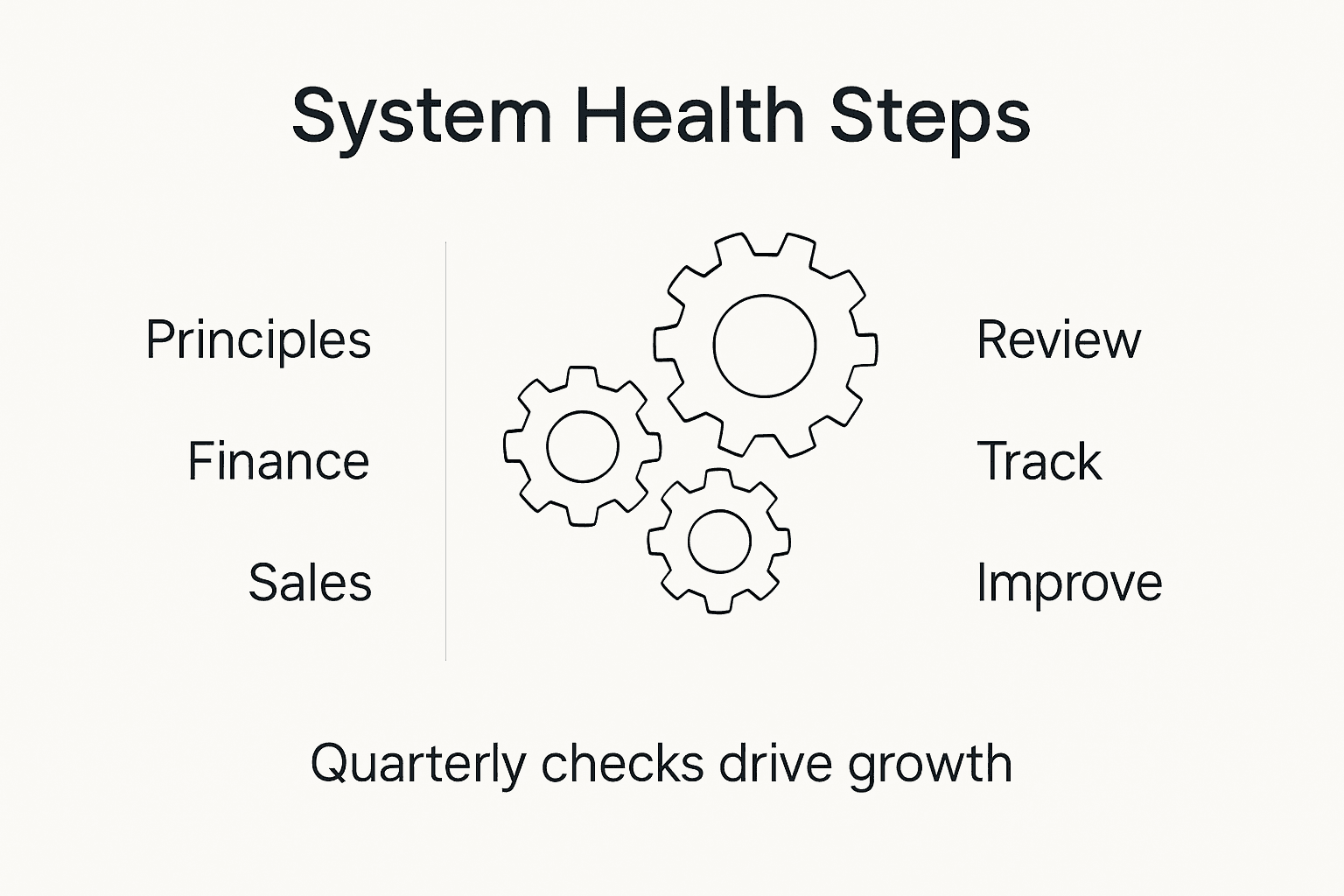
Implement feedback loops that enable rapid iteration and continuous improvement. This means creating channels for team members to report friction points, technological limitations, or process inefficiencies. Your verification process should be dynamic and responsive rather than a static annual ritual.
Pro tip: Create a cross functional assessment team that brings diverse perspectives to your system health verification process.
Here’s a concise comparison of the core focus for each foundational startup system described:
| Step | Main Focus Area | Key Objective |
|---|---|---|
| 1 | Operating principles | Guide behaviors and decisions |
| 2 | Financial clarity | Enable strategic growth |
| 3 | Sales automation | Streamline and scale revenue |
| 4 | Leadership resilience | Enhance adaptability |
| 5 | System health | Ensure sustainable scaling |
Build a Scalable Operating System That Works for You
Every founder knows that clear operating principles, financial clarity, and automated sales processes are essential for real growth. This article highlights the challenges of creating a solid startup operating system covering MATH (financial clarity), MECHANICS (sales infrastructure), and MIND (leadership resilience). If you feel overwhelmed by complex metrics or manual sales tasks, or struggle maintaining mental adaptability under pressure, you are not alone.
At Freedom Sun, we specialize in transforming these exact pain points into sustainable, automated systems modeled after Fortune 500 best practices. Our Operating System framework helps entrepreneurial leaders gain sovereignty over their financial measurements, sales workflows, and leadership mindset without sacrificing peace or well-being. Discover interactive training, diagnostic tools, and a supportive community designed to replace hustle with strategic management.
Ready to move from reactive chaos to proactive control? Explore how our platform can help you build a resilient, scalable business foundation today. Start your journey to profitable peace and leadership mastery at Freedom Sun.
Frequently Asked Questions
What are operating principles and why are they important for startups?
Operating principles are clear statements that guide decision-making and team behavior in a startup. They help create a consistent culture and direction, ensuring everyone understands the non-negotiable standards that drive success. To establish your operating principles, schedule a focused strategy session and document your core beliefs.
How can I create a financial clarity framework for my startup?
A financial clarity framework involves tracking essential financial metrics beyond basic accounting, such as customer acquisition cost and monthly recurring revenue. Start by systematically identifying key performance indicators relevant to your business model and set up spreadsheets or dashboards to automate these calculations for real-time insights.
What tasks can I automate in my sales process to scale my business effectively?
You can automate repetitive tasks such as lead scoring, email follow-ups, and meeting scheduling to streamline your sales process. Begin by mapping your sales workflow to identify time-consuming tasks, then implement automation tools that integrate smoothly with your existing systems to enhance efficiency and reduce manual effort.
How can I develop leadership resilience as a founder?
To build leadership resilience, incorporate daily mindfulness practices to strengthen your mental adaptability during challenging times. Consider dedicating 10 to 15 minutes each day to meditation or reflection, and track your mental and physical well-being to recognize areas for improvement.
What steps should I take to verify my startup’s system health and scalability?
To verify system health, establish a comprehensive dashboard that captures critical performance indicators across financial, operational, and human resource domains. Conduct quarterly reviews to identify potential bottlenecks or inefficiencies, and create feedback channels for team members to share insights, ensuring continuous improvement.
Recommended
- Welcome to Freedom Sun
- Financial Resilience: Why It Matters for Entrepreneurs
- Financial Wellness: Equipping Leaders for Sustainable Growth
- 7 Inspiring Examples of Growth Mindset for Entrepreneurs
- Business Setup in Dubai | New Company Formation in Dubai
- Zero Trust Architecture: Strengthen Cybersecurity Now - Heights Consulting Group