Money mindset guide for female founders: 23% gap

Only 23% of women entrepreneurs feel financially successful, compared to 32% of men. That gap is not about effort. You are already working hard. The real difference often comes down to money mindset and how you sell. A strong money mindset shapes every decision you make, from pricing to investment to how confidently you show up in a sales conversation. This guide breaks down the latest data on female founders, explains what money mindset actually means, and gives you a practical framework for sustainable selling. You will leave with clear actions you can use this week.
Table of Contents
- Understanding the unique financial landscape for female founders
- What is a money mindset and why does it matter?
- Reframing sales: A sustainable rhythm for wealth without burnout
- Applying money mindset shifts: From intention to daily practice
- What most guides miss: Profit clarity and the confidence cycle
- Take the next step in your wealth journey
- Frequently asked questions
Key Takeaways
| Point | Details |
|---|---|
| Mindset fuels success | Your beliefs about money drive business decisions and long-term wealth outcomes. |
| Sustainable sales rhythm | Service-focused sales strategies create revenue without burnout or overwhelm. |
| Profit clarity matters | Tracking and understanding your profit drivers unlocks confidence and better choices. |
| Daily action compounds | Consistent routines and small shifts gradually create significant financial growth. |
Understanding the unique financial landscape for female founders
To address this gap, it helps to examine the latest data on what is actually happening for women business owners. The picture is more nuanced than most headlines suggest.
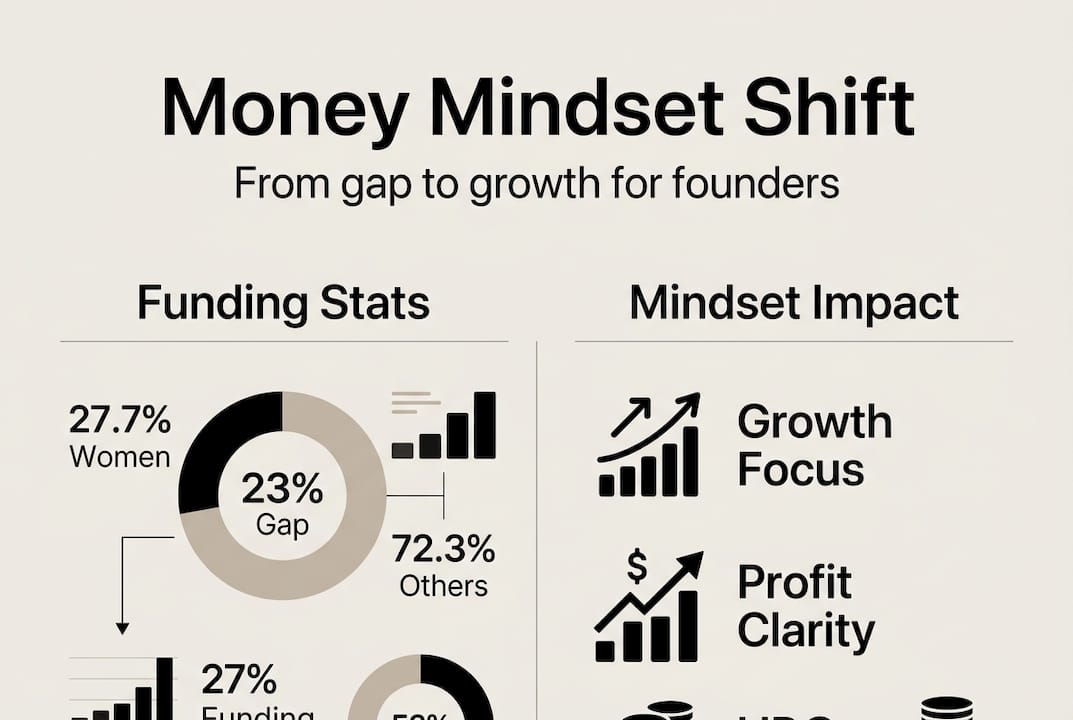
On one hand, the numbers are improving. Female-founded companies raised $73.6B in 2025, making up 27.7% of US venture capital. Women-led firms also showed a lower median burn rate than male-founded companies, which means they are running leaner and smarter. That is a real strength.
Women-owned businesses had a 36% funding approval rate in 2024, with revenue and average funding amounts rising significantly year over year. That is momentum worth acknowledging.
On the other hand, structural gaps persist. Female entrepreneurs are 31% less likely to get funding in the UK, and similar disparities show up across markets. Larger VC rounds still skew heavily male.
“The data shows female founders are more capital-efficient, yet they still face disproportionate barriers to accessing that capital. Efficiency alone does not close a structural gap.”
Here is a quick snapshot of where things stand:
| Metric | Women-founded | Industry average |
|---|---|---|
| Share of US VC (2025) | 27.7% | 72.3% (male/mixed) |
| Funding approval rate | 36% | Varies |
| Median burn rate | Lower | Higher |
| Funding likelihood (UK) | 31% less likely | Baseline |
What this means for you: your business is likely more efficient than you give yourself credit for. The challenge is not your capability. It is the combination of external barriers and the internal beliefs that form around them over time. That is where building an entrepreneurial wealth mindset becomes a genuine competitive advantage.
Key strengths female founders consistently demonstrate:
- Lower burn rates and stronger capital efficiency
- Higher ROI relative to funding received
- Faster early-stage revenue growth
- Stronger client retention and relationship-based sales
Developing a financial growth mindset means learning to see these strengths clearly, not just the gaps.
What is a money mindset and why does it matter?
Having explored the numbers and hurdles, it is time to define what really drives wealth: a founder’s money mindset.
Your money mindset is the set of beliefs you hold about what money is, what you deserve, and what is possible for you financially. It is not a buzzword. It is the lens through which every financial decision gets filtered, often without you realizing it.
There are three common mindset types:
| Mindset type | Core belief | Business impact |
|---|---|---|
| Scarcity | There is never enough | Undercharging, hoarding, avoiding investment |
| Abundance (ungrounded) | Money flows freely | Overspending, ignoring profit metrics |
| Practical wealth | Profit is built intentionally | Strategic risk, clear pricing, consistent growth |
The practical wealth mindset is the one that actually builds lasting wealth. It is not about thinking positive thoughts. A positive money mindset is a business owner’s greatest asset when it is balanced with financial consciousness, not used as a substitute for it.
Here is what this looks like in practice:
- A founder with a scarcity mindset prices her offer below market value because she fears clients will leave if she charges more.
- A founder with an ungrounded abundance mindset invests in every shiny tool but never reviews whether it generates a return.
- A founder with a practical wealth mindset sets prices based on value, tracks what is working, and invests in what moves the needle.
Pro Tip: Ask yourself this once a week: “Am I making this financial decision from fear or from strategy?” That single question can interrupt a scarcity pattern before it costs you money.
Your mindset also shapes how you handle risk. High earners tend to see calculated risk as a path to growth. Self-limiting beliefs, by contrast, make risk feel like a threat, which keeps founders playing small even when the numbers say otherwise. Learning how to change your money mindset is not a one-time event. It is a practice.

Reframing sales: A sustainable rhythm for wealth without burnout
If money mindset sets the foundation, sales is where wealth building happens, ideally without stress or exhaustion.
Most burnout in sales comes from inconsistency. You push hard for a week, land some clients, then stop selling because you are overwhelmed. Then the pipeline dries up and the panic cycle starts again. Sound familiar?
The fix is a structured weekly rhythm. Here is a simple three-part framework:
- Educate. Share content that demonstrates your expertise and helps your audience solve a real problem. This builds trust before you ask for anything.
- Invite. Make a clear, direct offer. Not a hint, not a soft suggestion. An actual invitation to work with you.
- Remind. Follow up. Most sales happen after the third or fourth touchpoint. One invite is rarely enough.
This Educate, Invite, Remind rhythm keeps momentum without requiring you to be in constant hustle mode. It is repeatable, low-drama, and effective.
Statistic to keep in mind: Most buyers need 5 to 7 touchpoints before they make a purchase decision. A weekly rhythm ensures you stay visible without feeling like you are chasing.
Pro Tip: Block one focused hour each day, sometimes called an “Hour of Power,” for sales activities only. No multitasking, no email, no admin. Just outreach, follow-up, and connection. That single hour, done consistently, compounds fast.
Offer stacking is another tool worth using. Instead of one offer at one price point, create multiple entry points for clients. A low-ticket resource, a mid-tier program, and a high-touch offer give potential clients a way to start working with you at whatever level feels right for them now. It also protects your revenue from depending on any single offer.
Pitfalls to avoid:
- Selling only when you need money (reactive, not strategic)
- Skipping follow-up because it feels pushy
- Ignoring client experience after the sale
For a deeper look at building sales without burnout, the approach works especially well for service-based founders who want to grow without grinding.
Applying money mindset shifts: From intention to daily practice
Knowing what to do is only half the equation. Consistency and small daily changes drive sustainable results.
Here are five daily actions that move the needle:
- Review one key metric each morning. Revenue, leads, conversion rate. Pick one and track it. What you measure, you manage.
- Use a daily affirmation tied to a specific goal. Not “I am rich” but “I charge prices that reflect my value and clients gladly pay them.”
- Make one investment in your growth each week. A course, a coach, a tool that saves you time. Wealthy founders invest in themselves consistently.
- Practice gratitude for current revenue. This is not toxic positivity. It is a neurological reset that reduces scarcity-based decision-making.
- Do your Hour of Power before checking messages. Protect your best energy for revenue-generating work.
Wealthy women focus on profit drivers and embrace risk as a natural part of building wealth. That means getting comfortable with discomfort, not eliminating it.
For your weekly planning, layer in the Educate, Invite, Remind rhythm:
- Monday: Create or share educational content
- Wednesday: Make a direct offer or send a proposal
- Friday: Follow up with warm leads
Community and mentorship accelerate all of this. When you are surrounded by women who are also building wealth intentionally, the habits normalize faster. Working with financial coaching for founders can also help you spot blind spots that are hard to see from inside your own business.
If you notice resistance, that is data, not failure. Resistance usually points to a belief worth examining. Pair that with the right tools for financial wellness and you have a system that supports both your growth and your wellbeing.
What most guides miss: Profit clarity and the confidence cycle
While daily habits ground the change, the secret ingredient is often overlooked: profit clarity.
Most advice stops at positive thinking. Affirmations are useful, but they do not replace knowing your numbers. Real leverage comes from tracking your profit drivers, understanding which offers and clients generate the most return, and using that data to make decisions with confidence.
Here is what we see consistently at Freedom Sun: when a founder gets clarity in profit focus, something shifts. She stops second-guessing her prices. She stops saying yes to low-value work out of fear. She starts making decisions from a position of strength.
That clarity creates a confidence cycle. Strong mindset leads to cleaner numbers. Cleaner numbers lead to better decisions. Better decisions lead to sustainable wealth. And that wealth reinforces the mindset. It is a loop, and profit clarity is what keeps it spinning.
Community amplifies this effect. When you are in a room, virtual or physical, with women who are doing the same work, the cycle accelerates. You normalize wealth. You stop treating financial ambition as something to apologize for.
Take the next step in your wealth journey
Ready to put these insights into action and deepen your money mindset and selling skills? Freedom Sun was built for exactly where you are right now: successful, generating revenue, and ready to stop leaving money on the table.
One area to strengthen your money mindset is how you sell and receive. If you want to practice that in a real, supported environment, check out the Practice Room at Freedom Sun. It is designed to help you get comfortable making offers and receiving payment without the anxiety that usually comes with it.
You can also join the FreedomSun community and explore money mindset guides built specifically for women entrepreneurs who are already in motion and want to go further, faster.
Frequently asked questions
What is a money mindset and how does it impact my business?
A money mindset is your core set of beliefs about money, shaped by experience and environment, and it directly influences how you price, invest, and grow. Founders with a positive money mindset tend to focus on profit drivers and take smarter risks, which compounds over time.
How can I avoid sales burnout as a female founder?
Follow a structured weekly rhythm of Educate, Invite, and Remind, and use an offer stack so your revenue is not dependent on a single offer. A focused sales rhythm with an Hour of Power each day keeps you consistent without draining you.
Are female founders closing the funding gap?
Yes, meaningfully. Women-owned businesses had a 36% funding approval rate in 2024 with rising average revenue, though a gap in larger VC rounds remains.
How can I start shifting my money mindset today?
Start with one small action: review your key revenue metric each morning, write one specific affirmation tied to your pricing, and find one community or mentor who normalizes financial ambition for women.