Financial Clarity for Founders: Pathway to Profitable Growth

Most American startup founders underestimate the chaos that financial fog can create until it stalls growth and drains confidence. Achieving financial transparency is critical for transforming rapid expansion into lasting wealth without draining your energy. Clarity turns overwhelming data into actionable insights, helping you seize new opportunities, limit costly surprises, and maintain control. Discover how a disciplined, transparent approach to your numbers can shape both healthy company operations and the future you envision.
Table of Contents
- Defining Financial Clarity For Founders
- Types And Levels Of Financial Clarity
- How Clarity Drives Informed Decisions
- Systemic Financial Health And Risk Management
- Avoiding Burnout Through Transparent Systems
Key Takeaways
| Point | Details |
|---|---|
| Financial Clarity is Essential | Founders must develop a deep understanding of financial mechanics to drive sustainable growth and informed decision-making. |
| Progressive Levels of Understanding | Financial clarity evolves from basic tracking to advanced modeling, enabling proactive strategic planning as businesses grow. |
| Informed Decision-Making | A comprehensive grasp of financial data allows founders to make confident decisions, reducing uncertainty and mitigating risks. |
| Transparent Systems Prevent Burnout | Implementing structured and automated financial systems simplifies management, alleviating stress and supporting entrepreneurial resilience. |
Defining Financial Clarity for Founders
Financial clarity is more than just understanding spreadsheets. It represents a strategic approach where founders develop comprehensive insights into their business’s financial mechanics, enabling sustainable growth and informed decision making. Financial discipline transforms entrepreneurial vision into measurable outcomes, turning potential into predictable performance.
For high-growth founders, financial clarity means developing a nuanced understanding of revenue generation, cost structures, and investment potential. This goes beyond basic accounting - it involves creating a narrative that demonstrates how your business model generates consistent value. Founders must transition from relying on innovation hype to presenting data-backed storytelling that attracts serious investment and validates sustainable business strategies.
Key elements of financial clarity include understanding precise revenue streams, tracking burn rates, managing cash flow, and developing robust financial projections. Successful founders treat their financial systems as dynamic intelligence platforms, not static record-keeping tools. They build frameworks that provide real-time insights, allowing quick strategic pivots and maintaining operational resilience.
Pro Tip: Create a monthly financial dashboard that tracks your top 5 critical business metrics, allowing you to make rapid, informed decisions without getting lost in overwhelming financial details.
Types and Levels of Financial Clarity
Founders experience financial clarity through progressive stages of understanding, each building upon the previous level of financial sophistication. Financial literacy evolves from basic bookkeeping to strategic forecasting, requiring founders to develop increasingly nuanced financial intelligence as their business grows.
The foundational level of financial clarity begins with basic financial tracking. Entrepreneurs must master essential skills like monitoring cash flow, understanding revenue streams, and maintaining accurate expense records. At this stage, founders learn to read financial statements, comprehend fundamental accounting principles, and develop basic financial discipline. Advanced levels introduce more complex financial modeling, where founders transition from reactive financial management to proactive strategic planning.

As businesses mature, financial clarity becomes more sophisticated. Startup finance leaders progress through incremental stages of financial understanding, moving from simple cash tracking to complex financial forecasting and strategic modeling. This progression involves developing deeper insights into total addressable market, profitability metrics, investment potential, and long-term financial sustainability. Successful founders recognize that financial clarity is not a destination but a continuous journey of financial intelligence and strategic adaptation.
Here’s a summary of the progressive levels of financial clarity for founders:
| Clarity Level | Core Focus Areas | Typical Tools Used | Key Outcomes |
|---|---|---|---|
| Basic | Cash flow tracking, expense records | Spreadsheets, basic accounting software | Foundational discipline, error reduction |
| Intermediate | Financial modeling, revenue analysis | Analytical dashboards, KPI trackers | Informed planning, early-stage forecasting |
| Advanced | Strategic forecasting, risk systems | Automated systems, predictive analytics | Confident decision making, investor readiness |
Pro Tip: Create quarterly financial self-assessments that evaluate your current financial clarity level, identifying specific skills and insights you need to develop for your next stage of business growth.
How Clarity Drives Informed Decisions
Financial clarity transforms decision-making from reactive guesswork to strategic precision. Financial empowerment enables leaders to unlock deeper insights into their business’s potential, allowing founders to move beyond intuition and base critical choices on robust financial intelligence.
Informed decisions emerge when founders develop a comprehensive understanding of their financial ecosystem. This means creating interconnected systems that track key performance indicators, anticipate potential challenges, and reveal hidden opportunities. Founders who cultivate financial clarity can quickly identify which revenue streams are most profitable, understand their true cost structures, and make strategic investments that align with long-term growth objectives.
The power of financial clarity lies in its ability to reduce uncertainty and mitigate risks. By developing granular insights into financial metrics, founders can create predictive models that forecast potential scenarios, stress-test business strategies, and make calculated decisions with confidence. This approach transforms financial management from a passive accounting function into an active strategic tool that drives sustainable business growth and competitive advantage.
Pro Tip: Develop a monthly financial dashboard that translates complex financial data into three to five actionable insights, allowing you to make rapid strategic decisions without getting overwhelmed by excessive information.
Systemic Financial Health and Risk Management
Comprehensive financial risk management requires founders to develop sophisticated strategies that transcend traditional accounting practices, creating resilient systems that proactively identify and mitigate potential financial vulnerabilities.
Systemic financial health demands a holistic approach to understanding organizational financial dynamics. Founders must construct robust frameworks that track multiple risk indicators, including cash flow volatility, expense allocation efficiency, revenue stream diversification, and potential market disruptions. This comprehensive perspective allows entrepreneurs to build adaptive financial infrastructures that can withstand unexpected challenges and capitalize on emerging opportunities.
Successful risk management goes beyond reactive problem-solving. Strategic financial partnerships and transparent systems help founders preemptively address potential risk points, transforming financial uncertainty into a structured, predictable operational model. By implementing advanced monitoring mechanisms, developing contingency plans, and maintaining financial flexibility, founders can create enterprises that are not just resilient, but strategically positioned for sustainable growth.
Pro Tip: Conduct quarterly financial stress tests that simulate potential economic scenarios, helping you identify and fortify potential systemic vulnerabilities before they become critical challenges.
Avoiding Burnout Through Transparent Systems
Founders frequently experience overwhelming stress when financial uncertainty dominates their decision-making landscape. Transparent financial systems dramatically reduce mental and emotional strain by replacing guesswork with reliable, real-time data, enabling entrepreneurs to make confident strategic choices without constant anxiety.
Building transparent systems requires creating structured financial frameworks that provide immediate visibility into business performance. These systems transform financial management from a source of continuous pressure into a predictable, manageable process. By implementing automated tracking mechanisms, standardized reporting protocols, and clear financial dashboards, founders can eliminate the mental overhead associated with constant financial uncertainty and reduce the cognitive load that leads to burnout.
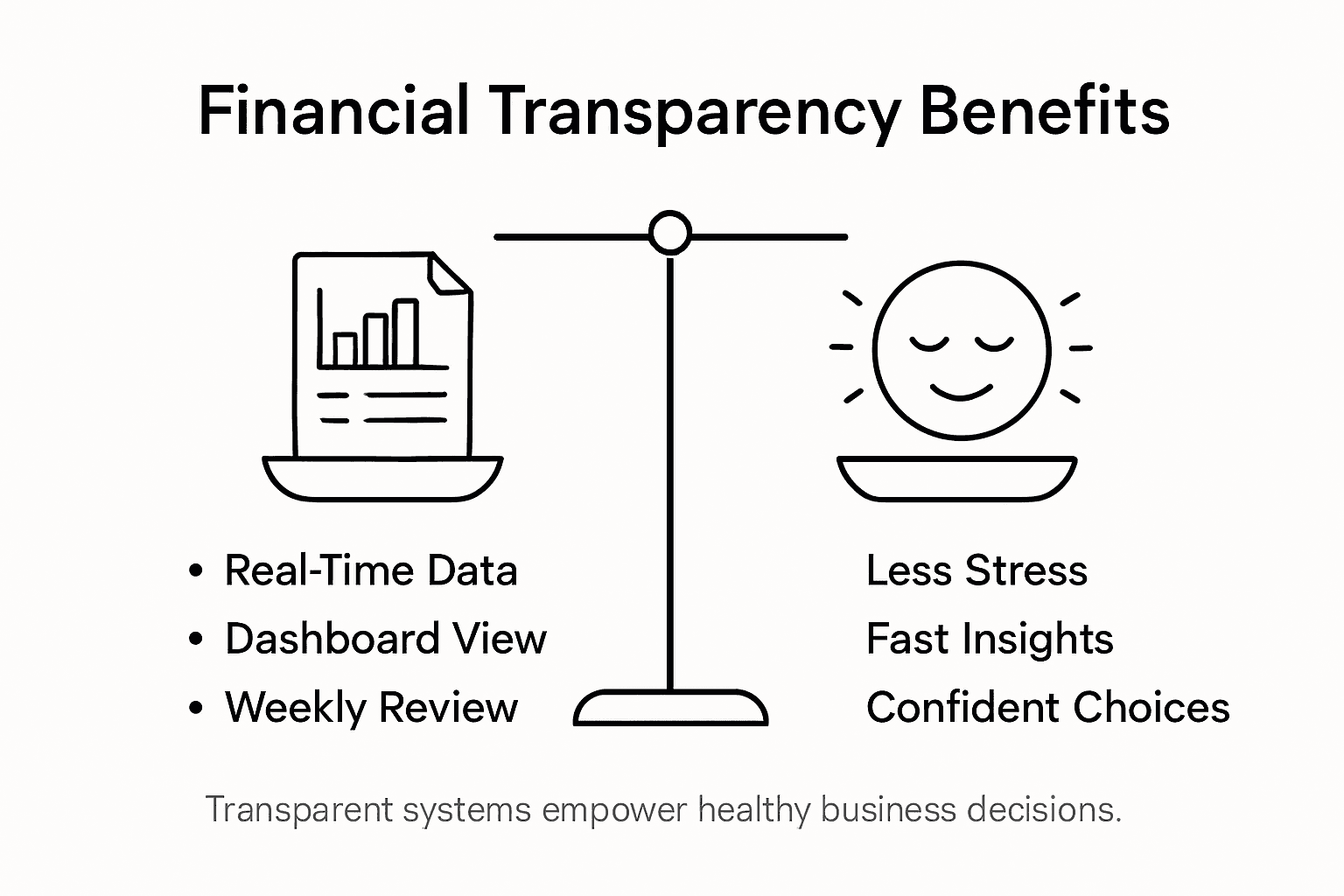
Transparency extends beyond mere number tracking - it represents a holistic approach to understanding business health. Effective systems integrate financial metrics with operational insights, allowing founders to see interconnected performance indicators that reveal both challenges and opportunities. This comprehensive perspective enables proactive problem solving, reduces reactive stress responses, and creates a sense of control that is critical for maintaining entrepreneurial resilience and long-term mental well-being.
The table below outlines how transparent financial systems help founders avoid burnout:
| System Feature | Stress Reduction Benefit | Impact on Business |
|---|---|---|
| Real-time dashboards | Immediate visibility reduces uncertainty | Faster reaction to changes |
| Automated reporting | Eliminates manual data entry burden | More time for strategic focus |
| Integrated metrics | Connects financial and operational insights | Smarter, holistic decisions |
Pro Tip: Implement a weekly 30-minute financial review that transforms complex data into three actionable insights, helping you stay informed without becoming overwhelmed by granular details.
Achieve Financial Clarity and Build Resilient Growth Systems Today
Founders face the challenge of transforming fragmented financial data into clear, actionable insights that drive confident, strategic decisions. The article highlights the struggle to balance understanding metrics like revenue streams, burn rates, and cash flow with the urgent need to avoid burnout caused by financial uncertainty and complexity. If you are seeking to move beyond reactive guesswork toward a systematized approach that integrates financial clarity with operational and leadership strength, this is your turning point.
Freedom Sun offers the professional development platform designed to solve exactly these pain points. Our unique Operating System (OS) framework combines MATH (financial clarity) with MECHANICS (systems infrastructure) and MIND (leadership resilience). This tailored approach empowers high-growth entrepreneurs to create automated, dynamic systems modeled after Fortune 500 CFOs without sacrificing personal well-being. By joining Freedom Sun, you gain access to interactive training, diagnostic assessments, and a community focused on sustainable wealth and peace.
Ready to transform how your business handles financial clarity and strategic growth? Discover how to build your robust financial systems and sharpen your leadership through proven methodologies. Take the next step at Freedom Sun and start designing your scalable path to profitable peace today. Explore more about mastering your financial clarity journey in our Operating System framework and leverage our expert training designed for founders ready to thrive.
Frequently Asked Questions
How can founders achieve financial clarity?
Financial clarity can be achieved by systematically tracking financial metrics, understanding revenue streams, managing cash flow, and developing financial projections. Founders should treat their financial systems as dynamic intelligence platforms that provide real-time insights for informed decision-making.
What are the key elements of financial clarity for startups?
Key elements include understanding precise revenue streams, tracking burn rates, managing cash flow, and developing robust financial forecasting models. These elements help founders pivot strategically and maintain financial health during growth phases.
How does financial clarity drive informed decision-making?
Financial clarity transforms decision-making by providing comprehensive insights into a business’s financial ecosystem. Founders can make strategic choices based on data rather than intuition, thereby reducing uncertainty and mitigating risks associated with financial management.
Why is burnout a concern for founders, and how can transparent financial systems help?
Burnout is a concern for founders due to the overwhelming stress caused by financial uncertainty. Transparent financial systems can alleviate this stress by providing reliable, real-time data, allowing founders to make confident decisions and manage their workload more effectively.