Changing Your Money Mindset: Unlocking Profitable Peace

Facing uncertainty around money is a common challenge for coaches and consultants starting their journey. Understanding that a money mindset goes beyond simple numbers, research confirms money attitudes are shaped by emotional and cultural experiences rather than just logic. Shifting these beliefs can unlock financial clarity and business stability for you and your clients. Explore the key concepts and actionable strategies that drive lasting transformation in both mindset and practice.
Table of Contents
- Defining Money Mindset and Common Misconceptions
- Recognizing Limiting Beliefs and Scarcity Patterns
- Abundance vs Scarcity Mindsets in Business
- Practical Strategies for Shifting Money Attitudes
- Long-Term Benefits for Coaches and Consultants
Key Takeaways
| Point | Details |
|---|---|
| Understanding Money Mindset | Money mindset shapes financial perceptions and behaviors, influenced by beliefs, emotions, and cultural contexts. |
| Scarcity vs. Abundance Mindsets | A scarcity mindset leads to fear and limited thinking, while an abundance mindset fosters growth and opportunity. |
| Transformative Strategies | Shifting money attitudes requires challenging limiting beliefs and practicing gratitude, ensuring a healthier financial perspective. |
| Coaching Implications | Coaches benefit from a strong money mindset by enhancing client relationships and improving decision-making for sustainable growth. |
Defining Money Mindset and Common Misconceptions
A money mindset represents the complex psychological framework of beliefs, emotions, and attitudes that shape our financial perceptions and behaviors. Psychological research on money attitudes reveals that money is far more than a neutral transactional tool - it’s deeply intertwined with personal experiences, cultural backgrounds, and emotional landscapes.
At its core, money mindset encompasses several critical elements:
- Personal beliefs about wealth and financial potential
- Emotional associations with earning and spending
- Inherited financial narratives from family and cultural contexts
- Subconscious patterns of financial decision-making
- Psychological barriers to financial growth
Common misconceptions about money mindset often stem from oversimplified perspectives. Many people incorrectly assume money is purely rational, ignoring its profound psychological dimensions. Money psychology research demonstrates that our financial behaviors are driven by complex emotional scripts developed through childhood experiences, societal conditioning, and personal interpretations.
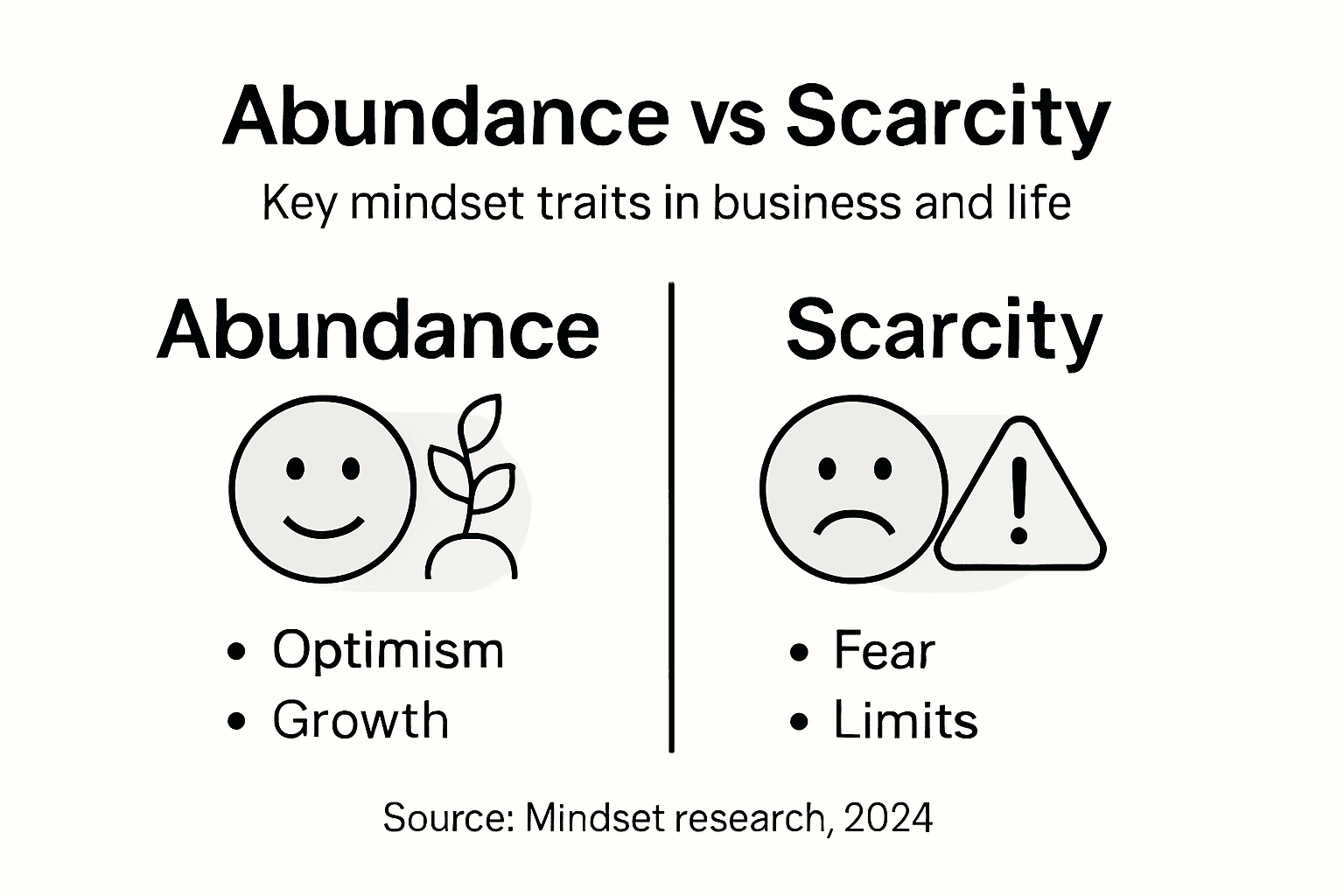
Two primary money mindset archetypes emerge in psychological studies: the scarcity mindset and the abundance mindset. The scarcity mindset operates from a place of fear, perceiving limited resources and potential financial threats. In contrast, the abundance mindset embraces opportunity, believes in continuous growth, and views financial challenges as chances for learning and expansion.
Your money mindset isn’t just about numbers - it’s about the stories you tell yourself about wealth, potential, and personal worth.
Pro tip: Regularly audit your internal financial narratives and challenge unconscious beliefs that might be limiting your economic potential.
Recognizing Limiting Beliefs and Scarcity Patterns
A scarcity mindset represents a profound psychological state where individuals perceive perpetual resource limitations, fundamentally impacting their financial and personal decision-making processes. Cognitive research on scarcity patterns demonstrates that this mindset creates significant neural and behavioral constraints that extend far beyond simple financial thinking.
Key characteristics of a scarcity mindset include:
- Constant worry about insufficient resources
- Hyper-focus on immediate survival needs
- Difficulty visualizing long-term financial possibilities
- Tendency to make reactive instead of proactive financial choices
- Persistent feelings of financial anxiety and stress
Psychological studies reveal that scarcity thinking triggers a complex chain of cognitive responses. Neural evidence on resource perception shows that individuals trapped in a scarcity mindset experience reduced empathy, heightened stress responses, and a narrowed perspective that prevents strategic financial planning.
Recognizing these limiting beliefs requires deep self-reflection and understanding. Coaches and consultants must help clients identify specific thought patterns that perpetuate financial scarcity, such as persistent narratives like “I’ll never have enough” or “Money is always a struggle.” These internalized beliefs create self-fulfilling prophecies that restrict financial growth and personal potential.
Scarcity is a mental prison constructed from fear, not an actual limitation of your potential.
Pro tip: Practice daily affirmations that challenge your existing financial narratives and consciously reframe thoughts from limitation to possibility.
Abundance vs Scarcity Mindsets in Business
In the complex world of entrepreneurship, business mindsets fundamentally determine success trajectories. Research on business decision perspectives reveals critical distinctions between abundance and scarcity thinking that profoundly impact organizational strategies and individual performance.
Key differences between abundance and scarcity mindsets include:
- Approach to opportunities
- Risk tolerance levels
- Collaborative vs competitive behaviors
- Strategic planning horizons
- Resource allocation philosophies
- Emotional responses to challenges
An abundance mindset operates from a perspective of possibility and potential, where resources are seen as expandable and opportunities are viewed as limitless. Entrepreneurs with this mindset approach challenges as learning experiences, invest in long-term growth, and believe in collaborative success. Conversely, those with a scarcity mindset perceive resources as finite, leading to defensive, short-term decision-making and heightened competitive behaviors.

Businesses driven by abundance thinking demonstrate remarkable resilience. They view setbacks as temporary, invest in team development, and create innovative solutions that transcend immediate constraints. These organizations cultivate environments of trust, continuous learning, and strategic risk-taking, ultimately generating more sustainable and scalable business models.
Here’s a quick comparison of scarcity and abundance mindsets in business settings:
| Perspective | Approach to Resources | Response to Challenges | Impact on Collaboration |
|---|---|---|---|
| Scarcity Mindset | Views resources as limited | Tends to react defensively | Prefers competition |
| Abundance Mindset | Believes resources are expandable | Sees setbacks as learning opportunities | Embraces collaboration |
Abundance is not about having everything, but believing you can create anything.
Pro tip: Conduct a monthly personal audit of your business decisions, consciously identifying and reframing thoughts from scarcity to abundance perspectives.
Practical Strategies for Shifting Money Attitudes
Transforming your financial perspective requires intentional, strategic approaches that challenge deep-rooted beliefs about money. Research on individual money attitudes reveals systematic methods for rewiring our fundamental financial narratives.
Key strategies for shifting money mindsets include:
- Identifying and challenging limiting financial beliefs
- Developing comprehensive financial literacy
- Aligning financial goals with personal values
- Practicing intentional gratitude around money
- Using cognitive-behavioral reframing techniques
- Creating visualization practices for abundance
Cognitive-behavioral techniques offer powerful mechanisms for transforming money attitudes. By systematically recognizing negative self-talk and replacing scarcity narratives with abundance thinking, entrepreneurs can fundamentally restructure their financial perspectives. This process involves active journaling, conscious reframing of past financial experiences, and developing a growth-oriented relationship with money.
Successful mindset transformation requires consistent practice and external accountability. Practical mindset change techniques demonstrate that seeking support through financial coaching, participating in entrepreneurial communities, and continuously educating oneself about financial principles can accelerate personal growth and economic potential.
Money is a tool, not a destination - your mindset determines its power and potential.
Pro tip: Create a weekly reflection journal specifically designed to track and transform your money thoughts, challenging each limiting belief with three potential abundance perspectives.
Long-Term Benefits for Coaches and Consultants
For coaches and consultants, mastering a transformative money mindset represents far more than personal financial growth - it’s a fundamental professional development strategy. Leadership mindset strategies demonstrate that financial perspective directly influences business sustainability, client relationships, and overall entrepreneurial success.
Long-term benefits of shifting money attitudes include:
- Enhanced client trust and credibility
- Improved pricing and value perception
- More strategic business decision-making
- Reduced financial stress and burnout
- Increased personal and professional resilience
- Greater capacity for wealth generation
Coaches who develop a sophisticated money mindset become powerful transformation agents for their clients. By modeling healthy financial attitudes, they create a ripple effect of abundance thinking that extends beyond individual interactions. This approach transforms consulting from a transactional service to a holistic life and business enhancement experience.
Professional growth in coaching requires continuous personal development. Entrepreneurs who invest in understanding their financial narratives create more authentic, impactful coaching practices. They learn to guide clients through complex emotional and financial landscapes, turning potential limitations into opportunities for exponential growth and success.
Below is a summary of long-term benefits coaches and consultants gain by cultivating a growth-oriented money mindset:
| Benefit Area | Value Delivered | Effect on Practice |
|---|---|---|
| Client Trust & Credibility | Builds lasting relationships | Attracts high-value clients |
| Pricing & Value Perception | Sets accurate fees confidently | Enhances perceived impact |
| Decision-Making | Improves strategic choices | Reduces stress and burnout |
| Professional Resilience | Increases adaptability during challenges | Enables sustainable business growth |
Your financial perspective is the lens through which clients will perceive your professional value.
Pro tip: Conduct a quarterly financial mindset audit, explicitly mapping how your money beliefs impact your coaching practice and client outcomes.
Shift Your Money Mindset and Unlock Profitable Peace Today
If you find yourself trapped in limiting financial beliefs or battling a scarcity mindset as described in “Changing Your Money Mindset: Unlocking Profitable Peace” you are not alone. Many coaches and consultants struggle with internal narratives that block their growth and financial potential. Freedom Sun understands these challenges and offers a strategic pathway to reframe your money mindset by integrating system health, mental resilience, and intentional leadership into your business foundation.
Our platform provides targeted training in sales, communication, financial management, and leadership specifically designed for coaches, consultants, and service-based entrepreneurs. Through interactive learning, diagnostic assessments, and a supportive community, we help you replace scarcity thinking with an abundance mindset and embrace profitable peace in your business. Start transforming your financial perspective and business strategy by exploring our full range of resources at Freedom Sun. Take the next step now toward sustainable success by visiting Freedom Sun’s training programs and join a community committed to shifting from hustle to strategic, automated management.
Frequently Asked Questions
What is a money mindset?
A money mindset refers to the beliefs, emotions, and attitudes that shape how we perceive and interact with money, influencing our financial behaviors and decision-making processes.
How does a scarcity mindset affect financial decision-making?
A scarcity mindset can lead to constant worry about resources, reactive decision-making, and difficulty in visualizing long-term financial possibilities, ultimately restricting financial growth and potential.
What are some strategies to shift from a scarcity mindset to an abundance mindset?
Strategies include identifying and challenging limiting beliefs, developing financial literacy, practicing gratitude around money, and using cognitive-behavioral techniques to reframe negative thoughts into positive ones.
Why is improving your money mindset important for coaches and consultants?
Improving your money mindset is crucial for coaches and consultants as it fosters client trust, enhances pricing and value perception, improves decision-making, and increases overall resilience in business.