Master a Financial Mindset for Sustainable Business Growth

Many service-based entrepreneurs find themselves burned out trying to keep up with nonstop hustle, yet lasting growth remains out of reach. Shifting to a strategic, automated financial mindset is the turning point for building sustainable wealth and wellbeing. By clarifying your income vision, identifying hidden money beliefs, and embracing automation, you can finally take control of your business finances and create true freedom. Discover practical steps to move beyond busyness and foster steady, impactful growth.
Table of Contents
- Step 1: Clarify Your Income Vision And Goals
- Step 2: Identify Limiting Beliefs About Money
- Step 3: Design Automated, Supportive Financial Systems
- Step 4: Embed Daily Financial Review Rituals
- Step 5: Measure Progress And Adjust Your Strategies
Quick Summary
| Key Insight | Explanation |
|---|---|
| 1. Define Specific Income Goals | Quantify your financial aspirations using the SMART framework to create clear, actionable revenue targets. |
| 2. Identify Money Mindset Barriers | Conduct a self-audit to recognize and challenge unconscious beliefs about money that hinder growth. |
| 3. Automate Financial Processes | Build integrated financial systems to streamline operations, reduce errors, and enhance decision-making. |
| 4. Establish Daily Financial Rituals | Implement short daily sessions to review financial data, fostering consistent awareness and accountability. |
| 5. Measure and Adjust Performance | Regularly track key metrics to understand trends and make informed adjustments for sustainable growth. |
Step 1: Clarify your income vision and goals
Clarifying your income vision transforms abstract financial desires into actionable strategies. This step helps you design a precise roadmap for sustainable business growth by understanding exactly what financial success means for your unique entrepreneurial journey.
To craft a meaningful income vision, start by getting brutally honest about your financial aspirations. Quantify your income goals with specific numbers, not vague hopes. Ask yourself critical questions: What monthly revenue would create genuine financial freedom? What annual income would allow you to scale your business without sacrificing personal wellbeing?
Utilize the SMART goal framework to structure your financial objectives. Break down your vision into clear, measurable targets:
- Baseline Income Goal: Determine your minimum viable monthly revenue
- Stretch Goal: Define an ambitious yet realistic annual income target
- Growth Trajectory: Map out incremental milestones toward your ultimate vision
Most service-based entrepreneurs sabotage themselves by keeping income goals fuzzy and undefined. Precision creates momentum. By crystallizing your financial vision, you transform abstract dreams into strategic targets.
Your income vision is not just a number—it’s a reflection of the impact and value you bring to your clients.
Pro tip: Review and recalibrate your income goals quarterly, treating them as dynamic targets that evolve with your business growth and market conditions.
Step 2: Identify limiting beliefs about money
Unlocking your financial potential begins with recognizing the invisible mental barriers that silently sabotage your business growth. Psychological money scripts can unconsciously dictate your financial behaviors, creating invisible roadblocks to success.
To effectively identify these limiting beliefs, start by conducting an honest self-audit of your financial mindset. Reflect on your money narratives by asking probing questions about your deep-seated financial assumptions:
- What did you learn about money from your family growing up?
- Do you believe wealth is scarce or abundant?
- When you think about earning more, what fears or doubts surface?
- How do you react to discussions about pricing and value?
Most entrepreneurs carry unconscious beliefs that create financial self-sabotage. These deeply ingrained money narratives often originate from childhood experiences, cultural conditioning, or past financial struggles. By bringing these beliefs into conscious awareness, you can begin to challenge and reframe them.
Your financial beliefs are not facts—they are stories you’ve chosen to believe, and stories can be rewritten.
Tracking your emotional and physiological responses when discussing money can reveal underlying limiting beliefs. Notice physical sensations like tension, anxiety, or resistance that emerge during financial conversations. These are clues to deeply rooted money scripts that need examination.

Pro tip: Keep a money mindset journal to document your automatic thoughts and reactions around finances, creating a map of your unconscious financial programming.
Step 3: Design automated, supportive financial systems
Transforming your business finances requires building intelligent financial infrastructure that works seamlessly in the background. Financial Management Information Systems represent the backbone of sustainable financial operations, enabling entrepreneurs to optimize workflow and decision-making.
To design supportive financial systems, focus on creating integrated processes that reduce manual labor and increase accuracy. Implement strategic automation across key financial domains:
- Invoicing and payment tracking
- Expense management
- Revenue forecasting
- Tax preparation and reporting
- Cash flow monitoring
Most service-based entrepreneurs struggle because they treat financial systems as an afterthought. Successful businesses understand that automated systems are strategic assets that provide real-time insights, reduce errors, and free up mental bandwidth for growth-focused activities.
Effective financial systems are not about complexity—they’re about creating intelligent, responsive frameworks that adapt to your business needs.
Choose technology platforms that communicate with each other, creating a holistic ecosystem where data flows smoothly between accounting, banking, invoicing, and reporting tools. This interconnectedness eliminates manual data entry and provides a comprehensive view of your financial landscape.
Pro tip: Schedule a quarterly technology audit to ensure your financial systems remain integrated, secure, and aligned with your evolving business strategies.
Compare these financial management tools for small businesses:
| Tool Type | Main Function | Typical Platforms | Business Impact |
|---|---|---|---|
| Invoicing Automation | Streamlines billing and payments | FreshBooks, QuickBooks | Reduces payment delays |
| Expense Tracking | Monitors outgoing costs easily | Expensify, Wave | Controls unnecessary spending |
| Forecasting | Predicts future revenue and cash flow | Float, Futrli | Informs better planning |
| Dashboard Visualization | Presents data for quick analysis | Tableau, Zoho Analytics | Spot trends and problem areas fast |
Step 4: Embed daily financial review rituals
Transforming your financial mindset requires consistent, intentional engagement with your money. Daily financial rituals create structure and accountability, turning financial management from a dreaded task into a powerful habit of business success.
Design a morning financial check-in routine that takes no more than 15-20 minutes and covers critical financial insights:
- Review previous day’s income and expenses
- Check bank and payment platform balances
- Update cash flow tracking spreadsheet
- Reconcile outstanding invoices
- Assess progress toward monthly revenue goals
Most entrepreneurs sabotage their financial growth by treating money management as an occasional event. Consistent daily practices transform your relationship with finances, turning potential stress into strategic awareness.
Financial rituals are not about perfection—they’re about creating consistent, intentional awareness of your business’s financial pulse.
Choose a consistent time for your daily review, such as first thing in the morning or right after your primary work block. Integrate this ritual into your existing routine to make it feel natural and sustainable.
Pro tip: Use a dedicated notebook or digital dashboard specifically for your daily financial review to create a sense of ritual and intentionality.
Step 5: Measure progress and adjust your strategies
Successful entrepreneurs transform their financial trajectory by consistently tracking meaningful performance metrics. Progress monitoring techniques provide a clear roadmap for strategic adjustments, turning data into actionable insights.
Create a comprehensive tracking system that goes beyond basic financial metrics:
- Revenue Trajectory: Monthly and quarterly income comparisons
- Profit Margin Analysis: Tracking net income against total revenue
- Client Acquisition Cost: Measuring marketing efficiency
- Service Profitability: Evaluating individual service line performance
- Growth Rate Indicators: Comparing current performance against historical benchmarks
Most service-based entrepreneurs struggle because they measure progress inconsistently or track irrelevant metrics. Strategic measurement requires focusing on indicators that truly reflect business health and potential growth.
Progress is not about perfection—it’s about understanding your trends and making intelligent, incremental adjustments.
Schedule quarterly deep-dive review sessions where you analyze your tracking data, identify patterns, and recalibrate your strategies. This proactive approach transforms data from a passive record into an active growth tool.
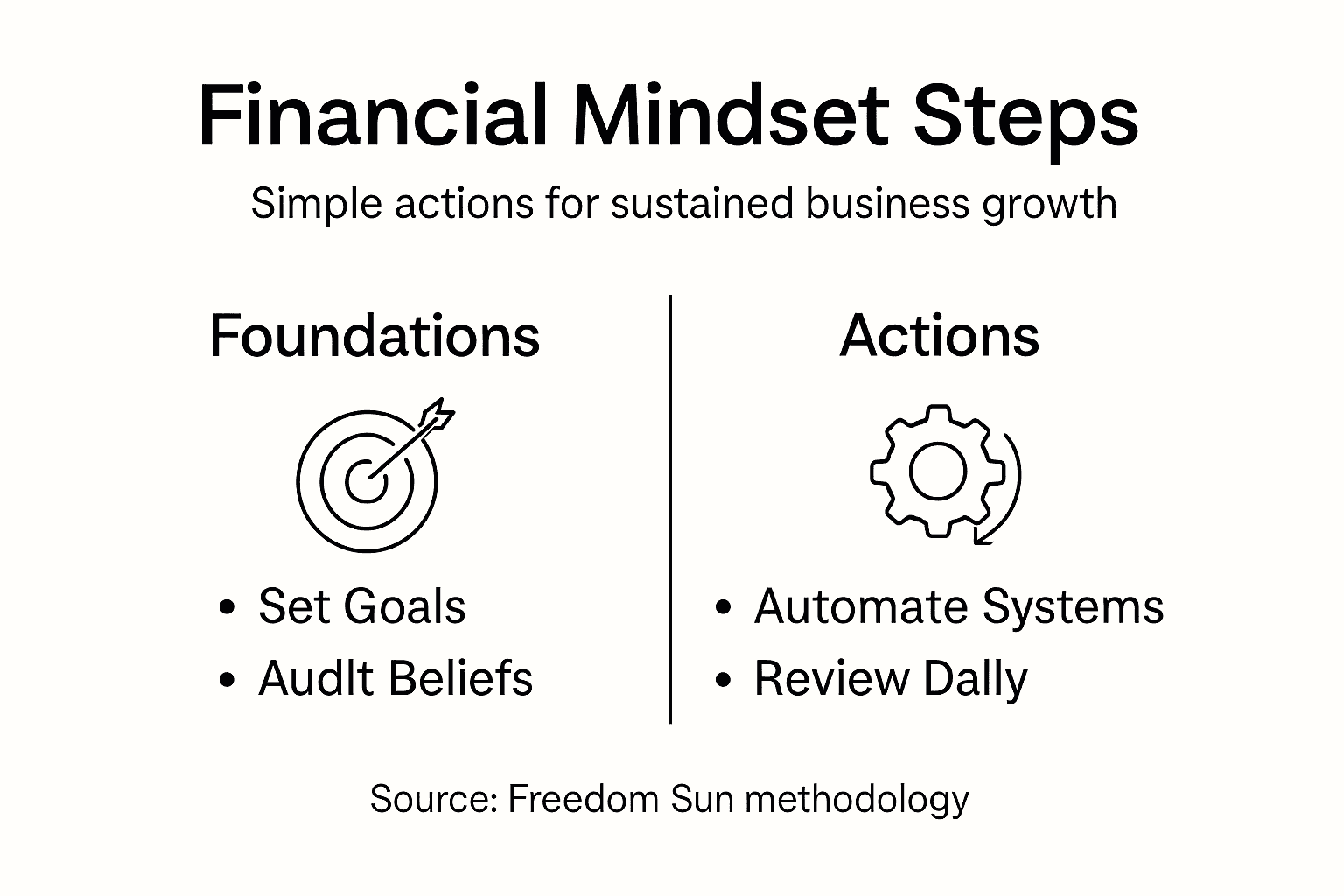
Pro tip: Develop a visual dashboard that simplifies complex financial data, making trends immediately understandable at a glance.
Here’s a summary of how each step supports sustainable business growth:
| Step | Core Focus | Key Benefit | Example of Implementation |
|---|---|---|---|
| Clarify Income Vision | Define specific financial targets | Provides direction for strategic decisions | Setting monthly and annual revenue goals |
| Identify Limiting Beliefs | Examine money mindset and narratives | Removes psychological barriers to growth | Journaling money thoughts and reactions |
| Automate Financial Systems | Implement smart financial processes | Saves time and reduces errors | Using automated invoicing tools |
| Daily Financial Rituals | Build consistent money habits | Increases financial awareness and accountability | Morning cash flow check-ins |
| Measure and Adjust | Track performance metrics and recalibrate | Enables data-driven improvements | Quarterly dashboard review sessions |
Build a Financial Mindset That Fuels Sustainable Growth
The challenge of mastering a financial mindset for sustainable business growth often lies in overcoming limiting beliefs and building smart, automated systems that work for you. This article highlights key struggles such as unclear income goals, unconscious money narratives, and inconsistent financial habits. If you relate to the frustration of feeling stuck in hustle culture while yearning for strategic, scalable success, you are not alone.
At Freedom Sun, we empower coaches, consultants, and service-based entrepreneurs to break free from these barriers by focusing on systemic architecture and mental resilience. Through our interactive training, diagnostic assessments, and supportive community, you will learn to clarify your income vision, automate financial workflows, and embed daily rituals that build profitable peace. Ready to shift from overwhelm to control and create long-term growth? Discover how our approach transforms your relationship with money and business at Freedom Sun. Start your journey today with strategic financial management and become the leader of your business systems by visiting our interactive training platform. Take control now and build the business growth mindset you deserve.
Frequently Asked Questions
How can I clarify my income vision for sustainable business growth?
To clarify your income vision, start by defining specific financial targets using the SMART goal framework. Set measurable milestones like your baseline income goal and stretch goal to transform vague aspirations into actionable strategies.
What steps can I take to identify limiting beliefs about money?
Begin by conducting a self-audit of your financial mindset. Reflect on your upbringing and personal experiences with money to uncover deep-seated beliefs and narratives that may be holding you back from achieving your financial goals.
How do I design automated financial systems for my business?
To design automated financial systems, focus on implementing intelligent processes that streamline tasks like invoicing, expense management, and cash flow monitoring. Prioritize integrating your financial tools to reduce manual labor and improve accuracy within 30 days.
What are some daily financial review rituals I can adopt?
Adopt a morning financial check-in routine where you spend 15-20 minutes reviewing income, expenses, and cash flow. This consistent practice will enhance your financial awareness and transform money management from a chore into a valuable habit.
How can I measure my progress and adjust strategies for financial growth?
Measure your progress by tracking key performance metrics, such as monthly revenue and client acquisition costs. Schedule quarterly reviews to analyze your data and make necessary adjustments to ensure you’re moving toward your financial goals effectively.
Recommended
- Transform Your Relationship With Money for Business Success
- Business Coach Leadership Training: Transforming Founder Success
- Sustainable Business Scaling Guide for Lasting Success
- Financial Wellness: Equipping Leaders for Sustainable Growth
- Employee Retention Solutions | Reduce Turnover | OpenElevator