Why You Undercharge and How to Set Powerful Prices

TL;DR:
- Women entrepreneurs often undercharge due to psychological factors like imposter syndrome, fear of losing clients, and deep-seated money beliefs. Underpricing leads to stagnant income, overwork, burnout, and reliance on transactional client relationships. Raising prices requires internal mindset work, honest business audits, and strategic communication to reflect true value and build sustainable wealth.
You have great reviews, a steady stream of clients, and a business that looks successful from the outside. Yet somehow, your bank account tells a different story. If you’ve ever wrapped up a project and felt that quiet, nagging sense that you left money on the table, you’re not alone. Undercharging is one of the most common and costly habits among women entrepreneurs who are already generating revenue. It doesn’t announce itself loudly. It quietly caps your income, accelerates burnout, and keeps you working harder than your prices justify. This guide unpacks the real reasons you undercharge and gives you a clear path to change it for good.
Table of Contents
- The hidden psychology behind undercharging
- Real-world indicators you’re undercharging
- Breaking the cycle: Why raising your prices matters
- How to start charging what you’re worth: Practical steps
- The uncomfortable truth about pricing as a woman entrepreneur
- Ready to charge what you’re truly worth?
- Frequently asked questions
Key Takeaways
| Point | Details |
|---|---|
| Mindset shapes pricing | Your beliefs about worth and money are the strongest factors in setting your prices. |
| Spot undercharging signs | Consistently full schedules, little pushback on rates, or burnout signal you are undervaluing your work. |
| Raising rates fuels growth | Strategic increases lead to better clients, improved revenue, and less burnout. |
| Take practical action | Intentional, step-by-step repricing helps you transition clients without harming relationships. |
| Challenge conventional wisdom | Women entrepreneurs benefit most by ditching old pricing rules and setting unapologetically high value. |
The hidden psychology behind undercharging
Undercharging is rarely about ignorance. You know how to price a service. You’ve read the articles, run the numbers, and still found yourself softening a quote at the last second. That’s not a strategy problem. That’s psychology.
Women entrepreneurs frequently attribute their undercharging to deep-seated beliefs about worth and money, and the research confirms it runs deep. Three patterns show up most consistently:
- Imposter syndrome: Even with years of results, many women entrepreneurs feel they haven’t “earned” the right to charge premium rates. The internal voice says, who am I to charge that much?
- Fear of client loss: Pricing feels like a negotiation where the client holds all the power. Dropping rates feels safer than risking a “no.”
- Outdated money beliefs: Messages absorbed in childhood, from families, culture, or even school, about money being hard to come by or women not being “good with money” don’t disappear just because you launched a business.
Societal conditioning adds another layer. Women are historically rewarded for being accommodating and penalized for appearing demanding. Charging boldly can feel like it conflicts with how you’ve been trained to show up. That tension is real, and it affects pricing decisions in ways that are hard to see without stepping back.
Here’s what makes this especially tricky: client praise can actually reinforce undercharging. When someone says “you’re so affordable” or “I tell everyone what a great deal you are,” it feels like a compliment. But take a closer look. Those words often signal that your prices are below market value, not that your work is exceptional.
“The moment you start pricing from your value instead of your fear, your entire client relationship shifts. You stop attracting people who want a deal and start attracting people who want results.”
Shifting this starts with awareness. You cannot rewire what you haven’t named. Notice the physical reaction you have when you quote a price. Hesitation, apologizing after stating a number, or instantly offering a discount are all signs the psychology is running the show. Confident client communication is one of the first skills to build once you’ve identified the pattern.
Pro Tip: Before your next sales conversation, write down your price and say it out loud three times at full volume. The discomfort you feel is the gap between your current nervous system setting and the price you actually deserve.
Exploring strategic pricing methods can also help you build an external framework to match the internal work.
Real-world indicators you’re undercharging
Once you understand the psychological drivers, you can start noticing real symptoms in your business. Some are obvious. Others are subtle enough that most entrepreneurs miss them entirely.
Here’s a comparison of what a healthy pricing structure looks like versus one that’s undervalued:
| Signal | Healthy pricing | Undervalued pricing |
|---|---|---|
| Client response to quotes | Occasional pushback, negotiation | Immediate “yes” every time |
| Your energy post-project | Satisfied, energized | Resentful, drained |
| Referral quality | Clients who can invest | Clients who negotiate down |
| Waitlist presence | Consistent demand | Always available, scrambling |
| Revenue growth | Steady, scalable | Flat despite more hours |
The immediate “yes” is one of the most misread signals in business. It feels like validation. It’s actually data. When no one pushes back on price, you haven’t hit the ceiling of what the market will pay. You’ve simply priced below it.
Subtle signs you may be undercharging right now:
- You feel reluctant to raise rates even though your costs have increased
- Your best clients send referrals who immediately ask for a discount
- You routinely add extra work or deliverables to feel like you’re “earning” your rate
- Your revenue has plateaued even as your experience and results have grown
- You dread the pricing conversation and often underprice on the spot to avoid it
Frequent overwork and capped revenue often signal underpricing, and the pattern tends to compound over time. The more you overdeliver at a low rate, the more that rate becomes the expectation, both for clients and for yourself.
Look at your business data. Calculate your effective hourly rate including admin, revisions, and client communication time, not just delivery. For many women entrepreneurs, that number is shocking. It’s often well below what the invoice suggests. Reviewing that number honestly is one of the fastest ways to build urgency around a pricing change. Growth strategies that move the needle always start with an honest look at where the leaks are.
If you’re unsure how to frame these conversations with clients, consultative selling tips can help you lead with value before price ever enters the room.
Breaking the cycle: Why raising your prices matters
The consequences of undercharging aren’t just financial. They’re personal. When you price below your value, you often overdeliver to compensate, which means more hours, more emotional labor, and less time for the parts of your business, or your life, that actually energize you.

Here’s what the data shows about the difference between undercharging and pricing for value:
| Outcome | Undercharging | Pricing for value |
|---|---|---|
| Annual income | Capped, despite growth | Scales with expertise |
| Time freedom | Minimal, always booked | Built in, by design |
| Client relationships | Often transactional | Invested, long-term |
| Burnout risk | High | Significantly lower |
| Business sustainability | Fragile | Resilient |
Revenue growth and reduced burnout are direct outcomes of pricing for value, not just a theory. When you charge more, you can serve fewer clients at a higher level. That’s not elitism. That’s sustainability.
Here’s how to start building the confidence and rationale before you raise your rates:
- Document your results. Gather client outcomes, testimonials, and measurable wins. These aren’t just for marketing. They’re the factual foundation of your new pricing.
- Research what others charge. Look at peers with comparable experience and results. If you’re consistently lower, that’s meaningful data.
- Identify the true scope. Add up every touchpoint of your service delivery, including the thinking time, the strategy, and the emotional investment. Most entrepreneurs dramatically undercalculate this.
- Anchor to transformation, not time. Your price should reflect the result you deliver, not the hours you log.
- Set a go-date. Decide when the new pricing goes live and communicate it proactively, not reactively.
“Charging more isn’t about greed. It’s about sustainability and growth.”
Pro Tip: When explaining a rate increase to existing clients, lead with what has changed in your service, your expertise, or the results you now deliver. Make the conversation about value, not about cost. That shift in framing changes everything. Explore coaching business strategies to see how other entrepreneurs have structured this successfully.
How to start charging what you’re worth: Practical steps
Knowing you need to raise your prices and actually doing it are two very different things. Here is a structured approach that works, even when it feels uncomfortable.
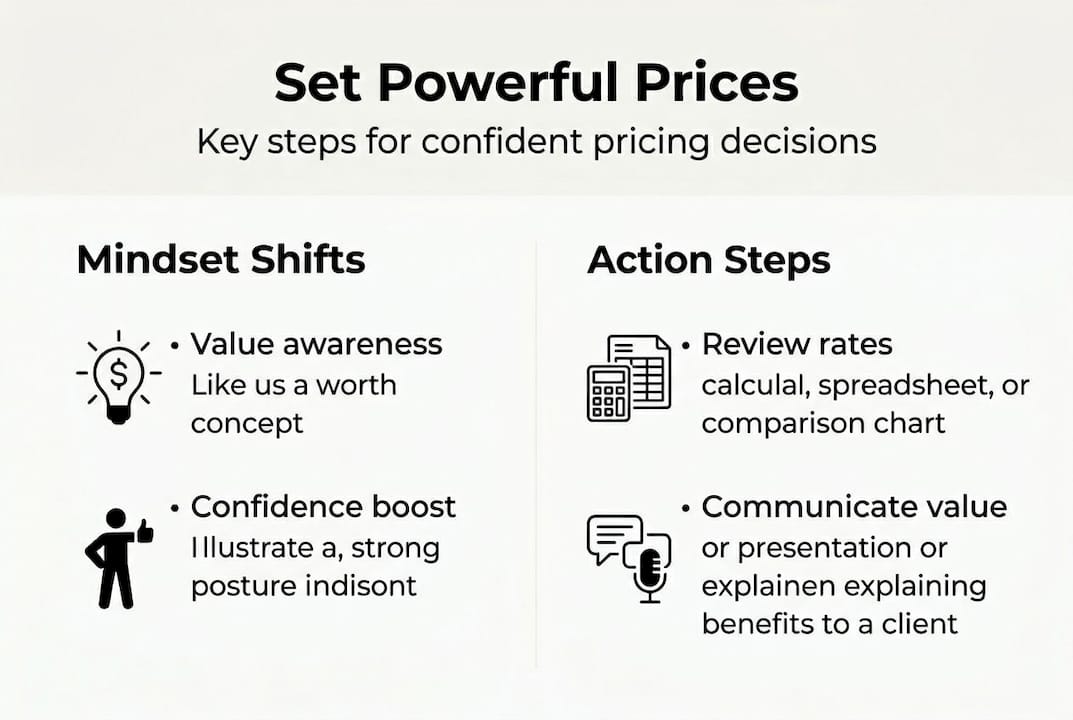
- Conduct an internal audit. Look at every offer you provide and calculate the real time, energy, and expertise investment. Compare that to your current rate.
- Run market research. Talk to peers, check competitor positioning, and look at what premium providers in your space charge. This gives you an objective anchor.
- Articulate your value clearly. Write out, in plain language, the specific outcomes your clients get from working with you. If you can’t articulate it, you can’t charge for it.
- Plan your client communication. Decide who gets advance notice, what language you’ll use, and how much lead time you’ll give. A structured repricing approach leads to greater client respect and higher retention.
- Roll out in phases. Raise rates for new clients first. Grandfather existing clients for one cycle, then transition them. This reduces friction and builds confidence.
Common objections you’ll face and how to handle them:
- “That’s more than I expected.” Respond with: “I understand. Let me walk you through what’s included and the outcomes other clients have seen.”
- “Can you do it for your old rate?” Respond with: “My pricing reflects the full scope of what I deliver now, and I want to make sure you’re getting that.”
- “I need to think about it.” Respond with: “Of course. What questions can I answer to help you decide?”
Pro Tip: Practice your new pricing conversation out loud with a trusted peer before any client call. Say the number without qualifying it. Silence after stating a price is normal. Let it land. Your discomfort with silence is often what triggers last-minute discounting.
Review your pricing structure at least once a year, or any time you add new skills, results, or offers. Sales strategy tips and financial coaching clarity can both support you through the ongoing process.
The uncomfortable truth about pricing as a woman entrepreneur
Here’s what most pricing articles won’t tell you: the conventional frameworks were largely built around male business norms, where confidence, directness, and charging boldly are culturally expected. For women entrepreneurs, the same behavior is often read differently by clients, and sometimes even by themselves.
The practical steps matter. But if you’re only fixing the external structure without addressing the internal story, the old patterns come back. You raise your prices, then quietly offer a discount in the next conversation. You send the invoice, then immediately add something extra to “justify” it.
Real, lasting pricing power comes from deciding, at a deep level, that your expertise has value regardless of whether every client agrees. That’s not arrogance. That’s how sustainable wealth gets built. Simone Cimiluca-Radzins has worked with women entrepreneurs across 30 countries, and the pattern is consistent: pricing is almost never just a math problem. It’s a decision about what you believe you deserve, and whether you’re willing to act on it.
Own your expertise without apology. That’s where transformation begins.
Ready to charge what you’re truly worth?
If this article has stirred something in you, that’s your signal. You’ve already built a business that works. Now it’s time to make sure it pays you what you’re actually worth. At Freedom Sun, we work with women entrepreneurs who are done leaving money on the table and ready to build real, lasting wealth without sacrificing their health or freedom. From expert coaching to community support and practical frameworks, the resources are here when you’re ready. Explore our coaching for profit guide as a starting point and take the next step toward pricing that reflects the full power of what you deliver.
Frequently asked questions
Can raising my prices really lead to more clients?
Yes. Higher rates attract more serious, loyal clients who are invested in outcomes rather than bargains, which improves both retention and referral quality.
How do I deal with guilt when pricing my services?
Recognize that social conditioning often drives that guilt, not logic. Practice stating your price as a fact, and remind yourself that fair pricing protects your capacity to serve clients well.
Is it normal to lose some clients when raising prices?
Some churn is expected and healthy. Remaining and new clients after a rate increase are typically more profitable and more respectful of your time and expertise.
How often should I review and adjust my rates?
At minimum, review your pricing annually, and also whenever you significantly expand your offers, results, or expertise level.
Recommended
- Pricing Services: Strategies for Startup Growth
- Pricing for Profit: Unlocking Sustainable Business Growth
- Changing Your Money Mindset: Unlocking Profitable Peace
- Communication
- Winning Amazon Pricing Strategies for Sellers – Reddog Consulting Group
- Understanding seller price changes: smart shopping insights | PriceLix