Pricing for Profit: Unlocking Sustainable Business Growth

Many founders in North America set their prices and never look back, only to realize later that stagnant pricing stifles growth and drains profits. As the competition adapts and costs shift, relying on static price tags can lead to lost opportunities and increased stress. Taking a strategic approach to pricing as a continuous profit driver helps entrepreneurs design financial models that serve long-term goals, maintain operational clarity, and protect their teams from burnout.
Table of Contents
- Defining Pricing For Profit In Modern Business
- Strategic Pricing Models For Entrepreneurs
- Integrating Pricing Into Operating Systems
- Maximizing Margins While Preventing Burnout
- Common Pricing Pitfalls And How To Avoid Them
Key Takeaways
| Point | Details |
|---|---|
| Continuous Pricing Strategy | Treat pricing as an ongoing strategic activity, reviewing it quarterly to adapt to market conditions and ensure profitability. |
| Holistic Pricing Integration | Embed pricing intelligence within all business systems, ensuring alignment between sales, finance, marketing, and customer success for maximized effectiveness. |
| Actionable Pricing Models | Select pricing models like subscription or tiered structures that align with customer value perception and operational capacity. |
| Avoiding Common Pitfalls | Conduct regular pricing reviews, focus on value communication, and test pricing models to prevent static pricing and discount spirals. |
Defining Pricing for Profit in Modern Business
Pricing is not just a number you slap on your product or service. It’s a direct lever that controls whether your business survives or thrives. Too many founders treat pricing as a one-time decision made during launch, then forget about it for years. That’s backwards. Pricing is actually a continuous strategic activity that sits at the intersection of profitability, market positioning, and customer perception. When you understand pricing as a profit driver rather than just a transactional detail, everything changes. You move from guessing at what customers will pay to strategically designing a pricing structure that aligns with your business goals. This shift requires viewing pricing as a strategic component that directly impacts your financial sustainability and brand positioning. Companies that apply scientific pricing principles consistently outperform their competitors and achieve above-average profitability.
So what does “pricing for profit” actually mean? It’s the intersection of three critical elements. First, your pricing must satisfy customers and make them feel like they received fair value. Second, it needs to stimulate demand for your product or service at the volume you need to operate profitably. Third, and most importantly for your business, it must generate genuine profit that allows you to reinvest, scale, and avoid burnout. This isn’t about squeezing customers dry. It’s about finding the sweet spot where customer satisfaction, market demand, and profitability align. The research shows that when organizations adopt a holistic view of pricing that considers ethical responsibilities alongside profitability, they unlock long-term firm viability and sustainable market success. Your pricing strategy should reflect your brand values while still protecting your bottom line. When you’re running a high-growth business, every dollar matters. Pricing directly impacts whether you can afford team members who reduce your workload, invest in systems that scale automatically, or take a vacation without everything falling apart.
For founders focused on building sustainable wealth and peace, pricing for profit means building a financial model that serves your life, not one that demands endless hustle. It means understanding the relationship between your pricing, your costs, and your capacity. Can you deliver at the price point you’ve set without destroying yourself? Will that price allow you to hire help so you’re not the bottleneck? These are the questions that separate founders who build sustainable businesses from those who burn out. When you work with your pricing strategically, you’re not just optimizing revenue. You’re optimizing for operational health. You’re creating the financial cushion that allows you to build robust systems, invest in your team, and maintain your mental health. The most successful high-growth founders use pricing as part of their operating system. They understand how pricing feeds into their financial clarity (MATH), their operational infrastructure (MECHANICS), and ultimately their ability to lead without exhaustion (MIND). You might also explore how to create profitable operations that work together with your pricing strategy to create real sustainable growth.
Pro tip: Review your current pricing quarterly rather than annually. Market conditions, your costs, and customer perception all shift faster than annual cycles. A quarterly check-in keeps your pricing aligned with your actual profitability needs and prevents you from leaving money on the table.
Strategic Pricing Models for Entrepreneurs
The difference between a pricing strategy and a pricing model matters more than most founders realize. Your pricing strategy is the methodology you use to arrive at a price—how you think about value, costs, and competition. Your pricing model is the actual structure you use to charge customers—how the transaction works. Think of it this way: value-based pricing is a strategy, but a subscription model is the mechanism you use to deliver it. Understanding this distinction helps you avoid common mistakes where founders adopt a great pricing strategy but implement it through the wrong model, which undercuts their profitability. The most successful high-growth businesses combine a thoughtful strategy with a model that actually supports their operational capacity and financial goals. Whether you’re choosing between value-based pricing approaches, cost-plus models, or penetration strategies, the goal is the same: find the intersection where customer value perception, your ability to deliver profitably, and market competitiveness all align. This is where your MATH (financial clarity) really comes into play. You need to understand your actual costs, your desired profit margin, and your customer’s willingness to pay before you can design a model that works.
Let’s look at some practical models that work well for entrepreneurs building sustainable businesses. Subscription models have become increasingly popular because they create predictable, recurring revenue that stabilizes cash flow. Instead of chasing one-time transactions, you build a revenue stream you can depend on. This allows you to hire team members, invest in systems, and plan for growth without constant hustle. Usage-based models work if your value delivery scales with customer consumption. A software tool might charge per user or per API call. This model aligns your revenue with customer success, which feels fair to customers and encourages loyalty. Tiered pricing lets you serve different customer segments without forcing everyone into one box. A starter tier serves price-sensitive customers, while premium tiers capture customers who need advanced features. This model requires understanding your customer segments deeply, but it maximizes your addressable market. Hybrid models combine multiple approaches. You might charge a base subscription with usage overages. The key is that whatever model you choose must work with your operational capacity. Can your team deliver different service levels profitably? Will your systems scale with your pricing structure? These practical considerations often matter more than the theoretical elegance of your model.
As market conditions shift with inflation and AI-driven tools becoming more accessible, pricing models need to adapt too. Dynamic pricing adjusts prices based on demand, seasonality, or competitive factors in real time. This approach requires technology and constant monitoring, but it optimizes revenue when implemented thoughtfully. However, be careful here. Dynamic pricing that feels unfair to customers damages trust and loyalty. Loyalty-based models reward repeat customers with better pricing or special access, which encourages the customer lifetime value you actually need to build sustainable wealth. The entrepreneurs who win long-term aren’t chasing maximum revenue per transaction. They’re building customer relationships that last for years. When designing your strategic pricing model, start with your business capacity and profit targets. Work backwards from the profit you actually need to fund your life and business goals. Then choose a model that supports that profit without requiring you to work 80-hour weeks. Your wealth-building strategy depends on pricing that generates real money, not just impressive revenue numbers that evaporate after you pay team members, software, and overhead.
Here’s a comparison of common strategic pricing models and their business impact:
| Pricing Model | Predictable Revenue | Customer Perceived Value | Operational Complexity |
|---|---|---|---|
| Subscription | High | Moderate to High | Moderate |
| Usage-Based | Variable | High | High |
| Tiered | Moderate | Very High | Moderate |
| Hybrid | Moderate to High | High | High |
| Dynamic | High (if managed) | Highly Variable | Very High |
| Loyalty-Based | Increasing | High | Moderate |
Pro tip: Test your pricing model with a small customer segment first before rolling it out company-wide. This lets you gather real data on customer reaction, payment behavior, and operational challenges without risking your entire revenue stream.
Integrating Pricing Into Operating Systems
Pricing can’t live in isolation anymore. If pricing sits only in your marketing department or gets decided once a year by finance, you’re leaving money on the table and creating chaos across your business. The most profitable companies embed pricing systematically throughout their entire operating system, making it a continuous strategic activity rather than a one-time decision. This means your pricing intelligence connects directly to your sales team, your financial forecasting, your marketing messaging, and your customer success operations. When these functions work together around pricing, something shifts. Your sales team knows which price points convert best. Your finance team can forecast revenue accurately. Your customer success team understands the value exchange they’re delivering. Your marketing team communicates confidence in the pricing because it reflects actual customer value. This integration transforms pricing from a friction point into a competitive advantage. Embedding pricing systematically across business processes ensures continuous monitoring and alignment with your overall business strategy, which is what separates sustainable growth from one-hit wonders.
Here’s what integration actually looks like in practice. Your financial systems need to track not just revenue, but pricing health. You should know your profit by customer segment, by product tier, by geographic region. Your accounting system should automatically flag when a customer is paying below your intended price point. Your sales infrastructure should have pricing authority clear at every level. Does your team know what they can discount and why? Can they see in real time which prices are working? Your customer data platforms should connect pricing decisions to customer lifetime value. You need to know if your cheapest tier has the highest churn or your premium offering has the happiest customers. Your forecasting processes should incorporate pricing sensitivity analysis. What happens to your cash flow if you increase prices 10 percent? What’s the customer acquisition impact? Integration means all these systems talk to each other. Your CRM pulls pricing data to show sales reps conversion rates by price point. Your financial dashboard shows marketing which customer segments are most profitable. Your customer success software flags retention risk before churn happens. This interconnection is what allows you to run pricing as a strategic capability rather than a guessing game.
For founders building sustainable operating systems, pricing integration ties directly into your MATH and MECHANICS pillars. Your MATH is the financial clarity you need to set prices confidently. Your MECHANICS is the systems infrastructure that makes those prices actually work at scale. When you integrate pricing into your operating system properly, pricing becomes the connective tissue between financial clarity and operational reality. You understand the cost structure behind every service level you offer. You know your unit economics by customer segment. You can predict cash flow impact of pricing changes. You can scale customer acquisition without destroying profitability. Without integration, pricing decisions happen in a vacuum. Someone in marketing sets a price without consulting finance. Sales undercuts the price without approval. Accounting can’t tell you if that huge customer is actually profitable. Customer success discovers the pricing was set wrong only when customers leave. Integration prevents this chaos. It also prevents the burnout that comes from constant firefighting. When pricing is embedded throughout your systems, it runs more automatically. Adjustments happen with data, not emotion. Decisions get made faster because everyone has the information they need. This is how you build a business that generates profit without demanding all your time and attention.
Pro tip: Create a monthly pricing review meeting with representatives from sales, finance, marketing, and customer success. This 30-minute standup ensures pricing stays aligned with what you’re learning from customers and prevents silos from forming as your business grows.
Maximizing Margins While Preventing Burnout
Here’s the trap most founders fall into: you increase prices to boost margins, but then your sales team panics about closing deals. So they start discounting. Marketing gets frustrated because the messaging no longer matches reality. Your operations team scrambles to deliver at the new price point without additional resources. Within months, you’re working harder than ever, margins are still thin, and everyone is exhausted. This isn’t maximizing margins. This is chaos dressed up as growth. Real margin optimization requires three things working together: intelligent pricing decisions, team alignment around those decisions, and systems that support both without creating unsustainable workload. When you get this right, margins improve and burnout decreases. When you get it wrong, you trade one problem for another. The difference between sustainable margin growth and burnout-inducing price increases comes down to how you implement pricing changes. Strategic pricing adjustments without overburdening operational teams requires empowering your team with clear strategies, proper tools, and continuous support to maintain motivation while hitting profit targets. This is not a finance department decision that gets handed down. It’s a collaborative process that includes your sales team, your delivery team, and your finance team working together.
Let’s talk about what actually happens when you increase prices thoughtfully. Your margins go up because you’re capturing more profit per transaction. But your sales velocity might dip initially because some customers will balk at the new price. This is normal and expected. The mistake is panicking and discounting back down to save deals. Instead, give your sales team three months to adjust their messaging and positioning. Help them understand the value they’re selling so they can articulate it confidently at the new price point. Provide them with case studies showing customer success. Give them positioning frameworks that explain why the price increased. When your sales team understands the rationale and has the tools to communicate it, they convert at higher rates and don’t resort to discounting. The same applies to your delivery team. If you raise prices but don’t change your delivery model, you’ve just increased margin while increasing workload. That’s a recipe for burnout. Instead, use your margin gains strategically. Maybe you hire an additional team member so your current team has breathing room. Maybe you invest in automation that reduces manual work. Maybe you implement service level agreements that clarify what customers get at each price point, so your team isn’t constantly saying yes to scope creep. The key is that margin improvements fund operational improvements, not just shareholder returns.

Automation becomes your secret weapon here. When you automate repetitive pricing tasks, your team spends less time on busywork and more time on strategic work. Your finance person isn’t manually updating pricing in five different places. Your sales team isn’t negotiating discounts based on outdated information. Your operations team isn’t frantically recalculating profitability on custom deals. Instead, systems handle the routine work, freeing your team to focus on high-value activities. This is where your MECHANICS infrastructure becomes critical. You need pricing systems that integrate with your sales tools, your accounting software, and your customer data platforms. You need visibility into which customers are profitable and which are margin drains. You need your team to have confidence that the prices they’re quoting are actually sustainable. This confidence is what prevents the slow death of a thousand discounts. It also prevents the slow death of a burned-out team. When your team knows that pricing is strategic, understood by leadership, and supported by systems, they feel less pressure to solve problems through discounting. They feel trusted to execute strategy rather than constantly improvising. This is the difference between productivity that sustainable versus productivity that burns people out. One is driven by systems and clarity. The other is driven by hustle and confusion.
The final piece is culture. You need to make it safe for your team to push back on pricing that doesn’t work. If your sales rep says a customer is at risk because of price, you need to listen instead of punishing them for not closing the deal. If your operations team says they can’t deliver at that price point without hiring more people, you need to believe them and adjust the model instead of expecting them to work harder. If your finance person flags that a customer is profitable at price but will require unexpected operational support, you need to adjust the deal terms instead of forcing it through. This cultural alignment prevents burnout because your team knows their input matters. They’re not just executing orders from above. They’re collaborating on decisions that affect their workload and wellbeing. When margins improve through this kind of collaborative process, the wins feel real to your team because they understand how it happened and know that improvements weren’t achieved by sacrificing their peace.
Pro tip: After implementing a price increase, conduct a team survey asking how the change impacted their workload and confidence level. Use that feedback to adjust your support systems before burnout starts showing up in your retention numbers.
Common Pricing Pitfalls and How to Avoid Them
Most pricing disasters don’t happen because founders are stupid. They happen because founders treat pricing like a one-time decision and then never revisit it. You set a price at launch, maybe adjust it once during a rebrand, and then assume that’s the pricing strategy for the next five years. Meanwhile, your costs changed. Your market shifted. Your customer base evolved. Your competition adjusted. Your value proposition improved. But your price stayed frozen in time. This static approach to pricing is the first pitfall, and it’s probably the most expensive mistake you can make. Treating pricing as a continuous strategic decision rather than a static choice means regularly reviewing and adjusting your strategy based on actual market dynamics and customer insights. Your pricing should evolve as your business evolves. At minimum, you should audit your pricing quarterly. Are your costs still aligned with your pricing? Is customer demand holding steady or weakening? Are competitors pricing similarly? Are your margins where they should be? These questions deserve answers, not assumptions.
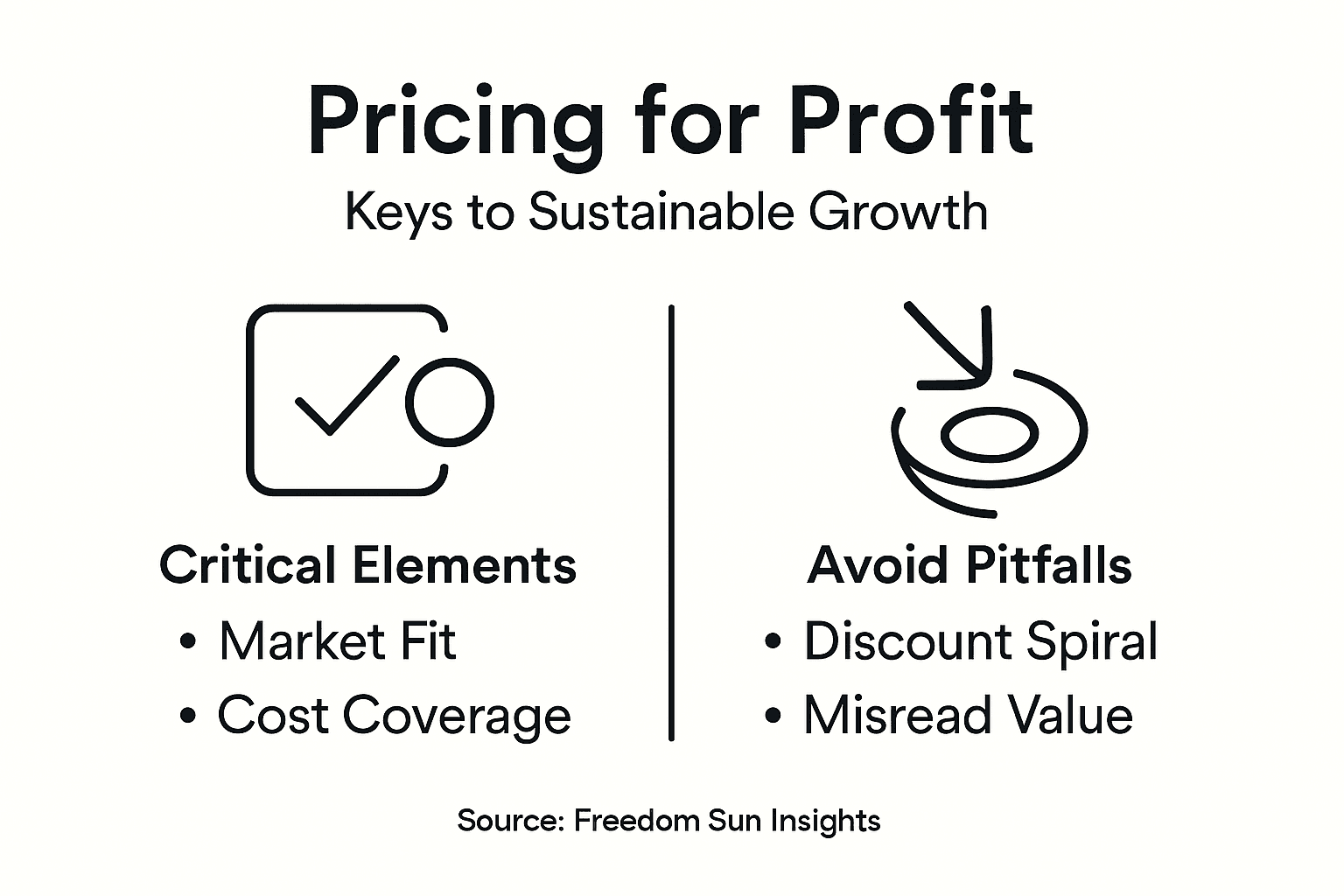
The second pitfall is the discount spiral. You set a price. A customer pushes back. You offer a discount to close the deal. Another customer hears about that discount and demands one too. Pretty soon you’re discounting 30 percent off your list price for almost every customer, your margins are destroyed, and your brand message is incoherent. This happens because founders confuse discounting with sales strategy. Discounting should be tactical and rare, not a negotiation starting point. If you find yourself discounting constantly, the problem isn’t that your price is too high. The problem is that your value messaging is weak, your sales process is ineffective, or your product doesn’t actually deliver the value you’re claiming. Discounting masks the real problem instead of solving it. You end up with lower margins and customers who always expect the discount, which means you can never raise prices without destroying customer relationships. The alternative is to invest in better value positioning, better sales conversations, and better product delivery so your price feels obvious and fair. This is harder in the short term but profitable in the long term.
The third pitfall is ignoring what customers actually perceive as valuable. You might think your software is valuable because of feature X. Your customers might actually value feature Y ten times more. If you’re pricing based on feature X and customers see feature Y as the real value driver, your pricing is wrong. This is why conducting thorough market research and understanding customer perceived value is essential before setting prices. Talk to your customers. Ask them what outcomes they achieve with your product. Ask them what they’d be willing to pay. Ask them what would make them switch to a competitor. Ask them about their budget constraints. Get actual data instead of making assumptions. The fourth pitfall is never testing your pricing. You can gather data and make intelligent assumptions, but until you actually test prices with real customers, you’re guessing. Maybe your model suggests you can charge 50 percent more. But what if testing reveals you can only charge 25 percent more before conversion drops significantly? That’s crucial information. A simple approach is A/B testing. Show 50 percent of new customers your current price. Show the other 50 percent a higher price. Track conversion rates. You’ll learn whether you have pricing power or not.
Here’s what separates sustainable pricing from pricing that creates constant friction. First, your pricing must reflect your actual costs plus desired profit margin. If you’re pricing without understanding your unit economics, you might be making money on paper but losing it in operations. Second, your pricing must be clearly communicated. Customers should understand what they’re getting at each price point and why the price is what it is. No hidden fees. No surprise tier jumps. Clarity prevents the slow accumulation of customer resentment. Third, your pricing must be defensible. You should be able to articulate to your sales team, your finance team, and your customers why the price is set where it is. If you can’t defend it, it probably isn’t right. Fourth, your pricing should have built-in flexibility so you can adjust without blowing up customer relationships. Maybe you offer grandfathering clauses where existing customers stay at old prices for a period. Maybe you announce price increases with generous notice. Maybe you create transitional pricing for customers who’ve been with you a long time. The goal is pricing that works for your business without feeling punitive to customers.
Use this summary to identify and address common pricing pitfalls:
| Pitfall | Root Cause | Consequence | Prevention Tip |
|---|---|---|---|
| Static Pricing | Infrequent review | Missed profit opportunities | Schedule quarterly audits |
| Discount Spiral | Weak value communication | Eroded margins, brand confusion | Focus on value messaging |
| Ignoring Value Signals | Lack of customer research | Incorrect pricing, lost sales | Conduct interviews and surveys |
| Avoiding Price Testing | Relying on assumptions | Overlooked pricing power | Run A/B or pilot tests |
Pro tip: Document your pricing decisions in a simple one-page document that explains the reasoning, the customer segment, and the expected economics. Review this quarterly and update it as you learn more. This keeps your pricing decisions transparent and prevents you from drifting into inconsistent pricing across similar customer types.
Master Pricing for Sustainable Growth with Freedom Sun
Pricing for profit is a critical challenge many founders face as they strive to build businesses that thrive without burnout. If you find yourself caught in the cycle of guessing prices, battling discount pressure, or struggling to align pricing with operational capacity and profit goals, you are not alone. The key is integrating strategic pricing into your entire operating system to unlock lasting financial clarity, operational efficiency, and mental resilience—concepts central to the MATH, MECHANICS, and MIND pillars.
At Freedom Sun, we empower high-growth entrepreneurs to transform pricing from a source of stress into a strategic advantage. Our professional development platform offers interactive training and diagnostic assessments designed to help you build robust financial models, scalable systems, and leadership practices modeled after Fortune 500 CFOs. Learn how to embed pricing into your operations for predictable margins, sustainable team support, and real wealth creation. Start shifting from hustle culture to strategic management that protects your business and wellbeing.
Discover how to build your own integrated operating system tailored for profitable peace by visiting Freedom Sun. Explore practical frameworks to sharpen your financial clarity and operational mechanics while strengthening your leadership mindset. Take control of your pricing strategy before the next quarter begins and begin accelerating your path to sustainable success today.
Frequently Asked Questions
What is pricing for profit?
Pricing for profit refers to a strategic approach that aligns customer satisfaction, market demand, and profitability to ensure a business can sustain itself and grow. It requires ongoing assessment and adjustment of pricing strategies to meet evolving market conditions and business objectives.
How often should I review my pricing strategy?
It is recommended to review your pricing strategy quarterly. This frequent evaluation helps you stay aligned with changing market conditions, costs, and customer perception, ensuring your pricing remains effective and maximizes profitability.
What are the common pricing models for entrepreneurs?
Common pricing models include subscription models, usage-based models, tiered pricing, hybrid models, dynamic pricing, and loyalty-based pricing. Each model serves different business needs and customer segments, allowing entrepreneurs to choose one that aligns with their operational capacity and financial targets.
How can I avoid the discount spiral in my pricing strategy?
To avoid the discount spiral, focus on strengthening your value messaging and sales process instead of resorting to frequent discounts. Ensure that customers understand the value they receive at your price point and provide your sales team with the tools they need to communicate this effectively without undermining margins.