Pricing Services: Strategies for Startup Growth

Defining the right pricing strategy can be a game-changer for any North American tech startup aiming for sustainable growth. Pricing goes far beyond assigning numbers to products—it is a blend of market analysis, customer perception, and competitive positioning. Making smart decisions around strategic pricing methodologies empowers founders to optimize financial systems and outpace rivals in fast-moving markets. This article highlights effective models, proven tactics, and practical steps for startups looking to build resilient pricing frameworks as they scale.
Table of Contents
- Defining Pricing Services And Key Concepts
- Popular Pricing Models And When To Use Them
- Aligning Value, Market, And Pricing Decisions
- Testing, Tuning, And Evolving Pricing
- Common Pitfalls And How To Avoid Them
- Scaling And Automating Pricing For Growth
Key Takeaways
| Point | Details |
|---|---|
| Strategic Pricing Importance | Effective pricing strategies create sustainable competitive advantages beyond just revenue generation. |
| Continuous Adaptation | Regularly assess market conditions and customer feedback to refine pricing strategies dynamically. |
| Holistic Pricing Strategy | Integrate customer perception, market dynamics, and actual product value for effective pricing alignment. |
| Automation and AI in Pricing | Leverage automated pricing systems to respond to market changes effectively while maintaining human oversight. |
Defining Pricing Services and Key Concepts
Pricing services represent strategic frameworks that enable businesses to design, implement, and optimize their financial approaches to product and service valuation. At its core, pricing involves more than simply attaching a number to an offering—it’s a complex process of understanding market dynamics, customer perceived value, and competitive positioning.
Businesses have multiple pricing strategies to choose from, each with distinct characteristics and potential advantages. Strategic pricing methodologies typically fall into three primary categories:
- Cost-based Pricing: Setting prices by calculating production expenses and desired profit margins
- Demand-based Pricing: Adjusting prices according to customer willingness to pay
- Competition-based Pricing: Positioning prices relative to market competitors
The primary goal of strategic pricing is not just revenue generation, but creating a sustainable competitive advantage. Value-based pricing approaches focus on understanding the economic value a product or service delivers to customers, which goes beyond simple cost calculations.
Successful pricing requires continuous analysis and adaptation. Companies must regularly assess market conditions, customer feedback, and competitive landscapes to refine their pricing strategies. This means developing robust systems that can quickly respond to changing economic environments and consumer preferences.
Pro tip: Implement a quarterly pricing review process that systematically evaluates your current pricing strategy against market benchmarks and customer feedback.
Popular Pricing Models and When to Use Them
Pricing models are strategic frameworks that help businesses determine the most effective approach to setting product or service prices. Product pricing strategies vary widely, each designed to address different market conditions and business objectives.
Several core pricing models emerge as particularly powerful for startup growth:
- Cost-Plus Pricing: Adding a standard markup percentage to production costs
- Value-Based Pricing: Setting prices based on customer perceived value
- Penetration Pricing: Initially setting lower prices to gain market share
- Dynamic Pricing: Adjusting prices in real-time based on market demand
- Competitive Pricing: Aligning prices with direct market competitors
Strategic pricing approaches require careful consideration of multiple factors. Cost-plus pricing provides predictable margins but might miss nuanced market opportunities. Value-based pricing, conversely, allows companies to capture additional revenue by focusing on the unique benefits their product delivers.
Startups must remain flexible, understanding that no single pricing model works universally. The most successful approaches involve continuous testing, customer feedback integration, and willingness to pivot strategies as market dynamics evolve. Some companies even blend multiple models to create hybrid pricing strategies that maximize revenue and customer satisfaction.
Here’s a comparison of major pricing models startups might consider:
| Pricing Model | Best Used When | Key Benefit | Main Risk |
|---|---|---|---|
| Cost-Plus | Cost structure is predictable | Easy to implement | May ignore market demand |
| Value-Based | Product offers unique customer value | Maximizes value capture | Difficult to measure perceived value |
| Penetration | Entering a new or crowded market | Gains market share quickly | Can erode brand perception |
| Dynamic | Market demand changes frequently | Responds rapidly to shifts | Possible customer confusion |
| Competitive | Highly competitive industry | Aligns with industry standards | Can trigger price wars |
Pro tip: Implement a monthly pricing model performance review to assess revenue impact and customer response, allowing data-driven adjustments to your pricing strategy.
Aligning Value, Market, and Pricing Decisions
Successful pricing strategies require a holistic approach that integrates customer perception, market dynamics, and intrinsic product value. Pricing algorithms have transformed how businesses develop nuanced pricing strategies that go beyond traditional cost-plus models.
Key components for effective value alignment include:
- Customer Perceived Value: Understanding what customers genuinely believe a product is worth
- Market Positioning: Analyzing competitive landscape and unique value propositions
- Cost Structure: Calculating true production and operational expenses
- Competitive Dynamics: Evaluating pricing strategies of market competitors
- Elasticity of Demand: Measuring how price changes impact customer purchasing behavior
Market pricing interactions demonstrate that sophisticated pricing requires more than simple mathematical calculations. Successful startups recognize that pricing is a dynamic process involving continuous learning and adaptation. This means developing flexible strategies that can quickly respond to market shifts, emerging competitors, and changing customer expectations.

The most effective pricing approaches integrate multiple data points, including customer feedback, market research, and real-time performance metrics. By creating a responsive pricing framework, businesses can balance profitability with customer satisfaction, ensuring that prices reflect true value while remaining competitive.
Below is a summary of core factors that shape effective pricing strategies:
| Factor | Description | Influence on Pricing |
|---|---|---|
| Customer Perception | How buyers value your offering | Drives willingness to pay |
| Market Positioning | Competitors’ prices and brand strengths | Informs pricing boundaries |
| Cost Structure | Real costs of production and operations | Sets minimum viable price |
| Demand Elasticity | Response to price changes | Affects revenue optimization |
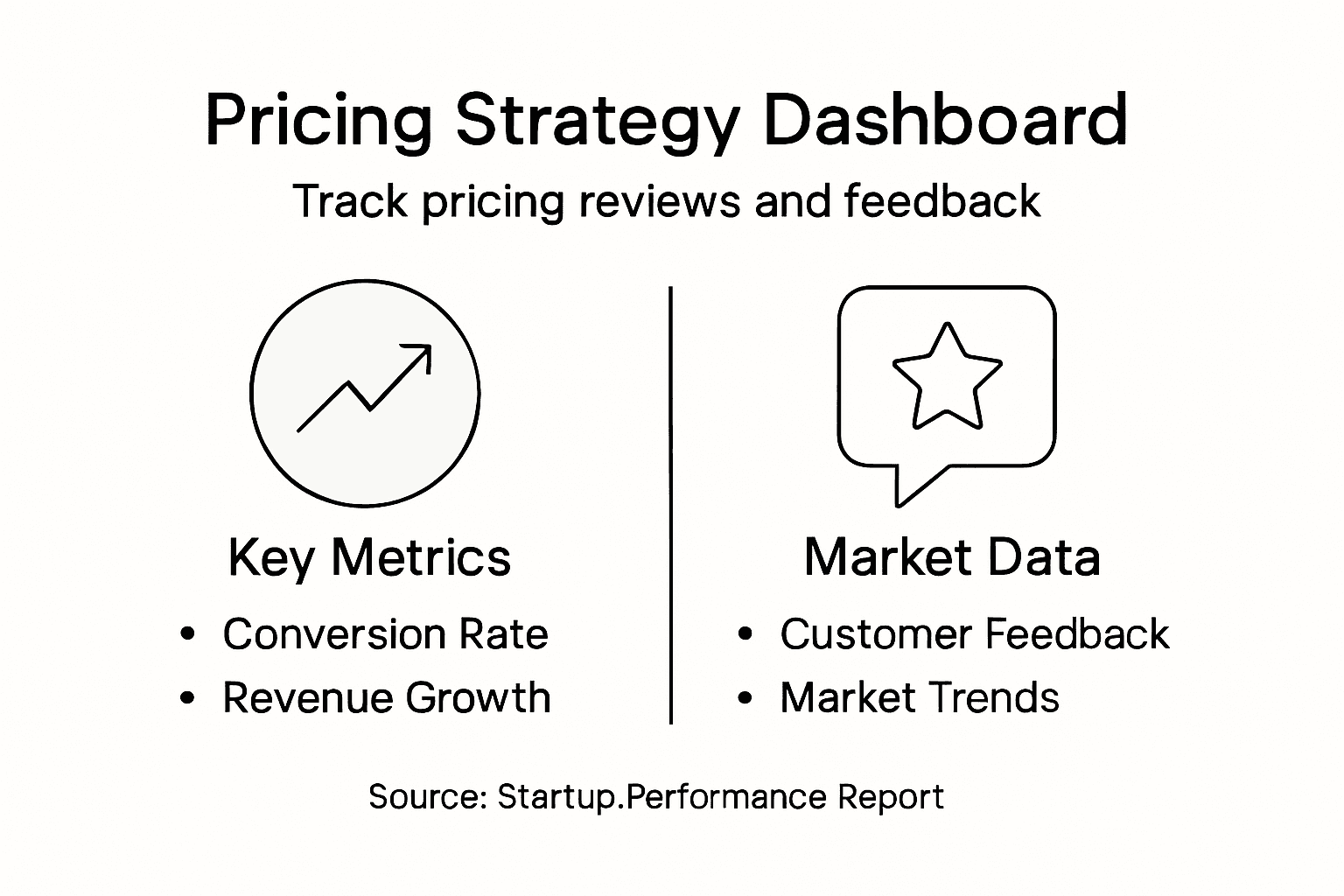
Pro tip: Create a quarterly pricing review dashboard that tracks customer feedback, market changes, and revenue performance to enable data-driven pricing adjustments.
Testing, Tuning, and Evolving Pricing
Pricing is not a static strategy but a dynamic process that requires continuous refinement and adaptation. Large language model tuning provides an insightful parallel to pricing strategies, emphasizing the importance of ongoing optimization and performance evaluation.
Key testing and tuning approaches include:
- A/B Price Testing: Comparing different price points to determine optimal revenue generation
- Customer Segment Analysis: Evaluating pricing effectiveness across different market segments
- Competitive Benchmarking: Tracking and responding to market pricing trends
- Price Elasticity Measurement: Understanding how price changes impact demand
- Feedback Loop Integration: Continuously incorporating customer and market insights
Dynamic pricing strategies demonstrate that successful pricing requires sophisticated AI-driven approaches that balance profitability with customer trust. Startups must develop robust frameworks that allow for rapid experimentation and data-driven decision-making. This means creating flexible pricing mechanisms that can quickly adapt to changing market conditions, emerging competitors, and shifting customer preferences.
The most effective pricing evolution strategies combine quantitative data analysis with qualitative market insights. By developing a comprehensive testing infrastructure, businesses can create pricing models that are not just reactive, but predictive—anticipating market changes and proactively adjusting strategies to maintain competitive advantage.
Pro tip: Develop a quarterly pricing performance dashboard that tracks key metrics like conversion rates, customer feedback, and revenue per customer segment to enable continuous strategic refinement.
Common Pitfalls and How to Avoid Them
Pricing strategies can quickly unravel when businesses fail to anticipate potential challenges. Pricing algorithm risks reveal complex dynamics that can undermine even the most carefully constructed pricing frameworks.
Critical pitfalls to watch for include:
- Rigid Pricing Models: Failing to adapt to market changes
- Miscalculated Value Perception: Overestimating or underestimating customer willingness to pay
- Neglecting Competitive Context: Ignoring broader market positioning
- Inconsistent Pricing Across Channels: Creating customer confusion
- Overlooking Hidden Costs: Miscalculating true product delivery expenses
Strategic pricing tactics demonstrate that successful pricing requires more than mathematical precision. Startups must develop nuanced approaches that balance technical accuracy with customer psychology. This means creating pricing strategies that feel transparent, fair, and aligned with customer expectations.
The most dangerous pitfalls often emerge from oversimplification. Businesses that rely exclusively on cost-plus models or fail to incorporate ongoing market research risk becoming disconnected from actual customer value perceptions. Successful pricing requires continuous learning, frequent validation, and a willingness to pivot strategies based on emerging data and market shifts.
Pro tip: Conduct monthly customer surveys to validate pricing perceptions and identify potential disconnects between your pricing strategy and market expectations.
Scaling and Automating Pricing for Growth
Automation represents the critical next frontier for strategic pricing, enabling businesses to respond dynamically to complex market conditions. Algorithmic pricing strategies provide sophisticated mechanisms for transforming pricing from a manual, reactive process into an intelligent, proactive system.
Key components of scalable pricing automation include:
- Real-Time Market Analysis: Continuous monitoring of competitive pricing
- Dynamic Price Adjustment: Automated responses to demand fluctuations
- Customer Segmentation Algorithms: Personalized pricing strategies
- Predictive Demand Modeling: Forecasting price sensitivity
- Performance Tracking Systems: Measuring pricing strategy effectiveness
Autonomous pricing frameworks demonstrate that successful automation requires more than technical implementation. Startups must develop intelligent systems that balance mathematical precision with nuanced market understanding. This means creating pricing mechanisms that can learn, adapt, and optimize without losing sight of broader business objectives.
The most effective automated pricing strategies integrate multiple data sources, combining machine learning algorithms with human strategic oversight. Businesses should view automation not as a replacement for human decision-making, but as a powerful tool that augments and accelerates strategic pricing capabilities.
Pro tip: Implement a hybrid automation model that uses AI-driven insights while maintaining periodic human review to ensure strategic alignment and ethical pricing practices.
Elevate Your Startup Pricing Strategy with Freedom Sun
Understanding and optimizing pricing models is a powerful step toward sustainable growth. This article highlights the complexity behind pricing services and the need for continuous tuning, strategic alignment, and market responsiveness. If you struggle with creating flexible pricing strategies that balance customer value, competitive pressure, and profitability you are not alone. Many founders face pain points such as rigid pricing systems, misjudged customer perceptions, and the challenge to scale pricing automation effectively.
Freedom Sun offers an Operating System designed specifically for entrepreneurial leaders seeking clarity in financial systems, resilient sales infrastructure, and strategic pricing that adapts to market demands. Our MATH pillar helps you build financial clarity, enabling informed pricing decisions based on real data rather than guesswork. The MECHANICS pillar supports scalable system infrastructure so you can automate pricing adjustments and reduce burnout. Combined with the MIND pillar that fosters leadership strength and resilience, we provide a holistic solution for mastering your pricing strategy with precision and confidence.
Take control of your startup’s pricing evolution today. Explore how our professional development platform can transform your internal systems into robust engines of profitable peace. Visit Freedom Sun now and start designing pricing systems built to scale without sacrificing your wellbeing.
Frequently Asked Questions
What are the main pricing strategies for startups?
Pricing strategies for startups typically fall into three categories: cost-based pricing, demand-based pricing, and competition-based pricing. Cost-based pricing focuses on production costs plus desired profit. Demand-based pricing adjusts prices based on what customers are willing to pay. Competition-based pricing sets prices in relation to competitors in the market.
How can businesses determine the right pricing model for their products?
Businesses can determine the right pricing model by analyzing various factors, including customer perceived value, production costs, market positioning, demand elasticity, and the competitive landscape. Testing different models, such as cost-plus or value-based pricing, can also provide insights into what works best for their offerings.
What is value-based pricing, and why is it important?
Value-based pricing is a strategy that sets prices based on the unique value a product or service delivers to customers rather than solely on production costs. It’s important because it allows businesses to capture maximum value from customers who recognize and are willing to pay for the benefits their products provide.
How can startups continuously refine their pricing strategies?
Startups can refine their pricing strategies through regular market analysis, customer feedback integration, A/B testing, and competitive benchmarking. Implementing a structured process for reviewing and adjusting pricing, such as quarterly pricing reviews, can lead to more effective strategies that align with market changes and customer expectations.