Sales Strategy for Consultants: Sustainable Growth Tactics

Every consultant knows the challenge of moving past the basic pitch and truly connecting with clients. Sales strategy today means understanding organizational dynamics and adapting your approach to shifting client landscapes. By embracing a customer-centric approach and prioritizing relationship engineering, consultants and coaches can achieve sustainable growth and operational stability while positioning their services as transformative solutions.
Table of Contents
- Core Principles Of Sales Strategy For Consultants
- Types Of Sales Approaches In Consulting
- Shifting From Hustle To Strategic Systems
- Building Trust And Authority With Clients
- Deploying Automation And Diagnostic Tools
- Common Sales Mistakes And How To Avoid Them
Key Takeaways
| Point | Details |
|---|---|
| Customer-Centric Sales Strategy | Focus on understanding client needs and building relationships over traditional sales techniques. |
| Adaptive Sales Methodologies | Utilize various sales approaches tailored to client complexity and industry context for effective results. |
| Strategic Systems Approach | Shift from hustle to systematic processes to enhance efficiency and scalability in consulting practices. |
| Building Trust through Expertise | Consistently demonstrate knowledge and commitment to client success to foster trust and authority. |
Core Principles of Sales Strategy for Consultants
Sales strategy for consultants transcends traditional pitch-and-close approaches. It requires a sophisticated understanding of client needs, market dynamics, and strategic relationship building. Strategic sales frameworks fundamentally pivot around understanding deep client motivations and organizational contexts.
The core principles of an effective sales strategy center on several critical dimensions:
- Customer-Centric Approach: Prioritizing client needs over transactional objectives
- Market Adaptability: Continuously evolving sales methods based on changing client landscapes
- Relationship Engineering: Building trust through genuine value proposition
- Strategic Alignment: Connecting sales efforts with broader business goals
Successful consultants recognize that modern sales strategy is less about persuasion and more about solving complex business challenges. This means developing deep diagnostic capabilities that allow you to understand a client’s underlying problems before presenting solutions.
The most effective sales strategies integrate multiple intelligence streams. Data-driven insights, emotional intelligence, and strategic positioning combine to create a holistic approach to client engagement. Consultants must become adept at reading organizational dynamics, understanding unstated needs, and positioning their services as transformative solutions.
Pro Tip: Develop a systematic discovery process that allows you to uncover client challenges through strategic questioning, not just surface-level discussions.
Types of Sales Approaches in Consulting
Consulting sales strategies are not one-size-fits-all but require nuanced understanding of different methodological approaches. Sales methodologies vary significantly depending on industry context, client complexity, and specific business challenges.
The primary sales approaches in consulting can be categorized into several strategic frameworks:
- Consultative Selling: Deep problem diagnosis and customized solution design
- Solution Selling: Focusing on specific client pain points and comprehensive problem resolution
- Transactional Sales: Quick, standardized service delivery with minimal customization
- Relationship-Based Selling: Long-term partnership development and trust building
Each approach demands unique skills and strategic positioning. Consultative selling remains the predominant method in professional services, where understanding client ecosystems takes precedence over standard product pitches. This approach requires extensive diagnostic capabilities, allowing consultants to uncover underlying organizational challenges before proposing targeted solutions.
The effectiveness of a sales approach depends on matching the methodology to the client’s specific needs. Complex, high-stakes consulting engagements typically require more sophisticated, relationship-driven strategies that emphasize collaborative problem-solving and strategic insight delivery.
Modern consulting sales increasingly integrate adaptive problem-solving frameworks that blend multiple approaches. Successful consultants develop flexibility in their sales methodology, shifting seamlessly between diagnostic, solutions-oriented, and relationship-building techniques based on client dynamics.
Here’s a concise comparison of consulting sales approaches and when they are most effective:
| Approach Type | Best Used When | Core Consultant Skill | Typical Client Outcome |
|---|---|---|---|
| Consultative Selling | Addressing complex challenges | Deep diagnostic ability | Tailored transformation |
| Solution Selling | Solving defined pain points | Solution design expertise | Comprehensive problem solved |
| Transactional Sales | Delivering standard services | Efficiency in execution | Quick turnaround |
| Relationship-Based Selling | Building long-term partnerships | Trust building | Repeat and referral business |
Pro Tip: Develop a flexible sales approach toolkit that allows you to dynamically adjust your strategy based on each client’s unique organizational context and challenge complexity.
Shifting From Hustle to Strategic Systems
The transition from hustle-driven work to strategic systems represents a fundamental reimagining of professional success. Proactive sales management requires moving beyond reactive effort toward intentional, structured growth strategies that prioritize efficiency and sustainable performance.
Key characteristics of shifting from hustle to strategic systems include:
- Process Documentation: Creating repeatable workflows that can be delegated and scaled
- Outcome Measurement: Tracking results instead of hours worked
- High-Value Client Prioritization: Focusing energy on most impactful relationships
- Systematic Task Management: Implementing structured approaches to workload distribution
Successful consultants recognize that continuous hustle leads to burnout, while strategic systems create predictable, scalable growth. Systematic approaches enable professionals to work smarter, not harder, by developing robust infrastructure that supports consistent performance without personal exhaustion.

Modern consulting demands a shift from individual heroics to intelligent system design. This means creating documented processes, leveraging technology for automation, and developing clear metrics that reveal true business performance beyond surface-level activity.
The systems optimization journey involves transforming chaotic, personality-driven work into structured, repeatable frameworks that can function independently of individual energy levels. Strategic systems provide consultants with the ability to generate consistent results while maintaining personal well-being and professional flexibility.
Pro Tip: Document your core business processes within 90 days, creating clear step-by-step workflows that can be executed without your direct intervention.
Building Trust and Authority With Clients
Trust is the foundational currency of successful consulting relationships. Trust development requires strategic, multidimensional approaches that go beyond surface-level interactions, demanding consistent demonstration of professional competence and genuine client commitment.
Key strategies for building trust and authority include:
- Transparent Communication: Providing clear, honest insights about capabilities and limitations
- Consistent Delivery: Meeting or exceeding promised outcomes consistently
- Demonstrated Expertise: Showcasing deep understanding through substantive problem-solving
- Genuine Client Investment: Prioritizing client success over immediate financial gains
Successful consultants understand that trust is an intricate social process involving both emotional and cognitive dimensions. Emotional intelligence plays a critical role in navigating client relationships, requiring consultants to balance professional competence with genuine empathy and understanding.
Modern consulting demands more than technical skills. Building credibility through reliability means creating predictable, transparent engagement models where clients feel genuinely supported rather than manipulated.
Authority emerges not from self-promotion, but from consistent demonstration of value. This requires developing deep domain expertise, maintaining professional integrity, and creating measurable, repeatable results that speak louder than marketing claims.
Pro Tip: Create a transparent onboarding process that explicitly outlines your working methodology, expected outcomes, and commitment to client success.
Deploying Automation and Diagnostic Tools
The modern consulting landscape demands intelligent technological integration that transforms traditional sales approaches. AI-powered diagnostic tools are revolutionizing how consultants analyze customer data, optimize lead generation, and personalize communication strategies.
Key automation strategies for consultants include:
- Customer Data Analytics: Leveraging advanced algorithms to extract actionable insights
- Lead Qualification Automation: Systematically screening and prioritizing potential clients
- Communication Personalization: Using intelligent tools to tailor engagement approaches
- Performance Tracking: Implementing real-time metrics and diagnostic dashboards
Successful consultants recognize that automation is not about replacing human interaction but enhancing its strategic effectiveness. These technological tools provide unprecedented visibility into client behaviors, preferences, and potential engagement opportunities.
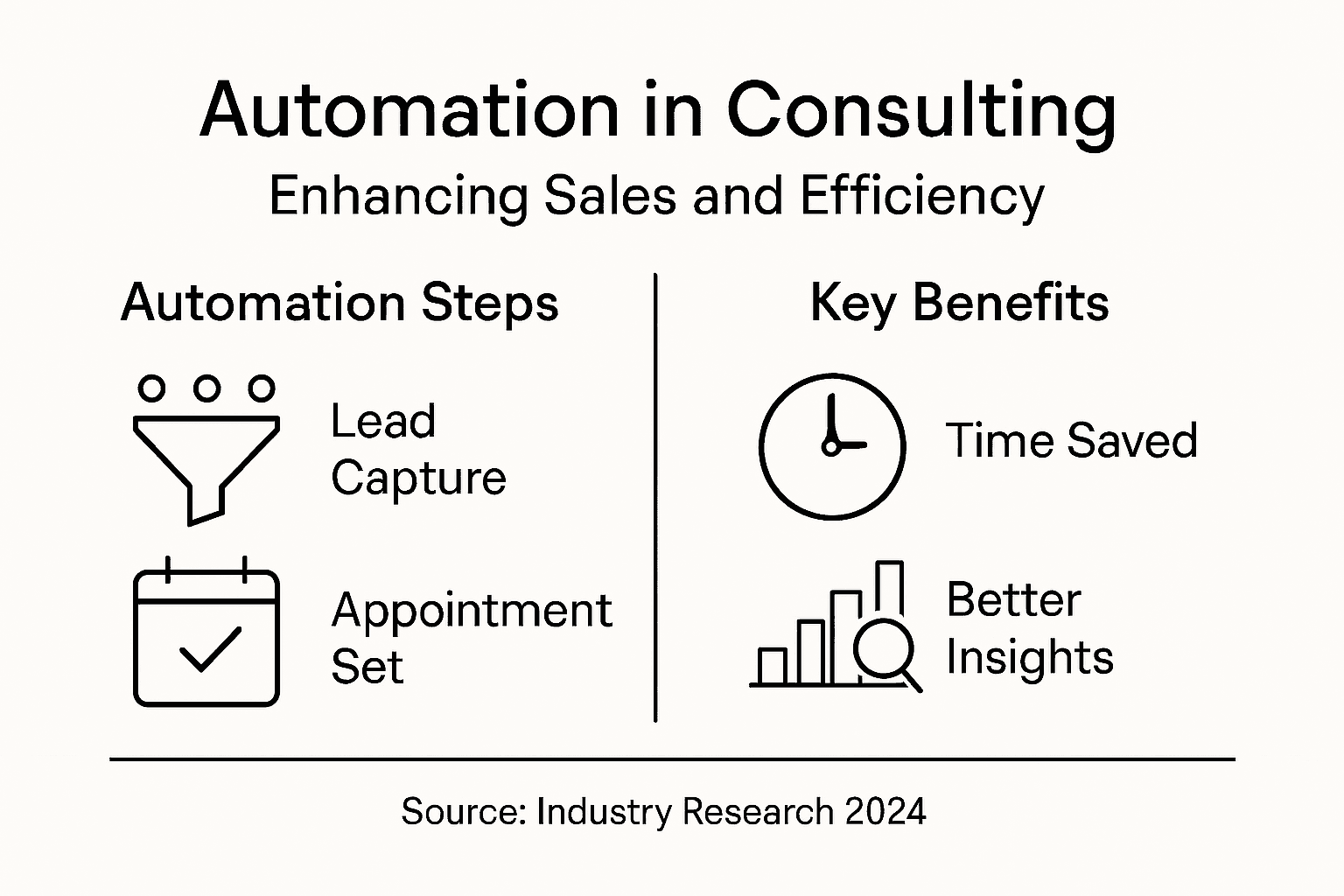
Digital tools transform sales process stages from prospecting to closing, generating deep customer insights and streamlining resource allocation. By integrating sophisticated diagnostic technologies, consultants can move beyond intuition-based strategies toward data-driven, precision-targeted approaches.
The future of consulting lies in creating symbiotic relationships between human expertise and technological capability. This means developing adaptive systems that augment human intelligence, provide predictive insights, and enable more nuanced, responsive client interactions.
Below is a summary showing how automation tools impact key stages of the consulting sales process:
| Sales Stage | Automation Benefit | Business Impact |
|---|---|---|
| Lead Generation | AI-driven targeting | Higher quality pipeline |
| Qualification | Automated scoring | Focus on best-fit clients |
| Proposal Creation | Template automation | Faster response times |
| Follow-Up | Scheduled reminders | Improved client engagement |
| Performance Review | Real-time dashboards | Data-informed strategy changes |
Pro Tip: Invest in one integrated diagnostic tool that provides comprehensive client insights across multiple engagement dimensions.
Common Sales Mistakes and How to Avoid Them
Sales strategies in consulting are fraught with potential pitfalls that can derail professional growth and client relationships. Common sales mistakes emerge from systematic strategic failures rather than individual performance shortcomings.
Most frequent sales mistakes consultants encounter include:
- Price-Driven Negotiations: Overemphasizing cost instead of demonstrating value
- Poor Lead Qualification: Pursuing unqualified prospects with low conversion potential
- Ineffective Communication: Failing to articulate clear, compelling value propositions
- Inadequate Follow-Up: Neglecting consistent, strategic client engagement
- Weak Objection Handling: Responding defensively instead of constructively
Sales failures often stem from fundamental misunderstandings about client needs and expectations. Successful consultants recognize that every interaction is an opportunity to demonstrate expertise, build trust, and create meaningful solutions.
Sales process refinement requires systematic approach that goes beyond traditional reactive methodologies. This means developing robust diagnostic capabilities, creating adaptive communication strategies, and maintaining a continuous learning mindset.
Transforming sales mistakes into growth opportunities demands intentional strategy. Consultants must develop sophisticated listening skills, create structured qualification processes, and maintain unwavering commitment to understanding client context beyond surface-level interactions.
Pro Tip: Implement a post-interaction review process where you critically analyze each sales engagement to identify improvement opportunities.
Elevate Your Consulting Sales Strategy with Freedom Sun
Navigating the complex world of consulting sales requires more than just hustle it demands a shift to strategic systems that prioritize sustainable growth and genuine client trust. If you struggle with adapting your sales approach to meet changing client needs or feel overwhelmed by inefficiencies in your sales process you are not alone. The article highlights critical challenges such as developing flexible sales methodologies, building lasting client relationships, and leveraging automation to enhance performance all while avoiding common pitfalls like poor lead qualification and ineffective communication.
At Freedom Sun we specialize in empowering coaches consultants and service-based entrepreneurs to master these exact challenges. Our interactive training and diagnostic assessments guide you from reactive hustle to a well-architected sales system focused on profitability peace and personal well-being. By integrating strategic sales frameworks and automation tools you gain control over your business growth while fostering authentic trust and authority with clients.
Ready to stop struggling with inconsistent sales and start building a scalable consulting practice Visit Freedom Sun and explore how our comprehensive platform supports you in adopting proven sales strategies designed for sustained impact. Discover how to transform your sales process with actionable insights and systematized workflows that keep your business thriving Visit Freedom Sun now and take the first step toward strategic sales mastery that creates profitable peace today.
Frequently Asked Questions
What are the core principles of a sales strategy for consultants?
The core principles include a customer-centric approach, market adaptability, relationship engineering, and strategic alignment with broader business goals.
How can consultants shift from a hustle-driven approach to a strategic system?
Consultants can shift by documenting processes, measuring outcomes rather than hours worked, prioritizing high-value clients, and implementing systematic task management strategies.
What common sales mistakes should consultants avoid?
Common mistakes include price-driven negotiations, poor lead qualification, ineffective communication, inadequate follow-up, and weak objection handling.
How does automation enhance the sales process for consultants?
Automation enhances the sales process by providing customer data analytics, automating lead qualification, personalizing communication, and enabling real-time performance tracking.
Recommended
- Sustainable Business Scaling Guide for Lasting Success
- 7 Proven Wealth-Building Strategies for Founders
- Business Coach Leadership Training: Transforming Founder Success
- Master Leadership Mindset for Strategic Growth Success
- Scalable Branding: Boosting Creative Business Growth
- Certification for Client Trust: Strategic Benefits in UK SMEs