How to Start a Business Coaching Business for Profit

Starting a business coaching career often means juggling high aspirations with the realities of unpredictable growth and lingering misconceptions. As workplace coaching quickly becomes one of the fastest-growing performance-enhancing tools for organizations, many aspiring coaches still struggle to define what sets genuine business coaching apart from consulting or quick-fix solutions. This article clears up the most common misunderstandings, helps you see the true impact of business coaching, and outlines proven frameworks so you can build a profitable practice while protecting your health and energy.
Table of Contents
- Defining Business Coaching And Key Misconceptions
- Core Coaching Models And Niche Variations Explained
- Building A Strategic System For Sustainable Growth
- Legal, Financial, And Certification Requirements
- Client Acquisition, Automation, And Brand Authority
- Mistakes To Avoid For Scalable, Profitable Success
Key Takeaways
| Point | Details |
|---|---|
| Business Coaching is Transformational | It is a strategic partnership focused on personal development and systemic performance improvement, not a quick fix. |
| Choose the Right Coaching Model | Different coaching models exist such as Leadership, Performance, and Executive Coaching, tailored for specific audiences and goals. |
| Implement a Sustainable Coaching System | Develop a comprehensive strategy involving client management, revenue modeling, and marketing to ensure scalable outcomes. |
| Avoid Common Pitfalls | Coaches must establish clear business plans and processes to avoid operational errors and inconsistent client acquisition strategies. |
Defining Business Coaching and Key Misconceptions
Business coaching is a strategic partnership designed to help entrepreneurs, leaders, and professionals unlock their full potential and achieve extraordinary business results. Unlike traditional consulting, coaching focuses on personal transformation, skill development, and systemic performance improvement. Workplace coaching has rapidly emerged as a powerful intervention for organizational growth and individual development.
At its core, business coaching involves a professional relationship where a trained expert helps clients:
- Clarify business vision and goals
- Develop actionable strategic plans
- Overcome performance barriers
- Build leadership capabilities
- Enhance personal and professional effectiveness
Common misconceptions about business coaching often stem from a lack of understanding about its true purpose and methodology. Many people mistakenly believe coaching is:
- Just another form of consulting
- A quick fix for complex business challenges
- Only for struggling businesses or underperforming leaders
- Purely theoretical without practical application
These assumptions could not be further from the truth. Business coaching is a nuanced, highly personalized process that combines psychological insight, strategic planning, and performance optimization. It’s not about telling clients what to do, but empowering them to discover their own solutions and potential.
Effective business coaching transforms individual potential into organizational excellence, bridging the gap between current performance and future aspirations.
The evolution of business coaching has been significant, especially in the post-pandemic landscape. Technology and formal training have refined coaching methodologies, making them more data-driven and results-oriented. Modern business coaches leverage sophisticated assessment tools, psychological frameworks, and strategic models to deliver targeted, measurable outcomes.
Pro tip: When selecting a business coach, prioritize practitioners with verifiable credentials, proven track records, and a systematic approach to performance enhancement.
Core Coaching Models and Niche Variations Explained
Business coaching is not a one-size-fits-all approach, but rather a dynamic field with multiple specialized models designed to address diverse organizational and individual needs. Contemporary coaching embraces multifaceted interventions that integrate technology, evidence-based practices, and contextual frameworks for maximum impact.
The primary coaching models can be categorized into several key variations:
- Leadership Coaching: Focuses on developing executive capabilities and strategic thinking
- Performance Coaching: Targets specific skill enhancement and professional development
- Career Coaching: Helps professionals navigate career transitions and growth trajectories
- Executive Coaching: Tailored for senior leaders and C-suite executives
- Entrepreneurial Coaching: Specialized support for business founders and startup leaders
Each coaching model brings unique methodological approaches and targeted outcomes. Performance coaching, for instance, concentrates on identifying and eliminating performance barriers, while leadership coaching delves deeper into systemic organizational transformation and personal leadership development.
To highlight the distinctions between coaching models, here’s a concise comparison:
| Coaching Model | Target Audience | Primary Focus | Typical Outcome |
|---|---|---|---|
| Leadership Coaching | Executives, managers | Strategic thinking, vision | Stronger leadership skills |
| Performance Coaching | Professionals, employees | Skill improvement, barriers | Enhanced productivity |
| Career Coaching | Job seekers, professionals | Career transitions, goals | Clear career direction |
| Executive Coaching | Senior leaders, C-suite | Organizational influence | Improved executive impact |
| Entrepreneurial Coaching | Business founders, startups | Startup strategies, growth | Accelerated business launch |
Effective coaching models recognize that individual growth is intrinsically linked to organizational success, creating symbiotic pathways for professional advancement.
Niche coaching variations have emerged to address increasingly specialized market demands. Technology startups might require coaches with deep understanding of digital ecosystems, while family-owned businesses need coaches who comprehend complex interpersonal dynamics.
Modern coaching practices increasingly integrate sophisticated assessment tools, psychological frameworks, and data-driven methodologies. This evolution ensures that coaching becomes more precise, measurable, and aligned with specific organizational objectives.
Pro tip: Select a coaching model that precisely matches your professional context, ensuring alignment between your developmental goals and the coach’s specialized expertise.
Building a Strategic System for Sustainable Growth
Successful business coaching requires more than individual expertise – it demands a comprehensive strategic system that creates predictable, scalable outcomes. Business systems optimization transforms coaching from a transactional service into a sustainable, profitable enterprise.
The foundational elements of a strategic coaching system include:
- Infrastructure Development
- Robust client management platforms
- Automated scheduling and communication tools
- Standardized coaching frameworks
- Revenue Modeling
- Tiered service packages
- Recurring revenue streams
- Clear pricing strategies
- Marketing Architecture
- Targeted client acquisition channels
- Personal brand positioning
- Consistent lead generation mechanisms
Effective coaching businesses distinguish themselves through systematized approaches that deliver consistent, measurable results. This means developing repeatable methodologies that can be scaled efficiently, reducing individual variability and increasing professional credibility.
A strategic system transforms individual coaching talent into a reliable, predictable business model that generates consistent revenue and client satisfaction.
Technological integration plays a crucial role in modern coaching systems. Digital tools enable coaches to track client progress, deliver personalized interventions, and create data-driven insights that demonstrate tangible value.

The most successful coaching businesses treat their practice like a sophisticated system – with clear inputs, defined processes, and measurable outputs. This approach shifts coaching from an artisanal service to a professional, replicable business model.
Pro tip: Document every aspect of your coaching process, creating standard operating procedures that can be consistently replicated and gradually refined.
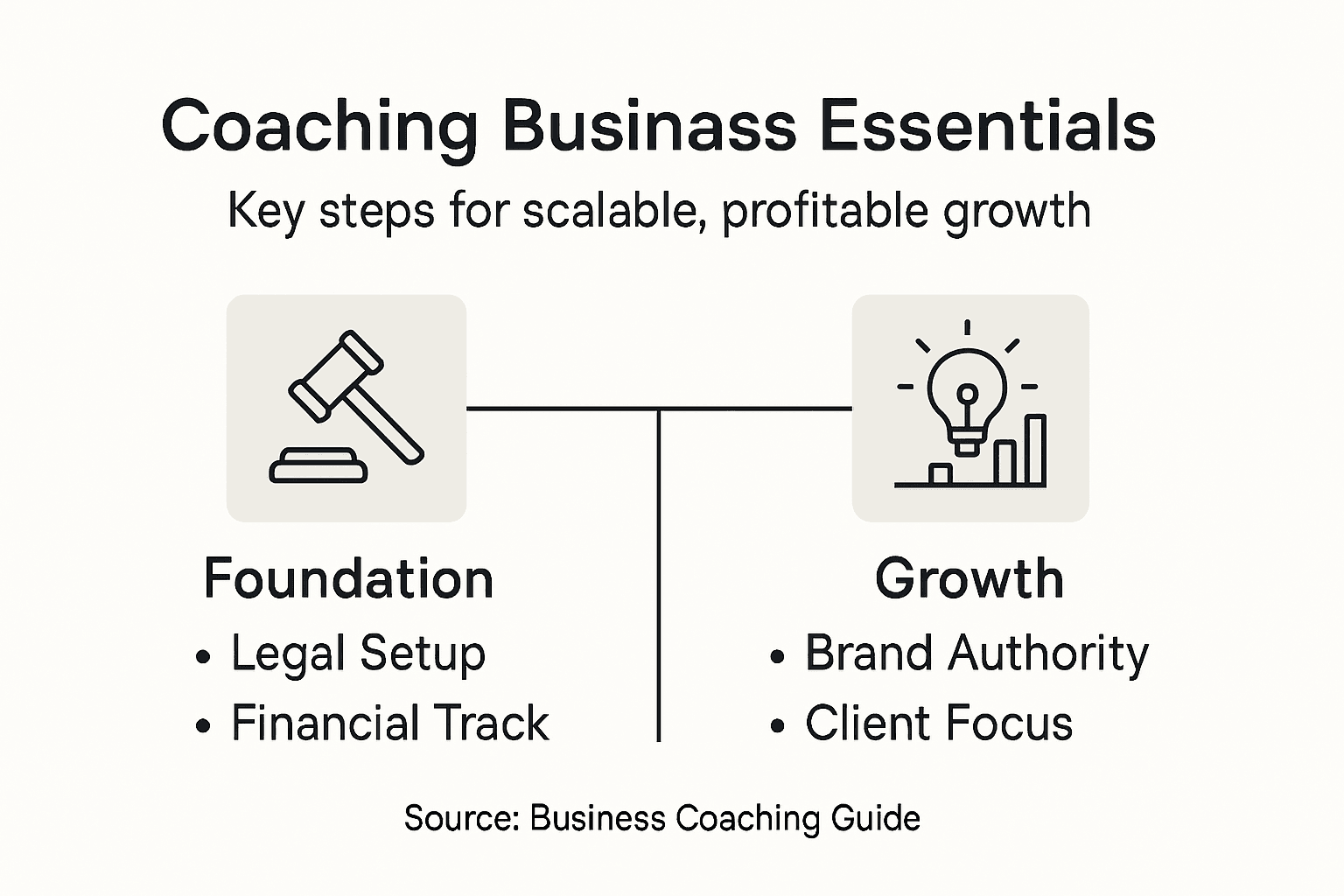
Legal, Financial, and Certification Requirements
Launching a business coaching practice requires navigating complex legal, financial, and professional credentialing landscapes. Professional liability and regulatory compliance form the foundation of a legitimate and trustworthy coaching enterprise.
Key legal and financial considerations include:
- Business Structure Options
- Sole proprietorship
- Limited liability company (LLC)
- S-Corporation
- Professional corporation
- Financial Requirements
- Business bank account
- Separate accounting systems
- Professional tax identification number
- Quarterly tax planning
- Insurance Protections
- Professional liability insurance
- General business insurance
- Errors and omissions coverage
Certification represents a critical differentiator in the competitive coaching marketplace. While not legally mandatory, professional credentials significantly enhance credibility and client trust. Recognized certification pathways include:
- International Coach Federation (ICF) credentials
- Center for Credentialing and Education certifications
- Specialized industry-specific coaching certifications
- Advanced graduate-level coaching programs
Professional certification transforms coaching from an informal practice into a recognized, credible professional service.
Financial management requires rigorous systems that protect both the business and client interests. This includes transparent pricing structures, clear service agreements, and robust invoicing and payment processes.
The most successful coaching businesses treat legal compliance and professional standards as fundamental business infrastructure, not optional add-ons. This approach builds long-term client trust and professional reputation.
For quick reference, here are major legal and financial requirements when launching a coaching business:
| Requirement Type | Key Actions | Business Impact |
|---|---|---|
| Legal Structure | Choose LLC, S-Corp, or Corporation | Liability and tax advantages |
| Financial Systems | Open business bank account | Clear accounting, easier audits |
| Insurance Coverage | Secure liability/omissions insurance | Risk mitigation, client trust |
| Certification | Gain recognized coaching credentials | Enhanced credibility, client appeal |
Pro tip: Consult with a business attorney and certified accountant to establish proper legal and financial foundations before launching your coaching practice.
Client Acquisition, Automation, and Brand Authority
Successful business coaching requires a sophisticated approach to client acquisition that blends strategic marketing with intelligent technology. Client acquisition automation transforms traditional lead generation into a streamlined, predictable system that consistently attracts high-quality prospects.
Key strategies for building brand authority and acquiring clients include:
- Digital Positioning
- Develop thought leadership content
- Create targeted social media presence
- Publish industry research and insights
- Automated Marketing Channels
- Email nurture sequences
- Webinar and workshop funnels
- Retargeting advertising campaigns
- Credibility Building
- Client testimonial systems
- Case study development
- Speaking and podcast appearances
Technological tools play a critical role in modern client acquisition. Automated coaching ecosystems enable coaches to maintain consistent engagement without sacrificing personalization.
Effective automation transforms client acquisition from a manual hustle into a predictable, scalable business system.
Brand authority emerges from consistently demonstrating expertise, delivering measurable client results, and leveraging technology to create seamless client experiences. This means developing a robust digital infrastructure that communicates professionalism and competence.
Successful coaches understand that client acquisition is not about volume, but about attracting ideal clients who align with their unique methodology and value proposition. Automation and strategic positioning make this targeted approach possible.
Pro tip: Invest in creating a signature coaching methodology that differentiates you, then systematically communicate its unique value through multiple digital channels.
Mistakes to Avoid for Scalable, Profitable Success
Building a successful business coaching practice requires strategic awareness and intentional avoidance of common pitfalls that derail professional growth. Coaching business mistakes can significantly impact long-term sustainability and profitability.
Critical mistakes that coaches must proactively prevent include:
- Strategic Errors
- Lack of clear business planning
- Inconsistent client acquisition approaches
- Undefined target market
- Poorly structured service offerings
- Operational Pitfalls
- Attempting to handle all tasks independently
- Inadequate technology integration
- Inconsistent pricing strategies
- Limited scalability frameworks
- Marketing Misconceptions
- Relying on generic marketing tactics
- Neglecting personal brand development
- Failing to demonstrate unique value proposition
- Inconsistent client communication
The most destructive mistake is attempting to build a coaching business without a systematic approach. Successful coaches understand that scalability requires deliberate infrastructure, not just individual talent.
Sustainable coaching success emerges from strategic systems, not heroic individual efforts.
Professional coaches must transition from a transactional mindset to a strategic business model. This means developing robust processes for client acquisition, service delivery, and continuous improvement that can operate independently of individual effort.
The coaching marketplace rewards those who treat their practice as a sophisticated business system, not a passion project. This requires continuous learning, technological adaptation, and a commitment to creating repeatable, scalable methodologies.
Pro tip: Document every client interaction, service process, and business workflow to create a comprehensive operational playbook that enables consistent, predictable growth.
Transform Your Business Coaching Vision Into a Scalable Success
Starting a profitable business coaching practice presents challenges like building strategic systems, mastering client acquisition, and establishing credible certification. The article highlights common hurdles such as inconsistent marketing, unclear target markets, and the need for structured operational frameworks. If you are eager to overcome these obstacles, develop automated client acquisition processes, and shift from hustle culture to strategic management, the right support is essential.
At Freedom Sun, we empower coaches, consultants, and service entrepreneurs to design resilient business architectures rooted in sales, communication, and financial mastery. Our interactive training and diagnostic assessments help you move beyond transactional coaching toward sustainable growth with mental resilience and profitability at the core. Whether you want to launch your own coaching practice or build a scalable, system-driven enterprise, explore our resources and certification programs tailored to your goals today. Don’t wait to create your profitable peace; visit Freedom Sun now and start turning your coaching dreams into a thriving business.
Explore our proven methodologies and become a certified business coach who leads with confidence. Find out how Freedom Sun rebuilds coaching practices with strategy, technology, and community to help you succeed.
Frequently Asked Questions
How do I choose the right business coaching model for my clients?
Selecting a coaching model involves understanding your target audience and their specific needs. Consider models like leadership coaching for executives or career coaching for job seekers, ensuring alignment between the model and the developmental goals of your clients.
What legal and financial requirements do I need to consider when starting a coaching business?
Establish a proper business structure, such as an LLC or S-Corporation, set up a separate business bank account, secure necessary insurance like professional liability, and consider obtaining certification to enhance credibility and client trust.
How can I effectively automate client acquisition for my coaching business?
Utilize automated marketing strategies, including email nurture sequences, webinars, and retargeting ads to consistently attract high-quality clients, ensuring that your brand authority is communicated effectively through digital channels.
What are common mistakes to avoid when building a coaching practice?
Avoid lack of clear business planning, inconsistent pricing strategies, and trying to handle all tasks independently. Develop structured service offerings and a systematic approach to client acquisition for sustainable growth.