Elevate your wealth and mindset in a women entrepreneur community

TL;DR:
- Elite women entrepreneur communities, like the Women Presidents Organization, significantly boost revenue by providing structured peer support and accountability. These communities focus on high revenue thresholds, advanced curricula, and funding insights to close the wealth gap. Mental resilience, challenging strategies, and intentional participation amplify growth and funding access.
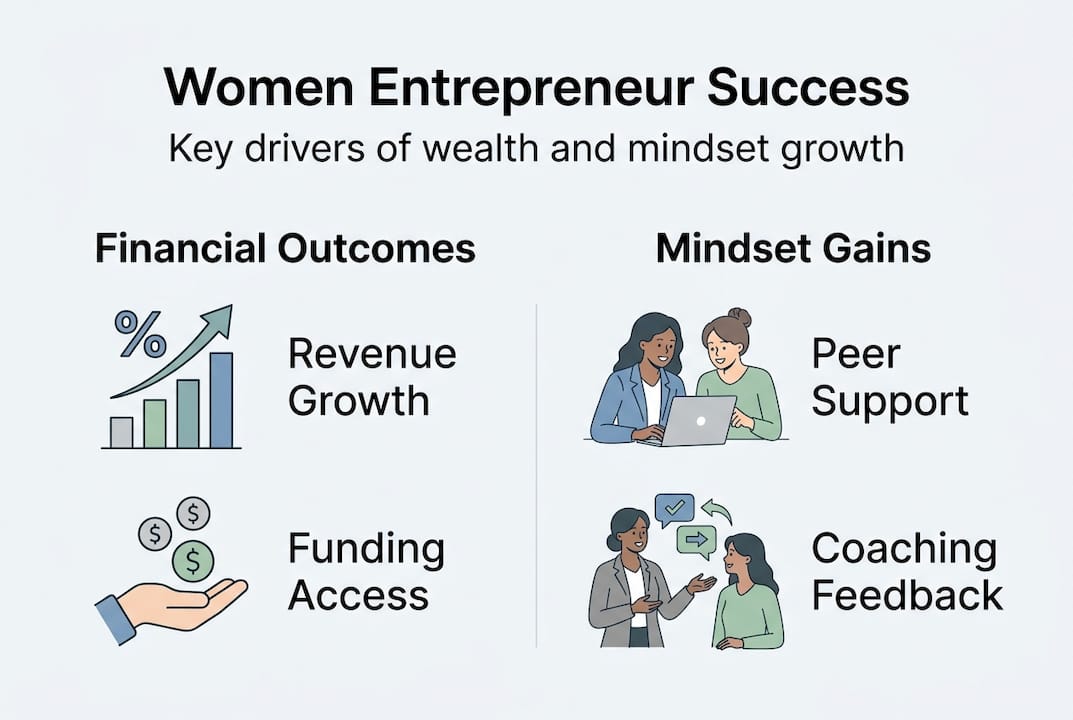
Members of the Women Presidents Organization average $16.2M revenue per company, roughly 31 times higher than the U.S. women-owned business average. That gap is not about talent or effort. It is about environment. The right women entrepreneur community gives you peer intelligence, structured accountability, and the psychological scaffolding that solo scaling simply cannot provide. This guide breaks down what separates elite communities from superficial networks, how advanced peer groups close the wealth gap, and exactly how to extract maximum value from the communities you choose to invest in.
Table of Contents
- What defines a successful women entrepreneur community?
- How advanced community support closes the wealth gap
- Addressing psychological barriers in women entrepreneur circles
- Practical playbook: Maximizing value from an elite women entrepreneur community
- Why most women entrepreneur communities miss the mark for advanced founders
- Next steps: Join a powerful network to propel your business
- Frequently asked questions
Key Takeaways
| Point | Details |
|---|---|
| Elite community impact | Top women entrepreneur communities drive up to $16M average revenue per company. |
| Closing the wealth gap | Strategic communities help increase funding rates and achieve faster business growth for women. |
| Overcoming barriers | Peer support and learning are crucial for tackling psychological hurdles to assertive decision-making. |
| Maximize membership | Advanced founders extract the most value by prioritizing structured education and accountability within their communities. |
What defines a successful women entrepreneur community?
The word “community” gets used for everything from a Facebook group to a $25,000 annual mastermind. That range matters because the structure of a community determines the outcomes it can actually produce for an experienced founder.
High-impact women entrepreneur communities share a specific set of characteristics that set them apart from general networking circles. The most important is a high barrier to entry. The Women Presidents Organization requires members to lead multi-million-dollar businesses and centers its work on peer advisory, executive education, and signature events such as the Entrepreneurial Excellence Forum. That selectivity is intentional. When everyone in the room is operating at a high level, the floor of the conversation rises dramatically.
Here is what separates truly elite communities from well-meaning but surface-level ones:
- Revenue-based membership thresholds that filter for founders already generating meaningful revenue
- Professionally facilitated peer groups where a trained facilitator keeps discussion focused and productive
- Advanced curriculum tracks covering topics like AI integration, exit planning, and equity structuring
- Event-driven benchmarking so members can measure their metrics against peers in comparable industries
- Accountability structures with defined check-ins, stated commitments, and peer follow-through
The financial outcomes speak clearly. While the average U.S. women-owned business generates under $520,000 annually, WPO members average $16.2M per company. That is not a coincidence. It reflects what happens when peer support for entrepreneurs at scale is structured around outcomes rather than connection.
Consider the contrast in a simple comparison:
| Community type | Typical member revenue | Primary focus | Accountability structure |
|---|---|---|---|
| General women’s networking group | Under $100K | Introductions and visibility | Low or informal |
| Mid-tier mastermind | $200K to $1M | Strategy and motivation | Moderate |
| Elite peer advisory (WPO-style) | $1M and above | Revenue growth, exit, leadership | High and professionally facilitated |
| Industry-specific consortium | Varies | Niche expertise | Varies |
Events are a particularly underused lever. Industry events for women founders that include specialized tracks on succession planning, AI-driven operations, or investor readiness go far beyond a keynote and a cocktail hour. They create structured opportunities to learn, benchmark, and build the kind of relationships that turn into referrals, partnerships, and co-investment.
“The moment I stopped going to events to collect business cards and started going to find three people who could challenge my thinking, my revenue trajectory changed completely.” — A sentiment shared repeatedly by seven-figure founders inside elite peer communities.
The bottom line is this: if you are already generating revenue and still attending communities that treat you like a beginner, you are leaving both money and intellectual capital on the table.
How advanced community support closes the wealth gap
Understanding what makes a strong community is the first step. Now examine the tangible financial outcomes these groups create and why they matter for women entrepreneurs specifically.
The most recent data shows that women-owned businesses saw a 15% year-over-year revenue increase, reaching an average of $519,886, with a $67,035 average funding amount and a 36% funding approval rate. That is genuine progress. But it also reveals how large the gap remains between the average and what is possible inside a high-accountability peer environment.
Here is how that gap closes, step by step:
- Join a curated community with a clear revenue threshold and structured peer groups.
- Audit your financials against member benchmarks within the first 90 days of membership.
- Identify your top three constraints using peer facilitation, not guesswork.
- Access shared funding intelligence, including which lenders, investors, and structures your peers are actually using.
- Implement at least one peer-sourced strategy per quarter and report back with measurable results.
- Use community events to practice pitching, presenting, and negotiating in a psychologically safe environment before doing so externally.
Funding access is a particularly powerful advantage. When you are embedded in a community where peers share their actual funding terms, lender relationships, and approval strategies, you stop operating in an information vacuum. The financial wellness frameworks that work at one revenue level often break down at the next, and peer intelligence fills that gap faster than any course or consultant.
| Revenue stage | Common funding challenge | Community-driven solution |
|---|---|---|
| $200K to $500K | Low approval rates, limited credit history | Peer referrals to proven lenders |
| $500K to $2M | Undercapitalization for growth | Shared deal structures and investor intros |
| $2M and above | Exit readiness, equity management | Advisory-level peer experience |
The psychological dimension of funding is rarely discussed openly. Many women entrepreneurs carry internalized narratives about whether they deserve capital, whether their businesses are “real enough” to raise money, or whether asking for funding signals weakness. Elite communities normalize large funding conversations. When you hear peers in your revenue range routinely discussing $500K credit lines or $2M raises, your own threshold for what feels possible shifts.
This is exactly where financial coaching for founders and community intersect. Strategy alone is not enough. The emotional calibration that comes from hearing peers discuss money without apology is often the trigger for a founder’s next financial breakthrough.
Addressing psychological barriers in women entrepreneur circles
Financial success is only part of the equation. Equally critical is tackling the mental barriers to even greater achievement, because those barriers do not disappear once you hit a revenue milestone.

Research on women entrepreneurs’ psychological barriers confirms that women use social learning and networking to build competencies, but also that rejection sensitivity increases risk aversion and that empowerment is what enables assertive, growth-oriented decision-making. In plain terms: who you surround yourself with directly influences what risks you are willing to take.
Inside elite communities, several mechanisms work to shift this pattern:
- Peer modeling. When you watch a founder you respect make a bold hire, raise prices significantly, or say no to a bad client without apology, your own nervous system registers that this is survivable. This is social learning in action.
- Structured vulnerability. Professionally facilitated peer groups create space where founders can say “I am terrified of this decision” without it undermining their authority. That safety is rare and powerful.
- Accountability that builds confidence. Stating a commitment to the group and following through creates a pattern of self-trust that counteracts imposter syndrome at a behavioral level.
- Access to experienced mentors. Hearing from founders who have already navigated the fear you are currently in collapses the perceived risk of moving forward.
- Normalization of ambition. In a room where everyone is building something large, your own ambition stops feeling excessive or inappropriate.
Building mental resilience as an entrepreneur is not about eliminating fear. It is about creating conditions where fear does not make your decisions for you. Community is one of the most reliable conditions for that outcome.
“Empowerment is not a state of mind. It is a social product. It grows in the presence of others who reflect your capability back to you when you have forgotten it.” — Drawn from the psychological research on women’s entrepreneurial communities.
Pro Tip: Ask your peer group to give you specific feedback on one decision you have been avoiding. Frame it as a business challenge, not a personal struggle. The structured outside perspective almost always reveals that the decision is less risky than your nervous system has been reporting.
Mentoring and coaching support works best when it runs alongside community, not instead of it. A coach can help you process what surfaces in peer groups, integrate new frameworks, and maintain momentum between meetings. The two structures are genuinely complementary.
Practical playbook: Maximizing value from an elite women entrepreneur community
Once mental blocks are removed, advanced entrepreneurs can focus on extracting maximal value from community membership. Joining is the beginning. What you do inside the community determines the ROI.
With 14 million women-owned firms in the United States and 48% of women entrepreneurs reporting a mentorship gap, community-based learning is one of the most scalable solutions available. But the results you get depend almost entirely on how intentionally you participate.
Here is the playbook:
- Set a 90-day community goal before your first meeting. Define what you want to have gained, decided, or changed by day 90. Vague participation produces vague results.
- Volunteer to present a challenge in your first quarter. Putting your real problem in front of the group accelerates trust-building and gets you substantive feedback faster than observing from the sidelines.
- Build three deep relationships before you build thirty shallow ones. Identify the two or three members whose businesses are closest to where you want to be in three years and invest in those relationships deliberately.
- Treat every event as an advanced curriculum module. Review the speaker list and track topics in advance. Arrive with specific questions, not general curiosity. Leadership training for founders compounds fastest when you apply what you learn within 72 hours of hearing it.
- Create a personal benchmarking dashboard. Track your revenue, profit margins, funding terms, and team metrics against community norms. Update it quarterly. Gaps become your growth roadmap.
- Use the community to stress-test major decisions. Before signing a significant contract, hiring a key team member, or restructuring your pricing, bring the decision to your peer group. The quality of feedback from experienced peers far exceeds what you will generate alone.
- Build an exit lens into your participation from day one. Even if you are not planning to sell for a decade, understanding how your peers think about business valuation, virtual CFO structures, and succession changes how you build. Every operational decision looks different when you are building for transferable value.
Pro Tip: After each peer group meeting, write down one thing you committed to and schedule it on your calendar before you leave the room. Founders who translate peer insights into same-week action consistently outperform those who wait for the “right moment” to implement.
The most common mistake experienced founders make in community settings is staying in learning mode instead of shifting into application mode. You have enough information. What you need is accountability and implementation pressure. That is what elite communities, when used well, deliver.
Why most women entrepreneur communities miss the mark for advanced founders
Here is something most community advocates will not say out loud: the majority of women entrepreneur communities are designed for founders who need encouragement, not challenge. That is not a criticism of those founders. But if you are already generating significant revenue and you keep joining groups that celebrate your wins without interrogating your strategy, you are paying for validation when you need friction.
After working with founders across 30 countries, the pattern is consistent. High-revenue women leaders often participate in communities for years without receiving a single uncomfortable question about their business model, pricing architecture, or exit readiness. The community feels warm, the connections feel meaningful, and the revenue stays flat.
What advanced founders actually need is structured intellectual pressure. They need peers who will ask “why haven’t you raised prices in 18 months?” not “wow, you are doing so well.” They need facilitators who push for specificity, accountability, and honest benchmarking. They need access to topics like succession planning, equity sharing, and exit strategy frameworks that most networking groups never touch. The advisor-first growth model that elite firms use is rarely discussed in generalist communities, yet it is precisely the framework that helps founders build businesses with real asset value.
Before joining or renewing with any community, ask three questions: What is the average revenue of current members? Who facilitates the peer sessions and what is their training? What advanced topics are explicitly on the curriculum? If the answers are vague, the community is not built for where you are going.
Next steps: Join a powerful network to propel your business
The research is unambiguous. The structure of your peer environment shapes your revenue ceiling, your funding access, and your psychological capacity to take the risks that growth actually requires. If you are generating revenue and still operating without the kind of rigorous peer accountability described in this guide, that is the gap worth closing first.
Freedom Sun is built for exactly this stage of the journey. Through the Women’s Wealth Collective and live events across the U.S. and Europe, Freedom Sun business training connects experienced women entrepreneurs with the financial strategy, leadership development, and psychological frameworks that move the needle when surface-level networking no longer does. If you are ready to build wealth with the same precision you have brought to building your business, this is where that work continues.
Frequently asked questions
What is the average revenue for a women-owned business in 2026?
U.S. women-owned businesses average $519,886 in annual revenue, reflecting a 15% year-over-year increase, though elite peer communities like WPO report member averages more than 30 times higher.
How do women entrepreneur communities help address psychological barriers?
They create structured environments where social learning and peer modeling normalize ambition and reduce the risk aversion that holds many experienced founders back from their next level of growth.
What are the core benefits of joining a high-level women entrepreneur community?
The core benefits include professionally facilitated peer advisory, executive education, benchmarking against high-revenue peers, and access to funding insights and event tracks focused on growth-stage topics.
Are mentorship gaps still a major challenge for women entrepreneurs?
Yes, 48% of women entrepreneurs report a mentorship gap, making structured community participation one of the most direct ways to access experienced guidance at scale.