Virtual CFO: Transforming Financial Leadership for Founders

Scaling a startup often means juggling growth ambitions with financial uncertainty. As the need for strategic financial leadership rises, many founders find it challenging to secure high-level expertise without overextending resources. The emergence of the Virtual CFO bridges this gap by providing cost-effective, flexible access to experienced financial professionals. This article unpacks how Virtual CFOs deliver financial clarity, support rapid business evolution, and help founders build resilient operational systems while keeping burnout at bay.
Table of Contents
- Defining The Virtual CFO Role Today
- Types Of Virtual CFO Services For Startups
- How Virtual CFOs Deliver Financial Clarity
- Integrating Virtual CFOs With System Architecture
- Common Pitfalls And How To Avoid Them
Key Takeaways
| Point | Details |
|---|---|
| Virtual CFO Accessibility | Virtual CFOs make high-level financial management available to startups and small businesses without the need for full-time employment. |
| Proactive Financial Management | They leverage technology to provide real-time financial insights, allowing for strategic planning and risk management. |
| Tailored Services | Virtual CFOs offer customized solutions such as budgeting and working capital optimization, aligning financial strategies with business growth. |
| Clear Communication Requirements | Establishing clear expectations and metrics is essential for successful collaboration and to avoid common pitfalls in Virtual CFO relationships. |
Defining the Virtual CFO Role Today
The modern business landscape has dramatically transformed how financial leadership operates, particularly with the emergence of the Virtual CFO. Traditionally reserved for large corporations with extensive budgets, strategic financial management is now accessible to startups and small businesses through flexible financial expertise.
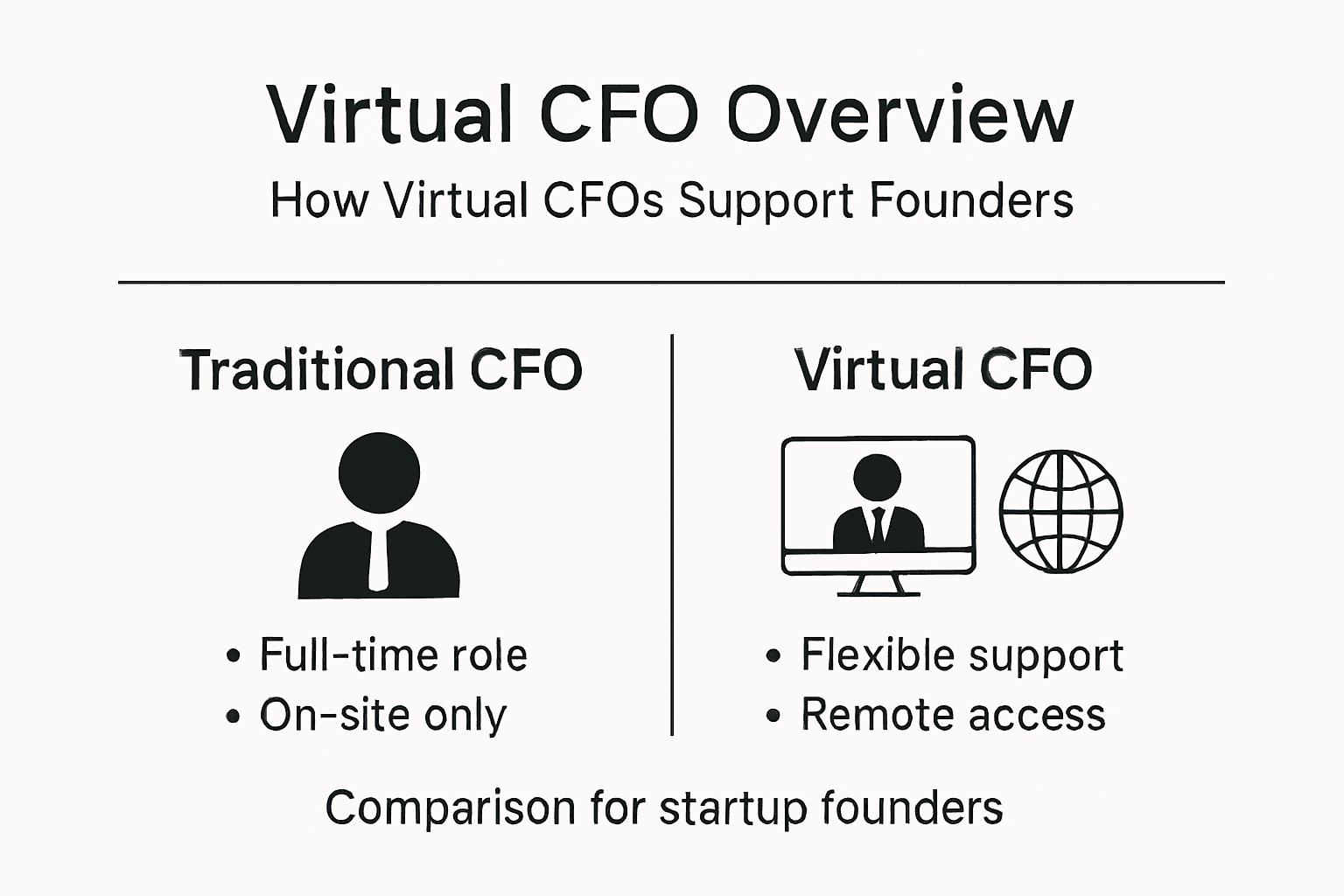
A Virtual CFO represents a strategic financial professional who delivers high-level financial guidance without requiring full-time employment. These seasoned experts provide comprehensive services ranging from detailed financial analysis to strategic planning, enabling businesses to access top-tier financial insights cost-effectively. Unlike traditional CFOs confined to physical offices, Virtual CFOs leverage technology to deliver real-time financial strategies, performance monitoring, and risk management across geographic boundaries.
The core responsibilities of a Virtual CFO extend far beyond basic bookkeeping. They serve as strategic partners who help founders make informed financial decisions, manage cash flow, support capital acquisition, and develop robust financial frameworks. By offering scalable and customized financial leadership, Virtual CFOs empower entrepreneurs to navigate complex financial challenges without the overhead of a full-time executive.
Pro tip: When selecting a Virtual CFO, prioritize professionals with demonstrable experience in your specific industry and a proven track record of helping businesses scale effectively.
Here’s a quick comparison of Traditional CFOs and Virtual CFOs to highlight differences in structure and value:
| Aspect | Traditional CFO | Virtual CFO |
|---|---|---|
| Employment Model | Full-time employee | Part-time/contractor |
| Cost to Company | High salary and benefits | Flexible, pay-as-needed |
| Accessibility | Often large companies only | Startups and small businesses |
| Location | On-site only | Remote, location-independent |
| Technology Use | Limited to office tools | Extensive use of cloud platforms |
| Scalability | Difficult to scale down | Easily scalable services |
| Hiring Speed | Lengthy recruitment process | Quick onboarding and ramp-up |
Types of Virtual CFO Services for Startups
Startups require flexible and strategic financial support, and Virtual CFO services provide a comprehensive range of solutions designed to meet these dynamic needs. Financial management services span from fundamental accounting tasks to high-level strategic planning, enabling entrepreneurs to access professional expertise without substantial overhead.
Typical Virtual CFO services for startups encompass several critical financial domains. These include management accounting and reporting, which involves creating detailed financial statements and performance dashboards. Budgeting system design represents another crucial service, where Virtual CFOs develop customized frameworks that align financial strategies with business growth objectives. Working capital optimization helps startups maximize cash flow efficiency, while profitability and cost management strategies ensure sustainable financial health.

Beyond traditional number crunching, Virtual CFOs act as strategic partners who provide nuanced financial guidance. They support critical decisions around funding, capital acquisition, and investment strategies. By offering tailored financial advisory services, these professionals help founders navigate complex financial landscapes, identify potential risks, and uncover growth opportunities that might otherwise remain hidden.
Pro tip: When engaging a Virtual CFO, request a comprehensive initial assessment that includes a detailed review of your current financial systems and potential improvement areas.
How Virtual CFOs Deliver Financial Clarity
Virtual CFOs transform complex financial data into actionable insights, providing founders with a crystal-clear understanding of their business’s financial landscape. Strategic financial planning enables entrepreneurs to make informed decisions by converting raw financial information into meaningful, comprehensible strategies that drive sustainable growth.
The mechanism of delivering financial clarity involves multiple sophisticated approaches. Virtual CFOs leverage advanced technologies and analytical tools to create comprehensive financial dashboards, performance monitoring systems, and predictive forecasting models. These tools help founders understand critical metrics like cash flow, profitability ratios, and potential financial risks with unprecedented precision. By breaking down complex financial data into digestible insights, they eliminate confusion and provide founders with a transparent view of their financial health.
Moreover, Virtual CFOs go beyond traditional reporting by utilizing AI-driven financial analytics that offer dynamic, real-time insights. They transform routine financial processes through automation, reducing errors and providing rapid, accurate financial assessments. This approach allows founders to shift from reactive financial management to proactive strategic planning, identifying potential opportunities and mitigating risks before they become significant challenges.
Pro tip: Request quarterly strategic review sessions with your Virtual CFO to ensure continuous alignment between financial insights and business objectives.
Integrating Virtual CFOs With System Architecture
Integrating a Virtual CFO into a company’s technological infrastructure requires a strategic approach that goes beyond traditional financial management. Cloud-based accounting platforms enable seamless data synchronization, allowing Virtual CFOs to access real-time financial information and provide comprehensive strategic insights across an organization’s entire technological ecosystem.
The integration process involves connecting multiple financial data sources through sophisticated software solutions. Virtual CFOs leverage advanced technologies that centralize operational, accounting, and performance data, creating a unified financial intelligence system. These technologies include enterprise resource planning (ERP) systems, financial management software, and advanced analytics platforms that enable comprehensive performance tracking and predictive financial modeling.
Modern Virtual CFOs are increasingly utilizing AI-driven financial technologies to enhance system integration capabilities. Machine learning algorithms and automation tools help consolidate complex financial data streams, reduce manual processing errors, and generate dynamic insights that support strategic decision-making. This technological alignment transforms financial management from a reactive reporting function to a proactive strategic partnership that drives organizational growth and efficiency.
Pro tip: Prioritize Virtual CFO candidates with demonstrated expertise in your specific technology stack and proven experience integrating financial systems across diverse digital infrastructures.
The following table summarizes key technologies leveraged by Virtual CFOs and their primary business benefits:
| Technology Solution | Key Benefit |
|---|---|
| Cloud accounting software | Real-time financial access |
| ERP systems | Centralizes diverse business data |
| Financial analytics platforms | Enables predictive modeling |
| AI-driven automation tools | Reduces manual errors and saves time |
| Performance dashboards | Monitors KPIs efficiently |
Common Pitfalls and How to Avoid Them
Founders often encounter significant challenges when integrating Virtual CFO services, with the most critical mistakes stemming from misaligned expectations and poor communication. Ineffective collaboration strategies can derail the potential benefits of financial leadership, transforming what should be a strategic partnership into a frustrating administrative exercise.
One of the most common pitfalls is the lack of clear scope definition and performance metrics. Founders must establish precise expectations about deliverables, communication frequency, and strategic involvement. This includes defining specific reporting standards, outlining decision-making frameworks, and creating transparent mechanisms for performance evaluation. Without these guardrails, Virtual CFO relationships can become ambiguous, leading to misunderstandings and suboptimal financial guidance.
Technology integration presents another significant challenge that founders must carefully navigate. Strategic financial platforms require careful selection and implementation to ensure seamless data flow and meaningful insights. Founders should avoid relying on fragmented spreadsheets or disconnected systems, instead investing in integrated financial technologies that enable real-time collaboration, comprehensive data analysis, and dynamic strategic planning. The goal is creating a unified financial intelligence system that supports agile decision-making.
Pro tip: Create a comprehensive onboarding document that clearly outlines your business goals, technological infrastructure, and specific expectations before engaging a Virtual CFO.
Elevate Your Financial Leadership with Freedom Sun
The article perfectly highlights the challenges founders face when managing complex financial realities without a full-time CFO. You confront the difficulty of gaining clear, strategic financial insights while avoiding burnout and operational chaos. If you are striving to transform your business financial systems from reactive to proactive, the powerful MATH pillar of the Operating System framework offers expert guidance to build that clarity and control.
Freedom Sun is designed specifically for entrepreneurs like you who need proven methods to build robust financial systems coupled with resilient leadership. Through interactive training, diagnostic assessments, and a supportive community, you learn to architect scalable financial and operational frameworks modeled after Fortune 500 CFOs. This approach helps you cut through confusion, avoid common pitfalls, and gain sovereignty over your systems while nurturing peace of mind.
Ready to move from overwhelm to strategic mastery and sustainable growth? Explore how Freedom Sun’s Operating System equips founders with the tools to automate, optimize, and lead effectively without burnout. Visit Freedom Sun now to fuel your financial empowerment journey and transform your leadership for lasting success.
Frequently Asked Questions
What is a Virtual CFO?
A Virtual CFO is a strategic financial expert who provides high-level financial guidance to businesses without being a full-time employee. They leverage technology to offer services like financial analysis, performance monitoring, and strategic planning.
What services do Virtual CFOs provide for startups?
Virtual CFOs offer a range of services including management accounting, budgeting system design, cash flow optimization, profitability management, and strategic financial advisory to help startups navigate their financial landscape effectively.
How do Virtual CFOs enhance financial clarity for businesses?
Virtual CFOs utilize advanced technologies and analytical tools to transform complex financial data into actionable insights. They create comprehensive financial dashboards, predictive forecasting models, and provide real-time analytics to aid decision-making.
What are the common pitfalls when integrating Virtual CFO services?
Common pitfalls include misaligned expectations, unclear scope, and ineffective communication. Founders should establish precise deliverables, communication frequency, and performance metrics to avoid misunderstandings and maximize the benefits of the partnership.