Overcoming fear of rejection in sales: women entrepreneurs

TL;DR:
- Fear of rejection is heightened for women entrepreneurs due to systemic barriers and limited resources.
- Core beliefs about money and self-worth drive sales success and can be changed through mindset work.
- Building systems like CRMs and community support sustain sales momentum and reduce emotional guesswork.
Fear of rejection stops more sales careers than lack of skill ever will. Call reluctance causes 80% of new salespeople to fail in their first year, and women entrepreneurs carry an extra weight on top of that. You’re navigating funding gaps, mentorship shortages, and a business culture that wasn’t designed with you in mind. The result is a fear that feels deeply personal, even when the data tells a different story. This guide breaks down why that fear runs so deep, what beliefs are quietly driving your results, and what you can do right now to move forward with confidence and consistency.
Table of Contents
- Why fear of rejection is different for women entrepreneurs
- Core beliefs that drive sales outcomes
- Frameworks for handling rejection and building resilience
- Systems and community: Momentum beyond willpower
- Why most advice about sales rejection misses the mark
- Move from fear to financial growth with expert support
- Frequently asked questions
Key Takeaways
| Point | Details |
|---|---|
| Beliefs drive results | Changing your beliefs about rejection and money is more powerful than learning new sales tactics. |
| Leverage frameworks | Use structured, proven frameworks like growth mindset training and role-play for lasting confidence. |
| Mentorship matters | Access to mentors and peers accelerates growth and helps you persist when rejection hits. |
| Systems beat willpower | Tracking sales activities and wins with technology builds resilience, even on tough days. |
Why fear of rejection is different for women entrepreneurs
Rejection stings for everyone. But the fear of it lands differently when you’re a woman running a business. It’s not just about a lost deal. It connects to years of navigating spaces where the rules weren’t written for you, where your credibility gets questioned faster, and where the systemic barriers are real and measurable.
Consider the numbers. Women-owned businesses generate $2.7T but receive only 2.1% of venture capital funding. Nearly half of women entrepreneurs, 48%, report a lack of mentorship as a major obstacle. These aren’t soft challenges. They shape how you show up in a sales conversation.
“When external systems consistently reject your growth, the brain starts to anticipate rejection before it even happens. Sales becomes another arena where failure feels pre-loaded.”
This psychological pattern is important to understand. When rejection is a recurring experience across funding, partnerships, and credibility, your nervous system starts treating a sales call the same way it treats a threat. You hesitate. You discount your prices. You over-explain. You wait for the right moment that never quite arrives.
Here’s a quick look at how the landscape stacks up for women entrepreneurs compared to the broader business population:
| Metric | Women entrepreneurs | Broader average |
|---|---|---|
| VC funding received | 2.1% | ~15% for mixed teams |
| Loan rejection rate | 10% higher than men | Baseline |
| Mentorship access | 48% lack mentors | Lower gap for men |
| Call reluctance failure rate | Up to 80% in year one | Same, but compounded |
The gap isn’t imaginary. It’s documented. And closing it starts with understanding the role of mindset in sales growth as a genuine business skill, not just a motivational concept. When you see mindset as infrastructure, the work of changing it becomes purposeful and practical rather than vague and optional.
Core beliefs that drive sales outcomes
Here’s what most sales training gets wrong: it focuses on techniques while ignoring the beliefs underneath them. But research is clear that top performers differentiate via beliefs like comfort with money, not just polished pitching skills. You can memorize every objection-handling script in existence and still freeze when a high-value client pushes back.
This is what’s often called Sales DNA, the underlying belief system that determines whether your skills actually get used under pressure. If your Sales DNA is working against you, tactics won’t save the call.
Some of the most common belief gaps that quietly derail women entrepreneurs in sales include:
- “My price is too high.” This belief causes preemptive discounting before the client even reacts.
- “I don’t want to seem pushy.” This leads to soft closes, buried calls to action, and deals that stall forever.
- “If they say no, it means I failed.” This makes every rejection feel personal rather than informational.
- “I should wait until I’m more ready.” This keeps high-potential entrepreneurs invisible for years.
- “People with money are different from me.” This belief creates invisible distance during conversations with premium buyers.
These beliefs often live below conscious awareness. You don’t think them in words. You feel them as a tightening in your chest right before you state your price, or a rush to fill silence after presenting your offer.

Pro Tip: Write down the last three sales conversations where you felt uncomfortable. Look for the pattern. What belief was active in each one? Naming it is the first move toward changing it.
Building a stronger foundation starts with honest assessment. Resources on growth mindset for entrepreneurs and a clear look at your financial mindset for growth can help you locate the specific beliefs worth rewriting. The work isn’t about positive thinking. It’s about identifying which mental programs are running your sales results without your permission.
Frameworks for handling rejection and building resilience
With the right beliefs as a foundation, the next step is adopting practical frameworks to conquer fear and power business growth. Growth mindset training, role-play, and activity tracking each accelerate sales success and resilience in measurable ways. The key is knowing which one to use and when.
Here’s how the three main frameworks compare:
| Framework | Effort level | Primary benefit | Best outcome |
|---|---|---|---|
| Role-play practice | Medium | Reduces performance anxiety | More confident delivery |
| Activity tracking | Low to medium | Builds data-based confidence | Replaces fear with feedback |
| Growth mindset training | High (long-term) | Rewires response to rejection | Sustained resilience |
Each framework targets a different layer of the fear. Role-play works on the surface, activity tracking works on your self-narrative, and mindset training works at the belief level. Layering all three is where the real shift happens.
Here’s how to start a simple role-play practice this week:
- Choose one sales scenario you’ve been avoiding, such as raising your price or following up after silence.
- Script out the conversation from both sides, including the most uncomfortable objection you’d expect.
- Practice it out loud, not just in your head. Your voice needs to experience the words before the real call.
- Record yourself and watch it back once. Notice where you soften, rush, or hedge.
- Adjust and repeat until the discomfort drops by at least half.
Pro Tip: Layer role-play with activity tracking by setting a weekly goal of five sales conversations regardless of outcome. Track completions, not results. This separates your identity from the outcome and builds sales resilience faster than any single technique.
If you want to develop a more consultative style that naturally reduces the fear of pushback, the consultative sales approach shifts the entire dynamic. And if you’re already feeling the grind, learning how to be better at sales without burnout is a critical skill in its own right.
Systems and community: Momentum beyond willpower
Frameworks can get you started. But willpower is a limited resource. The women who sustain sales momentum long-term aren’t tougher than everyone else. They’ve built systems and communities that carry them through the low-motivation days.
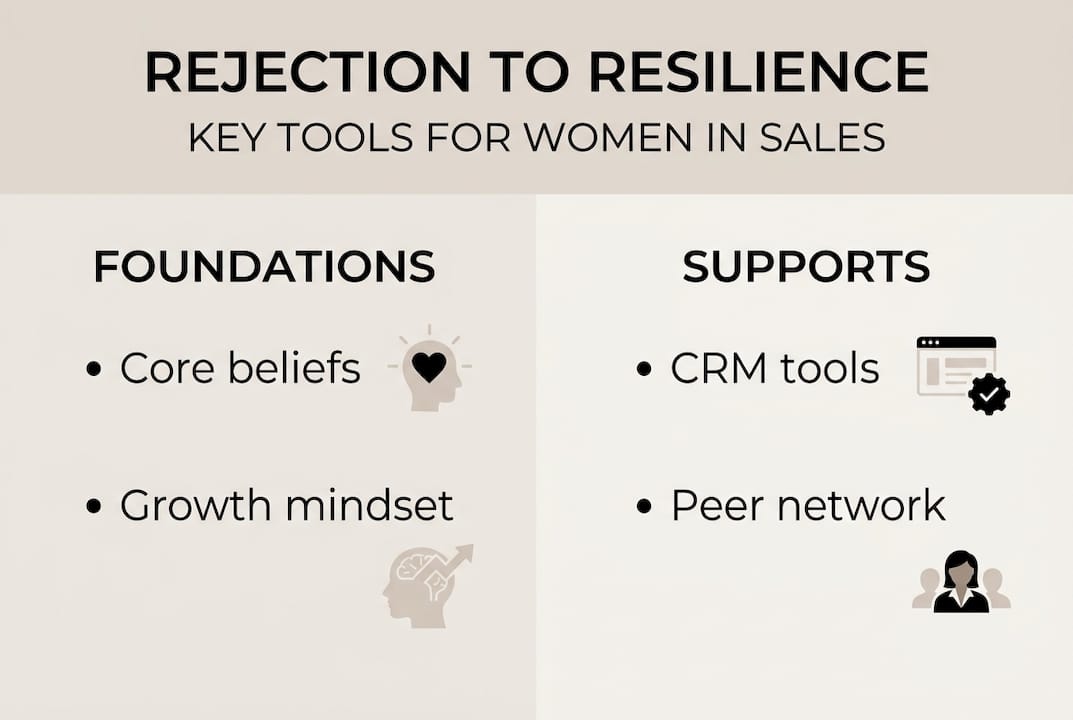
One of the most underused tools in this space is a CRM, which stands for customer relationship management software. CRM and activity tracking accelerate sales momentum significantly. But more importantly for women dealing with rejection fear, a CRM removes the emotional guesswork. Instead of relying on memory and feeling, you have data. You can see that you followed up, that you showed up, that your pipeline is moving, even when a single conversation didn’t go your way.
A CRM essentially turns your sales process into a system rather than a mood. You can learn more about using CRM for success and start treating your follow-up process like the business infrastructure it is.
Community matters just as much. 69% of women lack mentors in business, and that gap is costly. Mentorship isn’t just about strategy. It’s about having someone who has absorbed rejection and kept going, who can normalize the experience and show you what’s actually on the other side of it.
Practical ways to build or find that support:
- Join a women’s business community with an active sales culture, not just a networking group.
- Find a peer accountability partner and schedule weekly debrief calls focused on sales activity, not just wins.
- Look for mentors who have built the kind of business you want, especially in revenue generation and leadership mindset for growth.
- If formal mentorship isn’t accessible, curated masterminds and paid communities often provide a faster, more focused version of the same support.
- Document your own sales wins weekly, even small ones. Become your own evidence base.
Systems and community don’t replace your inner work. They sustain it.
Why most advice about sales rejection misses the mark
Most rejection advice sounds like this: hear more no’s, develop a thick skin, push through discomfort. And while persistence matters, that framing misses something essential. It treats rejection as a volume problem when it’s actually a beliefs problem.
Top performers stand out by changing their beliefs, not by simply enduring more rejections. The difference between a woman who closes consistently and one who stalls isn’t that the first one gets rejected less. It’s that rejection doesn’t activate the same threat response in her nervous system. That’s a belief shift, not a toughness upgrade.
For women entrepreneurs, this distinction is urgent. You’re already operating with fewer systemic resources. Telling you to just push harder without addressing the belief layer underneath is like prescribing running to someone with a stress fracture. The effort backfires.
What actually works is a combination: inner belief work, supported by smart mindset and leadership insights, paired with real systems like CRM tools and structured mentorship. The nervous system needs both the internal shift and the external scaffolding. When you build both simultaneously, rejection stops feeling like a verdict. It becomes information. And that’s when everything in your sales process starts to move.
Move from fear to financial growth with expert support
Reading about these strategies is a strong first step. Applying them consistently, especially while running a business, takes structured support and a community that understands the specific challenges you face. At Freedom Sun, women entrepreneurs find the expert guidance, accountability, and mindset development resources needed to close the gap between knowing and doing. Founded by Simone CR, CPA, with nearly 20 years of experience advising across 30 countries, Freedom Sun bridges financial strategy with the psychology underneath it. If you’re ready to stop letting fear shape your revenue, this is where that work gets real.
Frequently asked questions
Why do women entrepreneurs experience more sales rejection fear?
Women entrepreneurs face structural barriers like 10% higher loan rejection rates and access to only 2.1% of VC funding, which primes the nervous system to anticipate rejection in sales conversations too. These compounding pressures make the fear feel bigger and more personal than it does for others.
What mindset shifts can reduce the fear of rejection in sales?
Adopting a growth mindset and actively reshaping beliefs about money and self-worth are the most powerful moves available to you. Research shows that beliefs about money separate top sales performers from the rest, far more than technique alone.
How can technology support overcoming fear of rejection?
CRM tools track your activity and replace subjective self-doubt with objective data, making it easier to stay consistent after setbacks. Activity tracking accelerates momentum because it ties your confidence to actions taken rather than outcomes received.
Are there proven frameworks for handling sales rejection?
Yes. Role-play, activity tracking, and mentorship frameworks are all backed by evidence and build resilience at different levels of the fear response. Using them together produces faster and more lasting results than applying any single approach on its own.