Role of Mindset in Business Growth Explained

Did you know that over 80 percent of successful entrepreneurs credit their achievements to mindset, not just technical skills? In business, the beliefs you hold about your abilities shape every decision and reaction to setbacks. Shifting your focus from fixed talent to learning and growth opens doors for creativity, resilience, and long-term success. Understanding the role of mindset could be your key to thriving in a competitive business world.
Key Takeaways
| Point | Details |
| Mindset Matters | An entrepreneur’s mindset influences their approach to challenges and growth opportunities, impacting overall business success. |
| Growth Mindset Benefits | Cultivating a growth mindset allows business leaders to view obstacles as learning opportunities, fostering innovation and adaptability. |
| Leadership Impact | Leaders with a growth mindset enhance team dynamics and performance by encouraging continuous learning and openness to feedback. |
| Overcoming Barriers | Psychological barriers, such as self-doubt and fear of failure, can impede business growth, necessitating a shift toward a growth-oriented perspective. |
Defining Mindset in Business Growth
In the dynamic world of entrepreneurship, mindset represents the foundational mental framework that determines how business leaders perceive challenges, opportunities, and their potential for growth. According to research from Eric.ed.gov, mindset is an individual’s established set of attitudes, particularly regarding their own abilities and potential. This internal compass shapes everything from strategic decision making to personal resilience.
A growth mindset fundamentally transforms how entrepreneurs approach business challenges. As documented by Eric.ed.gov, this perspective involves believing that abilities can be developed through dedication and hard work. Entrepreneurs with a growth mindset view obstacles not as insurmountable barriers, but as opportunities for learning and improvement. They understand that skills are not fixed, but can be enhanced through consistent effort, strategic learning, and a commitment to personal development.
Key characteristics of a powerful business growth mindset include:
-
Embracing challenges as learning opportunities
-
Maintaining resilience in the face of setbacks
-
Viewing criticism as constructive feedback
-
Believing in continuous personal and professional improvement
-
Demonstrating adaptability in rapidly changing business environments
While technical skills and strategic planning are critical, your mindset ultimately determines how effectively you’ll navigate the complex landscape of business growth. Those who cultivate a flexible, learning-oriented perspective are more likely to innovate, pivot when necessary, and transform potential obstacles into stepping stones for success. For those seeking to deepen their understanding of mindset transformation, our guide on self-confidence offers practical strategies for personal development.
Types of Mindset: Fixed, Growth, and Beyond
According to groundbreaking research by Eric.ed.gov, psychologist Carol Dweck identified two primary mindset categories: fixed and growth. In a fixed mindset, individuals believe their abilities are static and predetermined, while those with a growth mindset understand that skills and intelligence can be developed through dedicated effort, learning, and persistent practice.
Interestingly, recent research from STEM Education Journal suggests that mindsets are more nuanced than previously thought. People may simultaneously hold different mindsets across various life domains, challenging the traditional binary perspective. This means an entrepreneur might exhibit a growth mindset in business strategy while maintaining a more fixed mindset in personal skill development.
Beyond the traditional fixed and growth mindsets, emerging psychological research explores additional mindset variations:
Here’s a summary of the main business mindset types and their key characteristics:
| Mindset Type | Core Focus | Typical Attitudes & Behaviors |
| Fixed Mindset | Abilities are static | Avoids challenges Fears failure Resists feedback |
| Growth Mindset | Skills develop through effort | Embraces learning Seeks feedback Perseveres through setbacks |
| Benefit Mindset | Collective and individual growth | Prioritizes community Values collaboration |
| Harm Mindset | Risk aversion, protection | Defensive decisions Focuses on minimizing losses |
| Performance Mindset | External achievements | Driven by results Seeks recognition |
| Learning Mindset | Continuous improvement | Seeks new skills Enjoys experimentation |
-
Benefit Mindset: Focuses on personal and collective growth
-
Harm Mindset: Emphasizes risk mitigation and defensive strategies
-
Performance Mindset: Centered on achieving specific external metrics
-
Learning Mindset: Prioritizes skill acquisition and continuous improvement
Understanding these mindset variations can significantly impact business success.
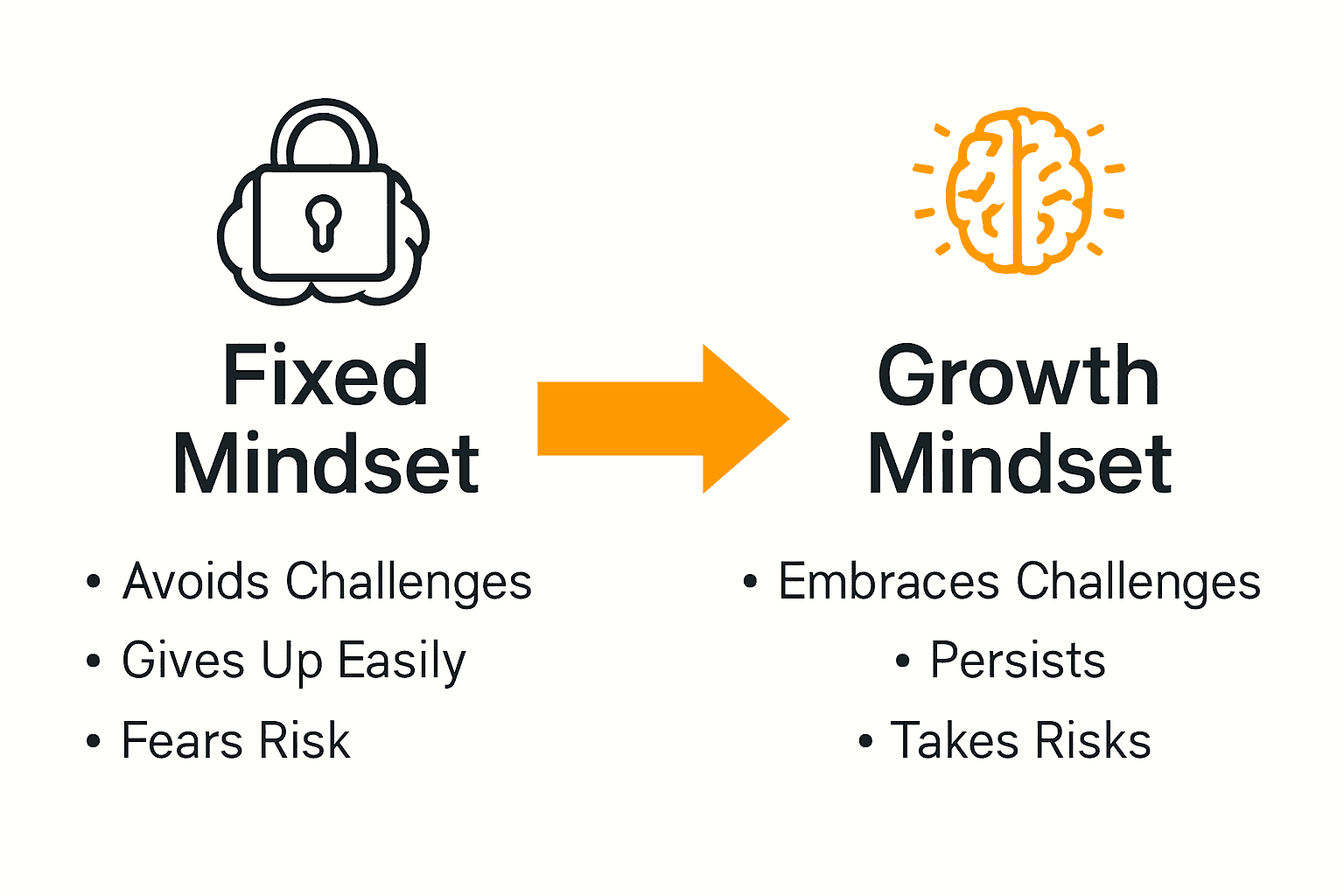
IMAGE:descriptive_key_1] By recognizing and consciously cultivating a flexible, adaptive mindset, entrepreneurs can transform challenges into opportunities. For those interested in deeper personal development strategies, our [guide on self-confidence offers practical insights into mindset transformation.
Impact of Mindset on Leadership and Teams
Leadership is fundamentally a mindset-driven practice. According to research from Eric.ed.gov, leaders with a growth mindset create environments that fundamentally transform team dynamics, encouraging members to develop skills, embrace challenges, and view failures as critical learning opportunities. This approach directly impacts team performance, innovation, and overall organizational resilience.
Research from the STEM Education Journal reveals that teams led by growth-minded leaders are significantly more adaptable in complex business landscapes. These leaders cultivate a culture of continuous learning where team members feel empowered to:- Experiment without fear of punishment- Share innovative ideas openly- Embrace professional development- Collaborate across diverse perspectives- Transform challenges into strategic opportunities
The ripple effect of a leader’s mindset cannot be overstated.
When leadership demonstrates a commitment to personal and collective growth, team members naturally become more engaged, creative, and resilient. This mindset transformation goes beyond individual performance, creating a systemic approach to organizational development. For entrepreneurs seeking to deepen their leadership capabilities, our guide on creating meaningful change offers practical strategies for holistic personal and professional growth.
Common Mindset Barriers to Business Success
Entrepreneurs face numerous psychological obstacles that can dramatically impede business growth. According to research from Eric.ed.gov, a fixed mindset can lead to profound challenges, causing business leaders to avoid risks, fear failure, and ultimately experience stagnation in their professional development. This mental barrier transforms potential opportunities into seemingly insurmountable challenges.
Research from the STEM Education Journal reveals that organizations predominantly operating with a fixed mindset struggle with critical business capabilities, including:
-
Resistance to market adaptation
-
Limited innovation potential
-
Decreased competitive responsiveness
-
Reduced team creativity
-
Inability to pivot during economic shifts
The most damaging mindset barriers typically manifest through specific psychological patterns. Self-doubt, imposter syndrome, fear of vulnerability, and an overwhelming need for perfection can paralyze decision-making processes and prevent entrepreneurs from taking calculated risks. These mental roadblocks create invisible barriers that limit potential, preventing businesses from exploring innovative strategies and embracing transformative opportunities. For entrepreneurs seeking to overcome these challenges and develop more robust communication skills, our communication resources offer strategic insights into breaking through these mental barriers.
Practical Strategies for Cultivating Growth Mindset
Cultivating a growth mindset requires intentional and strategic approaches to personal and professional development. According to research from Eric.ed.gov, organizations can foster growth mindset cultures by emphasizing effort and learning over inherent talent, providing constructive feedback that focuses on process rather than fixed outcomes, and promoting the fundamental understanding that abilities are not static but can be continuously developed.
Research from the STEM Education Journal highlights specific strategies for implementing growth mindset principles:
-
Develop training programs emphasizing skill malleability
-
Create recognition systems that reward learning efforts
-
Encourage experimentation and normalize failure as a learning opportunity
-
Implement regular skill development workshops
-
Foster open dialogue about personal and professional growth
Practical implementation begins with personal commitment and systematic approach. Start by reframing challenges as opportunities, actively seeking feedback, embracing continuous learning, and maintaining curiosity about your potential for growth. Small daily practices like reflective journaling, setting learning-oriented goals, and challenging self-limiting beliefs can dramatically shift your mindset. For entrepreneurs seeking a holistic approach to personal development, our Wheel of Life exercise provides an excellent framework for comprehensive self-assessment and growth planning.
Transform Your Mindset to Drive Real Business Growth
The article highlights a powerful truth: your mindset is the key to unlocking sustainable business success. If you find yourself stuck in limiting beliefs like fear of failure or resistance to change, you are not alone. These common mindset barriers often stop passionate entrepreneurs from reaching their full potential. Imagine shifting from a fixed mindset that fears risk to a growth mindset that embraces challenges as opportunities. This transformation can dramatically boost your leadership, innovation, and resilience.
At SimoneCR.com, we specialize in guiding entrepreneurs through this essential shift. Our coaching and courses focus on mindset shifts, emotional intelligence, and leadership development tailored for business growth without burnout.

Take control of your business future by nurturing a growth mindset today. Explore practical strategies and frameworks designed to overcome psychological roadblocks and cultivate confidence, adaptability, and lasting success. Begin your journey now with our self-confidence guide or deepen your impact through our leadership coaching resources. Visit SimoneCR.com and take the next step toward transforming your mindset and your business.
Frequently Asked Questions
What is the definition of mindset in the context of business growth?
Mindset in business refers to the mental framework that influences how entrepreneurs perceive challenges and opportunities. It shapes decision-making and resilience, ultimately impacting growth potential.
How does a growth mindset contribute to business success?
A growth mindset allows entrepreneurs to view challenges as opportunities for learning, fostering innovation and adaptability. This mindset encourages continuous improvement and helps overcome obstacles, thereby enhancing overall business performance.
What are the key characteristics of a growth mindset in leadership?
Key characteristics of a growth mindset in leadership include resilience, openness to feedback, adaptability to change, and a commitment to continuous learning. Leaders who embody this mindset create supportive environments that inspire team development.
What common barriers do entrepreneurs face that hinder a growth mindset?
Common barriers to a growth mindset include self-doubt, fear of failure, imposter syndrome, and perfectionism. These psychological obstacles can prevent entrepreneurs from embracing challenges and hinder business growth.