Mindset and Leadership: Building Profitable Peace

Many high-growth founders discover that scaling their business is not just about hustle or having a winning product. Instead, growth often stalls when leadership mindsets and systems lag behind revenue targets. Research confirms that mindset influences leadership effectiveness and directly affects organizational outcomes. This matters because the quality of your mindset and the foundation of your financial systems shape how your team responds, innovates, and handles stress. This guide provides clear strategies to help you upgrade both, so you build sustainable growth without burning out.
Table of Contents
- Defining Mindset And Leadership Foundations
- Core Leadership Mindsets For Entrepreneurs
- Financial Systems And Strategic Leadership
- Building Resilience And Mental Wellbeing
- Common Leadership Pitfalls To Avoid
Key Takeaways
| Point | Details |
|---|---|
| Mindset Shapes Leadership | Your mindset influences decision-making and impacts your team’s behavior and performance. Adopting a growth-oriented mindset fosters a culture of trust and accountability. |
| Balanced Leadership Mindsets are Critical | Founders should develop purpose-oriented, people-oriented, and learning-oriented mindsets simultaneously to effectively lead their teams. Each mindset plays a unique role in guiding decisions and team dynamics. |
| Financial Systems are Essential | Robust financial systems provide clarity and enable strategic decisions based on solid data rather than intuition. Without visibility into your finances, your leadership can lack direction. |
| Avoid Common Leadership Pitfalls | Micromanagement, avoiding difficult conversations, and poor delegation undermine team growth and effectiveness. Address these behaviors to create a more empowered and productive environment. |
Defining Mindset and Leadership Foundations
Your mindset is the operating system running beneath every decision you make as a founder. It shapes how you respond to obstacles, interpret market feedback, and allocate your time and money. Mindset isn’t some abstract psychological concept reserved for self-help books—it’s the lens through which you see problems and opportunities in your business. When you face a cash flow dip, does your mindset tell you the market is rejecting your product, or does it tell you that you haven’t found product-market fit yet? That single interpretation shapes your next 10 moves. Research shows that leadership mindsets directly affect organizational outcomes and employee engagement across industries. This matters because your team absorbs your mindset like a sponge. If you operate from scarcity, they’ll hoard information and resources. If you operate from abundance and strategy, they’ll contribute ideas freely.
Leadership, on the other hand, is how you translate that mindset into action through others. It’s the ability to set direction, build systems, and create accountability without being the bottleneck. Many founders confuse leadership with working harder, longer, and closer to every detail. Real leadership is the opposite. It’s about designing structures so that your business runs without you grinding through 60-hour weeks. Mindset development forms a core component of leadership foundations necessary for achieving organizational success. The best leaders don’t have better ideas than their teams—they have better systems for capturing, testing, and implementing those ideas at scale. They’ve built financial transparency through proper accounting, sales infrastructure that doesn’t depend on their charisma, and decision-making frameworks that guide their teams even when they’re not in the room.
These two pieces work together. Without a growth-oriented mindset, you’ll build fragile leadership structures that collapse under pressure because you’re constantly second-guessing your team and reversing decisions. Without solid leadership practices, even the healthiest mindset gets trapped in execution mode. You’ll want to do everything yourself because nobody else knows how to do it right. You end up burned out, your business stays flat, and your team never develops beyond relying on you. The foundation you’re building here is about integrating both: cultivating a mindset that trusts systems and people, then building those systems and people so they’re actually trustworthy. This is what separates founders who scale to $10 million and stay sane from those who hit $2 million and never escape the office.
Pro tip: Start by auditing your response to your last major setback. Did you blame external factors or take ownership? Did you make reactive decisions or pause to think strategically? Your natural response reveals your current mindset, and that’s where real change begins.
Core Leadership Mindsets for Entrepreneurs
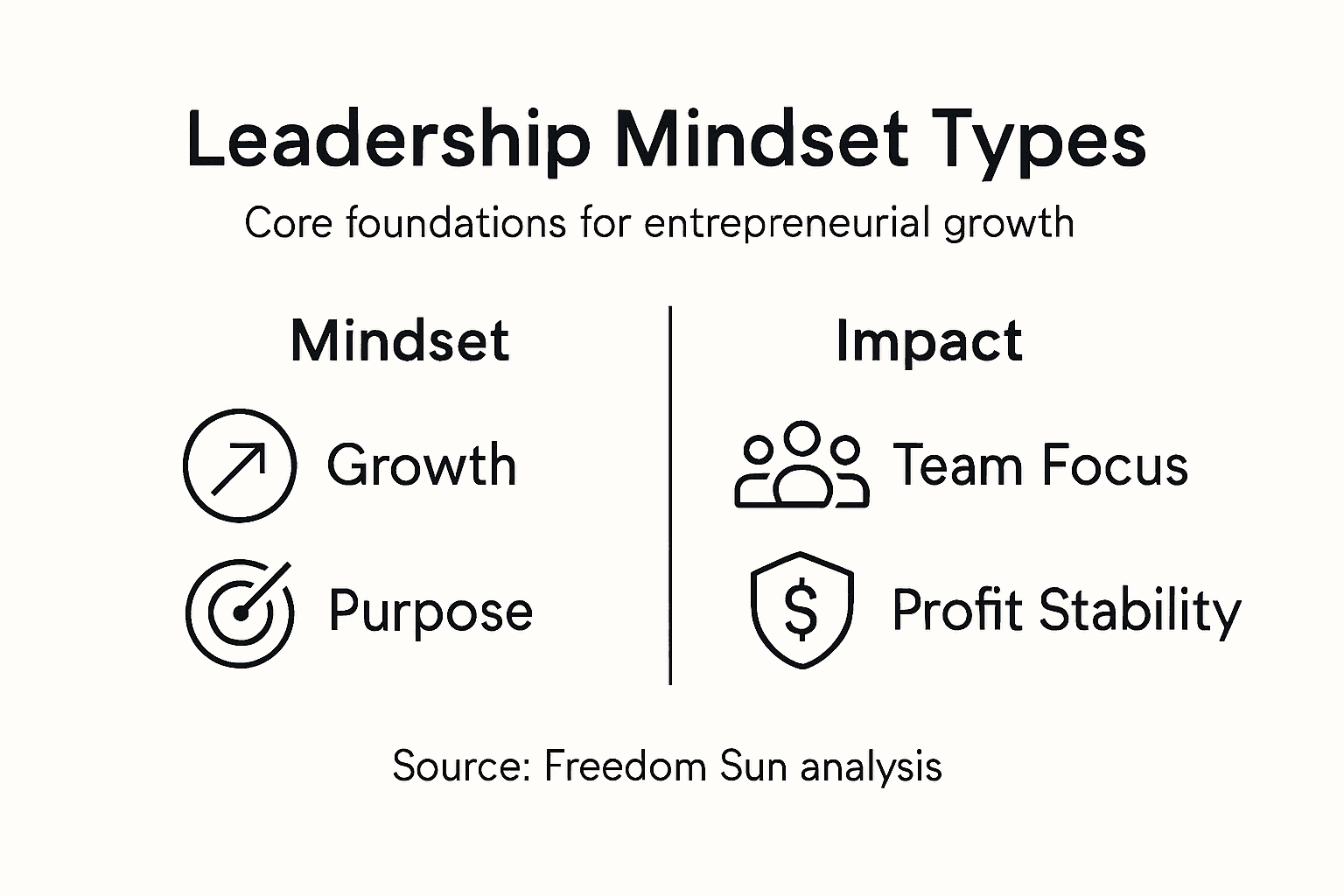
Not all founders lead the same way, and that’s the point. Your leadership effectiveness depends on which mindsets you’ve actually developed and which ones you’re still operating without. Research identifies three distinctive mindsets among entrepreneurial leaders: purpose-oriented, people-oriented, and learning-oriented. These aren’t personality traits you’re born with. They’re mental frameworks you build through deliberate practice, failure, and reflection. A purpose-oriented mindset means you’ve clarified why your business exists beyond making money. It’s the north star that guides your team when you’re not around to make decisions. Without this, your team scrambles during uncertainty because they don’t know what actually matters. A people-oriented mindset means you see your team as the primary asset of your business, not a cost center to minimize. You invest in their development, ask them for their perspective before deciding, and hold yourself accountable to their growth. A learning-oriented mindset means you view setbacks as data, not disasters. When a sales campaign fails, you’re already asking what you’ll do differently next time instead of spiraling about lost revenue.
Here’s where most founders get stuck. They adopt one mindset and ignore the others. The purpose-driven founder builds incredible culture but can’t scale because they won’t delegate. The people-focused founder develops talent beautifully but loses strategic direction. The learning-obsessed founder pivots constantly but exhausts their team with constant change. The reality is that entrepreneurial leadership requires balancing these mindsets to motivate followers and recognize opportunities effectively. Your job is to operate all three simultaneously. This doesn’t mean you’re equally strong in all three right now. Most founders are naturally stronger in one or two. The work is identifying your blind spot and building competency there.
Start with purpose. Can you explain your business’s reason for existing in three sentences without mentioning revenue or market size? If you stumble, you don’t have clarity yet, and neither does your team. Then assess your people-orientation. Do you know your team members’ career goals? Have you had a genuine conversation with them in the last month about their development? If not, you’re leading on assumption, not reality. Finally, examine your learning orientation. When things don’t go as planned, do you schedule a debrief to extract lessons, or do you move on quickly? Your answers reveal where you need to invest your attention.
Pro tip: Write down one recent decision you made as a founder, then identify which of the three mindsets drove that choice. Do the same for your next five decisions. You’ll quickly see which mindsets you’re defaulting to and which ones you’re neglecting.
Here’s a summary of the three essential leadership mindsets for entrepreneurs and their main influence areas:
| Mindset Type | Focus Area | Key Impact |
|---|---|---|
| Purpose-Oriented | Organizational Clarity | Guides team decisions |
| People-Oriented | Team Development | Boosts engagement & growth |
| Learning-Oriented | Responding to Setbacks | Fosters adaptability & growth |
Financial Systems and Strategic Leadership
Here’s the uncomfortable truth most founders avoid: you can have a brilliant mindset and still run a business that’s hemorrhaging money because your financial systems are invisible. Strategic leadership without financial clarity is like flying a plane without instruments. You feel like you’re making good decisions, but you’re actually flying blind. Your financial systems are the foundation that allows your leadership decisions to have teeth. When you can see exactly where money is coming in and going out, where it’s stuck, and what’s actually profitable, your strategic decisions stop being guesses. They become directives rooted in data. Effective strategic leadership combined with robust financial systems positively influences organizational performance. This isn’t just true in universities or corporations. It’s true in your business right now. If you can’t articulate your unit economics because your books are a mess, you’re making decisions based on intuition instead of reality. Your team mirrors this chaos. They don’t know if they should push for more volume or higher margins because leadership hasn’t given them clear financial targets.
The connection runs both directions. Your strategy informs what financial systems you need, and your financial systems reveal whether your strategy is actually working. Say your strategy is to become the premium option in your market. That sounds great until your financial systems show that your customer acquisition cost is so high that only 40 percent of your customers ever become profitable. That data forces a strategy conversation. Are you actually positioned as premium, or are you just priced high? Most founders skip this analysis because their accounting is too messy to extract the information. They stay stuck repeating the same mistakes because they never see the pattern. Strategic leadership requires aligning financial management with decision-making to navigate competitive challenges and maintain sustainability. Your systems need to answer specific questions: What’s your gross margin by product line? What’s your customer lifetime value versus acquisition cost? How much cash do you have runway for? What’s your monthly burn rate? If you can’t answer these in under five minutes, your financial systems are failing you.
Building this doesn’t mean becoming a spreadsheet expert. It means deciding which metrics actually matter for your business and then structuring your accounting to capture them automatically. Most founders either ignore their numbers entirely or obsess over vanity metrics like top-line revenue. The middle ground is where the work lives. You need enough financial discipline that your accounting systems feed you truth, not enough that they paralyze you with analysis. This is where many founders fail. They try to do it all themselves, or they hire a bookkeeper who follows outdated practices, or they use accounting software but don’t connect it to actual decision-making. Your financial systems should integrate with your strategic planning so that quarterly reviews become natural. You look at the numbers, extract what they’re telling you about your strategy, and adjust. No drama. No surprises.
Pro tip: Identify your three core financial metrics right now: one that measures growth, one that measures efficiency, and one that measures health. Then ask your bookkeeper or accountant if they can pull these numbers in 30 seconds. If they hesitate, you’ve found your first system to fix.
Building Resilience and Mental Wellbeing
Burnout isn’t a sign of weakness or dedication. It’s a sign that your systems have failed you. Most founders interpret exhaustion as proof they’re doing important work. The reality is much simpler: if you’re exhausted all the time, something in your business structure is broken. Mental wellbeing isn’t about finding peace despite your business. It’s about building a business that allows you to have peace. Your resilience as a leader directly impacts your team’s ability to stay engaged during uncertainty. When they see you burned out, making reactive decisions from a place of depletion, they shut down. They stop contributing ideas. They protect their energy instead of investing it in growth. Leadership resilience encompasses physical, mental, emotional, and social dimensions and requires deliberate practice, not just good intentions. This isn’t about meditation apps or weekly therapy sessions, though those can help. It’s about examining the actual structure of your work and asking whether it’s sustainable.

Start with the physical. You can’t lead effectively if you’re running on no sleep, skipped meals, and constant cortisol spikes. This isn’t weakness. It’s biology. Your brain makes worse decisions when you’re depleted. You become more reactive, less strategic, and more likely to make costly mistakes. Then examine the mental. Are you spending mental energy on problems that should be delegated or systematized? If your bookkeeper can’t pull your financial statements without your involvement, that’s a mental load you’re carrying unnecessarily. Look at emotional resilience. SME leaders build resilience through learning, networking, and relationship building to navigate disruption effectively. You need people in your corner who understand the specific pressures of leading a business. Not friends who say “just relax,” but other founders or advisors who get the weight you’re carrying. Finally, assess your social resilience. Are you isolated in your decision-making, or do you have a team that shares accountability?
The most overlooked resilience builder is saying no. Founders often confuse ambition with doing everything. Every new opportunity that passes your desk feels like potential growth. But bandwidth is finite. When you take on a project that doesn’t align with your core business, you’re not being ambitious. You’re being scattered. You’re diluting your focus and depleting your energy on distractions. Real resilience includes the confidence to reject opportunities that don’t serve your strategy. It includes setting boundaries with your team about communication after hours. It includes protecting time for thinking instead of just doing. Most founders can’t imagine taking a full day off without checking email. That’s not dedication. That’s a sign your systems don’t work without you. The goal is building a business where you can step away for a week and return to everything running smoothly. That requires systems, delegation, and trust. It also requires mental space to think strategically instead of just executing tactically.
Pro tip: Pick one area where you’re currently overextended. Is it a type of work that should be delegated, a meeting that should be eliminated, or a project that should be killed? Make one change this week and notice how it affects your energy and decision quality over the next month.
Common Leadership Pitfalls to Avoid
Most founder mistakes aren’t about lacking intelligence or work ethic. They’re about patterns of behavior that feel productive in the moment but slowly erode your business and team. The first major pitfall is micromanagement disguised as quality control. You tell yourself you’re staying involved to maintain standards. What’s actually happening is you’re creating a bottleneck where nothing moves without your approval. Your team stops making decisions. They wait for you to tell them what to do. They stop thinking about what’s best for the business because they know you’ll override them anyway. Poor communication and micromanagement undermine employee development and team engagement, creating dependency rather than growth. The irony is that the more you control, the more controlling you need to be. Your team atrophies because they never get to exercise judgment.
The second pitfall is avoiding difficult conversations. A team member isn’t performing. A customer relationship is breaking down. There’s tension between departments. Instead of addressing it directly, you hope it resolves itself or you quietly work around it. What actually happens is the problem compounds. Other team members notice you’re not dealing with it, which signals that accountability isn’t real. Standards slip. Mediocrity becomes acceptable. Before you know it, your best people are frustrated because they’re carrying the weight of people who aren’t pulling their load. Leadership effectiveness requires setting clear goals, having open dialogue, and managing conflict proactively rather than hoping problems disappear. The conversation you avoid today costs you exponentially more energy tomorrow.
The third pitfall is confusing delegation with abandonment. You hand off a project to a team member with minimal context, then disappear. When they get stuck or make a mistake, you swoop in disappointed that they “couldn’t handle it.” Real delegation includes context, authority, and support. It means you’ve clearly communicated what success looks like, given them the resources to succeed, and stayed available for questions without taking over. The distinction matters because bad delegation breeds resentment while good delegation builds capability. The most damaging pattern combines all three: you micromanage some things, avoid difficult conversations about poor performance, then delegate projects half-heartedly and get frustrated when they fail. This creates chaos. Your team never knows what to expect from you.
To help founders identify common leadership pitfalls, here’s a comparison of what failing versus effective leadership looks like for each pitfall discussed:
| Pitfall | Failing Approach | Effective Approach |
|---|---|---|
| Micromanagement | Controls every detail | Empowers team autonomy |
| Avoiding Difficult Talks | Ignores or delays issues | Addresses conflict directly |
| Poor Delegation | Lacks context/support | Provides guidance and clarity |
Pro tip: Write down the last three decisions you made without consulting your team. Ask yourself honestly: did you decide because only you could, or because you defaulted to controlling the outcome? Then identify one decision this week you’re going to let someone else own completely, with full authority and no second-guessing.
Build Profitable Peace by Mastering Your Mindset and Leadership Systems
This article uncovers the powerful connection between your mindset and leadership foundations with sustainable business success. If you find yourself stuck juggling micromanagement, unclear financial metrics, or burnout from overextension, you are not alone. The challenge lies in integrating a growth-oriented mindset with solid financial and operational systems that actually work for you. Your business needs more than ambition—it needs a clear purpose, strong people orientation, learning agility, and transparent financial clarity to break free from reactive chaos and scale confidently.
At Freedom Sun we specialize in empowering high-growth founders and executives to build that very foundation. Our unique Operating System framework focuses on MATH (financial clarity), MECHANICS (systems infrastructure), and MIND (leadership and mental resilience). Through interactive training and assessments you learn to architect your financial systems with precision, strengthen your leadership to delegate effectively, and reclaim your mental wellbeing without burnout. Stop risking your peace by flying blind or overworking. Discover how to shift from hustle to automated strategic management and lead a scalable, profitable business built to last.
Ready to transform your leadership and financial systems into reliable engines of growth? Visit Freedom Sun now to explore how our platform can support your journey toward profitable peace and sustainable success.
Frequently Asked Questions
What is the importance of mindset in leadership?
Mindset shapes how leaders respond to challenges and opportunities, influencing decision-making and team dynamics. A growth-oriented mindset can lead to more effective responses during setbacks and fosters a positive environment for team engagement.
How can I develop a people-oriented mindset as a leader?
Developing a people-oriented mindset involves viewing your team as your primary asset, investing in their growth, and actively engaging them in decision-making. Regular discussions about their career goals and involving them in projects can help cultivate this mindset.
What are the key financial systems necessary for effective strategic leadership?
Key financial systems should track metrics like gross margin, customer acquisition costs, and cash flow. Understanding these metrics helps make informed strategic decisions and aligns financial management with business goals.
How can I build resilience as a founder and avoid burnout?
Building resilience involves creating sustainable work structures, establishing supportive networks, and setting boundaries. Regularly assessing your work-life balance and delegating tasks can free up your mental energy and improve decision-making.