Master Leadership Mindset for Strategic Growth Success

Most American leaders spend just six minutes a day on meaningful self-reflection, missing a key opportunity for growth and resilience. If you are an entrepreneur aiming to reduce burnout and elevate operational efficiency, addressing your own leadership approach becomes essential. This guide shares proven steps to help ambitious owners everywhere design sustainable strategies that sharpen focus, align values, and deliver measurable impact.
Table of Contents
- Step 1: Assess Personal Leadership Patterns
- Step 2: Clarify Core Values And Vision
- Step 3: Redesign Decision-Making Processes
- Step 4: Build Systems For Sustainable Performance
- Step 5: Validate And Refine Leadership Outcomes
Quick Summary
| Key Point | Explanation |
|---|---|
| 1. Assess Your Leadership Patterns | Use self-reflection and research methods to evaluate your leadership style and behaviors across various scenarios. |
| 2. Define Your Vision and Values | Create a personal vision statement that clearly identifies your core values and professional objectives, ensuring authenticity. |
| 3. Rethink Decision-Making Processes | Implement a structured, data-driven approach to improve decision quality and minimize biases in your choices. |
| 4. Establish Sustainable Performance Systems | Design integrated frameworks that maintain high performance and adapt to organizational change without risking burnout. |
| 5. Measure and Refine Leadership Outcomes | Develop an evaluation framework to track both quantitative and qualitative leadership metrics for continuous improvement. |
Step 1: Assess Personal Leadership Patterns
Understanding your personal leadership patterns requires strategic self-reflection and systematic evaluation. By examining how your behaviors, motivations, and decision making align with effective leadership principles, you can unlock significant growth potential.
To start your assessment, leverage scientific research methods that provide deep insights into leadership effectiveness. Leadership behavioral research reveals that successful leaders systematically analyze their motivation styles, cultural adaptability, and self regulation capabilities. Begin by creating a comprehensive leadership profile that documents your typical responses across different scenarios: how you communicate during challenges, your approach to conflict resolution, and your methods for inspiring team performance.
Document your leadership behaviors using a structured framework. Map out your typical responses in key areas like strategic planning, team motivation, problem solving, and emotional intelligence. Pay special attention to patterns that emerge consistently across different work environments and interpersonal interactions. The goal is not to judge yourself harshly but to gain objective insights that can guide your professional development.
Pro tip: Create a leadership journal where you record your reactions, decisions, and outcomes to track your behavioral patterns over time and identify areas for targeted improvement.
Step 2: Clarify Core Values and Vision
Defining your leadership vision requires deep introspection and strategic clarity about what truly drives your professional journey. This critical step transforms abstract aspirations into concrete organizational direction that inspires and guides your entire leadership approach.

Start by developing vision statement frameworks that authentically reflect your professional values and long-term objectives. Most leaders make the mistake of creating generic statements that sound impressive but lack genuine meaning. Instead, craft a vision that connects directly to your unique leadership philosophy and professional mission. Consider exploring core questions like what impact you want to create, what principles guide your decision making, and what legacy you aim to build.
Break down your vision into specific actionable components that translate abstract ideas into practical leadership behaviors. This means connecting each value to tangible practices demonstrating how you will embody these principles daily. For example, if collaboration is a core value, outline specific strategies for promoting team communication and mutual support. Your vision should serve as a personal compass that helps you navigate complex professional challenges while maintaining consistent ethical standards and strategic focus.
Pro tip: Review and refine your vision statement quarterly to ensure it remains aligned with your evolving professional goals and organizational dynamics.
Step 3: Redesign Decision-Making Processes
Redesigning your decision-making approach is a critical leadership skill that transforms how you navigate complex professional challenges and drive strategic outcomes. This step is about creating a systematic framework that enhances your ability to make clear, consistent, and impactful choices.
Decision-making from experience requires understanding the cognitive mechanisms that influence your choices. Most leaders rely on intuition, but strategic decision making demands a more structured approach. Start by mapping your current decision-making process identify where emotional biases, incomplete information, or reactive thinking might compromise your judgment. Break down each decision into its core components analyzing the sources of information, potential blind spots, and the potential long-term consequences of your choices.
Implement a data-driven decision-making framework that balances analytical rigor with your accumulated professional wisdom. This means creating a repeatable process that combines objective data analysis with your experiential knowledge. Develop a decision matrix that weights different factors based on their strategic importance, allows for scenario planning, and provides a clear mechanism for reviewing and learning from past decisions. Your goal is to build a decision-making system that becomes more refined and accurate with each strategic choice you make.
Pro tip: Create a decision log that documents your choices, rationales, and outcomes to build a personal learning system that continuously improves your strategic thinking.
Step 4: Build Systems for Sustainable Performance
Building sustainable performance systems transforms your leadership from reactive management to proactive strategic architecture. This critical step involves designing integrated frameworks that consistently deliver high performance while protecting your professional energy and organizational resilience.
Sustainable performance systems require a holistic approach that connects organizational goals with systematic processes. Start by mapping your current operational infrastructure identifying bottlenecks, redundancies, and energy drains. Create a comprehensive system blueprint that includes clear performance metrics, automated feedback loops, and mechanisms for continuous improvement. Your goal is to build a self-regulating ecosystem where efficiency emerges naturally and team members can focus on high-value creative work.
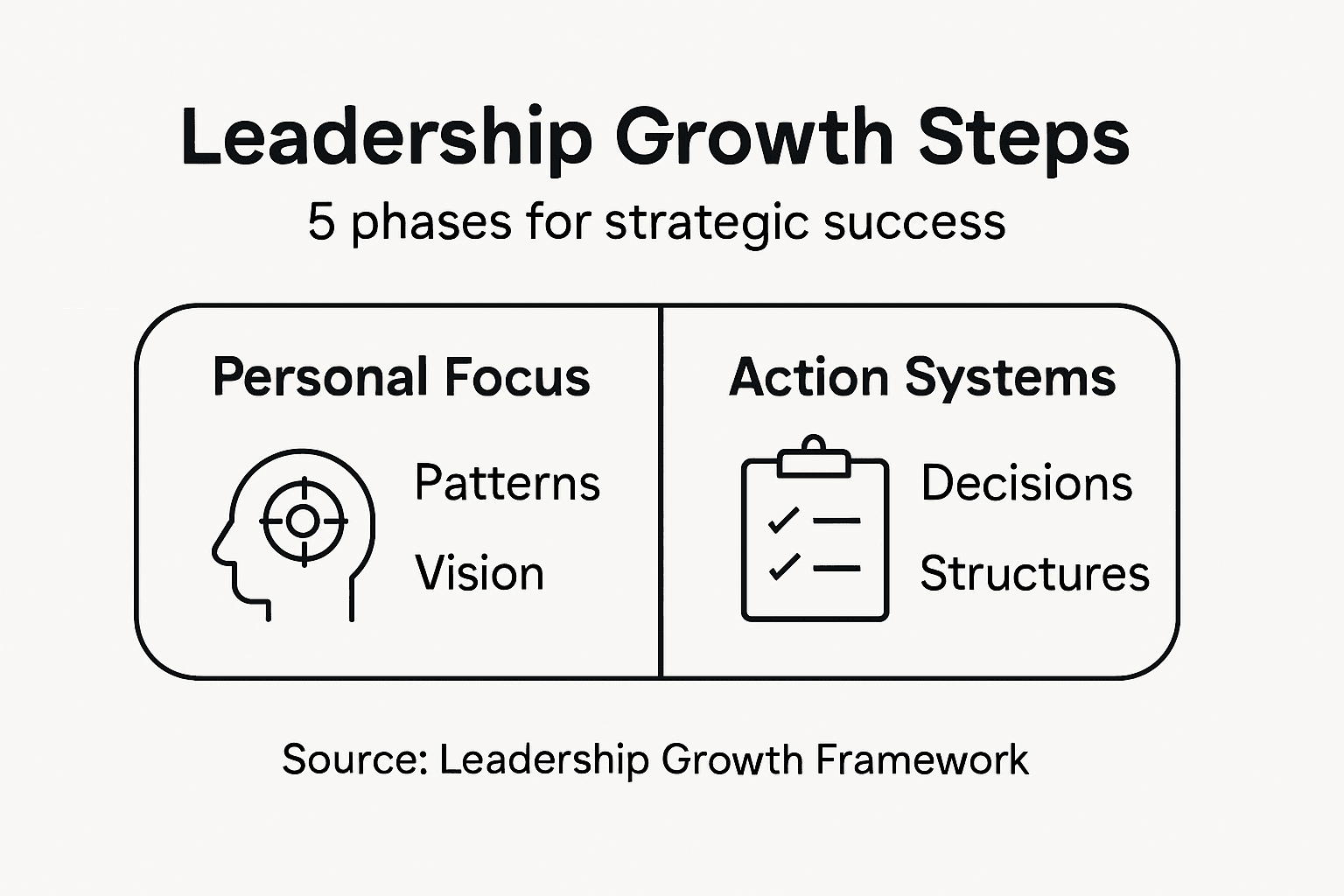
Implement modular and adaptable systems that can evolve with your organization. This means developing flexible frameworks that integrate technological tools, human processes, and strategic objectives. Break down complex workflows into repeatable, scalable components that can be easily adjusted as your business grows. Pay special attention to creating redundancies that prevent single points of failure while maintaining lean operational structures. By designing systems that are both robust and agile, you create an organizational environment capable of sustained high performance without risking burnout or operational breakdown.
Pro tip: Conduct quarterly system audits to identify emerging inefficiencies and recalibrate your performance frameworks before they become systemic problems.
Step 5: Validate and Refine Leadership Outcomes
Validating and refining your leadership outcomes transforms abstract goals into measurable, actionable performance improvements. This critical step bridges the gap between strategic intentions and actual organizational impact, ensuring your leadership approach consistently delivers tangible results.
Adaptive Leadership Behavior Scale research demonstrates the importance of empirical validation in leadership development. Create a comprehensive assessment framework that goes beyond traditional performance metrics. Develop a multidimensional evaluation system that captures both quantitative results and qualitative leadership effectiveness. This means tracking not just bottom line outcomes but also team engagement, innovation capacity, and long term organizational resilience.
Implement a continuous feedback and refinement cycle that treats leadership as an evolving practice rather than a static skill set. Break down your leadership performance into specific observable behaviors and measurable indicators. Establish clear benchmarks that allow you to track progress, identify improvement areas, and make data driven adjustments to your leadership approach. By creating a systematic method of reflection and recalibration, you transform leadership from a subjective art to a precise, adaptive science that can be intentionally developed and optimized.
This summary lists examples of measurable indicators for evaluating leadership effectiveness:
| Indicator Type | Example Metric | Why It Matters |
|---|---|---|
| Quantitative | Team productivity rate | Shows impact on output quality |
| Qualitative | Employee engagement score | Reflects influence on morale |
| Innovation | Number of new initiatives | Indicates adaptability to change |
| Resilience | Team retention rate | Demonstrates organizational stability |
Pro tip: Develop a personal leadership dashboard that tracks key performance indicators and provides real time insights into your leadership effectiveness across multiple dimensions.
Here’s a comparison of key frameworks used at different stages of leadership development:
| Stage of Leadership | Core Framework Used | Main Purpose |
|---|---|---|
| Self-Assessment | Behavioral Analysis | Identify personal strengths and blind spots |
| Vision Articulation | Vision Statement Model | Clarify long-term direction and values |
| Decision-Making | Decision Matrix | Improve choices and minimize bias |
| Performance Systems | System Blueprint | Drive ongoing efficiency and adaptability |
| Outcome Refinement | Evaluation Dashboard | Measure growth and guide future actions |
Elevate Your Leadership Mindset for Lasting Strategic Growth
The article “Master Leadership Mindset for Strategic Growth Success” highlights key challenges many leaders face including overcoming emotional biases in decision making, clarifying authentic vision, and building sustainable performance systems without burnout. If you find yourself struggling to create reliable leadership frameworks or seeking practical ways to validate and refine your leadership outcomes, you are not alone. These pain points are critical bottlenecks that hinder high-growth entrepreneurs and executives from reaching scalable success.
At Freedom Sun, we understand these struggles deeply. Our unique Operating System framework focuses on the MIND pillar—empowering you to redesign your decision-making processes, embed resilient leadership habits, and build systems that protect your energy while driving organizational growth. By integrating financial clarity and system infrastructure alongside leadership development, we help you escape hustle culture and move toward automated and strategic business management modeled on Fortune 500 CFOs. Join our platform for interactive training, diagnostic assessments, and a vibrant community dedicated to leaders who want profitable peace and operational sovereignty.
Ready to transform your leadership mindset and stop reactive management in its tracks Visit Freedom Sun now to learn how our system can help you build sustainable growth with less stress Explore our comprehensive solutions to personal leadership and business systems at Freedom Sun and start mastering strategic growth success today
Frequently Asked Questions
How can I assess my personal leadership patterns?
To assess your personal leadership patterns, start by documenting your behaviors, motivations, and decision-making styles. Create a leadership journal and record your reactions, decisions, and outcomes to track your patterns over time. Aim to identify consistent behaviors across various scenarios within 30 days.
What steps should I follow to clarify my core values and vision?
Begin by developing a vision statement that reflects your unique values and long-term objectives. Break down your vision into actionable components, such as specific practices that embody your core values, and review it quarterly to ensure alignment with evolving goals.
How can I redesign my decision-making processes effectively?
Redesign your decision-making process by analyzing the cognitive biases that affect your choices. Map out your current process and create a decision matrix that balances data analysis with your experience. Implement this structured approach over the next few weeks to improve clarity and consistency in your decisions.
What systems should I build for sustainable performance?
Build systems that align your organizational goals with efficient processes by mapping out your current operational structure. Identify bottlenecks and create a blueprint that includes performance metrics and automated feedback loops. Conduct audits quarterly to maintain high efficiency and adapt to changing needs.
How can I validate and refine my leadership outcomes?
Validate your leadership outcomes by establishing a comprehensive assessment framework that captures both quantitative and qualitative metrics. Track specific indicators related to team engagement and innovation capacity biannually to measure your impact and adjust your leadership approach accordingly.
Recommended
- Role of Mindset in Business Growth Explained
- 7 Inspiring Examples of Growth Mindset for Entrepreneurs
- Financial Empowerment: Unlocking Leadership and Clarity
- Financial Wellness: Equipping Leaders for Sustainable Growth
- Profesjonalny wizerunek – Klucz do sukcesu firmy - Coolheads - Fotografia biznesowa
- Understanding Amazon Growth Strategies - Scale Your Business
- Egenskaper hos en Byggprojektledare - Maleon - Projektledare inom bygg