Master hard conversations: strategies for women leaders

TL;DR:
- Women entrepreneurs often succeed through crucial conversations rather than strategies or tactics.
- Mastering hard conversations builds trust, enhances credibility, and prevents costly workplace issues.
- Preparing, maintaining safety, and using structured frameworks like the STATE path improve communication effectiveness.
Most high-performing women entrepreneurs will tell you that their biggest revenue breakthroughs did not come from a new funnel, a rebrand, or a better CRM. They came from a conversation they almost didn’t have. VitalSmarts research consistently shows that teams skilled in navigating crucial conversations outperform peers on revenue, retention, and workplace safety. If you are already generating revenue and feel stuck, there is a good chance your next level is not hiding in a strategy. It is hiding in a conversation you have been avoiding.
Table of Contents
- Why mastering hard conversations matters for women entrepreneurs
- Understanding the mechanics: What makes a conversation ‘hard’?
- A framework for action: Proven steps to navigate tough discussions
- Managing edge cases: Handling escalation, backlash, and remote dynamics
- Why hard conversations are the secret weapon most leaders ignore
- Take your communication further with Freedom Sun
- Frequently asked questions
Key Takeaways
| Point | Details |
|---|---|
| Master the moment | Effective leaders treat hard conversations as opportunities for growth and trust, not just problems to solve. |
| Frameworks improve outcomes | Using evidence-backed methods makes difficult business conversations more constructive and less stressful. |
| Preparation is power | Self-regulation and clarity on intent set the stage for mutual respect and positive results. |
| Follow up and realign | Addressing aftermath and repairing trust is as important as the conversation itself. |
Why mastering hard conversations matters for women entrepreneurs
There is a persistent myth that being liked and being effective are the same thing. For women entrepreneurs, that myth is especially costly. You are often navigating a landscape where speaking directly gets labeled as aggressive, where asking for what you deserve triggers discomfort in the room, and where avoiding conflict feels safer than risking your professional relationships. But avoidance has a price tag. A steep one.
Communication skills for business growth are not soft extras layered on top of your business strategy. They are the engine underneath it. When you can hold a hard conversation with clarity and composure, you move faster, build deeper trust with your team and clients, and protect your reputation as a leader who gets things done.
Research backs this up. VitalSmarts research draws a strong positive correlation between communication skills and how women are perceived as entrepreneurs and leaders. The data is unambiguous: women who communicate effectively in high-stakes moments are seen as more credible, more trustworthy, and more capable of leading growth. This is not about style. It is about skill.
The consequences of avoidance are just as real. Workplace incivility costs businesses approximately $2 billion per day globally, with 76% of employees reporting they have witnessed it firsthand. Much of that incivility does not come from malicious intent. It comes from conversations that never happened, feedback that was never delivered, and tensions that were allowed to fester until they became full blown crises.
Here is what avoidance actually costs you as a business owner:
- Opportunity loss: Clients sense when you are not being direct. Ambiguity in negotiations and scope conversations leads to underpricing, scope creep, and resentment.
- Team disengagement: Employees disengage when they sense their leader is conflict-avoidant. They stop bringing problems forward, and you lose the early warning system your business depends on.
- Reputation risk: How you handle hard moments defines how people describe you when you leave the room. That reputation either opens doors or closes them.
- Revenue leakage: Unresolved disputes with contractors, vendors, or partners cost real money in time, legal risk, and lost productivity.
“The single biggest problem in communication is the illusion that it has taken place.” This quote, often attributed to George Bernard Shaw, captures exactly what happens when leaders mistake silence for resolution.
You can optimize your business communication workflow with systems and templates, but the real shift happens when you decide that hard conversations are not obstacles to your success. They are the path. Developing leadership habits for founders that include intentional communication practices is what separates founders who plateau from those who scale.
Understanding the mechanics: What makes a conversation ‘hard’?
Before you can get better at hard conversations, you need to recognize what actually makes them hard. Most people assume it is the topic. Firing someone. Confronting a business partner about money. Telling a long-term client their behavior is unacceptable. But the topic is rarely the problem.
The Crucial Conversations methodology defines crucial conversations as discussions where three conditions align: the stakes are high, opinions differ, and emotions run strong. When all three show up together, your brain perceives threat. Your nervous system activates a fight or flight response. And suddenly you are not having a conversation. You are managing a physiological reaction while trying to think strategically.
That is why preparation matters. Not scripting. Not rehearsing the perfect comeback. Real preparation means understanding your own triggers, knowing what outcome you actually want, and recognizing the moment a conversation shifts from routine to crucial.
Here are the most common triggers in business settings:
- Performance feedback: Addressing underperformance without damaging the relationship or losing the team member entirely.
- Scope and contract renegotiations: Pushing back on a client who expects more without paying more.
- New strategic directions: Telling your team you are pivoting without creating panic or resentment.
- Values misalignment: When a partner, contractor, or client’s behavior conflicts with your company’s standards.
- Money conversations: Raising your prices, requesting late payment, or renegotiating a partnership split.
The difference between a typical disagreement and a truly crucial conversation is that crucial conversations carry lasting consequences. A typical disagreement resolves itself or fades. A crucial conversation, handled poorly, can fracture trust, end relationships, and follow your reputation for years.
| Conversation type | Stakes | Emotional intensity | Lasting impact |
|---|---|---|---|
| Typical disagreement | Low to moderate | Mild | Short term |
| Difficult conversation | Moderate to high | Moderate | Medium term |
| Crucial conversation | High | Strong | Long term |
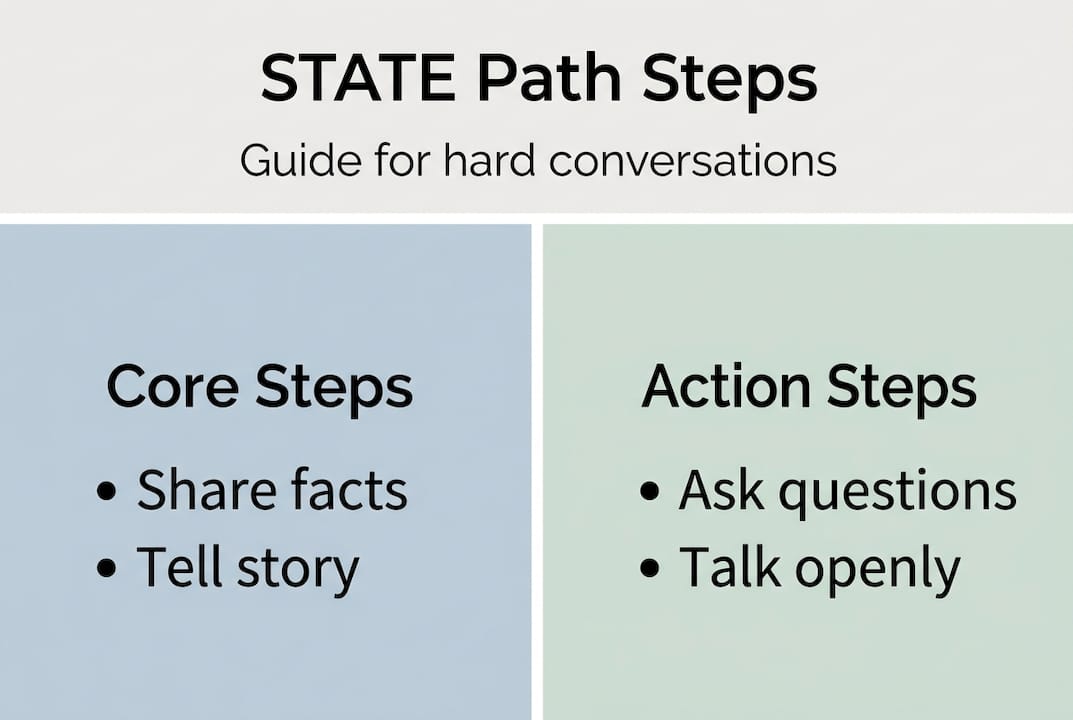
The STATE path from the Crucial Conversations framework gives you a practical structure for these moments. It stands for: Share your facts, Tell your story, Ask for the other’s path, Talk tentatively, and Encourage testing. The sequence matters because it respects the other person’s perspective while ensuring your own voice is heard without dominating.
Pro Tip: Before entering any crucial conversation, write down the one outcome you most want. Not what you want to say. What you want to achieve. This simple act shifts your brain from reactive to intentional, and it changes everything about how you show up.
Building mutual purpose is the foundation underneath all of this. When both parties feel that the conversation is in service of something they both care about, safety increases and defensiveness drops.
A framework for action: Proven steps to navigate tough discussions
Knowing what makes a conversation hard is one thing. Having a sequence you can actually use in the moment is another. Here is a field-tested framework for moving through difficult conversations from preparation to resolution.
Step 1: Prepare your own psychology first
Before the calendar invite goes out, do your internal work. What story are you telling yourself about this person or situation? Is it accurate, or is it a narrative your nervous system constructed to explain their behavior? Separate observable facts from the interpretations you have layered on top. Write both down. This is not soft work. It is strategic.

Step 2: Set the stage with psychological safety
Open the conversation by naming your positive intent. “I want to talk about something that matters to both of us, and I want to make sure we both walk away feeling clear and respected.” This does not guarantee comfort. It does lower defensiveness enough to create space for honest dialogue.
Step 3: Use the STATE path to deliver your perspective
Share the facts you observed, without judgment. Then share the story you made up about those facts, owning it as your interpretation. Invite the other person to share their perspective. Talk tentatively by using language like “I wonder if” or “It seems to me.” And actively encourage them to push back if your read is off.
Step 4: Monitor safety throughout
If the other person goes silent, gets aggressive, or deflects with humor, safety has broken down. Stop. The Crucial Conversations methodology recommends restoring safety first, either by contrasting (“I am not saying your work doesn’t matter. I am saying this one deliverable missed the mark.”), by recommitting to mutual purpose, or by offering a genuine apology when appropriate.
| Stage | What to watch for | Action to take |
|---|---|---|
| Before | Your own emotional charge | Clarify intent, regulate nervous system |
| Opening | Defensiveness or confusion | Name your positive intent explicitly |
| Middle | Silence, sarcasm, or withdrawal | Pause and restore safety |
| Closing | Vague agreement or deflection | Confirm specific next steps and follow-up date |
Step 5: Close with clarity and document it
Vague conclusions are almost as damaging as no conversation at all. Before ending, summarize what was agreed, who is doing what, and by when. Send a brief follow-up message the same day. This is not about covering yourself legally. It is about honoring the conversation you just had by treating it as real.
Pro Tip: If you are approaching a high-stakes conversation with a client, practice the opening sentence out loud three times before the meeting. Your mouth needs to rehearse, not just your mind. The physical act of speaking the words changes how confident you sound when it counts.
This framework applies whether you are working with consulting clients or leading internal team conversations. The principles are the same because people are the same.
Managing edge cases: Handling escalation, backlash, and remote dynamics
Even when you prepare well, some conversations go sideways. A client raises their voice. A team member bursts into tears. A partner goes cold and unreachable. These moments are not failures. They are edge cases that require a more nuanced response.
Hostile interactions tend to follow a predictable arc: trigger, escalation, crisis, and recovery. The most important thing to know is that you cannot effectively regulate someone else’s emotional state until you have regulated your own. Full stop. If you feel your own pulse rising or your thoughts narrowing, pause. Breathe deliberately. Give yourself 30 seconds before responding. This is not weakness. It is what skilled leadership actually looks like.
When you have made a major business decision that affects your team and the backlash arrives, five specific steps help realign employees: acknowledge their concerns out loud, clarify your reasoning without being defensive, invite questions, agree on what happens next, and follow up. Skipping any step leaves gaps that resentment fills.
Here are specific strategies for the most common edge cases:
- When someone goes silent: Do not fill the silence with reassurance. Ask a direct, open question. “What are you thinking right now?” Silence is often the sound of someone processing, not shutting down.
- When emotions escalate suddenly: Step out of content mode and into connection mode. “I can see this is bringing up a lot. What would help us both feel safe enough to keep talking?”
- When trust fractures significantly: Use contrasting to separate what you are not saying from what you are. Then recommit to shared purpose before returning to the original issue.
- When conversations happen in writing: Remote and hybrid team communication requires extra care because tone is invisible. Err toward over-clarifying your intent in written messages, and move to video for anything emotionally complex.
“The goal of crucial conversations is not to win. It is to reach a shared understanding that allows both people to move forward with clarity and respect.”
For scaling your consulting or service business, the ability to navigate these edge cases is not optional. Your reputation as a leader who remains steady under pressure is one of your most valuable business assets. And managing client relationships across time depends on your ability to repair ruptures quickly and cleanly when they happen.
Why hard conversations are the secret weapon most leaders ignore
Here is what two decades of working with women entrepreneurs across 30 countries has made undeniably clear: the leaders who grow fastest are not the ones with the best systems or the most sophisticated strategies. They are the ones who learned to walk into hard conversations without bracing for impact.
Most founders obsess over what to build next. They invest in technology, team structure, and marketing frameworks. But the culture breakthroughs, the retention wins, the pricing confidence, these almost always trace back to a single conversation that someone finally had the courage and skill to initiate.
The counterintuitive truth is that discomfort is not the enemy of connection. It is often the doorway to it. When you stop managing other people’s reactions and start showing up with honest, structured dialogue, you become a leader people genuinely trust. And trust, not tactics, is what builds lasting founder success.
What holds most women back is not a lack of strategy. It is a nervous system that has learned to associate direct communication with social risk. Your body learned this for good reasons. But that pattern is costing you clients, culture, and revenue. The goal is not perfection. It is practice. Every hard conversation you show up for, even imperfectly, is a rep. And those reps compound.
Take your communication further with Freedom Sun
The strategies in this article are a strong starting point, but applying them consistently under real business pressure is where most women entrepreneurs need support. At Freedom Sun, we help established women business owners build the communication and leadership skills that translate directly into stronger revenue, better team dynamics, and unshakable confidence in high-stakes moments. Founded by Simone CR, CPA, with nearly 20 years of experience advising across 30 countries, Freedom Sun’s Women’s Wealth Collective brings together the psychology and the practical frameworks you need to stop avoiding hard conversations and start using them as a growth engine. Explore our resources at freedomsun.co.
Frequently asked questions
What is a crucial conversation in a business context?
A crucial conversation in business is any discussion where the stakes are high, opinions vary, and emotions run strong, making mutual respect and shared purpose essential to a productive outcome.
How can I prepare for a difficult conversation with a team member?
Clarify your intent, regulate your own emotions first, and plan to listen actively while restoring psychological safety using frameworks like the STATE path if defensiveness arises.
Why do follow-ups after hard conversations matter?
Follow-ups predict leadership effectiveness and ensure that the agreements made during a difficult conversation translate into actual behavioral change and sustained team alignment.
How do I handle backlash when making big business decisions?
Acknowledge concerns openly, clarify your reasoning, and follow the five-step realignment process to restore trust and move the team forward without leaving resentment unaddressed.