Master Communication Skills Public Speaking for Business Growth

Standing in front of a room full of motivated professionals, you quickly realize that having expertise is not enough—how you communicate determines whether your message truly sticks. Coaches and consultants need more than knowledge to succeed, they need clear, impactful core messaging and stories that resonate with international audiences. This article offers practical strategies, drawn from proven communication research, to help you craft compelling messages, master storytelling, and refine your delivery for lasting client impact.
Table of Contents
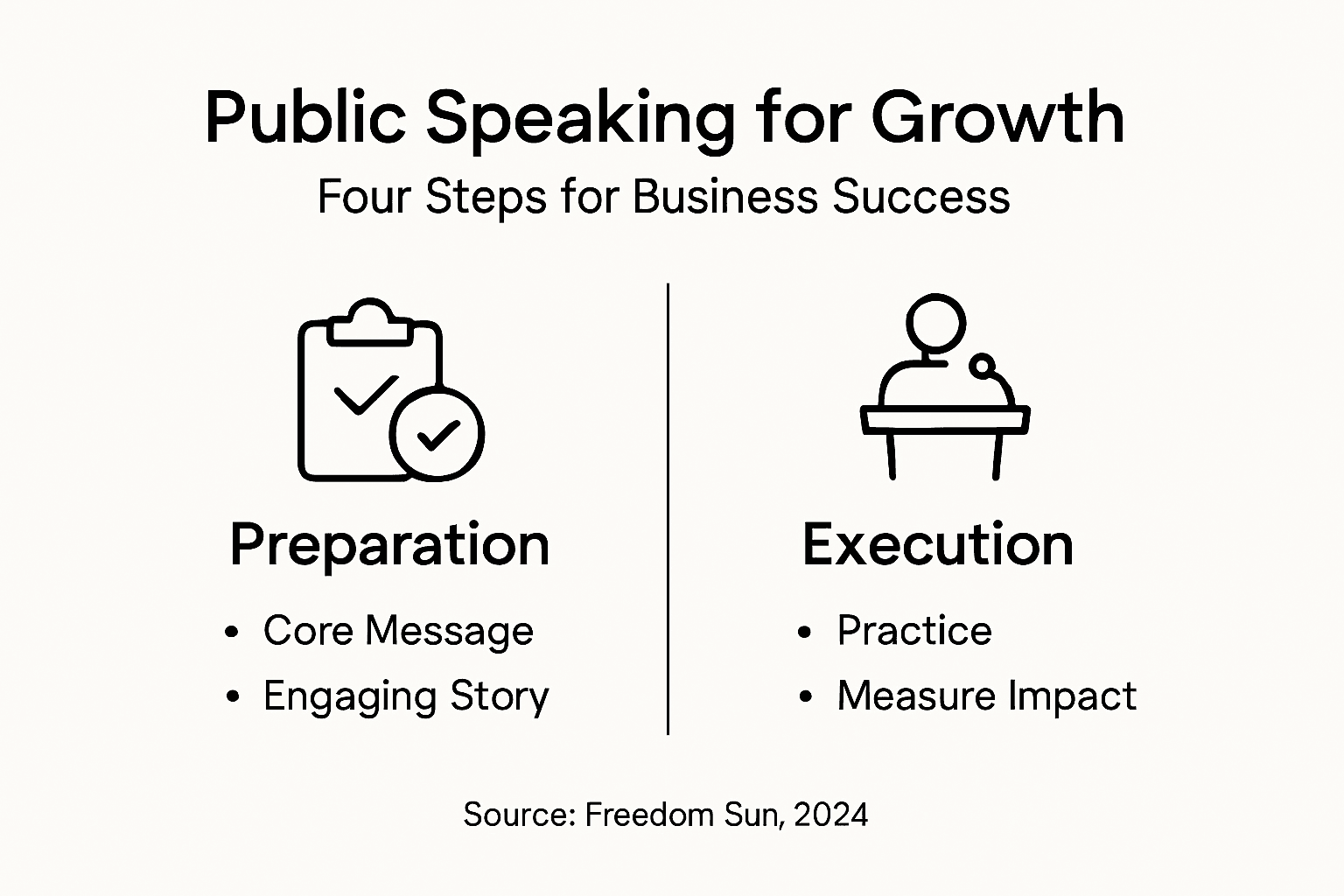
- Step 1: Develop Core Messaging For Your Audience
- Step 2: Craft Compelling Stories To Build Engagement
- Step 3: Practice Presentation Techniques With Feedback
- Step 4: Verify Client Impact And Refine Delivery
Quick Summary
| Key Point | Explanation |
|---|---|
| 1. Define a Core Message | Create a concise statement that addresses your audience’s specific pain points and clearly articulates what you offer. |
| 2. Tell Relatable Stories | Use authentic narratives that connect emotionally, illustrate struggles, and showcase transformations to engage your audience effectively. |
| 3. Practice with Feedback | Record your presentation to identify patterns and seek specific feedback to enhance delivery and clarify your message. |
| 4. Measure Client Impact | Track the effectiveness of your presentations by gathering real outcomes and specific feedback to refine future efforts. |
| 5. Tailor for Your Audience | Customize your messaging and stories to resonate with the unique concerns and goals of different audience segments. |
Step 1: Develop Core Messaging for Your Audience
Your core message is the backbone of every talk, workshop, or client conversation you give. It’s the single idea that ties everything together and makes your expertise stick with people.
Start by identifying what your audience actually needs to hear. As a coach or consultant, you know your clients struggle with specific problems. Your core message should directly address one of those pain points, not just showcase what you know.
Create a three-part message structure: a clear statement of what you’re offering, the evidence or reason why it matters, and what you want your audience to do next. This approach, rooted in crafting messages for impact, ensures your message lands with purpose and clarity.
Here’s the process broken down:
- Define the core statement: Write one sentence that captures your main point. Not two sentences, not three. One. If you can’t say it in one sentence, you haven’t distilled your thinking yet.
- Add supporting evidence: Back up that statement with real proof. A client result, data, or a story from your experience. This builds credibility.
- Include a call to action: Tell your audience what you want them to do. Schedule a call, implement a system, attend your workshop. Be direct.
When developing this message, think about your specific audience. What keeps them awake at night? What are they trying to accomplish? A message that resonates with burned-out entrepreneurs won’t land the same way with established business owners. Tailor your language and examples to match their world.
Your core message should answer three questions your audience is silently asking: What are you offering? Why should I care? What do I do next?
Test your message before you deliver it. Share it with a trusted colleague or client and watch their reaction. Do they get it immediately, or do they look confused? If confusion shows up, your message needs refinement.
Pro tip: Record yourself delivering your core message in 60 seconds, then listen back. If you stumble, use filler words, or explain it in more than two sentences, simplify until it flows naturally when you speak it.
Step 2: Craft Compelling Stories to Build Engagement
Stories are how humans actually remember things. When you share data alone, it goes in one ear and out the other. But wrap that same data in a story, and it sticks.
As a coach or consultant, you already have powerful stories hidden in your client work. A story about a consultant who was overwhelmed and broke free through your system beats a list of benefits every single time. Your job is to mine those stories and shape them.

A strong story has three moving parts: a character your audience relates to, a problem that creates tension, and a resolution that shows what’s possible. Crafting compelling narratives requires weaving together the setup, the struggle, and the outcome in a way that feels real, not rehearsed.
Here’s how to structure your stories:
- Start with the character: Introduce someone your audience recognizes. Not you yet. Let them see themselves in this person.
- Show the struggle: What was broken? What kept this person stuck? Make the problem real and uncomfortable.
- Reveal the shift: What changed? What did they do differently? This is where your method or wisdom appears naturally.
- Share the result: Don’t oversell it. Just show what became possible.
The key is authenticity over polish. Your audience senses when you’re performing versus when you’re genuinely sharing. If a story feels rough around the edges, that’s often what makes it believable.
When you practice your stories, time them. A powerful story doesn’t need ten minutes. Two to three minutes is plenty to create impact and move people emotionally. Longer stories lose people.
The best stories don’t tell people what to think. They show what changed when someone took action.
Pick one story to start with. Master it. Deliver it a dozen times before adding others. This repetition trains your delivery and lets you notice what lands and what doesn’t.
Pro tip: Record yourself telling your story on video, then watch it back with the sound off. If your body language and facial expressions don’t match the emotion of the story, your audience won’t believe it either.
Compare how story elements drive audience engagement:
| Story Element | Audience Effect | Coach’s Advantage |
|---|---|---|
| Relatable character | Eases skepticism, fosters trust | Positions coach as empathetic |
| Real struggle | Deepens emotional connection | Highlights problem-solving expertise |
| Transformation | Inspires behavioral change | Demonstrates tangible results |
| Authentic delivery | Encourages receptivity | Builds genuine credibility |
Step 3: Practice Presentation Techniques with Feedback
Practice alone won’t make you great. Deliberate practice with feedback makes you great. There’s a big difference.
Most coaches and consultants wing their presentations. They deliver the same talk a few times and assume they’ve mastered it. Meanwhile, they’re repeating the same nervous habits, pacing problems, and unclear phrases over and over. Feedback interrupts this cycle.
Start by recording yourself delivering your presentation. Watch it back without your ego in the way. You’ll spot patterns you never noticed while speaking. Maybe you pace back and forth constantly. Maybe you say “um” every ten seconds. Maybe you rush through your most important points.
Practicing presentations with authentic conditions means simulating the real environment where you’ll speak. Don’t practice sitting at your desk. Stand up. Use your slides. Speak out loud as if people are actually listening.
Here’s your feedback framework:
- Record your delivery: Use your phone or computer camera. Audio alone won’t show you body language and movement.
- Ask a trusted colleague for feedback: Not your spouse or best friend. Ask someone in your industry who understands your work. They’ll spot clarity issues you miss.
- Request specific feedback: Don’t ask “What do you think?” Ask “Was my main point clear in the first two minutes?” or “Did my pacing feel rushed?”
- Identify one thing to improve: Don’t try to fix everything. Pick one habit or element. Master it. Then move to the next.
Practice the same presentation at least five times before delivering it live. Each run should get smoother. If it doesn’t, you need different feedback or different practice.
Practice isn’t about performing perfectly. It’s about removing obstacles between your message and your audience’s understanding.
The discomfort you feel during practice is the point. That’s where learning happens. Embrace awkward repetition.
Pro tip: Practice with someone who will interrupt you and ask questions, just like a real audience would. Handling unexpected questions in practice prevents panic when they happen live.
Step 4: Verify Client Impact and Refine Delivery
You can’t improve what you don’t measure. And you can’t grow your business on assumptions about whether your presentations actually work.
Verifying client impact means tracking real outcomes from your speaking engagements. Did attendees actually implement what you taught? Did they take the next step you suggested? Did their business improve as a result? These answers tell you what’s working and what needs adjustment.
Start by defining what success looks like for your specific presentation. Success might mean attendees schedule a consultation with you, sign up for your program, or report implementing one key strategy within 30 days. Be concrete about this before you present.
Capturing and communicating research impact requires tracking evidence systematically. You need a way to collect data on outcomes. This doesn’t have to be complicated. A simple post-presentation survey asking three questions beats no data at all.
Here’s how to gather meaningful feedback:
- Send a follow-up email: Within 48 hours, ask one specific question. “Which strategy from the presentation have you started using?” or “What’s your next step?” Simple questions get more responses.
- Track conversions: Monitor how many attendees actually move forward with what you suggested. Did they book a call? Join your email list? Buy your course?
- Collect testimonials: Ask clients or attendees how your presentation impacted their thinking or business. A single specific story beats generic praise.
- Identify patterns: After three or four presentations, look for themes. Which stories landed? Which sections lost people? Where do questions cluster?
Once you have data, you refine. Maybe your core message resonated but your call to action was unclear. Maybe your story was too long. Maybe you need a different example for this audience.
The presentations that generate real client impact aren’t perfect. They’re responsive. They evolve based on what actually works.
This isn’t about vanity metrics. Focus on outcomes that matter to your business and your clients’ results.
Pro tip: Create a simple spreadsheet tracking attendance, conversions, and key feedback from each presentation. Over six months, you’ll see exactly which elements drive results and which you should cut.
Here’s how effective presentations benefit both coaches and their clients:
| Benefit for Coach | Benefit for Client | Long-Term Impact |
|---|---|---|
| Builds authority with audience | Gains clear actionable steps | Increases referrals and opportunities |
| Improves client engagement | Feels heard and understood | Higher program completion rates |
| Identifies which methods resonate | Access to proven solutions | Better business outcomes and growth |
| Refines service offerings | Receives relevant stories and examples | Stronger ongoing client relationships |
Elevate Your Public Speaking and Amplify Business Growth
Mastering communication and public speaking is essential to overcoming the challenges coaches and consultants face when trying to engage clients and create genuine impact. This article highlights how crafting clear core messages, sharing authentic stories, practicing with feedback, and measuring client outcomes can transform your presentations from ordinary to compelling. If you struggle with unclear messaging or inconsistent delivery that leaves your audience confused or disengaged, you are not alone. These pain points slow down business growth and limit your influence.
At Freedom Sun, we understand that effective communication is just one piece of a larger business system that needs to support your goals without burnout. Our unique training empowers coaches, consultants, and service-based entrepreneurs to build that system by combining strategic communication skills with automated frameworks, mental resilience, and scalable leadership. We help you move beyond hustle culture to sustainable success through interactive training, diagnostic assessments, and a supportive community.
Ready to transform your public speaking into a powerful driver for business growth? Discover how our approach can sharpen your core messaging, enrich your storytelling, and build confident delivery techniques so every presentation moves your audience to action. Take the next step today by exploring Freedom Sun and join a network focused on achieving profitable peace and strategic expansion.
Frequently Asked Questions
How can I develop a core message for my public speaking?
Start by crafting a single, clear statement that captures your main point. Then, add supporting evidence and include a specific call to action. Aim for clarity and conciseness to ensure your audience understands your message within minutes.
What are the key elements of a compelling story for presentations?
A compelling story should have a relatable character, a clear struggle, and a resolution showcasing what is possible. Focus on authenticity rather than polish; real stories resonate more with audiences. Prepare to share your story in two to three minutes for maximum impact.
How can I effectively practice my presentation skills?
Record yourself delivering your presentation to identify areas that need improvement, such as pacing or clarity. Seek feedback from a trusted colleague who understands your work so you can focus on one specific area to enhance before your live delivery.
How do I measure the impact of my public speaking on client engagement?
Define what success looks like for your presentation and use post-presentation surveys to gather feedback. Track how many attendees take action based on your suggestions, such as scheduling consultations or implementing strategies, to evaluate overall effectiveness.
What should I do if my audience seems confused during my presentation?
If you notice confusion, pause and clarify your core message. Ask if there are any questions, and be prepared to simplify or elaborate on complex points. Adjust your delivery based on feedback you receive after the presentation to minimize misunderstandings in the future.
How can I ensure my call to action is effective in my public speaking?
Make your call to action clear and direct by specifying exactly what you want the audience to do next. For example, encourage them to book a call or attend a workshop, ensuring it aligns with the core message. Aim to incorporate this action into your presentation within the final few minutes for lasting impressions.