Scaling a Consulting Firm: Systems, Automation, Impact

Many seasoned consultants find themselves working longer hours just to keep up, while overhead and complexity grow with every new client. Scaling a consulting firm means transforming your delivery so revenue rises faster than your workload. For professionals ready to move beyond founder-dependent growth, understanding repeatable, systematized service delivery is the foundation for building efficiency, profit, and lasting stability. This article reveals practical steps to decouple income from direct labor and create a scalable consulting business.
Table of Contents
- What It Means to Scale a Consulting Firm
- Choosing Scalable Service Delivery Models
- Building Systems for Operational Efficiency
- Automating Client Acquisition and Management
- Managing Risks and Preserving Firm Culture
Key Takeaways
| Point | Details |
|---|---|
| Scaling vs Growth | Scaling a consulting firm involves transforming service delivery to decouple revenue from direct labor hours, rather than merely increasing client load. |
| Choose the Right Delivery Model | Select a scalable service delivery model that allows for repeatable processes and delegation to free up founder involvement in every project. |
| Build Systems and Automation | Establish operational systems and utilize automation to eliminate repetitive tasks, thereby enhancing efficiency and enabling growth without proportional resource increases. |
| Maintain Firm Culture | As you scale, consciously protect and communicate your firm’s core values to prevent cultural dilution and sustain your competitive advantage. |
What It Means to Scale a Consulting Firm
Scaling a consulting firm isn’t about working harder or taking on more clients. It’s fundamentally about transforming how you deliver value so that revenue grows faster than your workload.
Most consultants equate growth with hiring more people. You sign a new client, you staff a consultant. Client doubles, you hire two consultants. Your revenue grows, but so does your overhead and complexity.
Scaling is different. Scaling means decoupling your revenue from your direct labor hours. It means building systems and processes that allow you to serve more clients without proportionally increasing your team.
The Core Difference Between Growth and Scale
Growth happens when you do more of what you’re already doing. You take on more projects, more clients, more hours. Your firm expands, but your business model stays the same.
Scale happens when you fundamentally change how you deliver services. You use technology, processes, templates, and trained team members to multiply your capacity without multiplying your personal involvement in every engagement.
Consulting firms that successfully scale typically experience three measurable shifts:
- Increased revenue per consultant as delivery becomes more efficient
- Higher profit margins because fixed costs are distributed across more client work
- Reduced founder dependency so the business doesn’t collapse if you take a vacation
Why Scaling Matters for Your Firm’s Future
Without scaling, your ceiling is determined by your personal capacity. You can only work so many hours. You can only be in so many meetings. You can only deliver so many projects before you hit a wall.
Scaling removes that ceiling. Consulting firms that implement scalable digital models leverage technology and structured processes to expand their impact without proportional cost increases.
But there’s another reason scaling matters: your own peace. A firm dependent on you working constantly isn’t a business. It’s a job that pays well. A scaled firm is an actual asset you can eventually step back from, sell, or hand off to a trusted team.
What Actually Changes When You Scale
Scaling doesn’t mean you stop doing client work. It means your role shifts from doing all the work to designing the systems that enable others to do the work effectively.
Here’s what typically transforms:
- Client delivery moves from custom, bespoke solutions to proven methodologies applied to each client
- Your team members shift from “just following along” to independently executing your frameworks
- Information stops living in your head and gets documented in playbooks, templates, and standard operating procedures
- Time gets freed up for high-leverage activities like sustainable growth strategies and business development
The Reality Check
Scaling isn’t quick, and it isn’t automatic. Building the systems, documenting processes, and training your team takes time and discipline. Many consultants start the journey but abandon it because the work feels less satisfying than serving clients directly.
But consider this: if your goal is impact, scaling multiplies it. You serve more clients. You solve bigger problems. Your methodologies reach more people through your team’s work, not just your own.
Scaling transforms your consulting firm from a personal services business into an organization with repeatable, delegable processes that generate consistent revenue growth.
Pro tip: Before scaling anything, identify your one core methodology or service that generates the highest client satisfaction and profit margins. Build your scaling strategy around that specific offering, not everything you do.
Choosing Scalable Service Delivery Models
Your service delivery model is the backbone of scalability. Choose wrong, and you’ll stay locked in a feast-or-famine cycle where every new client means hiring more people. Choose right, and you build a machine that grows revenue without proportional cost increases.
Most consultants default to the traditional model: clients hire you, you deliver custom work, you get paid for your time. This model has one fatal flaw for scaling. Your revenue is directly tied to your hours. Double your revenue? You need to double your team.
There’s a better way. Scalable consulting models separate revenue from direct time investment by using repeatable frameworks, systematized processes, and trained delivery teams.
The Three Main Delivery Models
Consulting firms typically operate within three distinct models. Understanding each helps you decide what fits your firm.
The Custom Consulting Model
Every project is unique. You scope it individually, customize your approach, and charge based on the project complexity. This model feels professional and commands premium pricing, but it doesn’t scale.
Why? Because each engagement requires your personal expertise and involvement. You can’t easily delegate. You can’t systematize the work.
The Productized Consulting Model
You define a specific service with a fixed scope, timeline, and price. All clients receive the same high-level offering applied to their situation. Think “brand audit,” “sales process audit,” or “team coaching program.”
This model is more scalable because you develop the process once, then replicate it. Your team members can deliver it. It’s repeatable.
The Hybrid Model
You offer core productized services with optional add-ons for customization. This balances revenue potential with scalability. You capture the efficiency gains from your core offering while still serving unique client needs.
Why Your Choice Matters
Your delivery model determines whether your business can scale. Firms using repeatable, systematized service delivery expand without proportional workload increases.
Here’s what changes with each model:
Here’s a side-by-side comparison of consulting delivery models for faster evaluation:
| Model Type | Delegation Potential | Pricing Flexibility | Scalability Level |
|---|---|---|---|
| Custom Consulting | Difficult to delegate | Highly flexible pricing | Low scalability |
| Productized Consulting | Easy to delegate | Fixed pricing | High scalability |
| Hybrid | Moderate delegation | Some pricing flexibility | Balanced scalability |
- Custom model: Low scalability, high price, founder-dependent
- Productized model: High scalability, predictable delivery, team-delegable
- Hybrid model: Balanced scalability, flexible pricing, moderate complexity
The Real Consideration
Don’t choose based on what sounds best. Choose based on what you can systematize. If you offer six different consulting services that all require your personal methodology, you’ve built a beautiful consulting practice, not a scalable firm.
Pick one or two service offerings that generate your highest profit margins and client satisfaction. Build your delivery model around those. Once they’re systematized and delegable, expand from there.
Your delivery model isn’t set in stone. Many successful firms start custom, then evolve toward productization as they identify what works best and what they can systematize.
Pro tip: Audit your last ten client engagements and identify what’s identical across them. That intersection of similarity is your scalable offering. Build your productized model around that, not around what clients ask for.
Building Systems for Operational Efficiency
Systems are what separate consulting firms from consulting practices. A practice is you delivering work. A firm is systems delivering work through people.

Most consultants avoid building systems because it feels like admin work. You’d rather be billing hours. But here’s the reality: without systems, you can’t scale. You’re the bottleneck.
Operational systems reduce friction, enable delegation, and create predictability. They’re what allow your firm to run without you being involved in every single decision and delivery.
What Systems Actually Do
Think of systems as the bones of your business. They hold everything up and keep everything moving in the same direction.
Process standardization and clear documentation reduce bottlenecks and enable more predictable delivery. When every consultant follows the same client onboarding process, onboarding takes less time and produces consistent results.
Good systems accomplish three things:
- Reduce decision fatigue by establishing standard ways of working
- Enable delegation because team members know exactly what’s expected
- Improve consistency so clients experience the same quality regardless of who delivers
The Core Systems You Need
You don’t need 50 systems. You need the essential ones that directly impact client delivery and your ability to scale.
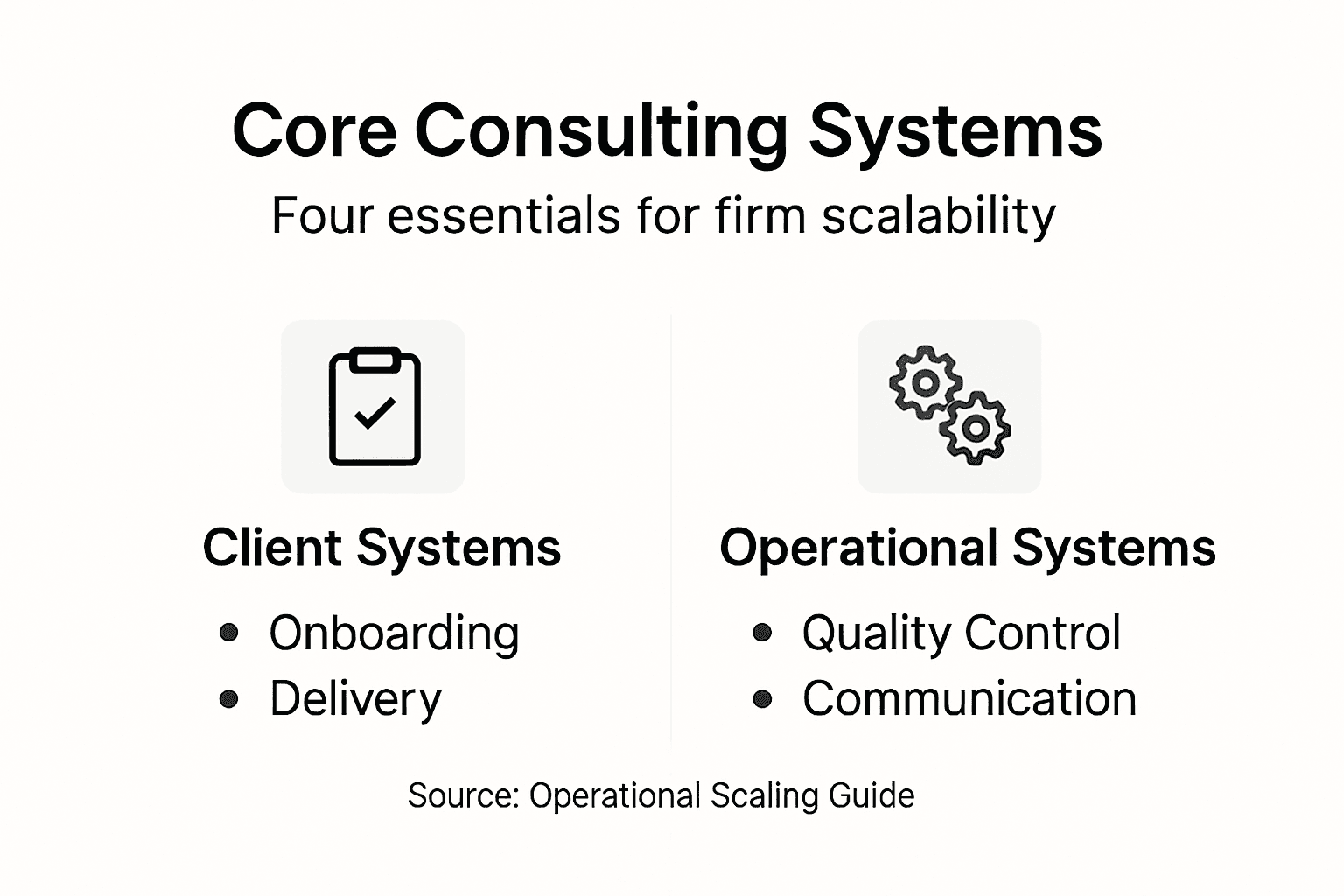
Client Onboarding System
Every new client follows the same intake process. You gather the same information. You communicate the same expectations. You establish the same timeline and deliverables. This system sets the tone and prevents scope creep.
Delivery Process System
Your core consulting work has a repeatable methodology. Document it. Break it into stages. Assign clear responsibilities. When a team member delivers, they follow your playbook, not reinventing it every time.
Quality Control System
Consistent documentation and clear role definitions ensure that deliverables meet your standards before they reach clients. Who reviews work? What constitutes “done”? What does “good” look like?
Communication System
How do team members update each other? How do clients stay informed? When do meetings happen? What gets documented where? This system prevents miscommunication and keeps everyone aligned.
These core systems are crucial to scaling a consulting firm:
| System Type | Main Purpose | Key Benefit |
|---|---|---|
| Client Onboarding | Standardizes new client processes | Reduces admin errors |
| Delivery Process | Structures consulting workflow | Ensures consistent output |
| Quality Control | Sets delivery and review standards | Maintains service quality |
| Communication | Organizes team/client interactions | Prevents miscommunication |
Where Most Consultants Fail
They build systems without enforcement. A documented process that nobody follows is just busy work. Systems only work when they’re actually used.
Start with the system that causes you the most headaches right now. Document it. Train your team on it. Enforce it consistently. Once it sticks, move to the next one.
Systems feel rigid at first, but they’re actually liberating. They free you from having to make the same decisions repeatedly and free your team from guessing what you want.
Pro tip: Start with your client onboarding process. It’s the highest-leverage system because it sets the foundation for the entire engagement and happens repeatedly with every new client.
Automating Client Acquisition and Management
Automation in client acquisition and management is where most consultants leave money on the table. You’re manually chasing leads, manually onboarding clients, manually following up. Every step is a bottleneck.
Automation doesn’t mean replacing relationships with robots. It means removing repetitive tasks so you can focus on the strategic work that actually converts prospects and deepens client relationships.
The right automation saves time, improves consistency, and creates a steady pipeline of qualified leads without you constantly hustling for new business.
Where Automation Has the Most Impact
Technology and automation tools streamline client acquisition and management by handling repetitive tasks at scale. The best places to start are where you’re currently doing the most manual work.
These are the high-leverage automation opportunities:
- Lead capture and qualification through website forms and automated scoring
- Email nurture sequences that educate prospects while you sleep
- Client onboarding workflows that guide new clients through setup steps
- Follow-up reminders so no lead falls through cracks
- Proposal generation from templates based on client information
The Three Core Automations to Build
Lead Nurture Automation
When someone downloads your guide or visits your pricing page, they should receive a sequence of emails. No manual effort required. Each email moves them closer to a decision.
You write the sequence once. Then it runs for every prospect, forever. That’s automation working for you.
Client Onboarding Automation
Automated client onboarding and communication workflows get new clients set up without you manually sending the same welcome email for the 50th time. Automated forms collect information. Automated emails send agreements. Automated reminders keep momentum going.
CRM Data Management
Everyone you talk to should be in your CRM. But manually entering data is exhausting. Use automation to capture prospect information from emails, forms, and conversations. Your team stays informed without extra work.
What Most Consultants Get Wrong
They automate without strategy. They set up email sequences that feel robotic and impersonal. Prospects immediately unsubscribe.
Automation should feel human. It should provide value at each step. It should move prospects toward the next logical conversation, not blast them with sales pitches.
Start with one automation. Get it working smoothly. Then build the next one. Quality automation beats scattered, half-built systems.
Automation multiplies your capacity. One good email sequence reaching 100 prospects daily accomplishes what would take you weeks of manual outreach.
Pro tip: Automate the first touchpoint in your sales process—lead capture and initial qualification. This frees you immediately from administrative work and ensures no lead goes unanswered.
Managing Risks and Preserving Firm Culture
Scaling your consulting firm creates tension. You’re hiring new people, taking on more clients, expanding into new markets. Growth is exciting. But it also introduces risk.
The biggest risk isn’t financial. It’s cultural. You built your firm on specific values and ways of working. As you scale, those values can dilute. New team members don’t know your culture. Systems feel impersonal. The magic that made your firm special fades.
Managing risks during scaling means protecting what makes your firm valuable while building the infrastructure to grow.
The Core Risks of Scaling
Scaling introduces three categories of risk:
- Quality risk where faster growth means inconsistent delivery and brand damage
- Cultural risk where new team members don’t embody your values
- Leadership risk where you can’t personally oversee everything anymore
Leadership commitment and embedding core values through transparent communication are essential to maintaining culture as your firm grows.
How Culture Gets Lost During Scaling
You hired your first team members because they shared your values. You could mentor them directly. You modeled the behavior you wanted.
Then you hired more people. And more. Suddenly, your values aren’t being reinforced consistently. New consultants follow what others do, not what you intended. Culture becomes whatever emerged organically, not what you designed.
This happens unconsciously. It’s the scaling trap most consultants fall into.
The Systems That Protect Culture
Governance structures, leadership development programs, and internal communication channels sustain firm values while you scale.
Here’s what actually works:
Document Your Culture
Write down your core values. Describe what they look like in practice. Share specific examples. This sounds obvious, but most consultants skip it.
Hire for Cultural Fit
Skill can be trained. Values are harder. Hire people who already align with your culture. During interviews, ask about their values. Listen for alignment, not credentials.
Build Mentorship Into Growth
Each new consultant should be mentored by someone who embodies your culture. Pair them with a senior team member. Make mentorship part of the job, not optional.
Communicate Consistently
Regular team meetings where you reinforce why your culture matters. Share stories about clients or team members living your values. Make culture visible and celebrated.
The Hard Truth About Risk
Scaling always involves risk. You can’t eliminate it. You can only manage it deliberately. The consultants who scale successfully are the ones who protect culture consciously while building systems.
Culture is your competitive advantage. It’s harder to replicate than your methods or your pricing. Protect it ferociously.
Pro tip: Before hiring your next team member, write down the three non-negotiable values you want them to embody. Use those as your primary screening criteria, and hire only people who clearly demonstrate them.
Unlock Scalable Success and Profitable Peace for Your Consulting Firm
If you feel trapped in the cycle of growing your consulting firm by simply adding more hours and hiring more people you are facing the exact challenge highlighted in the article: transforming your business to scale beyond your personal workload. The key pain points include reducing founder dependency increasing profit margins and building repeatable systems and automation that free you from constant client delivery and personal hustle. Concepts like productized consulting models client onboarding systems and meaningful automation need more than theory to become your firm’s reality.
At Freedom Sun we empower coaches consultants and service entrepreneurs to break through these barriers. Our interactive training and diagnostic assessments guide you to implement scalable systems with strategic management that prioritize your firm’s health and your personal wellbeing. We specialize in helping you design your consulting delivery model with intent establish automation workflows that nurture leads and clients without burnout and preserve your firm culture through leadership development. Don’t let your growth stall or your firm become a job. Visit Freedom Sun now to explore how our proven framework turns your consulting practice into a scalable firm delivering consistent impact and profitable peace. Start building sustainable growth today for a future where your business works for you not the other way around.
Frequently Asked Questions
What does it mean to scale a consulting firm?
Scaling a consulting firm means transforming how value is delivered so that revenue grows faster than workload, primarily by building systems and processes that allow for serving more clients without proportionally increasing the team.
How can I differentiate between growth and scale in my consulting business?
Growth refers to doing more of the same work, increasing projects, clients, or hours. In contrast, scaling involves changing the delivery method to enhance efficiency and leverage technology, processes, and trained team members to increase capacity without multiplying personal involvement.
What are some essential systems to implement for operational efficiency?
Key systems for operational efficiency include a Client Onboarding System, Delivery Process System, Quality Control System, and Communication System, which help reduce friction, enable delegation, and maintain consistency in client delivery.
How can automation benefit client acquisition and management in consulting?
Automation streamlines repetitive tasks such as lead capture, email nurturing, client onboarding, and follow-up reminders. This saves time and ensures consistent communication, allowing consultants to focus on strategic work that builds deeper client relationships.