How to price your services for profit and growth in 2026

Most established women entrepreneurs are stuck in a pricing trap that keeps revenue capped, no matter how hard they work. 88% of women-owned businesses generate under $100k revenue annually, and underpricing is the silent culprit. The belief that lower prices attract more clients is a myth that drains profitability and prevents sustainable wealth building. This guide teaches advanced pricing strategies designed specifically for women entrepreneurs ready to break through revenue ceilings, increase profitability, and create businesses that support their ambitions without burning them out. You’ll learn how to price with confidence, communicate value effectively, and implement changes that stick.
Table of Contents
- Why Many Women Entrepreneurs Underprice Their Services
- Core Pricing Strategies To Maximize Profitability And Perceived Value
- Comparing Pricing Models: Hourly, Project, Retainer, And Value-Based
- Practical Steps To Confidently Raise Your Prices And Sustain Client Trust
- Unlock Expertise With Freedom Sun Business Training
- Frequently Asked Questions
Key takeaways
| Point | Details |
|---|---|
| Underpricing limits growth | Most women entrepreneurs underprice due to confidence gaps and societal pressures, capping revenue potential. |
| Value-based pricing wins | Pricing based on client outcomes rather than hours worked maximizes profitability and perceived value. |
| Multiple models exist | Hourly, project, retainer, and value-based models each serve different business goals and client relationships. |
| Communication is critical | Transparent, advance notice with clear value justification prevents client loss during price increases. |
| Implementation requires strategy | Phased increases, tiered options, and consultative sales techniques sustain trust while optimizing revenue. |
Why many women entrepreneurs underprice their services
Underpricing isn’t a strategy problem. It’s rooted in deeper psychological and societal dynamics that keep talented women entrepreneurs trapped in low-revenue cycles. Understanding these causes is the first step toward breaking free.
Societal conditioning teaches women to be accommodating and avoid appearing greedy or demanding. This pressure translates directly into business pricing decisions. You might hesitate to charge what you’re worth because you fear being perceived as difficult or unreasonable. These invisible scripts run deep, influencing how you value your expertise and communicate your fees.
Imposter syndrome amplifies the problem. Even with years of experience and proven results, you might question whether you truly deserve premium pricing. This internal doubt leads to discounting services before clients even ask. You rationalize lower prices as being fair or accessible, but in reality, you’re undervaluing the transformation you deliver.
The fear of losing clients by raising prices keeps many entrepreneurs stuck. You worry that current clients will leave or prospects will choose competitors. This fear is rarely based on evidence. Most client relationships are built on trust and results, not just price. When you deliver genuine value, clients recognize it and are willing to pay appropriately.
88% of women-owned businesses generate under $100k revenue annually, and underpricing is a primary driver. This statistic reveals the scale of the problem. Low prices create a cycle where you need more clients to hit revenue goals, which leads to overwork, burnout, and less capacity to deliver exceptional results. The business becomes unsustainable.
Key factors contributing to underpricing include:
- Comparing yourself to competitors without considering your unique value proposition
- Pricing based on what you think clients can afford rather than the value you create
- Avoiding difficult communication about money and worth
- Accepting the first objection without exploring the real concern behind it
“The gap between what you’re capable of building and what you’re actually building isn’t about strategy. It’s about what your nervous system can handle when money is on the line.”
Breaking this pattern requires addressing both the external pricing strategy and the internal beliefs driving your decisions. You need frameworks that make pricing objective and confidence-building practices that help you hold your ground when clients push back.
Core pricing strategies to maximize profitability and perceived value
Effective pricing isn’t about charging more for the sake of it. It’s about aligning your fees with the genuine value you create while building a sustainable, profitable business. These strategies give you the frameworks to make that shift.

Value-based pricing focuses on client outcomes rather than your time or costs. Instead of calculating hourly rates or marking up expenses, you price based on the transformation, results, or problem solved. If your consulting saves a client $50,000 annually, charging $10,000 is a bargain. This approach shifts the conversation from cost to investment and return.
Implementing value-based pricing requires deep client understanding. You need to know what outcomes matter most, what problems cost them currently, and how your solution creates measurable improvement. Advanced pricing strategies increase profitability sustainably when aligned with client value perception. This alignment makes premium pricing feel natural rather than inflated.
Tiered pricing packages address different client needs and budgets while maximizing revenue. Create three options: a foundational package, a comprehensive mid-tier option, and a premium all-inclusive offering. Most clients choose the middle tier, but the premium option serves as an anchor that makes the mid-tier feel reasonable and accessible.
Each tier should deliver genuine value, not just more of the same. The foundational package solves a specific problem. The mid-tier adds strategic support or faster results. The premium tier includes personalized attention, implementation help, or ongoing access. This structure lets clients self-select based on their priorities and budget.
Anchoring uses higher-priced options to influence perception of your core offers. When you present a $15,000 package alongside a $5,000 option, the lower price suddenly feels more accessible. The expensive option doesn’t need to sell frequently. Its primary job is making your main offer appear reasonable and valuable.
Pro Tip: Always present your premium option first when discussing pricing. This sets the anchor high and frames the conversation around maximum value before introducing more accessible tiers.
Transparent value statements support premium pricing by making the benefits explicit and tangible. Don’t assume clients understand what they’re getting. Spell out the specific outcomes, time saved, revenue generated, or problems eliminated. Quantify whenever possible. Vague promises like “better results” don’t justify higher fees.
Consider these pricing strategy comparisons:
| Strategy | Best For | Key Advantage | Implementation Complexity |
|---|---|---|---|
| Value-Based | High-impact services with measurable outcomes | Maximizes profit margins | High (requires deep client insight) |
| Tiered Packages | Services with scalable components | Increases average sale value | Medium (needs clear differentiation) |
| Anchoring | Any service offering | Improves price acceptance | Low (simple presentation shift) |
These strategies work together. You might use value-based pricing to determine your premium tier, create tiered packages to serve different segments, and leverage anchoring in how you present options. The key is choosing approaches that fit your service model and client base.
Explore detailed pricing for profit strategies and pricing services startup strategies to refine your approach based on your specific business context and growth stage.
Comparing pricing models: hourly, project, retainer, and value-based
Choosing the right pricing model shapes your revenue potential, client relationships, and daily work experience. Each model serves different business goals and service types. Understanding the nuances helps you select the approach that aligns with your vision for sustainable growth.
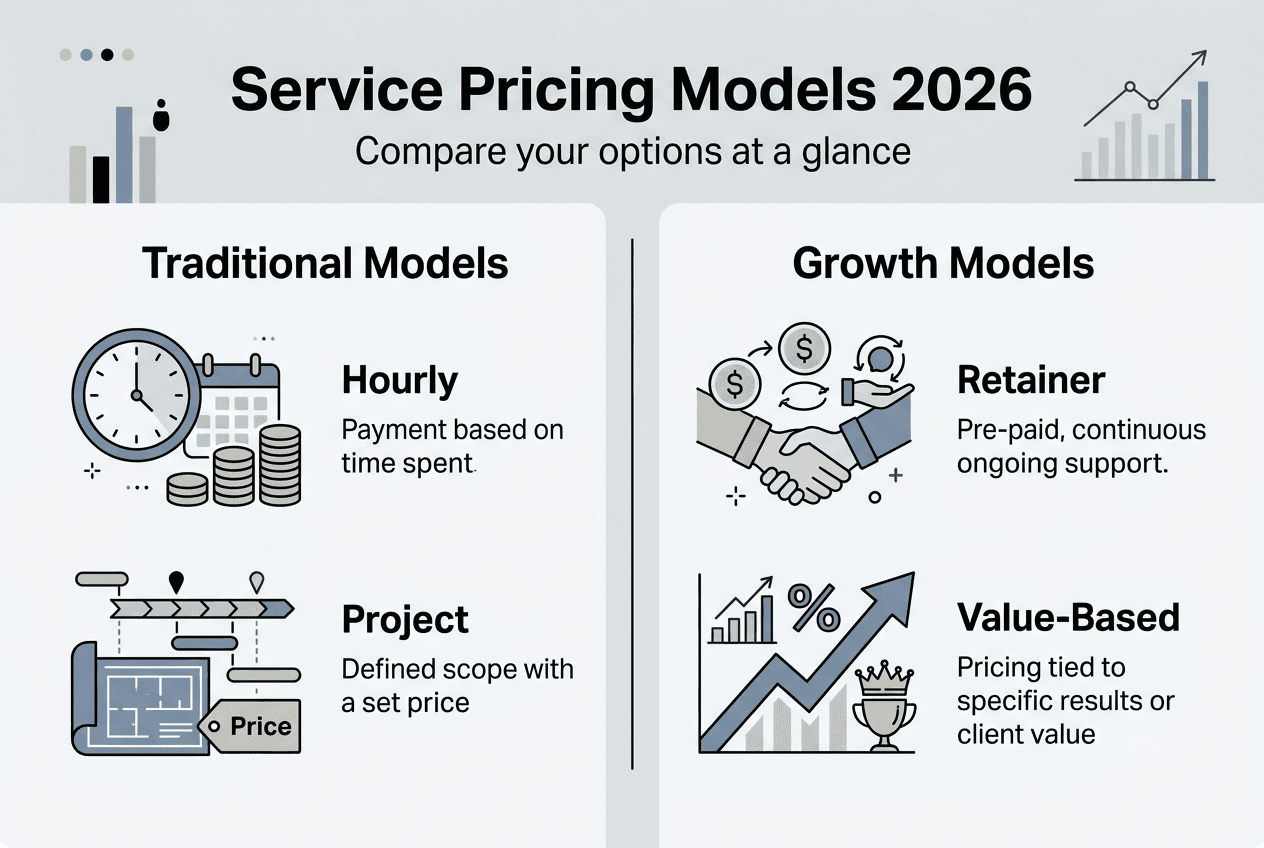
Hourly pricing charges clients for time spent on their work. It’s straightforward and easy to calculate, making it popular among new service providers. However, it creates a direct trade-off between your time and income. The faster you work or the more efficient you become, the less you earn. This model punishes expertise and caps your earning potential at available hours.
Hourly pricing also creates misaligned incentives. Clients want you to work faster and spend less time. You need more hours to increase revenue. This tension can damage relationships and create resentment on both sides. It’s the least profitable model for established entrepreneurs with deep expertise.
Project pricing sets a fixed fee for defined deliverables and scope. Clients know exactly what they’ll pay upfront, which reduces friction and speeds decision-making. You’re motivated to work efficiently because completing projects faster increases your effective hourly rate. This model rewards expertise and productivity.
The challenge with project pricing is scope creep. Without clear boundaries, clients may request additional work expecting it’s included. Detailed contracts and change order processes protect your profitability. Define deliverables precisely, outline what’s excluded, and establish how additional requests are handled and priced.
Retainer pricing provides recurring monthly revenue in exchange for ongoing access, support, or deliverables. This model creates predictable income, deepens client relationships, and allows you to plan capacity more effectively. Clients benefit from consistent support without negotiating new contracts constantly.
Retainers work best when clients need regular, ongoing help rather than one-time projects. Common structures include monthly hours, ongoing deliverables, or unlimited access within defined parameters. Clear expectations about response times, availability, and included services prevent misunderstandings.
Value-based pricing aligns fees with client outcomes and results rather than your inputs. This model offers the highest profit potential because pricing reflects the value created, not the cost to deliver. A strategy that generates $100,000 in new revenue might command a $20,000 fee, even if it takes you only 20 hours.
Understanding different pricing models helps entrepreneurs choose strategies that improve revenue and client satisfaction simultaneously. The right model depends on your service type, target market, and business goals.
Pro Tip: Many successful service businesses use hybrid models, combining retainers for ongoing clients with project fees for new work or value-based pricing for high-impact engagements.
Compare these models systematically:
| Model | Revenue Predictability | Profit Potential | Client Appeal | Best Service Type |
|---|---|---|---|---|
| Hourly | Low | Low | Medium | Tactical, time-based work |
| Project | Medium | Medium | High | Defined deliverables |
| Retainer | High | Medium to High | High | Ongoing support needs |
| Value-Based | Medium | Highest | Medium to High | Transformational outcomes |
Follow these steps to choose your optimal model:
- Assess what clients value most: your time, specific deliverables, ongoing access, or measurable outcomes
- Evaluate your service delivery: one-time engagements, ongoing relationships, or transformation-focused work
- Consider your revenue goals: stable predictability, maximum profit per client, or volume-based growth
- Test different models with new clients before switching existing relationships
- Refine based on client feedback, profitability data, and your lifestyle preferences
Integrating consultative sales strategies and financial coaching business strategies strengthens your ability to present and sell any pricing model confidently.
Practical steps to confidently raise your prices and sustain client trust
Knowing you should charge more and actually implementing price increases are entirely different challenges. The gap between knowledge and action is where most entrepreneurs get stuck. These practical steps bridge that gap with clear, actionable tactics.
Prepare a value-based justification before announcing any price change. Document the specific outcomes you’ve delivered, improvements you’ve made to your service, or additional expertise you’ve gained. This isn’t about defending your decision. It’s about helping clients understand the continued and growing value they receive.
Your justification should focus on client benefits, not your costs or needs. Saying “my expenses increased” is weak. Saying “I’ve added specialized training in X, which means you now get Y better results” is compelling. Frame the increase as an investment in their success.
Communicate transparently and well in advance. Give existing clients at least 30 to 60 days notice before new rates take effect. This shows respect for their planning and budgets. Send a personalized message explaining the change, the effective date, and what they can expect.
Confident communication and value demonstration prevent client loss during price increases. Most clients who are happy with your work will accept reasonable increases without issue. The ones who leave were likely price-shopping anyway and aren’t your ideal long-term clients.
Offer phased or tiered increases when appropriate. If you’re significantly underpriced, jumping to market rate immediately might shock clients. Consider implementing increases in stages: 20% now, another 15% in six months. Alternatively, offer current clients a grandfathered rate for a limited period while new clients pay the new fee.
This approach eases the transition and rewards loyalty without leaving money on the table indefinitely. Set clear end dates for any transitional pricing. Don’t let temporary discounts become permanent out of discomfort with the conversation.
Use consultative sales techniques to reaffirm service benefits during the transition. Schedule check-ins with key clients to review results, gather feedback, and discuss their evolving needs. These conversations naturally reinforce the value you deliver and make price increases feel like a minor detail in an otherwise strong relationship.
Pro Tip: When a client objects to a price increase, ask questions to understand the real concern. Often, it’s not about the money but about uncertainty regarding continued value or changing priorities.
Follow this implementation roadmap:
- Calculate your new pricing based on value delivered, market rates, and profit goals
- Prepare clear, benefit-focused messaging explaining the change
- Notify existing clients 30 to 60 days before the effective date
- Offer transitional options only if the increase is substantial or you’re correcting severe underpricing
- Hold firm on new rates for all new clients immediately
- Monitor client retention and feedback during the transition period
- Adjust messaging or timing for future increases based on what you learn
Key considerations during implementation:
- Expect some clients to leave; this is normal and often beneficial as it creates capacity for better-fit clients
- Don’t apologize for charging appropriately; confidence in your pricing signals confidence in your value
- Document client results continuously to make future increases easier to justify
- Review and adjust pricing annually rather than letting years pass between increases
Integrating start coaching business strategies and financial coaching services supports your overall business growth alongside pricing optimization.
Unlock expertise with Freedom Sun business training
Pricing strategies are just one piece of building sustainable wealth as a woman entrepreneur. The real transformation happens when you address the nervous system patterns keeping you stuck at the same revenue ceiling, no matter how much you know intellectually.
This is exactly the work we do inside the Women’s Wealth Collective, where women who are already successful come to build the next level of wealth, not just revenue. If you’re ready to stop circling the same ceiling and build something that actually reflects what you’re capable of, the Collective is where that happens. You’ll learn to bridge the gap between what you know you should do and what you can actually make yourself do when money, sales, and growth are on the line. The training covers all four pillars: Profit, Sales, Communication, and Leadership, delivered through practical frameworks you can implement immediately. Learn more about the Collective and join women entrepreneurs building real, sustainable wealth.
Frequently asked questions
How do I know if I am underpricing my services?
Signs include consistently offering discounts, feeling resentful about your workload relative to income, or avoiding conversations about raising rates. Compare your pricing to competitors with similar expertise and results. If you’re significantly lower without a strategic reason, you’re likely underpriced. Calculate your actual profit margins after all expenses. If margins are thin despite being busy, pricing is the problem.
What is the best way to communicate a price increase to existing clients?
Notify clients at least 30 to 60 days before the new rates take effect. Send a personalized message that focuses on the value they receive and any improvements you’ve made to your service. Offer a brief transition period or grandfathered rate if the increase is substantial. Be confident and matter-of-fact. Apologizing signals you don’t believe in your own value.
Which pricing model is most profitable for service entrepreneurs?
Value-based pricing typically offers the highest profit potential because it aligns fees with client outcomes rather than your time or costs. However, the best model depends on your service type and client relationships. Retainers provide stable recurring revenue. Project pricing rewards efficiency. Choose the model that fits your business goals and allows you to deliver exceptional results sustainably.
How often should I review and adjust my pricing?
Review pricing annually at minimum. Assess your costs, market rates, expertise growth, and the value you’re delivering. Small, regular increases are easier for clients to accept than large jumps after years of stagnant pricing. Adjust immediately when you add significant new capabilities, certifications, or service improvements that increase client value.
What if clients say they cannot afford my new rates?
Ask questions to understand whether it’s truly a budget constraint or a value perception issue. If they genuinely cannot afford your services, they may no longer be your ideal client as your business grows. Offer to refer them to someone at a lower price point. If it’s about perceived value, revisit the outcomes you’ve delivered and the results they’re getting. Often, objections dissolve when you reconnect clients to the transformation you provide.