Profitability Optimization Guide for Lasting Business Growth

Most American businesses lose up to 20 percent of revenue each year due to unclear financial systems and inefficient operations. For high-growth entrepreneurs and financial professionals, the challenge is balancing rapid expansion with sustainable systems that deliver genuine profitability. This guide brings you strategic insights for achieving financial clarity, building resilient automated processes, and driving long-term growth without risking burnout.
Table of Contents
- Step 1: Establish Financial Clarity With Accurate Data
- Step 2: Design Automated Systems For Operational Efficiency
- Step 3: Implement Scalable Sales And Revenue Strategies
- Step 4: Integrate Resilience-Driven Leadership Practices
- Step 5: Verify And Refine Systems For Ongoing Optimization
Quick Summary
| Key Point | Explanation |
|---|---|
| 1. Implement Accurate Data Tracking | Standardize financial data collection to ensure accuracy, enabling informed business decisions. Use digital tools to minimize errors. |
| 2. Automate Repetitive Processes | Identify and automate manual tasks to enhance efficiency and reduce risks. Ensure clear documentation for team understanding. |
| 3. Develop Scalable Sales Strategies | Create a lead generation system that utilizes various channels and focuses on personalized customer interactions for sustainable growth. |
| 4. Cultivate Resilient Leadership Practices | Foster a culture of resilience within the team by viewing challenges as learning opportunities and employing stress management techniques. |
| 5. Regularly Review Systems for Optimization | Establish a protocol for frequent performance audits and integrate adaptive technologies to continually enhance operational efficiency. |
Step 1: Establish financial clarity with accurate data
Establishing financial clarity starts with creating a robust data collection and analysis system that transforms raw numbers into strategic insights. Accurate financial reporting is the foundation of smart business decision making, allowing entrepreneurs to understand their true financial position and make informed strategic choices.
To build this system, start by standardizing your financial data collection process. Implement consistent tracking methods across all financial documents, ensuring financial data accuracy supports critical business decisions. This means developing clear protocols for recording income, expenses, investments, and financial transactions with meticulous attention to detail. Use digital accounting tools that automatically validate entries, reducing human error and creating a reliable financial record.
Track key performance indicators (KPIs) that provide meaningful insights into your business financial health. These might include revenue growth rate, profit margins, cash flow trends, and customer acquisition costs. Regular financial audits and reconciliation processes will help maintain data integrity and provide real time visibility into your business financial landscape.
Pro Tip: Invest in quarterly professional financial reviews to catch potential discrepancies early and maintain a clear, accurate financial picture.
Here’s a summary of key performance indicators and their strategic relevance for financial clarity:
| KPI Name | What It Measures | Business Impact |
|---|---|---|
| Revenue Growth Rate | Sales increase over time | Signals business expansion |
| Profit Margins | Earnings after expenses | Shows cost management effectiveness |
| Cash Flow Trends | Inflows vs. outflows | Indicates solvency and liquidity |
| Customer Acquisition Cost | Cost to gain new clients | Informs marketing and sales efficiency |
Step 2: Design automated systems for operational efficiency
Designing automated systems is a strategic approach to transforming your business operations from manual and time consuming processes to streamlined, predictable workflows. By implementing systematic approaches to procedural automation, you can significantly enhance your business productivity and reduce operational risks.
Start by identifying repetitive tasks within your organization that are prime candidates for automation. These typically include data entry, reporting, financial reconciliation, customer communication, and routine administrative functions. Prioritize tasks that are highly procedural and prone to human error, focusing on workflows that require consistent execution. Utilize workflow automation tools and enterprise software platforms that integrate seamlessly with your existing systems, enabling you to create rules based processes that run automatically.
Implement a phased automation strategy that allows for gradual integration and continuous improvement. Begin with smaller, low risk processes to build confidence and demonstrate value. Develop clear documentation for each automated workflow, ensuring team members understand the new systems and can troubleshoot potential issues. Regularly review and optimize your automated processes, tracking key performance metrics to validate their effectiveness and identify opportunities for further refinement.
Pro Tip: Always maintain a human oversight mechanism in your automated systems to catch unexpected variations and ensure quality control.
The following table compares manual vs. automated business processes:
| Aspect | Manual Processes | Automated Systems |
|---|---|---|
| Error Rate | Human-driven, higher risk | Minimized with validation tools |
| Consistency | Varies by employee | Standardized by workflows |
| Efficiency | Time-intensive | Fast and repeatable |
| Oversight Needed | Direct supervision | Integrated monitoring mechanisms |
Step 3: Implement scalable sales and revenue strategies
Implementing scalable sales and revenue strategies requires a comprehensive approach that transforms your current sales model into a dynamic growth engine. Top sales strategies for 2025 emphasize creating personalized value driven conversations that prioritize solving customer problems and building long term relationships.

Begin by developing a robust lead generation system that combines multiple channels. Leverage content marketing to attract potential customers, create targeted advertising campaigns, and utilize AI driven tools for predictive customer insights. Focus on building a sales infrastructure that can automatically qualify leads, track customer interactions, and provide personalized follow up. Scaling business revenue requires integrating advanced technologies and optimizing operational infrastructure to support consistent growth.
Develop a comprehensive training program for your sales team that emphasizes consultative selling techniques. Encourage a mindset of continuous learning and adaptation, where team members understand how to diagnose customer needs and provide tailored solutions. Implement performance tracking systems that reward not just sales volume, but also customer satisfaction and long term relationship building.
Pro Tip: Create a feedback loop that continuously captures customer insights to refine your sales strategies and product offerings.
Step 4: Integrate resilience-driven leadership practices
Resilient leadership is about developing a strategic mindset that transforms challenges into opportunities for growth and organizational strength. Resilience emerges as the most critical leadership skill for navigating complex business environments by enabling leaders to maintain focus and inspire teams during periods of uncertainty.
Develop a personal resilience framework that includes systematic approaches to emotional regulation and strategic thinking. This involves creating structured reflection practices where you analyze setbacks objectively, extract meaningful lessons, and develop adaptive strategies. Implement regular stress management techniques such as mindfulness meditation, strategic journaling, and periodic performance assessment that help you build mental fortitude and maintain emotional equilibrium even during high pressure situations.
Cultivate a team culture that views challenges as learning opportunities rather than obstacles. Encourage open communication about difficulties, normalize discussions about failure, and reward innovative problem solving approaches. Design training programs that teach team members how to develop personal resilience skills, including emotional intelligence, adaptive thinking, and constructive response mechanisms to unexpected business challenges.
Pro Tip: Schedule quarterly personal resilience audits to assess and recalibrate your mental and emotional leadership strategies.
Step 5: Verify and refine systems for ongoing optimization
Successful business optimization requires a strategic approach that continuously evaluates and improves your operational infrastructure. Business systems automation now demands implementing sophisticated AI technologies that enable autonomous decision making and continuous performance monitoring to maximize organizational efficiency.
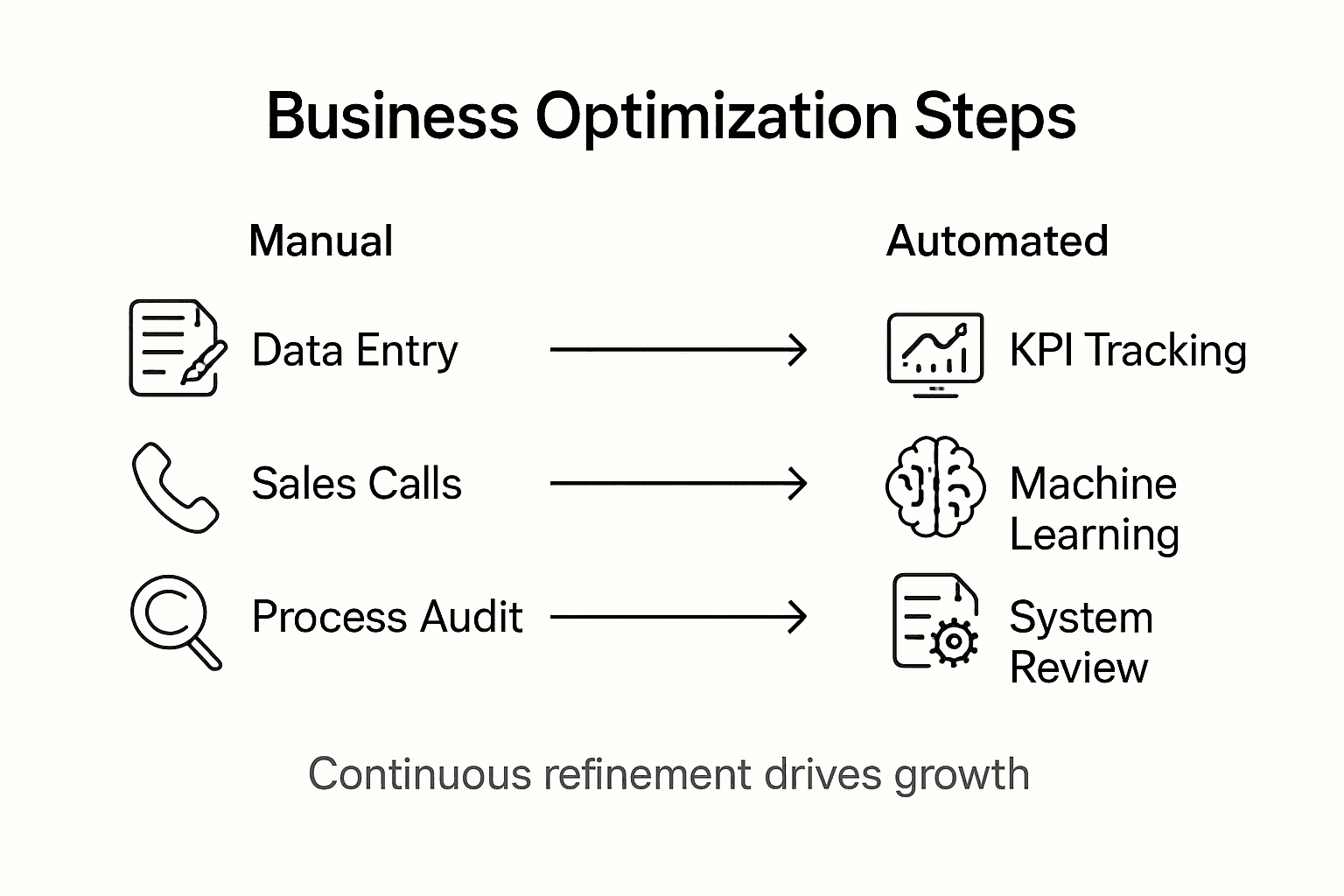
Establish a comprehensive system verification protocol that includes regular performance audits, data integrity checks, and algorithmic refinement. Create a structured framework for tracking key performance indicators across all operational domains, allowing you to identify potential inefficiencies or bottlenecks quickly. Develop automated reporting mechanisms that provide real time insights into system performance, enabling proactive adjustments before minor issues escalate into significant operational challenges.
Integrate machine learning and adaptive technologies that can self analyze and recommend optimization strategies. This means developing feedback loops that capture performance data, analyze historical trends, and suggest targeted improvements. Train your team to understand these adaptive systems, encouraging a culture of continuous learning and technological integration where human insight collaborates with artificial intelligence to drive systemic improvements.
Pro Tip: Conduct monthly system performance reviews that blend quantitative metrics with qualitative team feedback for holistic optimization.
Unlock Lasting Profitability with Strategic Business Systems
The challenges highlighted in the “Profitability Optimization Guide for Lasting Business Growth” show how crucial clear financial data, streamlined automation, scalable sales strategies, and resilient leadership are to sustainable success. If you feel overwhelmed by manual processes or uncertain about your financial clarity and leadership resilience, you are not alone. Many high-growth entrepreneurs struggle to align their internal systems with their growth ambitions without burning out.
At Freedom Sun, we understand these pain points deeply. Our unique Operating System framework centers on the three pillars of MATH for financial clarity, MECHANICS for operational systems, and MIND for leadership resilience. This structured approach helps you transform your business by building robust financial reporting, automating workflows, and cultivating strategic leadership—exactly what the article recommends for optimizing profitability and driving growth.
Are you ready to move beyond hustle culture and gain sovereignty over your systems while preserving personal wellbeing? Start your journey now with Freedom Sun for interactive training and diagnostics designed specifically for founders like you. Discover how to implement automation and sales infrastructure that scales without sacrificing peace at Operating System Framework. Take the next step and become the resilient leader your business needs by exploring our proven strategies today.
Frequently Asked Questions
How can I establish financial clarity in my business?
To establish financial clarity, begin by implementing a robust data collection and analysis system. Standardize your financial data tracking processes to ensure accuracy in income, expenses, and transactions, and consider utilizing digital accounting tools to enhance data integrity.
What key performance indicators should I track for profitability?
Track key performance indicators such as revenue growth rate, profit margins, cash flow trends, and customer acquisition costs. Regularly reviewing these KPIs will provide valuable insights into your business’s financial health and help inform strategic decisions.
What are the first steps to design automated systems for my operations?
Identify repetitive tasks in your business that can be automated, such as data entry and reporting. Start with low-risk processes and gradually implement automation tools that integrate with your existing systems, enhancing efficiency and reducing human error.
How can I develop effective sales and revenue strategies?
Create a lead generation system that combines multiple channels like content marketing and targeted advertising. Focus on building a sales structure that automatically qualifies leads and tracks customer interactions to foster long-term relationships.
How do I build resilience as a leader in my organization?
To cultivate leadership resilience, develop a personal framework that includes practices for emotional regulation and reflective thinking. Regularly analyze setbacks, learn from them, and maintain open communication with your team about challenges to promote a growth-oriented culture.
What steps should I take to verify and refine my business systems?
Establish a protocol for regular performance audits, data integrity checks, and algorithmic refinements. Create automated reporting mechanisms to gain real-time insights into your operational performance, allowing you to address any inefficiencies proactively.