How to Create Profitable Operations for Sustainable Growth

Over 60% of American entrepreneurs report that financial uncertainty is their biggest hurdle to making smart business decisions. Without financial clarity, even the most innovative ideas can lose momentum and direction. Understanding how to track the right numbers, build reliable systems, and harness automation is the difference between spinning your wheels and reaching real profitability. This guide reveals proven steps that help American business owners gain control, boost efficiency, and drive sustainable growth.
Table of Contents
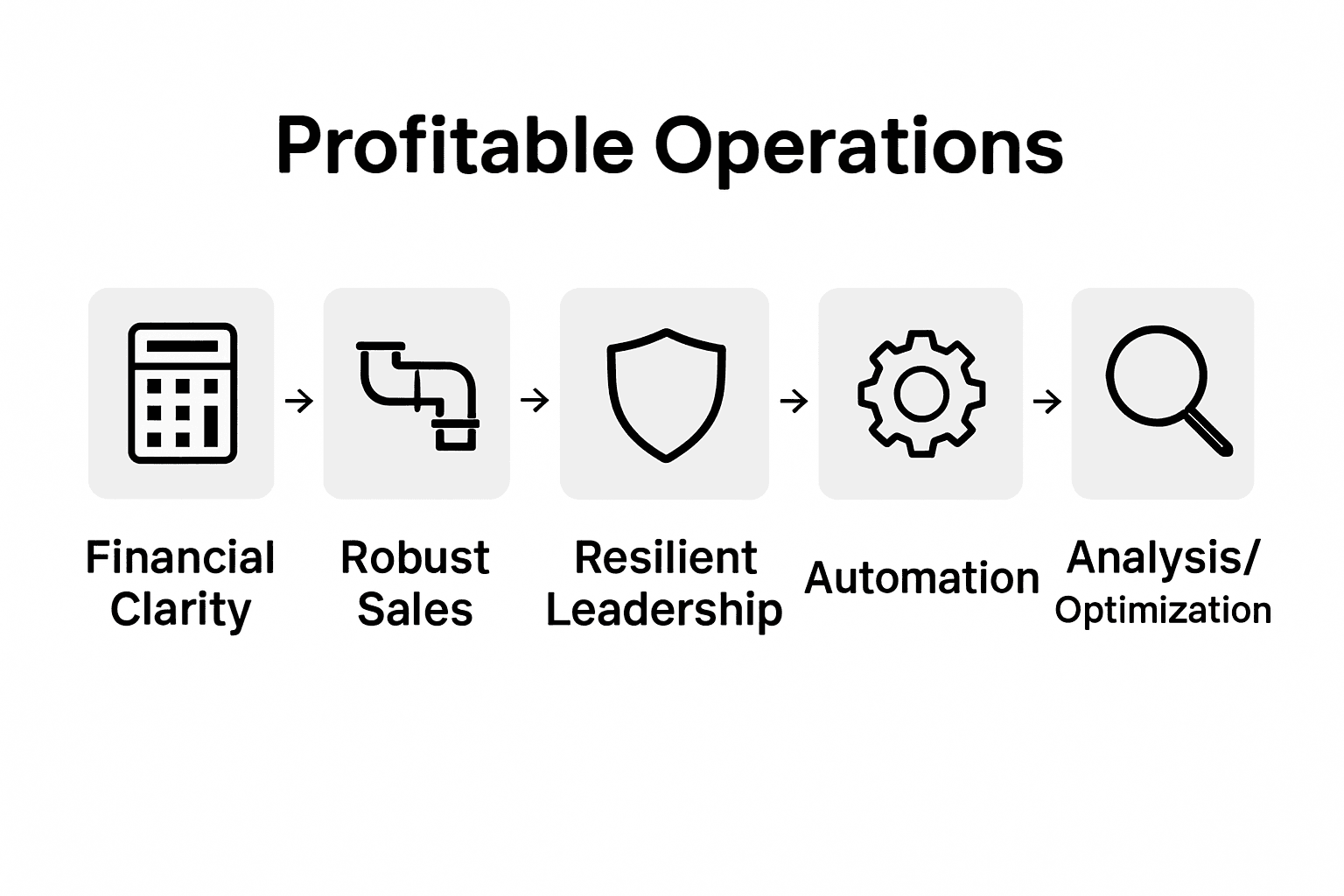
- Step 1: Establish Financial Clarity For Decision Making
- Step 2: Build Robust Sales And Revenue Systems
- Step 3: Implement Leadership Strategies For Resilience
- Step 4: Automate Processes For Sustainable Efficiency
- Step 5: Analyze Results And Optimize For Profitability
Quick Summary
| Key Insight | Explanation |
|---|---|
| 1. Financial Clarity Amplifies Decision Making | Understanding financial metrics leads to strategic planning and minimizes risks for sustainable growth. |
| 2. Systematic Sales Processes Drive Growth | Mapping out a structured sales pipeline ensures predictable income and reduces potential drop-off points. |
| 3. Leadership Resilience Enhances Problem-Solving | Developing a growth mindset and strategic flexibility helps leaders navigate challenges and foster innovation. |
| 4. Automation Increases Operational Efficiency | Implementing automated systems for repetitive tasks frees time for strategic initiatives and reduces errors. |
| 5. Data Analysis Optimizes Profitability | Regularly analyzing performance metrics transforms data into informed decisions for improving business outcomes. |
Step 1: Establish financial clarity for decision making
Financial clarity transforms guesswork into strategic planning. When entrepreneurs understand their financial landscape, they unlock powerful decision making capabilities that drive sustainable growth and minimize risks.
Creating financial clarity requires systematic analysis and intentional tracking. Start by developing a comprehensive financial dashboard that captures key performance indicators like cash flow, revenue streams, expense patterns, and profit margins. Financial insights from CEOs with strong financial knowledge demonstrate how understanding financial metrics directly impacts business innovation and strategic choices. Think of this dashboard as your financial compass showing exactly where your business stands at any moment.
To build your clarity framework, implement disciplined tracking practices. Categorize all financial transactions meticulously, review statements monthly, and create visual representations of your financial health. This means moving beyond basic accounting to understanding the story behind the numbers. Identifying trends, potential bottlenecks, and growth opportunities becomes possible when you transform raw data into meaningful insights.
Pro tip: Create a monthly financial review ritual where you analyze your dashboard, compare current performance against historical data, and adjust your strategy based on concrete evidence rather than intuition.
Here’s a summary of essential dashboard metrics and their value to decision making:
| Financial Metric | Insight Provided | Business Impact |
|---|---|---|
| Cash Flow | Tracks money in and out | Ensures liquidity, avoids crises |
| Revenue Streams | Shows income sources | Reveals growth, diversification |
| Expense Patterns | Identifies cost structures | Finds savings, controls waste |
| Profit Margins | Measures business efficiency | Guides pricing and investments |
Step 2: Build robust sales and revenue systems
Building robust sales and revenue systems is about creating a strategic framework that consistently generates predictable income while scaling your business efficiently. Your goal is to transform sales from a sporadic activity into a structured, repeatable process that drives sustainable growth.
Start by mapping out a comprehensive sales pipeline that tracks every customer interaction from initial contact to final conversion. AI driven sales strategies are revolutionizing how businesses approach customer acquisition and revenue generation. Break down your pipeline into clear stages: lead generation, qualification, engagement, proposal, negotiation, and closing. Each stage requires specific tactics and metrics to ensure smooth progression and minimize potential drop off points.
Develop a systematic approach to tracking and improving your sales performance. Create key performance indicators that measure conversion rates, average deal size, sales cycle length, and customer acquisition costs. Implement a customer relationship management system that provides real time insights into your sales ecosystem. This allows you to quickly identify bottlenecks, understand customer behavior patterns, and make data driven adjustments to your sales strategy.
Pro tip: Design a quarterly sales review process where you analyze your pipeline performance, identify top converting channels, and continuously refine your sales approach based on actual data and customer feedback.
Step 3: Implement leadership strategies for resilience
Leadership resilience is about building a robust mental framework that enables you to navigate complex business challenges with strategic clarity and emotional intelligence. The goal is to develop adaptive leadership skills that transform potential obstacles into opportunities for growth and innovation.
Leadership strategies for managing financial challenges become critical when entrepreneurs face unexpected market disruptions. Start by cultivating a growth mindset that views challenges as learning experiences rather than insurmountable barriers. Develop a personal leadership framework that includes mental flexibility, emotional regulation, and strategic problem solving skills. This means creating systematic approaches to stress management, decision making under pressure, and maintaining clear strategic vision even when external circumstances seem chaotic.
Build your resilience through continuous learning and strategic self development. Invest in workshops, simulations, and training programs that enhance your financial literacy and leadership capabilities. Boosting leadership confidence through financial mastery requires a commitment to ongoing education and self reflection. Create a personal development plan that includes regular skill assessments, mentorship opportunities, and targeted learning experiences that expand your strategic thinking and emotional intelligence.
Pro tip: Establish a weekly leadership reflection practice where you analyze your recent challenges, document lessons learned, and consciously design strategies to improve your resilience and adaptive capabilities.
Step 4: Automate processes for sustainable efficiency
Automation transforms operational complexity into streamlined performance. Your goal is to design systems that work seamlessly without constant manual intervention, freeing your leadership to focus on strategic growth and innovation.

Machine learning frameworks for sales opportunity prediction demonstrate how intelligent automation can dramatically enhance operational efficiency. Begin by mapping out your current business processes and identifying repetitive tasks that consume significant time and energy. Focus on creating automated workflows for critical areas like lead tracking, customer communication, financial reporting, and inventory management. This means implementing smart technologies that can learn from your existing data and continuously improve their performance without additional human input.
Prioritize strategic automation by selecting tools that integrate seamlessly with your existing technology stack. Advanced machine learning models for predictive sales forecasting showcase how intelligent systems can provide more accurate predictions and reduce human error. Develop a phased implementation approach where you gradually introduce automation technologies, measure their impact, and refine your systems. Start with low risk processes and progressively expand automation across more complex operational domains. This approach allows you to build confidence in your technological infrastructure while minimizing potential disruptions.
Pro tip: Create an automation scorecard that tracks efficiency gains, time saved, and error reduction for each automated process to continuously validate and improve your technological investments.
The following table compares key benefits of automation in business processes:
| Automation Benefit | Operational Impact | Strategic Advantage |
|---|---|---|
| Time Savings | Reduces manual workload | Frees leaders for big-picture |
| Error Reduction | Minimizes human mistakes | Improves reliability |
| Real-time Reporting | Provides up-to-date insights | Enables fast decision making |
| Scalability | Handles growth without more staff | Supports business expansion |
Step 5: Analyze results and optimize for profitability
Profitability optimization requires a systematic approach to understanding your business performance beyond surface level metrics. Your ultimate goal is transforming raw data into actionable insights that drive strategic decision making and sustainable financial growth.
Profit Impact of Market Strategy research demonstrates how empirical data analysis can reveal critical patterns in business performance. Develop a comprehensive performance dashboard that tracks key financial indicators including revenue streams, customer acquisition costs, profit margins, and operational expenses. Break down your analysis into granular segments examining each business unit, product line, and revenue channel. This means creating a holistic view that goes beyond aggregate numbers to understand the specific drivers of your financial performance.
Leverage advanced analytical techniques to enhance your profitability assessment. Interpretable AI models for investment decisions highlight the power of transparent analytical approaches that provide clear insights into performance factors. Implement quarterly review cycles where you conduct deep dive analyses, compare current performance against historical trends, and identify potential optimization opportunities. Focus on understanding not just what happened, but why it happened and how you can strategically improve future outcomes.
Pro tip: Create a quarterly profitability optimization report that documents your key insights, recommended actions, and tracks the financial impact of your strategic adjustments.
Unlock Profitable Growth Through Strategic Operational Mastery
Navigating the complexities of creating profitable operations requires more than just effort it demands precise financial clarity, scalable sales infrastructure, and resilient leadership — exactly the challenges highlighted in the article. Entrepreneurs often struggle with scattered data, unpredictable revenue flows, and leadership burnout that stall sustainable growth. This is where the Freedom Sun Operating System framework shines by offering a proven structure based on MATH for financial clarity, MECHANICS for sales systems, and MIND for leadership resilience.
If you are ready to move beyond guesswork and hustle culture and embrace a holistic approach that builds system sovereignty and peace of mind, explore our interactive training and diagnostic assessments tailored for high-growth leaders. Experience actionable insights that turn your financial dashboards into clear decision-making compasses, create repeatable sales pipelines, and develop the mental resilience vital for long-term success. Take the first step toward transforming your operations and scaling your leadership without burnout by visiting Freedom Sun today and discover how to build profitable peace with our Operating System designed for founders like you.
Make the leap now and secure your pathway to sustainable operational excellence.
Frequently Asked Questions
How can I establish financial clarity for decision making?
To establish financial clarity, develop a comprehensive financial dashboard that captures key performance indicators such as cash flow, revenue streams, and profit margins. Implement a monthly review of these metrics to gain insights into your business’s financial health and adjust strategies accordingly.
What are the essential metrics to include in a financial dashboard for profitability?
Include metrics such as cash flow, revenue streams, expense patterns, and profit margins in your financial dashboard. This allows you to track your financial performance and make informed decisions aimed at improving profitability and ensuring sustainable growth.
How do I build a reliable sales and revenue system?
Start by mapping out a sales pipeline that tracks customer interactions from lead generation to conversion. Aim to implement clear stages within your pipeline and systematically track conversion rates and sales performance to optimize your revenue generation process.
What leadership strategies can enhance resilience in my business?
Cultivating a growth mindset is key to enhancing resilience. Regularly reflect on challenges you face, and invest in leadership training that focuses on emotional intelligence and decision-making under pressure, helping you adapt to changing market conditions.
How can I automate processes to improve operational efficiency?
Automate repetitive tasks such as lead tracking and financial reporting to streamline operations. Identify processes that consume significant time and effort, and implement automation solutions to reduce manual workload and enhance overall efficiency.
What steps should I take to analyze results for optimizing profitability?
Conduct thorough performance analyses using a comprehensive dashboard that tracks key financial indicators like profit margins and customer acquisition costs. Schedule quarterly reviews to dive deep into your business performance and identify data-driven opportunities for profitability optimization.