Build Business Confidence: Strategies for Women Leaders

TL;DR:
- Women entrepreneurs report lower economic confidence and higher financial stress compared to men.
- Building lasting confidence requires skill development, peer support, and adaptive coaching tailored to women’s specific challenges.
- Reframing setbacks as learning opportunities and adopting holistic, resilience-focused strategies lead to sustainable business growth.
Only 21% of women small business owners rate the economy as excellent or good, compared to 34% of men, and 69% report financial stress versus 55% of their male counterparts. Those numbers are striking, but they tell only part of the story. The women reading this are already generating revenue, already leading teams, already delivering results. And still, something holds them back from the next level. This guide digs into where that confidence gap actually comes from, what drives lasting business confidence, and how you can move from grinding through obstacles to building wealth and leadership that lasts.
Table of Contents
- Understanding the confidence gap for women business owners
- Core drivers of business confidence for women leaders
- Overcoming confidence barriers: Training, skills, mindset shifts
- From surviving to thriving: Holistic strategies for sustainable confidence
- Why reframing confidence challenges changes outcomes for women entrepreneurs
- Unlock support for your confidence journey
- Frequently asked questions
Key Takeaways
| Point | Details |
|---|---|
| Confidence gap is real | Women founders face higher financial stress and lower business confidence compared to men. |
| Confidence builds with skills | Developing financial, digital, and leadership skills boosts long-term confidence. |
| Peer support strengthens growth | Learning from peers and coaches helps counteract self-doubt and unlock sustainable business growth. |
| Holistic strategies outperform quick fixes | Combining skill-building, trust, and adaptive learning leads to lasting confidence and resilience. |
Understanding the confidence gap for women business owners
Let’s start by examining what the confidence gap actually looks like, and why it persists for so many women in business.
The numbers are hard to ignore. According to the CNBC|SurveyMonkey Small Business Index Q2 2025, women entrepreneurs report significantly lower economic optimism and higher financial stress than men in the same position.
| Metric | Women owners | Men owners |
|---|---|---|
| Rate economy excellent/good | 21% | 34% |
| Stressed about finances | 69% | 55% |
| Expect a recession | 76% | 67% |
These gaps are not small. They signal something structural, not just personal.
“Confidence does not exist in a vacuum. It is shaped by the environment you operate in, the access you have, and the stories you’ve been told about your own potential.”
So what is driving this gap? The most common barriers women business owners face include:
- Financial anxiety rooted in inconsistent revenue or fear of economic downturns
- Limited access to business training specifically designed for women leaders
- Work-family balance pressures that compete with time for strategic thinking
- Economic pessimism amplified by fewer peer networks at senior levels
These are not personality flaws. Research on success factors shows that structural obstacles, not individual weakness, are the leading cause of confidence gaps in women entrepreneurs. Why does this matter for growth? Because confidence directly shapes the decisions you make: whether you raise your prices, pursue a major contract, or invest in your own development. Poor mental resilience for entrepreneurs translates into slower growth cycles and chronic undercharging.
Building financial wellness for entrepreneurs is not just about your balance sheet. It is about reducing the cognitive load of worry so your brain has room for strategy. When financial stress drops, decision-making sharpens and risk tolerance grows. That is where confidence starts to compound.
Core drivers of business confidence for women leaders
Now that we’ve outlined the confidence gap, let’s explore what really underpins lasting, transferable business confidence.
Confidence is not a personality trait you either have or don’t. It is a skill set that responds to deliberate input. Research confirms that self-confidence, risk-taking, and achievement orientation all positively correlate with entrepreneurial success, while training gaps and limited finance access consistently undermine it.

Here is how the key drivers compare between women and men in business:
| Driver | Women entrepreneurs | Men entrepreneurs |
|---|---|---|
| Primary confidence source | Peer validation, skill mastery | Risk outcomes, financial wins |
| Biggest confidence drain | Financial stress, role overload | Market uncertainty |
| Most effective booster | Mentorship, structured training | Competitive benchmarking |
For women leaders, confidence grows fastest when it is tied to visible competence. Financial literacy and digital skills are especially powerful here because they create concrete proof of capability. When you understand your numbers deeply, or learn to market yourself with precision, the internal narrative shifts.
The steps that build confidence most reliably are:
- Identify your highest-leverage skill gap and close it with targeted learning
- Engage with holistic confidence building through peer communities and adaptive coaching
- Track micro-wins to create an evidence file of your own capability
- Revisit your self-leadership for founders practices quarterly to reset your internal compass
- Protect financial clarity by strengthening your grasp of cash flow and building financial resilience
Pro Tip: Adaptive coaching, where a mentor adjusts their approach based on your specific stage and nervous system response, produces faster confidence shifts than generic advice. Look for coaches who challenge your assumptions while making you feel genuinely supported, not just motivated.
Combining training, peer support, and adaptive coaching yields outsized results compared to any single approach alone. The women who accelerate fastest are not the ones who work hardest. They are the ones who build the right structure around their growth.
Overcoming confidence barriers: Training, skills, mindset shifts
With core drivers established, let’s get practical: here’s how to shatter the most persistent barriers holding back your confidence.
Many women entrepreneurs know what they need to do but still feel frozen when it matters most. That freeze is not weakness. It is a nervous system response to unresolved risk and unaddressed skill gaps. Training and education gaps are among the top barriers to entrepreneurial success, and closing them is one of the fastest ways to rebuild confidence from the inside out.
Here is a stepwise approach to breaking through the most common barriers:
- Start with financial literacy because money clarity removes the biggest source of anxiety for most women founders
- Add digital skills in your highest-priority business area, whether that is marketing, analytics, or operations
- Develop your leadership communication using communication strategies that help you lead with authority and warmth simultaneously
- Work on mastering self-sufficiency so you stop outsourcing confidence to external validators
- Reframe imposter syndrome by treating it as a signal that you are growing, not failing
“The moment you stop treating self-doubt as evidence of inadequacy and start treating it as proof of rising standards, your entire relationship with risk changes.”
According to 2025 business confidence data, women are more likely than men to internalize economic uncertainty as personal failure. That pattern needs to be interrupted deliberately, not waited out.
Pro Tip: Hiring a consultant or mentor even for a short engagement produces a disproportionate confidence return. You are not paying for their answers. You are paying to borrow their certainty while you build your own.
Quick shifts that work immediately include replacing “I’m not sure if I can” with “I’m learning how to,” and replacing post-meeting self-criticism with a written list of what went well. These are not fluffy exercises. They are cognitive rewiring techniques that directly influence your next decision under pressure.
From surviving to thriving: Holistic strategies for sustainable confidence
As your skills and mindset evolve, the final step is weaving these strategies into a holistic, resilience-first approach.
There is a big difference between bursts of confidence and sustainable confidence. Bursts happen after a win or a good coaching session. Sustainable confidence is structural. It holds even when revenue dips, clients leave, or the market shifts.
Holistic approaches that combine digital skills, peer learning, and adaptive business services are what transition women from survival mode into genuine resilience and wealth-building. That is not a theory. It is what the research shows actually works.
Here is what a holistic strategy looks like in practice:
- Trust-building systems: Establish relationships with mentors, peers, and advisors who know your business and tell you the truth
- Digital literacy: Continuously update your skills so technology feels like a tool, not a threat
- Peer learning groups: Join communities where women at your level share wins, losses, and strategies without judgment
- Adaptive coaching services for founders: Work with coaches who evolve their methods as you grow
- Layered skill development: Build on each capability so your confidence compounds rather than resets
Statistic to remember: Women using holistic approaches that combine peer networks, skills training, and tailored coaching are consistently making the shift from reactive survival mode to proactive wealth strategy. This is not a bonus. This is the engine.
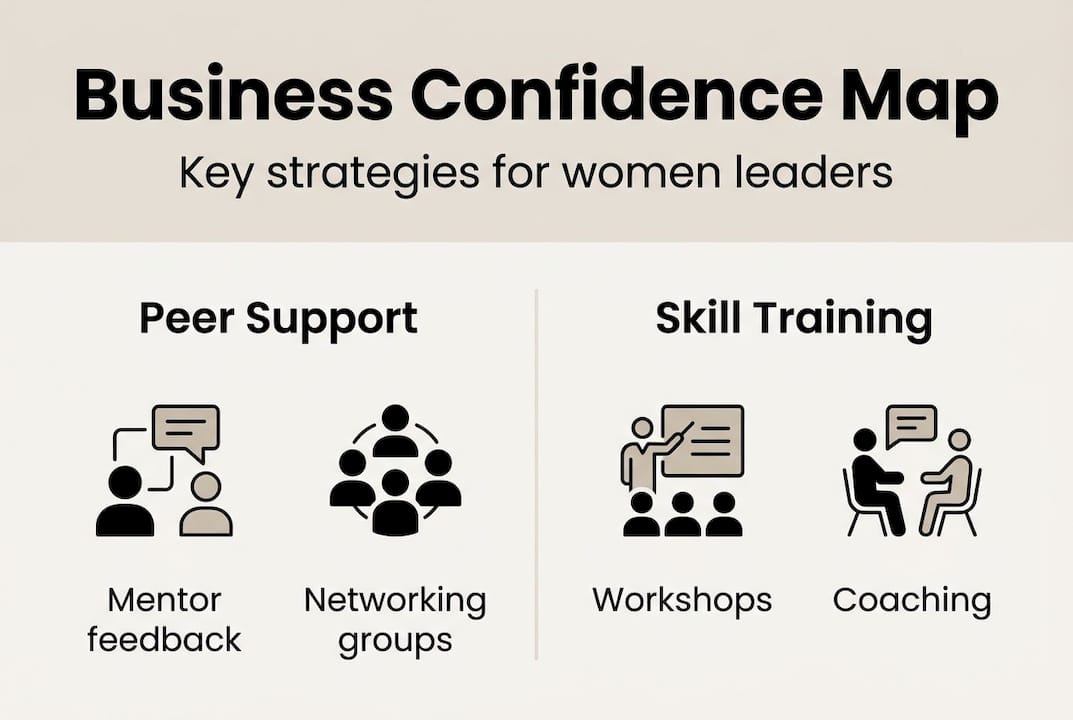
The women exploring coaching business strategies at this level are not starting out. They are optimizing. They already know what to do in theory. The holistic layer is what makes it stick in practice, especially when women’s confidence initiatives integrate identity-specific strengths into the work.
Why reframing confidence challenges changes outcomes for women entrepreneurs
Pulling back from the frameworks, let’s look at what really changes outcomes in the real world.
Most conversations about women and confidence land in the same place: women lack it, men have it, here are some tips. That framing is not just unhelpful. It is inaccurate and quietly damaging.
The women I have watched transform their businesses did not do it by finally feeling confident enough. They did it by reframing what confidence actually means. They stopped treating setbacks as evidence that they were not cut out for this, and started treating them as data about what to try next. That shift, from “I failed” to “I learned something faster than most people would,” is what sustainable confidence actually looks like.
Adaptive experimentation, celebrating micro-wins, and leaning into identity-specific strengths are more powerful than any generic confidence formula. Your perspective as a woman in business is not a liability to overcome. It is a strategic asset if you build your confidence architecture around it.
Building mental resilience for entrepreneurs is not about becoming someone who never doubts. It is about becoming someone who moves through doubt faster every time.
Unlock support for your confidence journey
If you’re ready to take the next step in your confidence journey, dedicated support and proven resources are just a click away.
The strategies in this article are grounded in what actually works for women entrepreneurs who are already generating revenue and ready to grow without burning out. At Freedom Sun, we go beyond surface-level advice to address both the financial strategy and the psychology underneath it. Whether you need sharper leadership skills, a stronger relationship with money, or a peer community that challenges you to rise, Freedom Sun business training offers the frameworks, coaching, and community designed specifically for women founders ready to build real, sustainable wealth.
Frequently asked questions
Why do women entrepreneurs face lower business confidence?
Women entrepreneurs experience confidence gaps due to barriers like financial stress and lack of training, combined with the structural pressure of balancing work and family responsibilities that men in business rarely face at the same level.
What strategies build lasting confidence for women in business?
Combining skill-building, peer networks, and professional coaching produces sustainable confidence because each layer reinforces the others. Holistic approaches that address both capability and mindset are what create durable results rather than temporary motivation.
How can I overcome imposter syndrome as a woman founder?
Shift your self-talk by replacing judgment with curiosity, and build an evidence file of real wins you can return to when doubt spikes. Engaging with mentors and peer learning communities provides external grounding when your internal voice gets loud.
Is business confidence something you’re born with?
No. Confidence is a learnable skill that strengthens when you develop capabilities, gather evidence of your own effectiveness, and reframe challenges as learning data. Research confirms that mindset shifts and deliberate skill-building are the actual drivers of entrepreneurial self-confidence.
Recommended
- Business Coach Leadership Training: Transforming Founder Success
- Self-Leadership: Unlocking Sustainable Success for Founders
- Financial Wellness: Equipping Leaders for Sustainable Growth
- 7 Proven Wealth-Building Strategies for Founders
- Aesthetic Treatments for Women: Enhancing Confidence in Knightsbridge - The Aesthetics Room