Reset your money thermostat: wealth without burnout

TL;DR:
- Your money thermostat is a subconscious set point that influences your financial comfort and behavior.
- It is shaped by early experiences, cultural messages, and emotional associations with money.
- Resetting it involves awareness, nervous system regulation, small financial actions, and cycle alignment.
You can be talented, driven, and fully booked — and still hit the same income ceiling every single year. Not because your strategy is wrong, but because of something far less visible: your money thermostat, the subconscious set point that quietly decides how much wealth you’re allowed to keep. This article breaks down what that set point is, how it got programmed, what the science actually says, and — most importantly — how to raise it in a way that builds real, lasting wealth without grinding yourself into the ground.
Table of Contents
- What is the money thermostat?
- How your money thermostat is set — and why it keeps you stuck
- Resetting your money thermostat: Strategies that really work
- Empirical evidence and edge cases: What does science really say?
- Our take: Why the money thermostat matters for women entrepreneurs
- Ready to reset your money thermostat?
- Frequently asked questions
Key Takeaways
| Point | Details |
|---|---|
| Money thermostat explained | Your money thermostat is a subconscious set point that controls your comfort and results with wealth. |
| Origins of financial set points | Childhood beliefs, culture, and past experiences set your default money comfort zone, often limiting success. |
| Effective reset strategies | Combining awareness, self-talk, nervous system work, and safe upgrades helps you expand your wealth capacity. |
| Lasting change for women | Cycle-aligned business strategies and embodied practices are key to preventing burnout while growing wealth. |
| Empirical support and nuance | Evidence shows people return to old set points after windfalls, but intentional change is possible with the right methods. |
What is the money thermostat?
Think about how a home thermostat works. You set it to 68 degrees, and the system keeps fighting to return to that number no matter what happens outside. Your financial life works the same way. Your money thermostat is a subconscious set point that determines how much income, wealth, and financial ease you feel comfortable holding. When your results drift too far above or below that number, your behavior quietly corrects course — often without you realizing it.
The concept was popularized by T. Harv Eker in Secrets of the Millionaire Mind, where he introduced the idea of a “money blueprint” — the internal programming that drives your financial outcomes. According to this model, your thoughts create feelings, your feelings drive actions, and your actions produce results. Change the blueprint, change the results.
For women entrepreneurs, this plays out in very specific ways. You land a big client and suddenly feel the urge to discount your next proposal. Revenue spikes and you find yourself spending on things you didn’t plan for. Or you avoid raising your rates even when demand is clearly there. These aren’t random choices. They’re your thermostat doing its job.
“Your financial blueprint is the combination of your thoughts, feelings, and actions in relation to money. It operates below the level of conscious awareness — and it runs the show.” — T. Harv Eker
Here’s a quick comparison of what life looks like above and below your set point:
| Scenario | Typical behavior |
|---|---|
| Income rises above set point | Overspending, discounting, sudden “emergencies” |
| Income drops below set point | Hustle mode, urgency, short-term fixes |
| Income matches set point | Comfort, status quo, no growth pressure |
Common signs your thermostat is running the show:
- You keep hitting the same revenue number month after month
- Windfalls disappear faster than expected
- You feel guilty or anxious when things go too well financially
- You undercharge clients you actually want to work with
- You procrastinate on financial decisions that would grow your business
Understanding why your money thermostat keeps you stuck is the first real step toward changing it.
How your money thermostat is set — and why it keeps you stuck
Your thermostat wasn’t set by accident. According to research on financial conditioning, it was shaped by your early experiences, the money conversations (and silences) in your household, cultural messages, and the emotional weight attached to financial events in your past.
Did you grow up hearing “money doesn’t grow on trees”? Or watching a parent stress every time a bill arrived? Maybe you were the first in your family to earn at a certain level, and success started to feel like betrayal. These aren’t small things. They become the money blueprint model that runs quietly in the background of every financial decision you make.
For women entrepreneurs, there are additional layers. Societal conditioning around women and money — the idea that earning too much is aggressive, or that receiving without working harder is somehow wrong — adds complexity that many generic money mindset programs completely miss.
Here are the most common thermostat-setting sources:
- Family money beliefs passed down through behavior, not just words
- Cultural narratives about what women should earn or want
- Early financial wins or losses that created emotional associations
- Verbal conditioning like repeated phrases about money being scarce or dangerous
- Identity conflicts around out-earning a partner, parent, or peer group
These patterns show up as invisible ceilings. You work harder, you add more offers, you optimize your funnel — and still land in the same place. That’s not a marketing problem. That’s a set point problem. Developing a financial mindset for business growth means learning to see these patterns clearly before trying to push through them.

Working with a financial coaching for founders perspective can help you identify exactly where your set point sits and what installed it — which is far more efficient than trying every tactic and wondering why nothing sticks.
Pro Tip: Notice your emotional response the next time revenue spikes or a large payment lands. Do you feel excited and grounded, or anxious and compelled to spend? That reaction tells you exactly where your thermostat is set.
Resetting your money thermostat: Strategies that really work
Knowing your set point is one thing. Actually shifting it is another. The good news is that your thermostat is not fixed. It was programmed, which means it can be reprogrammed — but the process requires more than positive thinking.
Think of your financial capacity like a cup. Right now, your cup holds a certain amount. Pour in more than it can hold and it spills — through overspending, self-sabotage, or avoidance. The goal isn’t to force more in. It’s to expand the cup itself. That takes gradual, intentional work.
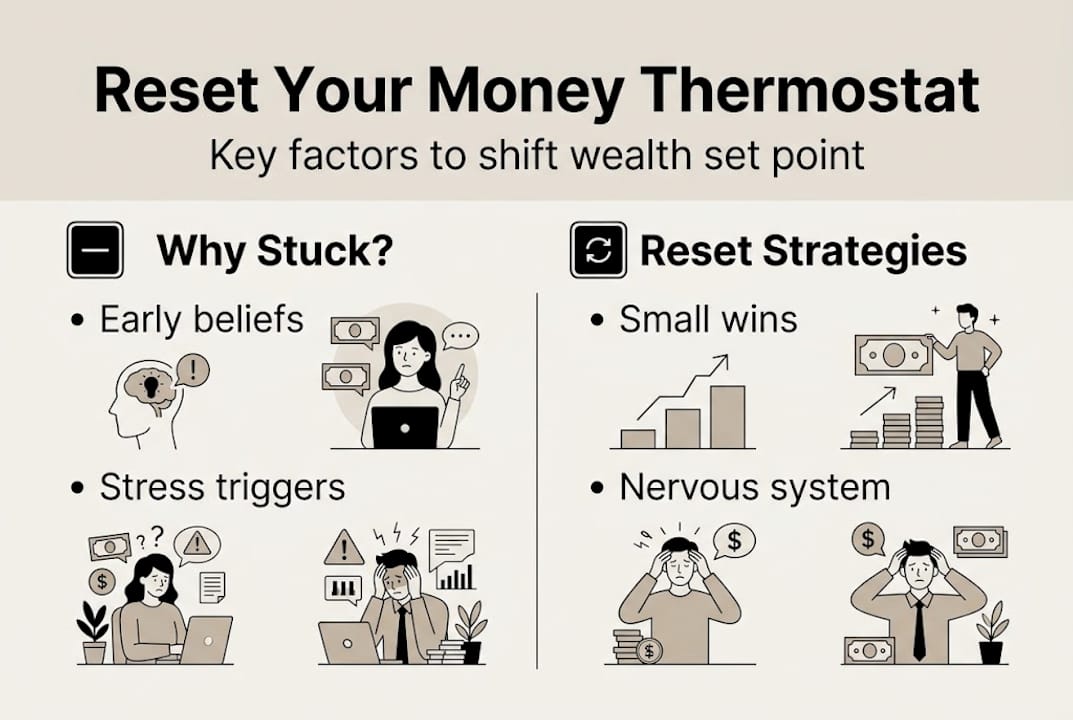
Effective reset strategies used by practitioners include:
- Awareness audit — Write down every belief you hold about money, wealth, and what you deserve. Most people have never done this.
- Targeted declarations — Not generic affirmations, but specific, present-tense statements that address your exact limiting beliefs.
- Incremental financial upgrades — Raise your rates by a small but meaningful amount. Open a dedicated profit account. Each small action rewires the association between money and safety.
- Nervous system regulation — Breathwork, somatic practices, and body-based tools help your system feel safe at higher income levels, not just intellectually convinced.
- Profit-first allocation — Structuring your money flow so wealth accumulation becomes automatic, reducing the emotional friction around keeping money.
- Cycle-aligned planning — For women, syncing high-output work with natural energy cycles reduces the burnout that often triggers financial self-sabotage.
Research on resetting money beliefs emphasizes that sustainable change happens when the nervous system feels safe, not when you white-knuckle your way to a new behavior. That’s why so many mindset programs produce short-term results and long-term frustration.
For deeper support on applying these strategies to your specific business context, financial mindset mastery resources can help bridge the gap between knowing and doing.
Pro Tip: Instead of trying to “fake it till you make it” at a much higher income level, take one concrete financial action that feels slightly uncomfortable but not terrifying. That’s the sweet spot for thermostat expansion.
Empirical evidence and edge cases: What does science really say?
The money thermostat is a compelling model — but what does actual research show? The evidence is mixed, and that’s worth being honest about.
The most cited data point comes from lottery studies. Research on lottery winners shows that many return to their previous financial levels within a few years, and some experience worse outcomes than before the windfall. This strongly supports the idea of a financial set point. Sudden wealth without internal recalibration tends not to stick.
However, contrasting perspectives from economic research suggest the picture is more nuanced. Some lottery winners do improve their long-term well-being and financial stability, particularly when they had existing financial literacy. Gender differences in set point behavior are minimal in the data, which means the barriers women face are more likely cultural and systemic than neurological.
Key empirical findings:
- Most people revert to previous income levels after sudden windfalls
- Financial literacy significantly moderates set point reversion
- Emotional associations with money are more predictive of behavior than income level
- “Faking it” with debt to signal wealth accelerates financial instability, not growth
- Nervous system dysregulation correlates with poor financial decision-making under stress
For benchmarks on women entrepreneurs, the data consistently shows that access to financial education and peer community are among the strongest predictors of sustained revenue growth.
“Your psyche knows the truth about your money capacity. You can dress it up, but you cannot outrun it — until you do the internal work to expand what feels real.”
This is why the business scaling guide at Freedom Sun integrates both financial strategy and the psychological foundations underneath it. Strategy without internal alignment produces short-term results at best.
Our take: Why the money thermostat matters for women entrepreneurs
Here’s what most money mindset content gets wrong: it treats this as a purely mental problem. Read the right books, repeat the right affirmations, and your income will follow. That’s incomplete advice, and for many women entrepreneurs, it’s the reason they feel like they’re failing at something they’re doing correctly.
The real breakthrough comes when you stop treating your money thermostat as a thought problem and start treating it as a nervous system problem. Nervous system safety is what allows new financial behaviors to actually stick. Without it, your body keeps overriding your best intentions.
We’ve seen this consistently with clients at Freedom Sun. Women who integrate somatic regulation and cycle-aligned planning alongside financial strategy don’t just raise their income. They hold it. They stop the boom-and-bust cycle. They build wealth without the constant pressure to perform at full capacity every single week.
Generic advice also ignores the cyclical nature of women’s energy and focus. Pushing for linear, constant growth is a setup for burnout. When you align your highest-output work with your natural rhythms, you stop fighting your own biology — and your thermostat rises in a way that feels sustainable, not forced.
Building self-sufficiency in business means your financial growth doesn’t depend on perpetual hustle. It depends on a system that works with you, not against you.
Ready to reset your money thermostat?
If this article resonated, it’s because you already know something needs to shift. The strategies here are real and they work — but implementation is where most women entrepreneurs get stuck, not because they lack discipline, but because they’re trying to do it alone without the right framework.
At Freedom Sun, we combine financial strategy with nervous system work and cycle-aligned planning to help women like you raise their financial set point and actually keep the results. If you’re ready to stop circling the same income ceiling, master your financial mindset with tools built specifically for women entrepreneurs who are already generating revenue and ready to grow sustainably.
Frequently asked questions
What is a money thermostat?
A money thermostat is a subconscious set point that determines your comfort level with wealth and quietly shapes your financial decisions and outcomes.
How do I know if my money thermostat is too low?
If you consistently hit the same income ceiling or notice that extra income disappears quickly through unplanned spending or self-sabotage, your set point is likely lower than your financial goals.
Can women entrepreneurs intentionally reset their money thermostat?
Yes. Through nervous system safety practices, targeted mindset work, and cycle-aligned planning, women can raise their financial set point for growth that actually lasts.
Is there scientific evidence for the money thermostat?
Lottery winner studies show that most people revert to previous financial levels after windfalls, which supports the concept of a financial set point.
What’s the first step to raise my money thermostat?
Start with an awareness audit — write down your core beliefs about money and wealth, and notice where self-sabotage shows up most consistently in your business.