What is a financial thermostat and why yours keeps you stuck

You know your strategy. You understand pricing. You have the expertise. Yet somehow, your revenue keeps hitting the same invisible ceiling. The reason has nothing to do with market conditions or your skill level. It is your financial thermostat, a subconscious setting that determines exactly how much wealth you will allow yourself to accumulate before you quietly sabotage your own growth.
Table of Contents
- Understanding The Financial Thermostat: What It Is And Why It Matters
- How Your Financial Thermostat Creates Invisible Barriers To Business Growth
- Spotting Your Financial Thermostat And Raising Your Set Point
- Applying Mindset Shifts To Break Free And Accelerate Financial Growth
- Unlock Your Growth Potential With FreedomSun Coaching
- FAQ
Key takeaways
| Point | Details |
|---|---|
| Your financial thermostat is a subconscious limit on how much money you feel comfortable earning and keeping | It operates below your conscious awareness, triggering self-sabotaging behaviors when you approach your internal set point |
| Early money beliefs and experiences program your financial thermostat to maintain familiar financial patterns | These patterns feel safe even when they keep you stuck at lower revenue levels than your capability |
| Identifying your thermostat requires observing repeated financial behaviors and emotional responses around money | Common signs include undercharging, avoiding sales conversations, and feeling anxious when bank balances rise |
| Raising your financial set point involves conscious mindset work combined with strategic financial practices | This shift enables sustainable growth without the constant cycle of earning and unconsciously spending down |
| Financial coaching accelerates thermostat reprogramming by providing accountability and personalized strategies | Working with experts helps you recognize and interrupt limiting patterns faster than solo efforts |
Understanding the financial thermostat: What it is and why it matters
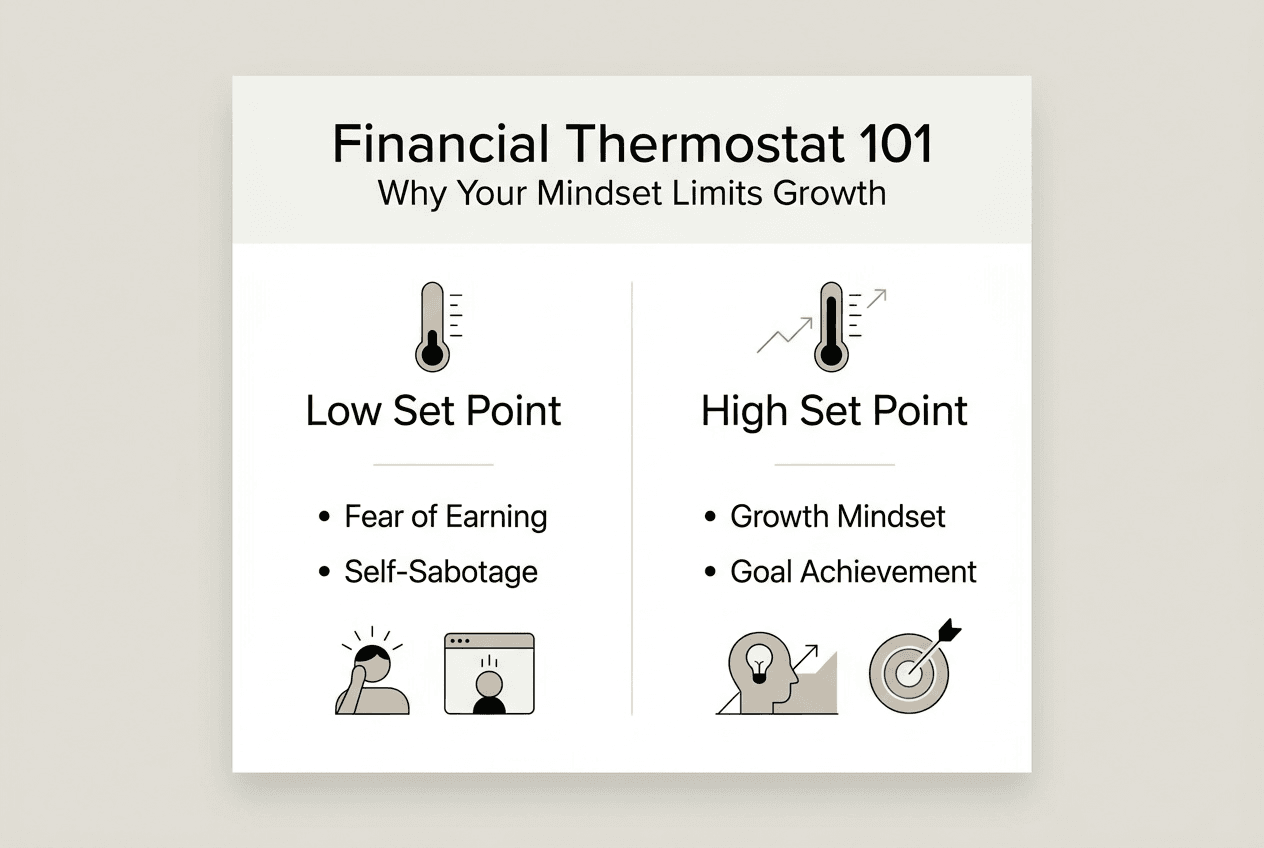
Your financial thermostat is a subconscious money limit based on beliefs and past experiences. Think of it like the thermostat in your home. When the temperature rises above your set point, the system automatically cools things down. When it drops too low, heat kicks in. Your financial thermostat works the same way, but instead of regulating temperature, it regulates how much wealth you accumulate.
This internal setting was programmed early. The messages you absorbed about money as a child, what you watched your parents do with finances, the socioeconomic environment you grew up in, all of these experiences created your baseline financial comfort zone. For many women entrepreneurs, this zone was set lower than their actual earning potential. You internalized beliefs like “money is hard to come by,” “wealthy people are greedy,” or “I should not want more than I need.”
Here are signs your financial thermostat is keeping you stuck:
- You hit the same revenue plateau repeatedly despite different strategies
- Unexpected expenses always seem to appear right after big income months
- You feel guilty or anxious when your bank balance exceeds a certain amount
- You undercharge consistently even though you know your value
- You avoid raising prices or having sales conversations
The psychological mechanism behind this is simple but powerful. Your nervous system perceives unfamiliar financial territory as danger. When you start earning beyond your set point, your brain interprets this as unsafe. It triggers stress responses designed to return you to familiar financial ground. You might suddenly “need” expensive repairs, invest in unnecessary business tools, or simply stop marketing until revenue drops back to comfortable levels.
Pro Tip: Notice what happens in the 48 hours after you receive a large payment. Do you immediately think about what you need to spend it on? That is your thermostat trying to regulate back to your set point.
Women entrepreneurs face specific limiting beliefs that compound this effect. Cultural messaging tells you to be modest, not too ambitious, grateful for what you have. You worry about being perceived as greedy or difficult. You tie your worth to being helpful rather than profitable. These beliefs do not make you weak. They make you human. But they do make you stuck.
How your financial thermostat creates invisible barriers to business growth
Your financial thermostat does not just control your comfort with money. It directly correlates with stalled business growth and missed opportunities. Every financial decision you make passes through this filter, and most of the time, you have no idea it is happening.

Consider pricing. You research market rates, calculate your costs, determine fair value. Then you quote 20% lower than planned because “the client might not be able to afford more.” You just watched your thermostat override your logic. Or you land a dream client at premium rates, then overdeliver to the point of losing money on the project. Same mechanism, different expression.
The thermostat shows up in these patterns:
- Chronic undercharging despite expertise and results you deliver
- Avoiding visibility that would attract higher-paying clients
- Saying yes to misaligned opportunities because you fear turning down money
- Keeping your business small to avoid “becoming someone you are not”
- Sabotaging growth through inconsistent marketing or sales efforts
“The gap between what you are capable of building and what you actually build is not a strategy problem. It is a nervous system problem.”
This is why effort alone cannot shift your revenue without mindset change. You can work 60-hour weeks, perfect your offer, build the funnel, show up on social media. If your thermostat says you are only worth $5,000 months, you will unconsciously ensure that is exactly what you make. You will find ways to leak revenue. You will procrastinate on the sales call. You will underprice the proposal.
The invisible barrier is not external. It is the gap between your conscious goals and your subconscious safety zone. Your thermostat prioritizes familiar over prosperous. It would rather keep you stuck at a known income level than risk the unknown territory of wealth. This is not about intelligence or capability. It is about nervous system regulation.
Women entrepreneurs often mistake this for lack of strategy or poor execution. You blame your marketing, your niche, your messaging. You invest in another course, hire another consultant. But the real issue is that your internal financial ceiling is lower than your external growth potential. Until you address that, no strategy will stick.
Spotting your financial thermostat and raising your set point
Identifying your current financial thermostat requires honest observation of your money mindset patterns. Most entrepreneurs have never consciously examined their relationship with wealth. They react to financial situations automatically, never questioning why they react that way.
Start with these steps:
- Track your emotional responses to money for two weeks. Notice when you feel anxious, guilty, excited, or resistant around financial decisions.
- Identify your current income comfort zone. What amount feels safe and manageable? What amount triggers stress even though you want it?
- List five money beliefs you absorbed before age 18. Do not judge them. Just write what you genuinely believed about wealth and wealthy people.
- Examine your financial patterns over the past three years. Do you see a revenue ceiling you keep bumping against?
- Ask yourself what earning double your current income would mean about you as a person. Your immediate reaction reveals your thermostat setting.
Your thermostat setting shows up in contrasting ways:
| Low Financial Thermostat | High Financial Thermostat |
|---|---|
| Charges based on what feels comfortable to ask for | Charges based on value delivered and market positioning |
| Feels guilty about profit margins above 30% | Views strong profit margins as business health indicator |
| Avoids discussing money until client asks about price | Leads pricing conversations confidently |
| Nervous system activates with bank balance over set point | Nervous system stays calm as wealth accumulates |
| Focuses on being affordable and accessible | Focuses on serving ideal clients at premium rates |
Raising your set point is not about positive thinking or affirmations. It requires creating new experiences that prove higher financial levels are safe. Your nervous system learns through repetition and evidence, not through wishful thinking.
Pro Tip: Set a new financial target that feels slightly uncomfortable but not terrifying. This is your growth edge. Practice holding that number in your mind daily while noticing the resistance that comes up.
Consciousness is the first step. You cannot change what you cannot see. Once you spot your thermostat in action, you can interrupt the automatic patterns. When you catch yourself about to undercharge, pause. When anxiety hits after a big income month, name it. Recognition creates the space for choice.
Ongoing awareness and adjustment matter because your thermostat will try to reassert itself. Growth means continuously expanding your financial comfort zone. Each new revenue level requires nervous system recalibration. This is not a one-time fix. It is an ongoing practice of choosing expansion over familiar limitation.
Applying mindset shifts to break free and accelerate financial growth
Reprogramming your financial thermostat requires deliberate mindset work combined with strategic support. The techniques that work are not complicated, but they do require consistency and often benefit from external accountability.
Effective mindset transformation techniques include:
- Rewriting your money story by examining and consciously choosing new beliefs about wealth
- Practicing discomfort tolerance by staying present when financial anxiety arises instead of immediately acting to relieve it
- Celebrating financial wins rather than minimizing them or immediately focusing on what is next
- Surrounding yourself with people operating at higher financial set points to normalize bigger numbers
- Working with your nervous system directly through somatic practices that release old financial trauma
Financial coaching helps entrepreneurs transform their money mindset, leading to measurable growth. A skilled coach spots your blind spots, the patterns you cannot see because you are living inside them. They hold the vision of your expanded capacity when your thermostat is screaming to contract. They provide the accountability that keeps you taking growth actions even when fear shows up.
This table shows typical mindset blocks versus transformed perspectives:
| Common Mindset Block | Transformed Perspective |
|---|---|
| “If I charge more, I will lose clients” | “Premium pricing attracts committed clients who value my expertise” |
| “Making too much money will change who I am” | “Wealth amplifies my existing values and expands my positive impact” |
| “I should not want more than I have” | “Desiring growth is natural and allows me to serve at a higher level” |
| “Financial success will make others uncomfortable” | “My success gives other women permission to pursue their own” |
| “I am not qualified to earn that much” | “My results and transformation speak louder than my credentials” |
Reprogrammed thermostats translate directly to business milestones. When you genuinely believe you can hold and manage $20,000 months, you start making decisions aligned with that reality. You price accordingly. You market consistently. You have sales conversations without apologizing. The external results follow the internal shift.
This journey is ongoing. Each new financial level will bring up new thermostat resistance. That is not failure. That is growth. Your nervous system needs time to adjust to each expansion. Be patient with the process while staying committed to forward movement. Small, consistent mindset work compounds into major financial transformation.
Unlock your growth potential with FreedomSun coaching
If this article is resonating, you are not alone. Thousands of talented women entrepreneurs struggle with the exact patterns described here. FreedomSun coaching programs are specifically designed to help you identify and reprogram your financial thermostat. Our approach combines strategic financial guidance with nervous system work because we understand that sustainable growth requires both.
Our coaching addresses the gap between what you know you should do and what you can actually make yourself do when money is on the line. We work with women entrepreneurs who are already generating revenue and ready to break through their current plateau. If you are tired of hitting the same income ceiling, we can help you raise your set point and build wealth that lasts.
If this is resonating, there is a reason. The pattern you are reading about is the same one I have watched cap the income of talented women entrepreneurs for nearly two decades. The Wealth Capacity Intensive is a $55 deep-dive into exactly this, your financial thermostat, where it was set, and how to begin expanding it. It is the starting point for everything we do inside Freedom Sun. Start the Intensive — $55 →
FAQ
What is a financial thermostat?
A financial thermostat is your subconscious comfort zone around money. It determines how much wealth you allow yourself to earn and keep before unconsciously sabotaging your own growth. This internal setting was programmed by early experiences and beliefs about money, and it operates automatically unless you consciously intervene.
Why might my financial thermostat keep me stuck in my business growth?
Your financial thermostat creates a perceived safety zone around familiar income levels. When you start earning beyond your set point, your nervous system interprets this as danger and triggers behaviors to bring you back down. This shows up as undercharging, avoiding sales, or sudden expenses that drain accounts right after big income months.
How can I start changing my financial thermostat today?
Begin by identifying your limiting money beliefs and observing your emotional responses around finances. Track what happens when you receive large payments or consider raising prices. Practice sitting with financial discomfort instead of immediately acting to relieve it. Working with a coach provides structured support for making these shifts sustainable.
What role can financial coaching play in resetting my financial thermostat?
Financial coaching supports mindset transformation leading to measurable growth. A coach helps you recognize unconscious patterns, provides accountability when your thermostat tries to pull you back to familiar territory, and offers personalized strategies for expanding your financial comfort zone. Coaching accelerates change because you are not trying to spot your own blind spots alone.