Boost Operational Stability: 14M Women Founders' Guide

You’ve built a business that generates revenue. You’ve proven your concept works. Yet somehow, predictable growth feels just out of reach. The conventional wisdom says you need better systems or smarter strategy, but women-owned businesses generate $2.7 trillion annually while still facing unique operational challenges that have nothing to do with capability. The gap between what you’re capable of building and what you’re actually building isn’t about working harder or knowing more. It’s about understanding the hidden psychological and structural barriers that keep talented women entrepreneurs stuck in reactive mode, and then systematically dismantling them.
Table of Contents
- Why operational stability matters for women founders
- Hidden barriers to stability: Gendered dynamics and psychological traps
- Building blocks of operational stability: Processes, people, and mindset
- Action plan: Steps to enhance operational stability now
- Unlocking long-term operational stability: Your next step
- Frequently asked questions
Key Takeaways
| Point | Details |
|---|---|
| Stability boosts growth | Consistent processes and systems are essential for scaling a women-led business with less stress. |
| Recognize hidden barriers | Psychological traps and gender dynamics often quietly stall operational performance unless addressed directly. |
| Leverage family advantages | Family-run women-owned businesses can outperform average when autonomy and clear roles are established. |
| Actionable first steps | Clarify key processes and delegate to team members to rapidly increase reliability and founder freedom. |
Why operational stability matters for women founders
Operational stability isn’t about perfection or rigid control. It’s the foundation that allows your business to function predictably without requiring your constant intervention. When you have genuine operational stability, revenue becomes consistent, processes run reliably, and you stop living in crisis mode.
The numbers tell a compelling story. Over 14 million women-owned businesses operate in the US as of 2024, yet many founders report feeling trapped in operational chaos despite generating solid revenue. This isn’t a coincidence. Stability directly impacts three critical areas: your ability to scale revenue without proportional stress increases, the sustainability of your business model over time, and your personal well-being as a founder.
“The difference between a business that grows and one that grinds isn’t always strategy. It’s whether the operational foundation can support what you’re trying to build.”
Consider these key stability metrics:
- Revenue consistency: Predictable income patterns that allow for strategic planning rather than reactive scrambling
- Process reliability: Systems that function without your direct oversight, freeing your attention for high-value decisions
- Founder well-being: Reduced stress, clearer boundaries, and sustainable energy levels that prevent burnout
When these elements align, you create space for actual growth rather than just survival. The connection between operational stability and wealth-building foundations becomes clear: you can’t build lasting wealth when you’re constantly putting out fires.
Hidden barriers to stability: Gendered dynamics and psychological traps
Here’s what most business advice won’t tell you: the obstacles preventing operational stability in women-led businesses often have nothing to do with your competence. Research reveals spousal co-ownership and home-based operations contribute to measurable performance gaps, not because women lack capability, but because these structures create invisible constraints.
Let’s examine three traps that specifically impact women entrepreneurs:
Gender dynamics in management create subtle but powerful barriers. When spousal co-ownership exists without clear role delineation, decision-making becomes muddied by relationship dynamics rather than business logic. You might find yourself deferring on strategic choices or second-guessing operational decisions because of relationship preservation instincts that have nothing to do with business acumen.
Superman Syndrome emerges when your competence becomes your cage. You’re so good at handling everything that your team, family, or partners develop learned dependency. They stop stepping up because you’ve proven you’ll catch whatever falls. This isn’t about them being lazy. It’s about you inadvertently training everyone around you that you’re the solution to every problem.
Home-based operations sound ideal for flexibility, but they often mask operational gaps. Without physical separation between business and personal life, boundaries blur. Professional processes get deprioritized. The infrastructure that would force clarity in a traditional office setting never develops.
| Barrier Type | How It Shows Up | Impact on Stability |
|---|---|---|
| Gendered Decision-Making | Deferring to spouse/partner on strategy despite being primary operator | Slowed growth, misaligned priorities |
| Superman Syndrome | Team waits for you to solve problems they could handle | Founder bottleneck, burnout risk |
| Home-Based Constraints | Lack of formal processes, blurred work/life boundaries | Inconsistent operations, revenue gaps |
Pro Tip: Track how many times this week someone asks you a question they could answer themselves or waits for your input on a decision within their role. That number reveals your dependency trap.
Recognizing these patterns in your business requires honest assessment. Are you the bottleneck because systems don’t exist, or because you’ve made yourself indispensable? Understanding founder leadership traits that either enable or prevent delegation becomes critical here. The path to sustainable scaling starts with identifying which of these traps you’re caught in, because you can’t fix what you won’t acknowledge.
Many founders discover they’re scaling without the right infrastructure, adding complexity instead of clarity with each growth phase.
Building blocks of operational stability: Processes, people, and mindset
Stability doesn’t happen by accident. It’s built through deliberate choices about how work gets done, who does it, and what you believe about control. The research is clear: family-owned, women-led firms outperform non-family counterparts when structure supports autonomy rather than undermining it.
Process and systematization create the scaffolding for predictable operations. This isn’t about bureaucracy. It’s about documenting how recurring work gets done so it doesn’t require your brain every single time. When you systematize, you create transferable knowledge. Your business becomes less dependent on any single person, including you.
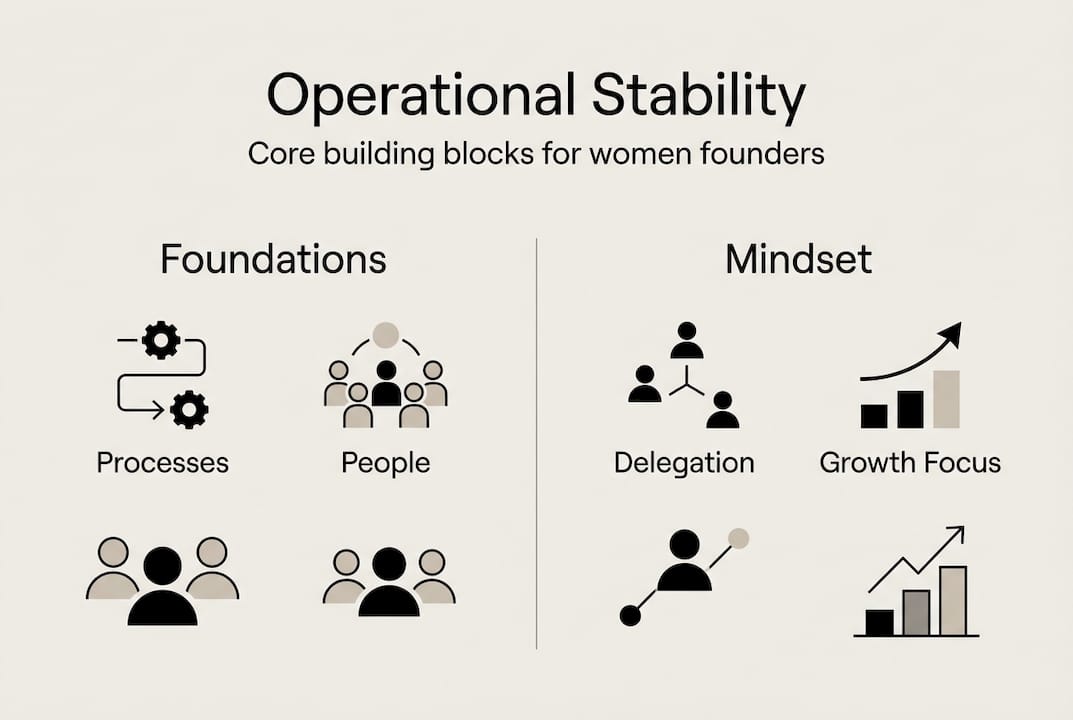
Start with your revenue-generating activities. What’s the exact process for onboarding a new client? How do you deliver your core service? What happens when something goes wrong? If these answers live only in your head, you don’t have a business system. You have a job that happens to pay you.

Delegation and team building require confronting an uncomfortable truth: your competence might be preventing others from developing theirs. Building a competent team means hiring for capability, then actually letting people use it. This sounds obvious until you’re watching someone do something differently than you would, and every instinct screams to take it back.
The shift happens when you realize that 80% done by someone else is better than 100% done by you, because the former scales and the latter doesn’t. Your role isn’t to be the best at everything. It’s to ensure everything gets done well.
Founder mindset shifts separate businesses that grow from those that grind. You must move from “I’m the only one who can do this right” to “I’m responsible for ensuring this gets done right.” That’s not semantics. It’s a fundamental reframe of your role.
| Traditional Approach | Stability-Focused Approach | Result |
|---|---|---|
| Hold all decisions | Delegate with clear parameters | Faster execution, reduced bottlenecks |
| Be available 24/7 | Set boundaries, build systems | Sustainable energy, team autonomy |
| Fix every problem | Teach problem-solving frameworks | Organizational capability growth |
Three key upgrades to implement immediately:
-
Document your top three recurring processes in detail. Use video, written steps, or flowcharts. Make them accessible to your team. This creates your operating system setup foundation.
-
Identify one decision category you currently own that someone else could handle with clear criteria. Define those criteria, communicate them, then step back. Watch what happens when you’re not the bottleneck.
-
Schedule weekly process reviews where you ask: “What broke this week, and what system would prevent it next time?” This builds organizational learning instead of just firefighting.
Pro Tip: Every time you solve a problem, immediately document the solution. Your future self will thank you, and your team will have a resource instead of another question for you.
The connection to financial stability becomes obvious here. When operations run predictably, you can implement CFO strategies for scale that actually stick, because you’re building on solid ground rather than shifting sand.
Action plan: Steps to enhance operational stability now
Knowledge without application changes nothing. You need a concrete playbook for diagnosing where your operational stability breaks down and specific interventions to fix it. The evidence shows women entrepreneurs outperform in family-run businesses when processes and autonomy are clear, so let’s make yours crystal clear.
Immediate diagnostic steps:
-
Map your founder involvement across all business functions for one week. Track every decision you make, every question you answer, every task you complete. This reveals where you’re truly needed versus where you’re just habitual.
-
Identify your top three revenue bottlenecks. What consistently delays client delivery, slows sales cycles, or creates service gaps? These are your stability weak points.
-
Assess team capability gaps. For each bottleneck, ask: Does the right person exist to handle this? Do they have clear authority? Do they have the resources and training needed?
-
Evaluate your psychological barriers. Which tasks do you avoid delegating because you don’t trust the outcome? That’s not a team problem. That’s a control problem.
Questions to uncover hidden barriers:
- When you imagine stepping away from daily operations for two weeks, what breaks first? That’s your critical dependency.
- What decision are you making repeatedly that should be someone else’s job? That’s your delegation opportunity.
- Where do you feel most indispensable? That’s likely where you’re creating learned dependency.
- What process failures do you tolerate because “it’s easier to just do it myself”? That’s your scaling ceiling.
Quick wins for immediate stability:
- Revenue reliability: Implement a simple pipeline tracking system. Know exactly where every potential client sits in your process. This single change creates predictability.
- Founder peace of mind: Block two hours weekly for strategic thinking only. No email, no client work, no firefighting. Use it to work on the business, not in it.
- Process improvement: Choose your most frequent client complaint or internal frustration. Design one systematic fix this month.
Pro Tip: Start measuring your “founder-free” metrics. How many client deliveries happened without your direct involvement this month? How many sales closed without you on the call? These numbers reveal your true operational stability.
Tracking progress requires specific metrics:
- Revenue consistency score: Calculate the standard deviation of your monthly revenue over six months. Lower variation means higher stability.
- Process completion rate: What percentage of standard processes finish on time without your intervention?
- Founder bottleneck index: How many decisions or tasks are waiting on you at any given time? Track this weekly.
- Team autonomy level: What percentage of problems get solved without escalating to you?
The path to profitable operations runs directly through operational stability. You can’t optimize what you can’t predict. These steps create the foundation for genuine profitability optimization because they remove the chaos that makes strategic financial decisions impossible.
Implement these changes systematically, not all at once. Pick one area, fix it completely, then move to the next. Partial implementation across everything creates the illusion of progress without actual results.
Unlocking long-term operational stability: Your next step
You’ve identified the barriers. You understand the building blocks. You have an action plan. But here’s what separates founders who achieve lasting operational stability from those who stay stuck: they get support for the psychological shifts that make systematic change possible.
The gap between knowing what to do and actually doing it isn’t about information. It’s about nervous system regulation, ingrained patterns, and the deep work of changing how you show up as a leader. This is where strategy meets psychology, and where most business advice falls short.
At Freedom Sun, we work specifically with women entrepreneurs who are generating revenue but stuck in operational chaos. Our approach bridges the financial strategy you need with the psychological foundation that makes implementation possible. We don’t just tell you to delegate. We help you understand why you can’t make yourself do it, then rewire the patterns keeping you trapped.
Through the Women’s Wealth Collective academy, the Nervous System of Money podcast, and live events, we teach the four pillars of sustainable growth: Profit, Sales, Communication, and Leadership. Not as separate skills, but as an integrated system that supports both your business stability and your personal well-being.
If you’re ready to stop undercharging, start building real wealth, and create a business that works without burning you out, the next step is exploring how strategic support can accelerate your progress. Because operational stability isn’t just about better systems. It’s about becoming the founder whose nervous system can handle the business you’re trying to build.
Frequently asked questions
What is operational stability for founders?
Operational stability means having predictable, reliable systems in your business that sustain growth and reduce daily stress for founders. It’s the foundation that allows scaling without proportional chaos increases.
How do psychological traps affect women entrepreneurs?
Traps like Superman Syndrome and gendered business dynamics can create hidden performance barriers, leading to dependency and stalled growth. These patterns keep capable founders stuck in reactive mode despite strong revenue.
What is the fastest action to boost stability?
Clarifying processes and delegating key tasks are the quickest ways to create business reliability and free founder focus. Start by documenting one recurring process completely this week.
Is home-based operation a disadvantage?
Research suggests home-based operations can limit performance, especially when paired with unclear roles or dependencies. The lack of physical boundaries often prevents necessary operational infrastructure from developing.
How do I measure operational progress?
Track metrics like revenue consistency, process completion rates, and reduced founder bottlenecks to assess gains. Calculate your standard deviation in monthly revenue and monitor how many decisions wait on you weekly for concrete progress indicators.