CFO Strategies in Startups: Building Scalable Success

Pressure rises quickly in high-growth startups as financial leaders navigate fast-changing markets and competing priorities. Modern CFOs face challenges that go far beyond traditional accounting, balancing strategic vision, operational agility, and the constant risk of burnout. Whether you are shaping a resilient financial system or building a leadership approach that actually lasts, this guide explores strategic financial leadership and actionable practices for creating sustainable success without sacrificing your well-being.
Table of Contents
- Defining CFO Strategies For Startups
- Types Of CFO Approaches In Startup Environments
- Designing Financial Clarity With The MATH Pillar
- Building Systems Infrastructure Via MECHANICS
- Cultivating Leadership Resilience And The MIND Factor
- Avoiding Burnout And Ensuring Sustainable Growth
Key Takeaways
| Point | Details |
|---|---|
| Dynamic CFO Role | Modern CFOs are strategic partners who focus on creating sustainable growth through actionable financial insights instead of merely tracking numbers. |
| CFO Approach Variety | Different CFO approaches, such as Financial Guardian and Growth Enabler, are tailored to a startup’s specific challenges and growth stages for optimal impact. |
| MATH and MECHANICS Pillars | Implementing the MATH and MECHANICS pillars enhances financial clarity and builds scalable systems essential for startup success. |
| Leadership Resilience | Successful leaders cultivate resilience by adopting a growth mindset, focusing on adaptability, and maintaining personal well-being to prevent burnout. |
Defining CFO Strategies for Startups
Startups require dynamic financial leadership that transcends traditional accounting roles. A modern CFO acts as a strategic partner, transforming financial data into actionable growth roadmaps. Strategic financial leadership has become critical for navigating complex startup ecosystems.
The CFO’s role in startups involves multiple strategic dimensions beyond number-crunching:
- Shaping organizational financial vision
- Managing resource allocation
- Conducting comprehensive risk assessments
- Driving data-driven decision making
- Creating scalable financial infrastructure
Modern startup CFOs are strategic architects who understand that financial management isn’t just about tracking expenses—it’s about creating sustainable growth models. Financial strategy requires anticipating challenges, designing resilient systems, and translating complex financial insights into clear organizational direction.
CFOs are no longer just financial controllers—they are strategic navigators guiding startup success.
Successful startup CFOs focus on building proactive financial frameworks that balance immediate operational needs with long-term strategic objectives. This means developing flexible financial systems that can adapt quickly as the startup evolves.
Pro tip: Develop a comprehensive financial dashboard that provides real-time insights into key performance indicators, enabling faster and more informed decision-making.
Types of CFO Approaches in Startup Environments
Startup environments demand nuanced financial leadership that goes far beyond traditional accounting roles. CFO mindsets vary dramatically depending on the organization’s specific challenges, growth stage, and strategic objectives.
CFOs in startups typically emerge in four primary strategic profiles:
- Financial Guardian: Focuses on risk management and fiscal discipline
- Growth Enabler: Drives strategic financial planning and expansion
- Operational Driver: Optimizes internal financial systems and processes
- Strategic Architect: Designs comprehensive financial infrastructure
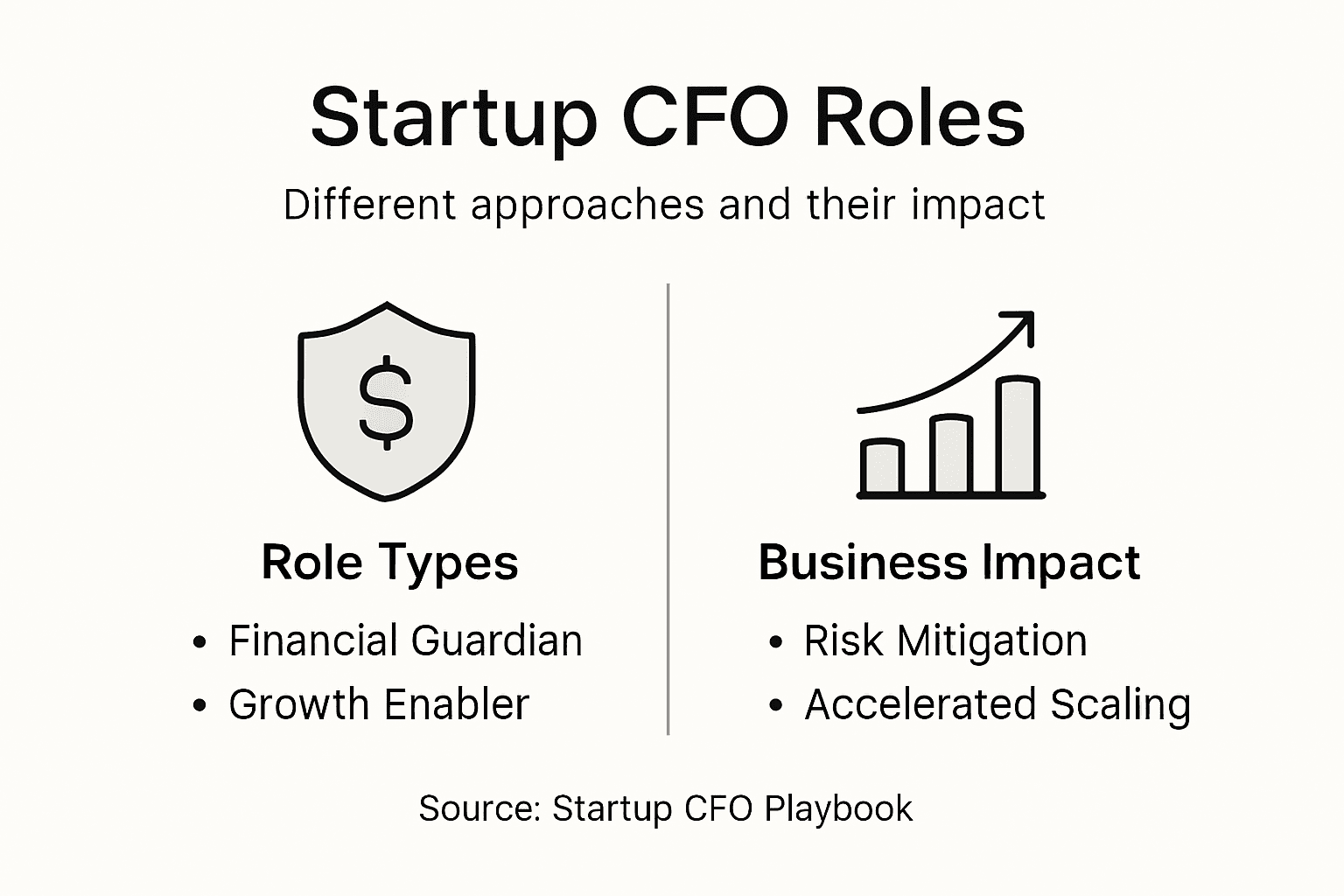
Each CFO approach brings unique strengths to the startup ecosystem. The Financial Guardian prioritizes protecting the company’s financial health, implementing rigorous control mechanisms and preventing potential fiscal risks. In contrast, the Growth Enabler functions more like a strategic partner, actively identifying investment opportunities and supporting aggressive scaling strategies.
Not all CFOs are created equal—the right financial leadership depends on your startup’s specific developmental stage.
Interim CFO approaches demonstrate exceptional flexibility in addressing startup financial needs. Adaptive financial expertise allows these professionals to rapidly diagnose challenges and implement targeted solutions across different organizational contexts.
Here’s a comparison of CFO approaches and their typical business impact in startup environments:
| CFO Approach | Main Focus | Typical Business Impact |
|---|---|---|
| Financial Guardian | Risk control and compliance | Stable cash flow, minimized financial risk |
| Growth Enabler | Strategic scaling and investment | Rapid expansion, increased capital access |
| Operational Driver | Process and system optimization | Streamlined operations, reduced overhead |
| Strategic Architect | Infrastructure and future design | Long-term resilience, prepared for scaling |
Pro tip: Conduct a comprehensive assessment of your startup’s current financial maturity to determine which CFO approach will be most effective for your specific growth trajectory.
Designing Financial Clarity With the MATH Pillar
The MATH pillar represents a transformative approach to financial management in startups, breaking down complex financial strategies into actionable, transparent frameworks. Strategic financial reporting becomes the cornerstone of sustainable business growth, enabling founders to make informed decisions with precision and confidence.
The MATH pillar consists of four critical components:
- Metrics: Quantifiable indicators of financial performance
- Analysis: Deep interpretation of financial data
- Transparency: Clear, honest financial communication
- Hub: Centralized financial information management
Each component plays a crucial role in building financial clarity. Metrics transform abstract financial concepts into concrete, measurable outcomes. Analysis goes beyond surface-level numbers, uncovering strategic insights that drive intelligent business decisions. Transparency ensures all stakeholders understand the financial narrative, while the hub function creates a centralized system for comprehensive financial oversight.
Financial clarity is not about perfect numbers, but about creating a meaningful narrative that guides strategic decision-making.
Data-driven financial models empower startups to move beyond reactive financial management. By implementing the MATH pillar, organizations can develop predictive capabilities, scenario plan effectively, and align financial strategies with long-term growth objectives.

Pro tip: Develop a monthly financial dashboard that incorporates all four MATH pillar components, providing a holistic view of your startup’s financial health and potential growth trajectories.
Building Systems Infrastructure via MECHANICS
Startup success hinges on creating robust, adaptable operational systems that can scale rapidly and efficiently. Strategic infrastructure development transforms fragmented processes into cohesive, high-performance organizational mechanisms.
The MECHANICS pillar encompasses six critical system design components:
- Management: Organizational structure and decision-making protocols
- Efficiency: Process optimization and workflow automation
- Coordination: Cross-functional communication and alignment
- Harmonization: Standardizing operational procedures
- Agility: Adaptive and responsive system design
- Networks: Interconnected technological and human systems
- Infrastructure: Foundational technological and operational support
- Configurability: Flexible system architectures
- Systems: Integrated technological platforms
Each component represents a strategic approach to building scalable organizational infrastructure. Management establishes clear governance, while efficiency eliminates redundant processes. Coordination ensures smooth communication across departments, and harmonization creates standardized operational excellence.
Effective systems infrastructure is less about controlling every detail and more about creating adaptive, intelligent organizational mechanisms.
Successful startups understand that infrastructure is not a static construct but a dynamic, evolving ecosystem. By implementing comprehensive MECHANICS principles, organizations can create resilient frameworks that anticipate change, optimize resources, and accelerate growth potential.
Pro tip: Conduct a quarterly systems audit to identify bottlenecks, eliminate inefficiencies, and reconfigure your organizational infrastructure for maximum adaptability and performance.
Below is a summary of how MATH and MECHANICS pillars complement startup financial success:
| Pillar | Primary Purpose | Example Benefit |
|---|---|---|
| MATH | Enhance financial clarity | Informed decision-making |
| MECHANICS | Build scalable systems | Efficient resource management |
Cultivating Leadership Resilience and the MIND Factor
Leadership in high-growth environments demands far more than technical expertise. CFO leadership resilience represents a complex blend of mental agility, emotional intelligence, and strategic adaptability that transforms financial leaders into organizational catalysts.
The MIND factor encompasses five critical leadership dimensions:
- Mindfulness: Maintaining strategic awareness and emotional equilibrium
- Intentionality: Purposeful decision-making and goal alignment
- Navigational: Adapting to changing business landscapes
- Decisiveness: Rapid, informed strategic choices
- Emotional Intelligence: Understanding and managing interpersonal dynamics
Successful leaders recognize that resilience is not about never experiencing challenges, but about developing robust mechanisms for navigating uncertainty. Mental flexibility allows CFOs to pivot quickly, transforming potential obstacles into strategic opportunities. Strategic thinking becomes less about predicting every outcome and more about creating adaptive response frameworks.
True leadership resilience emerges from the ability to learn, recalibrate, and advance—not from avoiding difficulty.
Strategic leadership skills require continuous development, moving beyond traditional financial management into holistic organizational leadership. This means cultivating a mindset that sees challenges as opportunities for growth and innovation.
Pro tip: Develop a personal leadership reflection practice, dedicating 30 minutes weekly to analyze your decision-making processes, emotional responses, and strategic adaptability.
Avoiding Burnout and Ensuring Sustainable Growth
Startup leaders face extraordinary challenges in maintaining personal sustainability while driving organizational success. Sustainable business scaling requires a holistic approach that balances professional ambition with personal well-being.
Critical strategies for preventing burnout include:
- Energy Management: Prioritizing physical and mental recuperation
- Boundary Setting: Establishing clear professional and personal limits
- Strategic Delegation: Distributing responsibilities effectively
- Systematic Recovery: Implementing intentional rest and reflection periods
- Adaptive Planning: Creating flexible work structures
Entrepreneurial sustainability demands more than time management—it requires a fundamental reimagining of personal productivity and organizational design. High-performing leaders understand that consistent performance emerges from strategic recovery, not continuous exertion. By designing systems that naturally support human energy cycles, founders can create more resilient and adaptive organizations.
Sustainable growth is not about working harder, but about working smarter and maintaining your most critical resource: yourself.
Entrepreneurship productivity strategies reveal that peak performance comes from intentional design, not relentless effort. This means creating organizational frameworks that inherently support human potential while preventing systemic exhaustion.
Pro tip: Implement a weekly personal performance audit, dedicating time to assess your energy levels, identify potential burnout signals, and proactively recalibrate your professional approach.
Unlock Scalable Financial Leadership with Proven CFO Strategies
Startups face the critical challenge of building financial clarity and robust systems while avoiding burnout and sustaining growth. This article highlights the need for strategic CFO roles that balance the MATH of financial insight, MECHANICS of systems infrastructure, and MIND of leadership resilience to foster long-term success. Founders and leaders often struggle with translating complex financial data into actionable decisions and creating adaptable operational frameworks that support rapid scaling.
At Freedom Sun, we understand these pressures and offer a unique Operating System framework designed specifically for entrepreneurial founders striving to gain control over their internal systems. Our platform integrates the exact principles from the CFO strategies discussed, providing interactive training and diagnostic assessments to develop your financial clarity, build scalable systems, and cultivate resilient leadership. Start shifting from reactive hustle to proactive strategic management today.
Explore how Freedom Sun’s approach to the MATH, MECHANICS, and MIND pillars can transform your startup’s financial management and leadership style. Visit Freedom Sun now to begin your journey toward sustainable growth and Operating System framework mastery. Don’t wait to empower your business with scalable CFO strategies tailored for your startup’s success.
Frequently Asked Questions
What are the primary responsibilities of a CFO in a startup?
A CFO in a startup is responsible for shaping the financial vision, managing resource allocation, conducting risk assessments, driving data-driven decision-making, and creating scalable financial infrastructure.
How do different CFO approaches impact startup growth?
CFO approaches—such as Financial Guardian, Growth Enabler, Operational Driver, and Strategic Architect—each focus on unique aspects of financial leadership that can significantly influence a startup’s growth trajectory and overall success.
What does the MATH pillar in startup financial management consist of?
The MATH pillar comprises Metrics, Analysis, Transparency, and Hub, which together enhance financial clarity and support informed decision-making within startups.
How can startups prevent burnout while pursuing growth?
Startups can prevent burnout by implementing energy management strategies, setting boundaries, strategically delegating responsibilities, integrating systematic recovery periods, and creating flexible work structures that support sustainable growth.
Recommended
- Operating System Setup for Founders: Achieve Scalable Success
- Sustainable Business Scaling Guide for Lasting Success
- 7 Proven Wealth-Building Strategies for Founders
- Financial Literacy for Founders: Keys to Lasting Success
- Employee Retention Solutions | Reduce Turnover | OpenElevator
- Scalable Branding: Boosting Creative Business Growth