Imposter Syndrome Pricing: Confident Strategies for Women

TL;DR:
- % of female executives experience imposter syndrome affecting their pricing decisions.
- Imposter syndrome leads to undercharging, discounting, and self-doubt despite business success.
- Addressing both mindset and systemic bias is essential for confident, value-based pricing.
Up to 75% of female executives report imposter syndrome symptoms that directly affect their pricing decisions. If you have built a real business, serve real clients, and still feel a knot in your stomach every time someone asks your rates, you are not alone and you are not broken. Imposter syndrome does not discriminate against success. It actually tends to show up louder as your business grows. This guide walks you through why it happens, what fuels it underneath the surface, and exactly what to do about it so you can charge what your work is actually worth.
Table of Contents
- Why imposter syndrome sabotages your pricing
- Superwoman syndrome: The hidden driver of underpricing and burnout
- Cultural bias or mindset: The real roots of imposter syndrome pricing
- Action steps for confident pricing and financial growth
- What most guides miss about imposter syndrome and pricing
- Ready to elevate your business? Explore next steps
- Frequently asked questions
Key Takeaways
| Point | Details |
|---|---|
| Imposter syndrome is common | Most women entrepreneurs face imposter syndrome, which can severely limit pricing confidence and business growth. |
| Perfectionism drives underpricing | ‘Superwoman’ syndrome pushes successful women to work harder and charge less, fueling burnout. |
| Systemic bias matters | Real-world bias and cultural barriers affect women’s pricing decisions, not just mindset. |
| Action steps lead to confidence | Practical strategies and mindset shifts can help women entrepreneurs price their services boldly and sustainably. |
Why imposter syndrome sabotages your pricing
Imposter syndrome is the persistent internal experience of believing you are not as competent as others perceive you to be, even when evidence clearly says otherwise. For women entrepreneurs, this rarely stays in the background. It shows up right at the moment of truth: when you have to name your price.
The symptoms look like this:
- Undercharging because you fear losing the client
- Adding extra hours, calls, or deliverables to “justify” your rate
- Freezing when asked to quote, then offering a discount before they even push back
- Comparing yourself to others who charge more and deciding you are not there yet
- Feeling relief when someone accepts your price, then immediately wondering if you should have charged less
The data makes it undeniable. 75% of female executives and 69% of female entrepreneurs report imposter syndrome symptoms affecting their pricing decisions. These are not struggling beginners. These are accomplished, revenue-generating women who cannot seem to connect their real results to their rates.
“Self-doubt is a major growth barrier for 37% of female business owners.”
What makes this especially insidious is that success does not cure it. Many women assume that once they reach a certain revenue level or land a big client, the self-doubt will disappear. Instead, the stakes feel higher, and the fear of being “found out” intensifies. Learning about pricing for profit strategies is only half the equation if your nervous system keeps pulling you back to the safe, small number.
Understanding the role of mindset in business growth helps you see that this is not a knowledge gap. You probably already know what to charge. The barrier is what happens in your body and brain when it is time to say the number out loud.
| Imposter syndrome signal | What it looks like in pricing |
|---|---|
| Discounting preemptively | Offering a lower rate before the client asks |
| Over-delivering silently | Adding unpaid scope to feel “worth it” |
| Avoiding rate conversations | Letting projects drag before invoicing |
| Seeking external validation | Checking what others charge instead of your own value |
Superwoman syndrome: The hidden driver of underpricing and burnout
Imposter syndrome rarely travels alone. For high-achieving women entrepreneurs, it often arrives with a companion: Superwoman syndrome. This is the relentless drive to prove yourself by doing more, being more, and never letting anything fall short. It feels like ambition. It operates like self-punishment.
The Superwoman phenomenon worsens underpricing and burnout for women entrepreneurs in a specific way. When you believe you have to constantly prove your worth, your pricing becomes entangled with your identity. Raising your rates feels like you are making a claim you have not earned yet. So you keep them low and work harder to compensate.
Here are the signs you may be caught in this cycle:
- You give discounts to clients you want to impress
- You work nights and weekends to “earn” what you already charged
- You apologize when presenting your pricing, even casually
- You say yes to scope creep rather than renegotiating
- You feel guilty charging full price for work that came easily to you
That last point matters. Many women unconsciously believe that if something feels natural or fast, it is less valuable. In reality, the ease comes from years of hard-won expertise. That expertise is exactly what clients are paying for.

Pro Tip: Before any pricing conversation, take five minutes to review three specific results you have delivered for past clients. Numbers work best. This grounds you in evidence before your nervous system tries to talk you down.
The comparison table below shows how Superwoman-driven underpricing stacks up against a value-based model:
| Underpricing (Superwoman mode) | Value-based pricing | |
|---|---|---|
| Price set based on | Hours, guilt, fear of rejection | Client outcomes and transformation |
| Scope boundaries | Blurry, always expanding | Clearly defined upfront |
| Burnout risk | High | Manageable |
| Client quality | Mixed, price-sensitive | Aligned, results-focused |
| Revenue ceiling | Low | Scalable |
Strategies for avoiding sales burnout start with recognizing that your energy is a business asset. If your pricing depletes you, it is not sustainable, no matter how many clients you land. Pairing that awareness with solid money mindset tips creates the internal foundation that pricing strategy alone cannot build.
Cultural bias or mindset: The real roots of imposter syndrome pricing
Here is where most conversations about imposter syndrome get it only half right. The dominant narrative says: fix your mindset, build your confidence, and the pricing problem goes away. That is not wrong. But it is incomplete.
Some experts argue that imposter feelings reflect real systemic bias rather than a personal flaw. Women, and especially women of color, operate in markets where their expertise is more frequently questioned, their prices are more often negotiated, and the bar for credibility is set higher. That is not a mindset problem. That is a structural one.
“Systemic bias, not mindset alone, shapes women’s pricing confidence.”
So how do you know what is driving your pricing hesitancy? Here are practical ways to identify the source:
- Audit your rejection patterns. When clients push back on your price, do they question your qualifications specifically? That may signal external bias, not internal doubt.
- Compare across networks. If male peers or majority-group peers with similar experience charge significantly more and face less resistance, that data tells you something real.
- Notice where confidence shows up. If you are confident in your work but not in naming your price, the hesitancy is likely conditioned, not inherent.
- Track scope creep by client type. If certain clients consistently push boundaries more than others, the pattern is worth examining.
This is not about assigning blame. It is about accuracy. Knowing whether you are fighting internal doubt or external friction determines which tools you actually need. Good startup pricing strategies address market positioning. A strong business mindset addresses the inner work. Most women need both, working together, not one instead of the other.
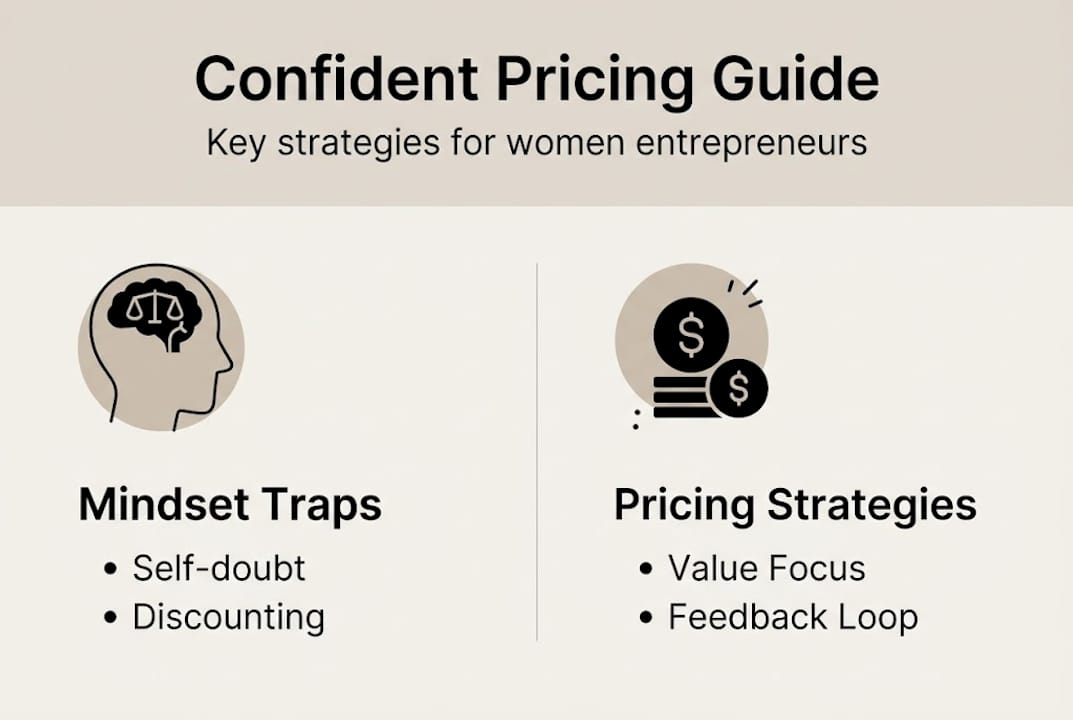
Action steps for confident pricing and financial growth
Understanding the roots of the problem is powerful. Now let’s make it practical. Here is a step-by-step process for reclaiming your pricing power:
- Audit your results, not your feelings. Pull together specific outcomes you have delivered: revenue generated, time saved, problems solved. Quantify them. This is your pricing evidence base.
- Research real market rates. Benchmark against peers with comparable experience and results. Use industry reports, professional communities, and direct conversations. Close the information gap.
- Set your price before the conversation. Decide your rate in writing before any client call. This removes the in-the-moment pressure that triggers self-doubt.
- Practice stating your price without a hedge. Say it out loud, alone, until the number feels neutral. Filler phrases like “I think it might be around…” signal uncertainty before the client even responds.
- Build a testimonial library focused on outcomes. Collect client feedback that speaks to transformation and results, not just effort. Read it before pricing conversations.
- Seek mentorship from women who charge more. Proximity to women who hold firm on their rates normalizes it faster than any mindset exercise alone.
Pro Tip: Create a pricing feedback loop. After each project, ask clients one question: “What was the most valuable outcome of working together?” Their answers, in their own words, become your most powerful pricing tool.
Resources for building mental resilience support this process at the nervous system level, not just the strategic one. And revisiting profitable pricing steps regularly keeps your rates aligned with your actual growth, not where you started.
Remember: 37% of female business owners name self-doubt as a major growth barrier. That means two out of three have found ways through it. So can you.
What most guides miss about imposter syndrome and pricing
Most imposter syndrome content hands you a list of affirmations and calls it a solution. We have seen enough real business situations to know that affirmations do not hold up in a negotiation.
Traditional solutions often ignore systemic bias and the emotional costs of perfectionism. They treat pricing confidence as a personal development project when it is actually a business skill that lives at the intersection of strategy, psychology, and real-world practice.
Three overlooked truths worth sitting with:
- Mindset work without negotiation practice is incomplete. You can believe you are worth more and still fold the moment a client hesitates. Practice is the bridge.
- Perfectionism costs money. Every hour you over-deliver without charging for it is revenue you chose not to collect. Perfectionism is not a virtue when it operates below market rate.
- Community changes your nervous system faster than content. Seeing women in your peer group hold firm on premium rates rewires what feels possible for you.
At Freedom Sun, we work from the belief that the gap between what you are capable of and what you are building is not a strategy problem. It is a nervous system problem. Tackling structural bias is as important as boosting self-belief, and neither one works in isolation. Pair your entrepreneurial money mindset work with real skill-building and real community, and the pricing confidence you want becomes something you can actually hold onto.
Ready to elevate your business? Explore next steps
If this article stirred something in you, that recognition is worth following. You already know your work is valuable. The next step is building the internal and strategic foundation to price it that way, consistently, without the guilt or the second-guessing.
Freedom Sun is built for exactly where you are right now: successful, generating revenue, and ready to close the gap between what you know and what you actually do when money is on the table. Explore Freedom Sun business training to find the programs, community, and tools that help women entrepreneurs charge with clarity, sell with confidence, and build real wealth without burning out.
Frequently asked questions
How can imposter syndrome influence my pricing decisions?
Imposter syndrome creates a persistent disconnect between your actual results and your perceived value, which pushes you to set prices below what your work is worth. Even high-achieving women face this pattern, with prevalence among women leaders and entrepreneurs remaining notably high.
What are signs my pricing is affected by ‘Superwoman’ syndrome?
If you discount before clients ask, work unpaid hours to feel “worth” your rate, or apologize for your prices, the Superwoman cycle is likely in play, blending perfectionism with chronic underpricing.
Can cultural bias really affect women’s pricing confidence?
Yes. Systemic bias shapes pricing confidence for women in ways that individual mindset shifts alone cannot fully address, which is why both internal and structural factors need attention.
What’s the first step to more confident, value-based pricing?
Start by documenting your specific client outcomes in concrete terms, then benchmark your rates against peers with similar results. With 37% of female owners citing self-doubt as a growth barrier, grounding your pricing in data is one of the fastest ways to quiet that inner critic.