Why you keep undercharging and how to stop

Women freelancers charge 32% less than men on average, losing tens of thousands in annual revenue. If you’re a woman entrepreneur generating income but still feel underpaid, overworked, and stuck, you’re not imagining it. Undercharging isn’t just about confidence or imposter syndrome. It’s rooted in systemic barriers, pricing strategies that don’t reflect your value, and a nervous system wired to avoid rejection. This guide explains why you keep undercharging and gives you practical steps to stop, build sustainable wealth, and avoid burnout.
Table of Contents
- Key takeaways
- Understanding why you keep undercharging
- The real costs of undercharging: burnout, lost revenue, and wrong clients
- How to break the pattern: shift to value-based pricing
- Navigating nuances: profitability, revenue growth, and systemic barriers
- Build profitable confidence with Freedom Sun
- How can I determine the right price for my service?
- What if I’m afraid to raise my prices and lose clients?
- How does value-based pricing differ from hourly rates?
Key Takeaways
| Point | Details |
|---|---|
| Gender pay gap | Women freelancers earn 32 percent less than men for identical work, costing them tens of thousands of dollars each year. |
| Structured pricing framework | A structured pricing framework removes emotion and helps you charge what you are worth without second guessing each proposal. |
| Burnout from undercharging | Undercharging leads to burnout, wasted revenue, and attracting clients who do not value your work. |
| Higher rates attract quality clients | Charging premium prices attracts clients who value expertise, trust your process, and refer you within their networks. |
Understanding why you keep undercharging
You’re not undercharging because you lack confidence. You’re undercharging because the system is rigged against you. Women freelancers earn $46 per hour compared to $69 for men doing identical work. That’s a 32% pay gap that costs you real money every single day.
The confidence gap narrative is convenient but incomplete. Yes, women often struggle to own their expertise. But blaming yourself ignores the structural forces at play. Women-led startups receive only 2.1% of venture capital funding. Your professional networks are statistically smaller and less connected to decision makers. You’re navigating a business landscape designed for someone else.
Undercharging also stems from undervaluing your expertise and fearing client loss. You’ve internalized messages that your work isn’t worth premium rates. You worry that raising prices will send clients running. So you keep your rates low, work twice as hard, and wonder why you’re exhausted.
The gap between what you’re capable of building and what you’re actually building isn’t a strategy problem. It’s a nervous system problem.
Your pricing reflects what you believe you deserve, not what you deliver. When money is on the line, your nervous system kicks in. Fight, flight, or freeze. You freeze at the negotiation table. You flight by avoiding sales conversations. You fight by justifying low rates with elaborate explanations.
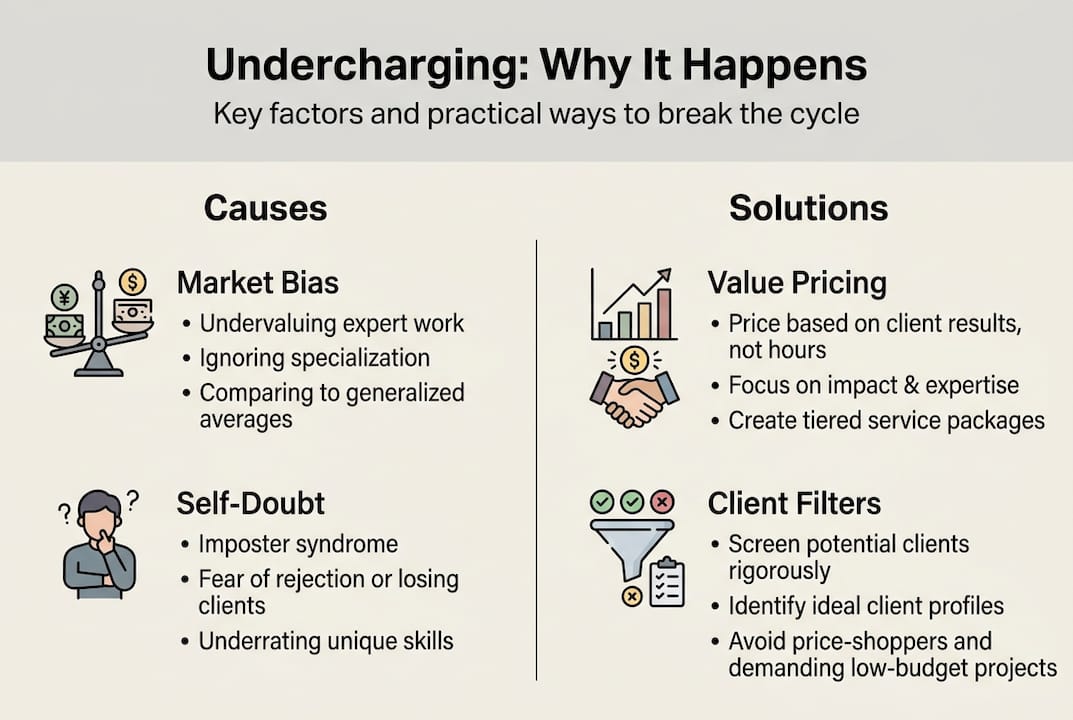
A structured pricing framework helps you override these patterns. It removes emotion from the equation. It gives you a system to follow when your nervous system wants to cave. It lets you charge what you’re worth without second-guessing every proposal.
Here’s what keeps you stuck:
- Comparing yourself to male competitors who started with more capital and connections
- Discounting your rates to compete instead of differentiating your value
- Avoiding sales conversations because they feel uncomfortable
- Believing that raising prices requires permission from someone else
You don’t need permission. You need a plan.
The real costs of undercharging: burnout, lost revenue, and wrong clients
Undercharging destroys more than your bank account. It burns you out, attracts clients who don’t value your work, and keeps you trapped in a cycle of overdelivering for underpayment.
Let’s talk numbers. If you’re charging $75 per hour when market rate is $150, you’re losing $75 every single hour you work. At 20 billable hours per week, that’s $78,000 per year walking out the door. Over five years, you’ve left nearly $400,000 on the table.
| Your rate | Market rate | Annual loss (20 hrs/week) |
|---|---|---|
| $75/hr | $150/hr | $78,000 |
| $100/hr | $175/hr | $78,000 |
| $125/hr | $200/hr | $78,000 |
Low pricing attracts clients who shop on price, not value. These clients demand more revisions, question every invoice, and drain your energy. They don’t see you as an expert. They see you as a commodity. When you raise your rates, these clients leave. Good. They were costing you more than they paid.
Burnout is the inevitable result of undercharging. You work more hours to hit your income goals. You take on projects that don’t excite you because you need the cash. You resent your clients, your business, and yourself. This isn’t sustainable. It’s a recipe for quitting.

Higher rates filter for better clients. When you charge premium prices, you attract people who value expertise. They trust your process. They implement your recommendations. They refer you to their networks. These are the clients who make your business sustainable and enjoyable.
Pro Tip: Calculate your true hourly value by adding your desired annual profit to your actual costs, then dividing by billable hours. Include the cost of burnout (lost productivity, health impacts, opportunity cost). This number is your minimum rate, not your goal.
Here’s what undercharging costs you:
- Revenue loss from pricing below market rate
- Time lost working extra hours to compensate
- Energy drained by difficult, price-focused clients
- Opportunities missed because you’re too busy and burned out
Your pricing strategy should build wealth, not deplete it. Stop trading time for money at rates that don’t reflect your value.
How to break the pattern: shift to value-based pricing
Value-based pricing charges for the results you create, not the hours you work. It’s the fastest way to increase your income without increasing your workload. Instead of billing $150 per hour, you charge 10-30% of the value you create for your client.
Here’s how it works. Your client will generate $500,000 in additional revenue from implementing your strategy. You charge 15% of that first-year value, which is $75,000. If the project takes you 100 hours, your effective rate is $750 per hour. Same work, five times the income.
Value-based pricing requires a structured sales strategy and the confidence to have different conversations. You’re no longer selling hours. You’re selling outcomes. This shift changes everything.
Implementing value-based pricing:
- Assess client outcomes: What specific, measurable results will your work create?
- Quantify benefits: Translate outcomes into dollars (revenue increase, cost savings, risk reduction)
- Calculate your fee: Charge 10-30% of year one value, adjusted for implementation risk
- Position your price: Present it as an investment with clear ROI, not a cost
- Handle objections: Use consultative sales techniques to address concerns
Start with clients where you can clearly demonstrate value. A marketing consultant who increases sales by $200,000 can justify a $40,000 fee. A business strategist who saves $100,000 in operational costs can charge $20,000. The math works when you focus on outcomes.
Pro Tip: Build a portfolio of client success stories that quantify your impact. When prospects ask about pricing, show them the ROI other clients achieved. This makes value-based pricing feel logical, not aggressive.
Value-based pricing also requires you to get comfortable with higher numbers. Your nervous system will resist. You’ll want to discount. You’ll worry about losing the deal. This is normal. Have a pricing framework you follow regardless of how you feel in the moment.
Key advantages of value-based pricing:
- Income increases without working more hours
- Clients focus on results, not your process
- You attract buyers who understand ROI
- Profitability improves dramatically
Shifting to value-based pricing isn’t about tricking clients. It’s about aligning your compensation with the value you deliver. When you solve a $500,000 problem, charging $75,000 is fair for everyone.
Navigating nuances: profitability, revenue growth, and systemic barriers
Women-owned businesses are growing in revenue but still struggle with profitability. The average women-owned business generates $520,000 in annual revenue, yet profitability lags behind male-owned businesses. Why? Sector concentration in lower-margin industries and systemic funding gaps.
Women entrepreneurs are more likely to operate in service-based, education, and healthcare sectors where margins are tight. You’re doing high-value work in industries that historically undervalue it. This isn’t your fault, but it is your problem to solve. Pricing strategically helps you break out of the low-margin trap.
Systemic barriers amplify the undercharging challenge. Women-led startups generate more revenue per dollar invested than male-led startups, yet receive only 2.1% of venture capital funding. You’re playing a different game with different rules and fewer resources.
| Metric | Women-owned | Male-owned |
|---|---|---|
| Average revenue | $520,000 | Higher profitability |
| VC funding received | 2.1% | 97.9% |
| Revenue per dollar invested | Higher | Lower |
| Profit margin | Lower (sector concentration) | Higher (diverse sectors) |
Structured pricing frameworks help you overcome these barriers. When you have a system for calculating value, positioning your offer, and handling objections, you don’t need to rely on confidence or connections. You have a repeatable process that works regardless of how you feel.
Building strong networks matters too. Women’s professional networks are statistically smaller and less connected to capital and decision makers. Invest in relationships with other entrepreneurs who charge premium rates. Join mastermind groups. Attend industry events. Your network shapes your pricing norms.
Investing in sales skills is non-negotiable. Most women entrepreneurs avoid sales because it feels pushy or uncomfortable. But sales is just structured communication. Learning to become a consultant who sells with integrity changes your business trajectory. You can charge what you’re worth when you know how to communicate that worth.
Here’s how to address systemic challenges:
- Use pricing frameworks that remove emotion from negotiations
- Focus on high-margin services and niches where you can demonstrate clear ROI
- Build relationships with peers who charge premium rates
- Invest in sales training to communicate value confidently
Profitability isn’t just about revenue. It’s about keeping more of what you earn. Pricing strategically, managing costs, and focusing on high-margin work are how you build sustainable wealth. Revenue growth without profit growth is just busy work.
Build profitable confidence with Freedom Sun
You’ve learned why you keep undercharging and how to stop. Now it’s time to implement. Freedom Sun offers business training specifically designed for women entrepreneurs who are ready to stop undercharging, build real wealth, and create businesses that don’t burn them out.
Our training covers pricing strategy, consultative sales, and sustainable growth tactics that bridge financial strategy with the nervous system work underneath it. You’ll learn how to charge what you’re worth, have confident sales conversations, and build a business that works for you.
Join women entrepreneurs who are closing the gap between what they know they should do and what they can actually make themselves do when money is on the line. You don’t need more strategy. You need a system that works when your nervous system wants to cave.
How can I determine the right price for my service?
Start by calculating the value you create for clients, not the hours you spend. Research what competitors charge, but don’t let that limit you. Factor in your costs, desired profit, and the tangible outcomes clients achieve. Value-based pricing frameworks give you a structured approach to pricing that reflects your true worth. The right price is one that sustains your business and rewards the results you deliver.
What if I’m afraid to raise my prices and lose clients?
Clients who leave over price increases are usually the ones draining your energy anyway. Higher prices attract clients who value your expertise and are easier to work with. You’ll do better work for fewer people and enjoy it more. Use a consultative sales approach to communicate the value behind your pricing. When clients understand the ROI, price becomes less of an issue. Losing the wrong clients makes room for the right ones.
How does value-based pricing differ from hourly rates?
Hourly rates charge for your time. Value-based pricing charges for the impact and results you create. If you save a client $200,000, charging $40,000 reflects that value regardless of whether it took you 50 or 150 hours. This approach aligns your compensation with client outcomes and dramatically increases your earning potential. You’re no longer capped by billable hours. Sales strategies for consultants help you position and sell value-based offers effectively.