How to Become a Consultant: Building Profitable Freedom

Stepping into consulting presents both excitement and uncertainty for those seeking fresh career opportunities and a balanced lifestyle. For aspiring consultants and coaches, the chance to apply deep expertise and problem-solving skills can be both professionally rewarding and personally enriching. This article highlights the realities and opportunities of consulting work, exploring the essential skills, specialization paths, and the business structures that underpin sustainable growth and wellbeing in a rapidly evolving marketplace.
Table of Contents
- Consulting Defined: Core Concepts And Realities
- Consulting Types And Specialization Paths
- Essential Skills And Qualifications For Success
- Business Structure, Legal, And Financial Setup
- Best Practices For Sustainable Consulting Growth
Key Takeaways
| Point | Details |
|---|---|
| Consulting Expertise | Consultants leverage specialized knowledge to tackle complex business challenges, providing objective insights and innovative solutions. |
| Diverse Specializations | Consulting careers offer various paths, including Strategy, Operations, and Technology Consulting, each delivering unique value to organizations. |
| Essential Skills | Success in consulting requires a blend of analytical, communication, and interpersonal skills, along with relevant qualifications and continuous learning. |
| Business Structure | Choosing the right business structure is crucial for liability protection and operational flexibility, impacting the long-term success of a consulting practice. |
Consulting Defined: Core Concepts And Realities
Consulting represents a dynamic professional practice where specialized experts provide strategic guidance to organizations seeking transformative solutions. At its core, consulting involves deep expertise applied to complex business challenges across multiple domains like management, finance, technology, and human resources.
Professional consultants are essentially problem-solving strategists who bring external perspective and specialized knowledge to help clients optimize their operations. Professional consulting skills typically encompass critical capabilities such as:
- Advanced analytical thinking
- Strategic communication
- Complex problem resolution
- Data-driven decision making
- Systems design and intervention
The consulting landscape has dramatically evolved from traditional advisory roles into a sophisticated ecosystem of strategic intervention. Modern consultants don’t merely recommend solutions—they collaborate deeply, design systemic approaches, and often participate in implementation to ensure meaningful organizational transformation.
Organizations engage consultants precisely because they need objective, specialized insights that internal teams might overlook. These professionals bring rigorous methodologies, cutting-edge research, and an unbiased external viewpoint that can unlock breakthrough performance improvements.
Consulting is less about having all the answers and more about asking the right questions that reveal transformative possibilities.
Key Consultant Characteristics:
- Possess specialized domain expertise
- Maintain objective, external perspective
- Communicate complex ideas clearly
- Adapt quickly to diverse organizational contexts
- Drive strategic, measurable outcomes
Pro tip: Successful consultants invest continuously in expanding their knowledge base and developing cross-disciplinary skills that enhance their strategic value.
Consulting Types And Specialization Paths
The consulting profession offers a diverse landscape of specialized career paths that cater to different skills, industries, and organizational needs. Consulting career progressions typically follow a structured hierarchy that allows professionals to develop deep expertise and leadership capabilities.
Consulting specializations can be broadly categorized into several key domains:
- Strategy Consulting: Focuses on high-level organizational transformation
- Operations Consulting: Optimizes business processes and efficiency
- Technology Consulting: Addresses digital transformation and IT solutions
- Human Resources Consulting: Develops talent management and organizational culture
- Financial Advisory Consulting: Provides strategic financial planning and analysis
Each specialization demands unique skills and offers distinct career trajectories. Strategy consultants, for instance, work closely with executive leadership to design comprehensive organizational approaches, while technology consultants dive deep into complex digital infrastructure challenges.
Here is a comparison of major consulting specializations and how each adds value to organizations:
| Specialization | Core Focus Area | Unique Value Provided |
|---|---|---|
| Strategy Consulting | Organizational transformation | Guides high-level vision and long-term roadmap |
| Operations Consulting | Process optimization | Enhances efficiency and cost savings |
| Technology Consulting | Digital & IT solutions | Implements digital innovation and integration |
| HR Consulting | Talent & culture development | Strengthens teams and company culture |
| Financial Advisory | Financial planning & analysis | Supports fiscal health and growth |
Career Progression Stages:
- Analyst (Entry-level)
- Associate Consultant
- Consultant
- Senior Consultant
- Manager
- Senior Manager/Partner
Successful consultants continuously adapt their expertise to evolving business landscapes and emerging industry challenges.
The most effective consultants develop a blend of technical proficiency and exceptional interpersonal skills. They must translate complex analytical insights into actionable strategies that drive meaningful organizational change.

Pro tip: Choose your consulting specialization by aligning your personal strengths with industry demands and continuously invest in developing cross-functional expertise.
Essential Skills And Qualifications For Success
Consulting success requires a sophisticated blend of technical expertise, strategic thinking, and exceptional interpersonal capabilities. Successful consulting skills encompass a comprehensive range of competencies that go far beyond traditional academic qualifications.
Critical professional skills for consultants include:
- Analytical Problem-Solving: Ability to deconstruct complex challenges
- Strategic Communication: Translating technical insights into actionable recommendations
- Data Interpretation: Extracting meaningful patterns from complex information
- Adaptable Project Management: Navigating diverse organizational environments
- Emotional Intelligence: Building trust and managing client relationships
Educational requirements for consulting typically involve advanced degrees in business, economics, engineering, or specialized technical fields. However, practical experience often carries equal or greater weight in demonstrating professional competence.
Core Qualification Components:
- Advanced Academic Credentials
- Specialized Technical Knowledge
- Proven Professional Experience
- Industry-Specific Certifications
- Demonstrated Problem-Solving Track Record
Technical expertise without interpersonal skills creates knowledge barriers; true consulting excellence integrates both intellectual and relational capabilities.
The most effective consultants develop a holistic professional toolkit that combines rigorous analytical skills with exceptional communication and strategic thinking. They must quickly understand complex organizational dynamics and design targeted interventions that drive meaningful change.
Pro tip: Continuously invest in developing cross-functional skills and seek opportunities that expand your professional versatility beyond your initial specialized domain.
Business Structure, Legal, And Financial Setup
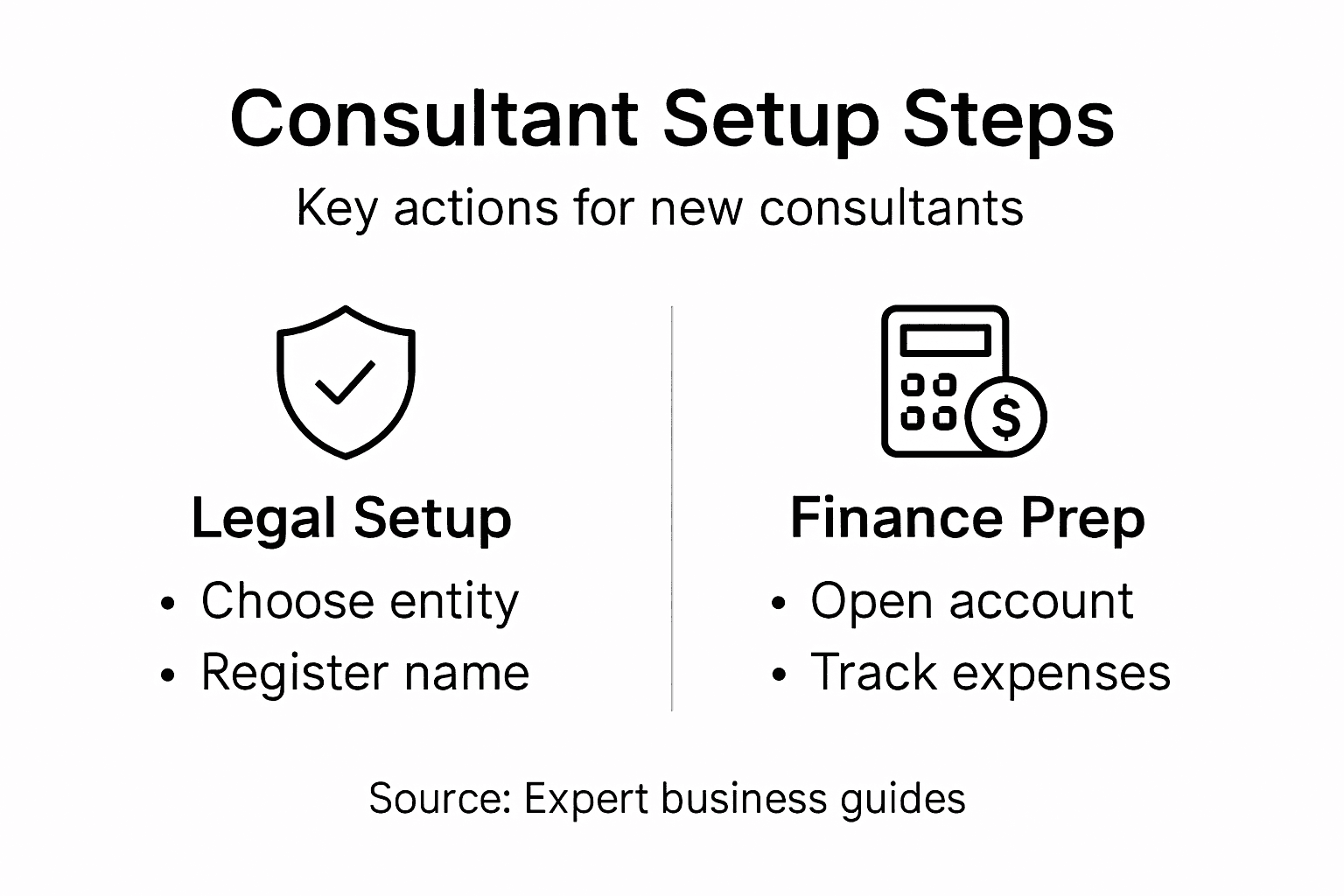
Choosing the right business structure is a critical foundation for consulting success. Business structure selection determines your legal protection, tax obligations, and operational flexibility as a professional consultant.
Consultants typically have several business structure options:
- Sole Proprietorship: Simplest structure with minimal administrative requirements
- Limited Liability Company (LLC): Provides personal asset protection and tax flexibility
- S Corporation: Offers tax advantages and potential self-employment tax savings
- Partnership: Allows shared business responsibilities and resources
- C Corporation: Provides maximum legal protection but with more complex regulations
Each business structure carries unique legal and financial implications that directly impact your consulting practice’s long-term sustainability and growth potential. Factors to consider include personal liability protection, tax efficiency, and administrative complexity.
The following table summarizes key business structure options for consultants and their main advantages:
| Structure Type | Liability Protection | Tax Advantages | Administrative Complexity |
|---|---|---|---|
| Sole Proprietorship | Minimal | Simple to file | Very low maintenance |
| LLC | Strong | Flexible, single or pass-through | Moderate paperwork, annual filings |
| S Corporation | Strong | Savings on self-employment tax | Strict compliance, specific criteria |
| Partnership | Shared or limited | Profit sharing among partners | Varies by partnership agreement |
| C Corporation | Maximum | Flexible ownership structure | High reporting and legal costs |
Key Considerations for Structure Selection:
- Personal Asset Protection
- Tax Filing Requirements
- Operational Flexibility
- Startup and Maintenance Costs
- Future Growth Potential
The right business structure is not just a legal formality—it’s a strategic decision that shapes your entire consulting journey.
Financial setup goes beyond structure selection and requires establishing robust systems for invoicing, expense tracking, tax preparation, and financial reporting. Professional consultants must develop disciplined financial management practices that ensure transparency, compliance, and sustainable growth.
Pro tip: Consult with both a tax professional and a business attorney to design a business structure that aligns perfectly with your specific consulting goals and risk tolerance.
Best Practices For Sustainable Consulting Growth
Sustainable consulting growth requires a strategic approach that integrates continuous learning, technological adaptation, and holistic business practices. Sustainable business practices demand a comprehensive framework that goes beyond traditional revenue metrics.
Key strategies for sustainable consulting growth include:
- Continuous Skill Development: Regular upskilling and knowledge expansion
- Technology Integration: Leveraging digital tools and emerging technologies
- Client-Centric Innovation: Developing solutions that create measurable value
- Ethical Governance: Maintaining transparent and responsible business practices
- Adaptive Business Model: Flexible approaches to changing market dynamics
Successful consultants understand that sustainable growth is not just about financial performance but about creating lasting impact. This requires developing a robust ecosystem of skills, relationships, and strategic capabilities that can adapt to complex business environments.
Core Sustainable Growth Principles:
- Prioritize long-term client relationships
- Invest in continuous personal development
- Embrace technological innovation
- Maintain ethical and transparent practices
- Create measurable value beyond financial metrics
Sustainable consulting is about generating meaningful transformation, not just transactional services.
Technological integration plays a crucial role in sustainable consulting, with emerging tools like AI, data analytics, and blockchain offering unprecedented opportunities for creating strategic value and operational efficiency.
Pro tip: Develop a personal learning roadmap that connects emerging technologies, industry trends, and your unique consulting expertise to ensure continuous relevance and growth.
Build Your Consulting Career with Profitable Freedom and Strategic Growth
The journey to becoming a successful consultant demands more than just expertise. As highlighted in “How to Become a Consultant Building Profitable Freedom,” key challenges include mastering strategic communication, managing complex business structures, and developing sustainable growth practices. If you find yourself overwhelmed by questions about business setup, client acquisition, or balancing technical skills with leadership qualities, you are not alone. Many aspiring consultants struggle to move beyond hustle culture to find scalable peace and financial independence.
Freedom Sun specializes in empowering coaches and consultants to overcome these exact challenges by focusing on system health, strategic implementation, and mental resilience. Our platform offers interactive training, diagnostic assessments, and a vibrant community to help you master the essential skills outlined in the article including financial management and leadership. Whether you want to build a solid business structure or develop a sustainable growth strategy, you can start transforming your consulting practice today.
Explore how Freedom Sun can become your strategic partner in creating profitable freedom and scalable leadership success. Discover personalized pathways that align with your consulting goals at Freedom Sun. Learn more about our approach to overcoming hustle culture in favor of automation and self-sufficiency with our interactive training programs. Ready to take control of your consulting career now Tap into expert guidance and start building lasting freedom by visiting Freedom Sun today.
Frequently Asked Questions
What are the essential skills needed to become a successful consultant?
To be successful as a consultant, you need a blend of analytical problem-solving skills, strategic communication abilities, data interpretation proficiency, adaptable project management capabilities, and emotional intelligence to build trust with clients.
What types of consulting specializations can I pursue?
Consulting specializations include strategy consulting, operations consulting, technology consulting, human resources consulting, and financial advisory consulting. Each specialization demands different skills and offers distinct career trajectories.
How do I choose the right business structure for my consulting practice?
Choosing a business structure involves considering factors like personal asset protection, tax advantages, operational flexibility, and administrative complexity. Common structures include sole proprietorships, LLCs, S corporations, partnerships, and C corporations.
What strategies can help ensure sustainable growth in a consulting business?
Key strategies for sustainable growth include continuous skill development, technology integration, client-centric innovation, ethical governance, and maintaining an adaptive business model that responds to changing market dynamics.