How to Talk About Your Prices With Confidence

TL;DR:
- Women entrepreneurs often underprice due to social conditioning and fear of rejection. Reshaping mindset and confidently framing value helps set sustainable rates. Practicing communication strategies and handling pushback improves pricing confidence and business sustainability.
If you already have clients and revenue but still feel your stomach drop the moment someone asks what you charge, you are not alone. Many women entrepreneurs consistently underprice their services, and the financial cost is staggering. Women-owned businesses are disproportionately concentrated in lower revenue brackets, not because their work is worth less, but because the conversation around pricing is loaded with invisible weight. This guide gives you the frameworks, scripts, and mindset shifts to talk about your prices clearly, hold your ground when clients push back, and finally charge what your work is actually worth.
Table of Contents
- Why women entrepreneurs struggle to state their prices
- How to reframe your mindset around value and money
- Practical frameworks for talking about your prices
- What to do when clients push back
- A fresh perspective: Why talking about price is more than just numbers
- Ready to raise your prices? Get support
- Frequently asked questions
Key Takeaways
| Point | Details |
|---|---|
| Mindset shift | Owning your worth starts with changing how you view money and value. |
| Confident communication | Clear language and preparation enable you to share your prices without apology. |
| Handle objections | Maintain boundaries using scripts and tools to respond to price resistance. |
| Business growth | Correctly pricing leads to more sustainable, profitable entrepreneurship. |
Why women entrepreneurs struggle to state their prices
With a clear sense of the challenge, let’s examine the roots of the problem. Pricing hesitation is rarely about not knowing your numbers. It runs deeper than that, woven into how women are socialized to relate to money, worth, and likability.
From a young age, many women are conditioned to be agreeable, modest, and non-confrontational. Stating a high price can feel like breaking an unspoken social rule. The fear is not just rejection. It is the fear of being seen as arrogant, greedy, or out of touch. That fear is powerful enough to make talented, experienced women shrink their rates before a client even blinks.
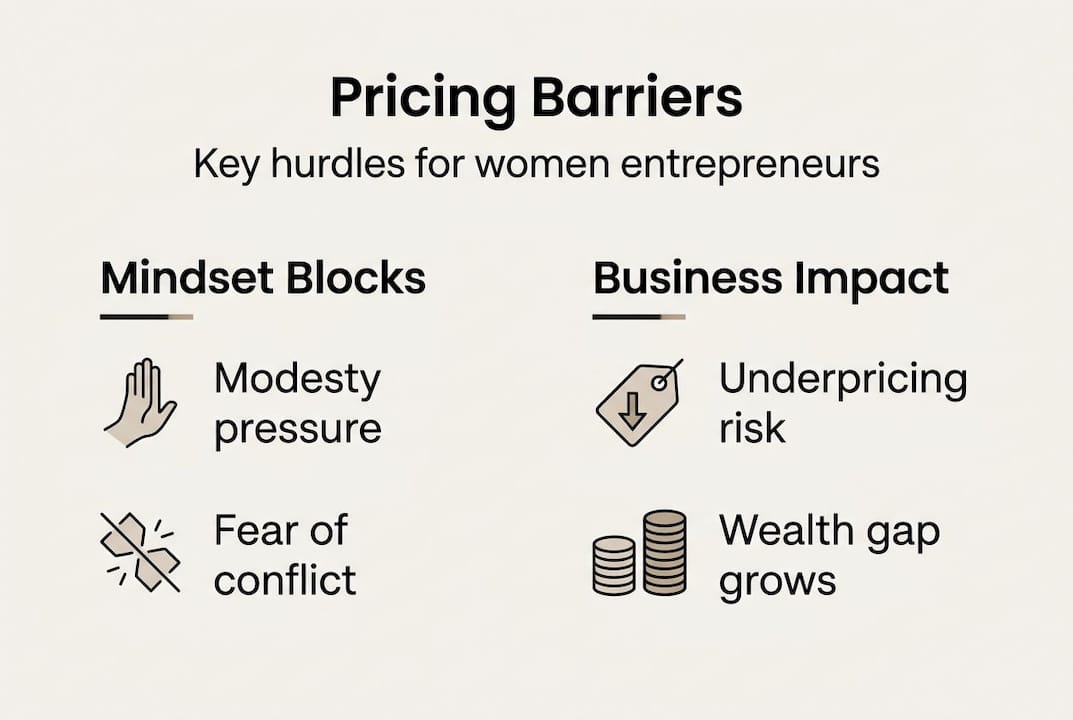
The data backs this up. 67% of UK women-owned businesses earn under £25,000 per year, a figure that points directly to a systemic underpricing pattern, not a lack of skill or ambition. This is not a personal failure. It is a structural one, shaped by gendered expectations that have been reinforced for decades.
Psychological factors compound the problem. Imposter syndrome leads many women to question whether their expertise is “enough” to justify premium rates. The internal monologue sounds like: Who am I to charge that much? Someone else is probably better and cheaper. That voice keeps prices artificially low and clients undertreated, because underpriced services often attract clients who undervalue the work.
Here are the most common reasons women entrepreneurs underprice:
- Fear of rejection or losing the client entirely
- Tying self-worth to client approval rather than results delivered
- Comparing rates to peers who are also undercharging
- Lack of clear pricing strategies for services that reflect transformation, not just time
- Discomfort with communicating value to clients in a direct, confident way
“Underpricing is not humility. It is a habit that costs you money, energy, and the clients who would have valued you most.”
Underpricing also widens the gender wealth gap. When women consistently earn less, they invest less, save less, and build less long-term wealth. Fixing your pricing conversation is not a small tweak. It is a wealth-building act.
How to reframe your mindset around value and money
After understanding the roots of hesitation, the next step is reshaping beliefs. Mindset is not a soft topic. It is the foundation that determines whether you can hold a price under pressure or cave the moment a client hesitates.
The first shift is moving from time-based thinking to transformation-based thinking. You are not selling hours. You are selling outcomes. A client who hires you for brand strategy is not paying for five hours of your time. They are paying for the clarity, positioning, and revenue growth that follows. That reframe alone can justify doubling your rate.

Limiting beliefs about money are incredibly common and deeply sneaky. They often sound like logic. “The market won’t support higher prices.” “My clients are small businesses, they can’t afford more.” “I need to build my reputation first.” These are stories, not facts. Challenging them requires asking: Where did this belief come from? Is it actually true? What would I charge if I were not afraid?
Here is a practical process for building price confidence:
- Write down your current rate and the rate you actually want to charge.
- List every outcome and transformation your work has produced for past clients.
- Read that list aloud before every sales conversation.
- Practice stating your price out loud, without apology, until it feels neutral.
- Use pricing for profit strategies to anchor your rates in business sustainability, not fear.
Visualization is underused and genuinely effective. Spend two minutes before a pricing conversation imagining yourself stating the number calmly, the client nodding, and the conversation moving forward. Your nervous system responds to rehearsed scenarios. Give it a confident one to work from.
Pro Tip: Record yourself saying your price and listen back. If you hear hesitation, trailing off, or over-explaining, that is exactly what your client hears too. Adjust until your voice sounds as steady as your conviction.
Your pricing also sends a signal to clients. A 67% concentration of women-owned businesses in low revenue brackets is partly a confidence problem. Higher prices attract clients who are serious, committed, and ready to do the work. Raising your rate is not just about your income. It filters for better client relationships.
Practical frameworks for talking about your prices
With a new mindset, let’s get practical on how to actually talk about your prices. Knowing what to say and how to say it removes the guesswork and replaces anxiety with structure.
Preparation is everything. Before any sales conversation, write out your talking points. Know your price, know your top three outcomes, and anticipate the two or three objections you hear most often. When you walk in prepared, you stop improvising under pressure.
Here are scripts you can use immediately:
- Stating your price: “My investment for this program is $X. That includes [deliverables] and most clients see [specific result] within [timeframe].”
- After a pause: “Take a moment if you need it. I am happy to answer any questions about what is included.”
- When asked for a discount: “I keep my pricing consistent for all clients. What I can do is [alternative option].”
Avoid these common phrases that undermine your price before it lands:
- “It’s only…” (minimizes value)
- “I know it’s a lot, but…” (pre-apologizes)
- “I can be flexible” (before they even object)
- “What’s your budget?” (too early in the conversation)
The consultants’ sales strategies that work best share one trait: they lead with value before price. When a client understands the transformation first, the number lands in context.
| Phrase to avoid | Use this instead |
|---|---|
| “It’s only $500” | “The investment is $500” |
| “I can probably do it cheaper” | “Here is what is included at this rate” |
| “Is that okay?” | “Does that work for you?” |
| “I know it’s expensive” | “This is priced to reflect the outcome” |
Handling objections starts with listening, not defending. When a client hesitates, pause. Ask what specifically concerns them. Then address that concern directly, without adjusting your price. Practicing handling client hesitations as a skill, not a crisis, changes everything about how you show up in these moments. The underpricing pattern among women entrepreneurs is partly sustained by the habit of caving at the first sign of resistance.
What to do when clients push back
Having learned what to say, it is vital to know what to do when clients challenge your prices. Pushback is normal. It does not mean no. It means the client is processing.
Here is a four-step process for holding your price with grace:
- Acknowledge: “I hear you, and I appreciate you sharing that.”
- Restate value: “What you are getting is [specific outcome], which most clients find pays for itself within [timeframe].”
- Offer an alternative structure: “If budget is the concern, I do offer a payment plan option.”
- Hold the line: “The rate itself stays consistent, but I want to make sure this is the right fit for you.”
Discounts are a nuanced topic. Offering a discount without reason trains clients to always negotiate and signals that your original price was inflated. Payment plans are different. They remove a cash flow barrier without reducing your perceived value. Use them intentionally, not reactively.
Pro Tip: When a client pushes back hard, try silence. State your price, hear their concern, and then pause before responding. Silence feels uncomfortable, but it is powerful. It communicates confidence and gives the client space to reconsider without you filling the gap with concessions.
| Client behavior | Your response strategy |
|---|---|
| “That’s too expensive” | Restate value, ask what specifically concerns them |
| “Can you do it for less?” | Offer payment plan, hold the rate |
| “I need to think about it” | Confirm next steps, set a follow-up date |
| “Someone else charges less” | Acknowledge, clarify your differentiators |
The consultative sales approach works here because it keeps the conversation focused on the client’s goal, not the price itself. When you shift back to outcomes, the price becomes a means to an end rather than the obstacle. Financial coaching clarity also helps you understand what your business actually needs to sustain itself, which makes it easier to hold firm. The underpricing data is clear: women who raise their rates and hold them consistently build more profitable, more sustainable businesses.
A fresh perspective: Why talking about price is more than just numbers
To bring these lessons home, let’s zoom out for a wider look at what talking about your prices really represents. Every pricing conversation you have is a vote for the kind of business you are building and the kind of industry you are helping to shape.
When women entrepreneurs charge what their work is worth, it does not just change their income. It shifts the market expectation. It signals to clients, peers, and the next generation of women in business that expertise has a real price and that price deserves to be honored. That is not a small thing.
At Freedom Sun, we see this pattern constantly. Women who master the pricing conversation do not just earn more. They attract better clients, set cleaner boundaries, and feel less resentful of their work. The transformation is not just financial. It is relational and deeply personal.
If you are ready to start a business coaching business or scale the one you have, pricing confidence is not optional. It is the foundation. The numbers on your invoice are a direct reflection of how you see your own value. Change that, and everything else follows.
Ready to raise your prices? Get support
Knowing the frameworks is one thing. Implementing them when your palms are sweating and a client is waiting is another. That is exactly where Freedom Sun comes in. Built by Simone CR, CPA, with nearly 20 years of experience advising businesses across 30 countries, Freedom Sun bridges financial strategy with the psychology that holds women entrepreneurs back from charging what they are worth.
Through the Women’s Wealth Collective academy, the Nervous System of Money podcast, and live events across Europe and the United States, Freedom Sun gives you the tools, community, and coaching to put profitable pricing strategies into consistent practice. Your next step is not another article. It is action with support behind it.
Frequently asked questions
How do I respond when a client says my price is too high?
Thank them for their honesty, restate the specific value and outcomes your work delivers, and ask what their main concern is before offering any alternatives. Avoid discounting immediately, as women-owned businesses already trend toward underpricing, and reflexive discounts reinforce that pattern.
What if I feel nervous telling people my rates?
Practice your scripts aloud daily, reframe the nerves as your body preparing for an important moment, and remind yourself that your price reflects the real results you deliver, not just the time you spend.
Do I have to justify my prices to clients?
You do not need to over-explain. A brief, confident statement of what is included and the outcome the client can expect is enough. Let the price stand on its own.
Should I offer discounts if someone can’t afford my rate?
Consider a payment plan as a first alternative, since it removes a cash flow barrier without reducing your value. Only discount if it genuinely aligns with your business model and does not create resentment or unsustainable revenue.