Sales as a service: scale revenue and avoid burnout

TL;DR:
- Sales as a service outsources the full sales cycle to specialists, reducing operational workload.
- It enables women entrepreneurs to focus on strategic growth and reduces burnout.
- Choosing the right provider involves industry expertise, clear metrics, and cultural alignment.
You’ve built a real business. Revenue is coming in. But somewhere between closing deals, managing clients, and running everything else, sales starts to feel like a trap you can’t escape. The idea that you have to personally drive every sale to keep growing is one of the most exhausting myths in entrepreneurship. Sales as a service can change that by shifting the operational burden off your plate so you can focus on what you do best. This article breaks down exactly how the model works, what to look for in a partner, and how to use it to scale sustainably without sacrificing your health or freedom.
Table of Contents
- What is sales as a service? Breaking down the model
- Key components of sales as a service for scaling sustainably
- How women entrepreneurs benefit: Outsourcing sales, building wealth, and beating burnout
- Choosing a sales as a service partner: What to look for and common pitfalls
- Our take: What most guides get wrong about sales as a service for women founders
- Ready to scale your sales—with less stress?
- Frequently asked questions
Key Takeaways
| Point | Details |
|---|---|
| Sales as a service explained | This model lets you outsource your complete sales process to expert teams so you can scale without the stress of day-to-day selling. |
| Sustainable scaling for women founders | Smart outsourcing supports your revenue growth and well-being, freeing you to focus on strategy and long-term wealth. |
| Choose the right partner | Look for proven sales providers with industry expertise and tailored support for women entrepreneurs. |
| Avoid burnout, build confidence | Sales as a service gives you powerful options for building profit confidently instead of burning out hustling for every deal. |
What is sales as a service? Breaking down the model
Sales as a service (often abbreviated as SaaS in the sales world, not to be confused with software) is a model where you hire external providers to handle some or all of your sales functions. Think of it as outsourcing your revenue engine rather than building every piece in-house.
According to the model’s core definition, sales as a service covers lead generation, prospecting, qualification, closing, and account management. That is the full sales cycle, handled by specialists who do this every day for multiple clients. You get the expertise without the overhead of hiring, training, and managing a full internal team.
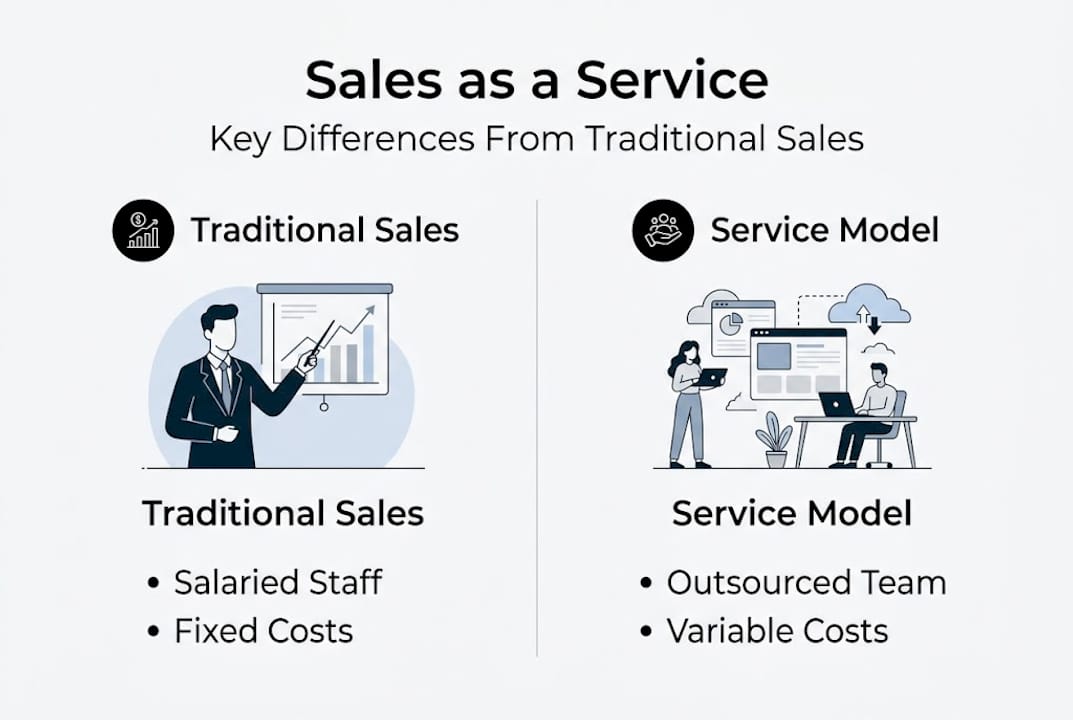
Here is how it compares to the traditional approach:
| Factor | Traditional sales model | Sales as a service |
|---|---|---|
| Cost structure | Fixed salaries, benefits, overhead | Variable, performance-based fees |
| Ramp-up time | 3 to 6 months for a new hire | Often 30 to 60 days |
| Scalability | Slow, tied to headcount | Fast, scales with demand |
| Expertise | Depends on who you hire | Built-in, specialized teams |
| Risk | High if wrong hire | Lower, easier to adjust |
For women entrepreneurs who are already generating revenue, this shift matters for a specific reason. Most of us were never trained in sales. We built our businesses on expertise, relationships, and reputation. Handing off the parts of sales that drain us, like cold outreach or pipeline management, frees us to stay in our zone of genius.
The functions a provider can cover include:
- Lead generation: Finding and attracting potential clients
- Prospecting: Researching and reaching out to qualified leads
- Qualification: Filtering out poor fits before they waste your time
- Closing support: Helping convert warm leads into paying clients
- Account management: Nurturing existing clients for retention and upsells
If you want to understand how consultative sales services fit into this picture, the distinction matters. Consultative selling is about building trust through expertise, and a good sales as a service partner should operate the same way.
Pro Tip: When evaluating providers, ask directly whether they have experience working with women founders or service-based businesses. Generic B2B sales firms may not understand the nuance of how your clients buy.
Key components of sales as a service for scaling sustainably
Now that you understand the model, let’s look at what actually powers high-performing sales as a service solutions. The mechanics go deeper than just handing off a few tasks.
High-performing providers use dedicated sales teams, AI-driven analytics, operational support, tech-enabled execution, and structured sales motions from pipeline management to full go-to-market strategy. That last part is important. A strong partner does not just execute tactics. They bring a system.
There are three main engagement models to know:
- Full outsourcing: The provider runs your entire sales function. Best for founders who want to step fully out of day-to-day selling.
- Fractional sales leadership: You bring in a part-time VP of Sales or sales director to lead strategy without a full-time salary.
- Revenue operations support: Focused on the systems, data, and processes behind sales rather than the selling itself.
When you are ready to move forward, here is what to include in your service agreement:
- Clearly defined scope of work and deliverables
- Performance metrics and how they will be tracked
- Reporting cadence and communication expectations
- Ramp-up timeline and onboarding process
- Exit clauses and flexibility terms
The table below gives you a realistic picture of what to expect:
| Engagement type | Typical monthly cost | Timeline to results | Best for |
|---|---|---|---|
| Full outsourcing | $3,000 to $15,000+ | 60 to 90 days | Scaling fast, high-volume |
| Fractional leadership | $2,000 to $8,000 | 30 to 60 days | Strategy and team building |
| Revenue operations | $1,500 to $5,000 | 45 to 75 days | Systems and process fixes |
If you are also exploring scaling with systems and automation, pairing that with a sales as a service model creates a compounding effect. Your systems run the backend while your provider drives the pipeline. For founders who want to go further, AI-powered sales strategies are increasingly embedded into these engagements, giving you data on what is working before you even notice a pattern.
How women entrepreneurs benefit: Outsourcing sales, building wealth, and beating burnout
Understanding the moving parts is powerful, but let’s get specific. Why does this approach matter so much for women building sustainable, thriving businesses?
The most direct answer: outsourcing your sales function removes the operational burden that keeps founders stuck in execution mode. Fractional models in particular offer flexible, cost-effective leadership that lets you scale without locking into expensive fixed costs. That is not just a business benefit. It is a nervous system benefit.

When you are not spending your best hours chasing leads or managing a pipeline, you have energy for the work that actually builds wealth: strategy, relationships, offers, and growth.
Here are the key benefits women founders consistently report:
- More time for high-value activities like product development, partnerships, and thought leadership
- Flexible cost structure that scales with revenue rather than draining it
- Scalable results without the emotional labor of managing an in-house team
- Higher confidence in the sales process because experts are handling what they do best
- Reduced burnout from stepping out of the parts of sales that feel most draining
Women-led firms like Minerva, Monica Stewart, and inspir’em have shown that when founders stop trying to do everything themselves, their confidence in selling actually increases. The distance from day-to-day execution gives you perspective, and perspective is where strategy lives.
“When founders stop white-knuckling every sales conversation and trust a system, they stop selling from fear and start selling from value.” This shift is not just psychological. It shows up in revenue.
For more on building sustainable growth tactics that support this kind of model, the principles overlap significantly. And if you are thinking about the bigger picture, sustainable business scaling requires that your growth engine does not depend entirely on your personal energy.
Pro Tip: Before signing with any provider, ask for case studies from founders in your industry and revenue range. Results vary widely, and specificity matters more than impressive-sounding client logos.
Choosing a sales as a service partner: What to look for and common pitfalls
Great. So how do you make sure you choose the right partner and sidestep common traps?
Start with these criteria when evaluating providers:
- Industry expertise: Do they understand your market, your buyer, and how your clients make decisions?
- Performance-based pricing: Are they incentivized by your results, not just their retainer?
- Quick ramp-up: Can they be operational within 30 to 45 days without a six-month onboarding?
- Women-founder alignment: Do they understand the specific dynamics of how women-led businesses operate and sell?
Coaches and firms with proven track records like Michele Fuller and Petra Wagner have built reputations specifically around helping founders in this space. That specificity matters more than size or brand recognition.
Now, the pitfalls. These are the most common mistakes founders make:
- Choosing based on price alone: The cheapest option almost always costs more in the long run through lost deals and misalignment.
- Skipping goal alignment: If your provider does not understand your revenue goals, values, and growth stage, they cannot serve you well.
- Accepting vague promises: “We will increase your pipeline” means nothing without defined metrics and timelines.
- Ignoring tech compatibility: If their tools do not integrate with yours, expect friction and data gaps from day one.
- Overlooking cultural fit: Your sales team represents your brand. If they do not sound like you, your clients will notice.
As Emma Maslen of inspir’em points out, outsourcing shifts cost from fixed to variable and focuses on results, but it only works when founder goals and provider approach are genuinely aligned. That alignment is not a nice-to-have. It is the whole thing.
When deciding between fractional and full-service, consider your current revenue stage. If you are under $500K annually, fractional leadership usually makes more sense. Above that, a full-service engagement may deliver faster returns. To elevate trust with consultative sales principles, make sure your provider uses a relationship-first approach rather than a volume-first one. And if you need help streamlining client success through better systems, that belongs in the conversation too.
Our take: What most guides get wrong about sales as a service for women founders
Here is the perspective most articles leave out entirely. Sales as a service is not just about adding capacity. It is not about hiring extra hands so you can do more of the same thing faster.
The deeper opportunity is strategic. When you bring in the right partner, you gain access to thinking that most founders never get. You see your pipeline from the outside. You stop guessing what is working. You start making decisions based on data instead of anxiety.
For women entrepreneurs, this matters even more because so many of us carry a complicated relationship with selling. We were not socialized to push, to follow up aggressively, or to treat revenue conversations as normal. Handing those mechanics to someone skilled at them is not weakness. It is revenue scaling with systems thinking at its clearest.
The founders who use this model well do not just grow their pipeline. They grow their confidence, their clarity, and their capacity to build something that lasts. That is not a short-term fix. That is the foundation of generational wealth. Explore more on AI and consulting sales insights to see how the landscape is evolving.
Ready to scale your sales—with less stress?
If this article gave you a clearer picture of what sales as a service can do for your business, the next step is figuring out what it looks like for you specifically. Not a generic framework. Your revenue stage, your offers, your nervous system.
At Freedom Sun, we work with women entrepreneurs who are already generating revenue and ready to build something that does not require them to be everywhere at once. Whether you want to discover strategic sales solutions that fit your business or go deeper into the principles of learn consultative selling, the resources are here. You do not have to figure this out alone, and you definitely do not have to burn out to grow.
Frequently asked questions
How is sales as a service different from hiring a sales rep or agency?
Sales as a service provides full-funnel, intelligence-powered outsourced teams covering your entire sales cycle, unlike a single rep or traditional agency, and typically includes performance-based models and operational support.
What are signs that it’s time to outsource my sales as a woman founder?
If sales is consistently draining your focus or slowing your growth, outsourcing removes operational burden so you can prioritize higher-value work and scale without adding to your personal workload.
Are there women-led sales as a service firms that specialize in startups and consulting?
Yes. Firms like Minerva, Monica Stewart, and inspir’em specialize in founder-led and women-owned companies across the US and Europe, with approaches built around confidence and sustainable growth.
How do I make sure my outsourced sales team understands my unique market and values?
Ask for references, sector-specific case studies, and a detailed onboarding plan. Providers with industry expertise and proven results in your market will be able to demonstrate fit before you sign anything.