Practice Sales Pitch: Advanced Strategies for Women Entrepreneurs

TL;DR:
- Women entrepreneurs can significantly improve sales by practicing advanced pitch techniques and objection handling.
- Psychological readiness, storytelling, and strategic frameworks like Challenger and consultative methods are key to scaling.
- Addressing gender-specific barriers and reflective practice enhances confidence, authority, and deal closure.
Most women entrepreneurs generating consistent revenue have already mastered the basics of a sales pitch. But here is the uncomfortable truth: basic pitch repetition is not what separates good from great at the scaling stage. Women-owned businesses average $520K in revenue and are actively closing the funding gap, yet most sales training still treats them like beginners. The real growth edge is psychological as much as tactical. This guide goes beyond the basics to cover advanced pitch practice, objection handling, and methodology choices that match where you actually are in your business.
Table of Contents
- Why pitch practice transforms advanced sales performance
- Core frameworks: From structured scripts to advanced role-play
- Mastering objection handling and deal advancement
- Advanced sales methodologies: Challenger vs consultative
- Our perspective: What most sales guides miss for scaling women-led businesses
- Ready to maximize your revenue and impact?
- Frequently asked questions
Key Takeaways
| Point | Details |
|---|---|
| Repetition beats perfection | Consistent pitch practice drives better results than aiming for flawless delivery every time. |
| Frameworks empower objection handling | Using LAER and Challenger methods helps women entrepreneurs move past common deal blockers. |
| Sales is advanced service | Reframing sales as an act of service and insight creates both confidence and growth. |
| Mindset shifts accelerate scaling | Overcoming fear of rejection or being ‘pushy’ unlocks new sales opportunities for women-led businesses. |
| Advanced methods drive revenue | Blending Challenger and consultative tactics can dramatically grow funding and top-line revenue. |
Why pitch practice transforms advanced sales performance
There is a reason elite performers rehearse obsessively. Pitch practice is not about memorizing lines. It is about building the mental and emotional muscle to stay grounded when a high-stakes conversation gets uncomfortable.
For women entrepreneurs, the psychological dimension of sales is especially significant. Role-play practice addresses psychological barriers like anxiety and reframes sales as an act of service rather than persuasion. That reframe is everything. When you see your pitch as delivering value instead of pushing a product, the fear of appearing aggressive dissolves. The conversation shifts from “will they like me” to “how can I help them.”
Repetition also reduces the two biggest anxiety triggers in sales: fear of rejection and fear of being perceived as too pushy. Both are particularly common for women navigating gendered expectations in business. The more you practice, the more those fears lose their grip. Your nervous system stops treating a “no” like a threat and starts treating it like data.
Skills worth building through consistent practice include:
- Handling surprise objections without losing composure
- Pivoting naturally when a conversation goes off-script
- Holding your pricing with confidence under pressure
- Staying curious instead of defensive when buyers push back
- Improving your public speaking in sales presence and authority
The compounding effect is real. Every practice session builds on the last. After ten realistic role-plays, you stop reacting and start responding. That shift alone can transform your close rate. For more on building that foundation, sales improvement techniques designed for service entrepreneurs offer a strong next layer.
You can also study pitch strategies for women that specifically address the nuances of communicating value in ways that resonate with your ideal buyers.
Pro Tip: Treat pitch practice like a professional rehearsal, not a recitation drill. Record yourself, watch it back, and focus on how you handle the moment after an objection lands, not just how you open.
Core frameworks: From structured scripts to advanced role-play
Knowing why practice is powerful, let’s break down the actionable formats that really level up your skills.
Core mechanics for practicing sales pitches include role-playing realistic scenarios, using structured scripts, and building feedback loops around diagnostic questions. Each format serves a different purpose, and advanced sellers use all three.
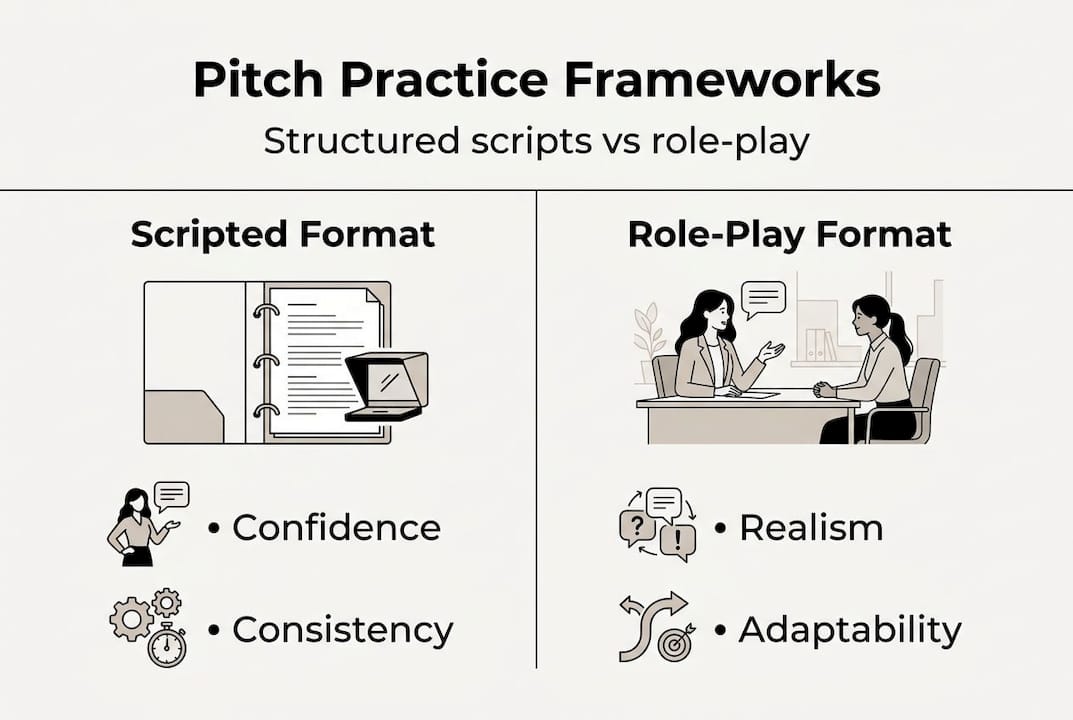
Scripted practice is where you start. It builds foundational confidence and helps you internalize language that feels natural under pressure. Cold call scripts, pricing conversation frameworks, and objection response templates all belong here. Once the language lives in your body, you can improvise without falling apart.
Free-form role-play is where you grow. It introduces unpredictability: the buyer who goes silent, the prospect who challenges your pricing mid-call, the client who seems interested but keeps stalling. Benefits of sales role-play include faster skill development and better retention of techniques because you are learning through experience, not just exposure.
Here is a step-by-step role-play process that works for growth-stage entrepreneurs:
- Select a realistic buyer scenario based on a deal you have actually lost or stalled
- Write a brief script covering the opening, value proposition, and likely objections
- Assign roles, one person plays the buyer and commits to realistic pushback
- Run the session without stopping, even when it gets awkward
- Debrief using diagnostic questions: what worked, what stalled, what would you change
For pricing conversations specifically, this format is invaluable. Practicing the moment you name your price, out loud, with a real person pushing back, is one of the fastest ways to stop undercharging.
| Element | Structured scripts | Free-form role-play |
|---|---|---|
| Control | High | Low |
| Realism | Moderate | High |
| Skill building | Foundational | Advanced |
| Best for | New scenarios, pricing language | Complex objections, live deal prep |
Mastering objection handling and deal advancement
With pitch practice frameworks established, it is crucial to focus on what truly differentiates advanced sellers: expert-level objection handling and closing.

Every stalled deal has an objection at its center. Price, timing, fit, risk, and budget are the five most common. The mistake most entrepreneurs make is treating these as problems to solve. Advanced sellers treat them as signals to explore.
The LAER framework and Feel-Felt-Found method provide structured approaches for addressing objections and reframing them toward ROI. LAER stands for Listen, Acknowledge, Explore, Respond. It slows the conversation down in a way that builds trust instead of defensiveness.
Here is how to apply LAER in practice:
- Listen fully before responding. Do not interrupt or start forming your rebuttal mid-sentence.
- Acknowledge the concern without minimizing it. “That makes sense” is more powerful than “I understand but…”
- Explore with a diagnostic question. “What would need to be true for this to feel like the right investment?”
- Respond with evidence, story, or reframe, not a feature list.
For more on applying this in client relationships, consultative objection-handling offers deeper frameworks for service-based businesses.
“High performers maintain a 43:57 talk-to-listen ratio.” The best closers are not the best talkers. They are the best listeners.
Pro Tip: Build a library of two or three customer ROI stories before your next big pitch. Stories outperform statistics when a buyer is emotionally resistant. Pair the story with a number and you have a closing tool that is hard to argue with.
| Objection type | Emotional root | Best-fit framework |
|---|---|---|
| Price | Fear of loss or overpaying | ROI reframe, Feel-Felt-Found |
| Timing | Uncertainty, overwhelm | LAER, diagnostic questions |
| Fit | Skepticism, past bad experience | Story-based evidence, LAER |
| Risk | Fear of failure | Feel-Felt-Found, social proof |
| Budget | Resource scarcity mindset | ROI reframe, phased proposal |
Also explore mastering sales objections for additional tactical approaches that complement these frameworks.
Advanced sales methodologies: Challenger vs consultative
Once you can move through tough objections, the next step is knowing which sales mindset positions you for big-league growth.
The Challenger methodology teaches new insights and outperforms consultative selling in complex B2B environments. Rather than asking buyers what they need, Challenger sellers reframe what the buyer thinks they need. They teach, tailor, and take control of the conversation.
The consultative approach builds deep trust through needs discovery. It is relationship-first and works beautifully for long sales cycles and service-based businesses. The risk is that it can lead to buyer-controlled conversations where you spend months building rapport without ever closing.
Here is a quick breakdown of each:
Challenger pros and cons:
- Pros: Commands authority, accelerates decisions, works well for complex deals
- Cons: Requires deep industry insight, can feel aggressive if misapplied
Consultative pros and cons:
- Pros: Builds genuine trust, ideal for high-touch services, creates loyal clients
- Cons: Slower to close, buyer can steer the deal away from commitment
For a deeper look at applying the consultative sales approach in client relationships, or building a sustainable sales growth strategy, both are worth exploring as your business scales.
For more on the Challenger methodology overview, the research behind it is compelling for anyone selling in competitive markets.
| Factor | Challenger | Consultative |
|---|---|---|
| Primary driver | Insight and control | Trust and discovery |
| Best use case | Complex B2B, competitive markets | High-touch services, long relationships |
| Outcome speed | Faster | Slower |
| Risk | Can alienate if poorly timed | Buyer-led stalling |
The most effective growth-stage sellers blend both. Use Challenger to open and reframe. Use consultative to deepen trust and close. Multi-threaded deals especially benefit from this combination.
Our perspective: What most sales guides miss for scaling women-led businesses
Most sales guides stop at technique. They give you scripts, frameworks, and closing lines without ever addressing the layer underneath: the psychological and cultural dynamics that shape how women sell and how buyers respond to them.
Women-led firms are outperforming in revenue growth and closing the funding gap, yet standard sales advice consistently underestimates the barriers and levers specific to this group. Internalized limits on ambition, external gender bias in enterprise buying rooms, and the social conditioning to be likable over authoritative are not small footnotes. They are central to why talented women plateau in sales.
Reflective practice, not just repetitive practice, is what creates the breakthrough. Reviewing your recordings and asking “where did I shrink?” is more valuable than counting how many times you practiced your opener.
“Practice is not just repetition. It is transformation and negotiation power for women entrepreneurs.”
The competitive edge comes from insight-driven, story-rich Challenger moves layered over a consultative foundation. That combination signals both authority and care. It is rare. And it is what enterprise buyers remember. Explore financial growth for founders and financial coaching for women founders to build the full picture alongside your sales strategy.
Ready to maximize your revenue and impact?
You now have a clearer map of what separates good sales from transformational sales at the scaling stage. The next step is putting these frameworks into consistent practice with the right support around you. Freedom Sun offers advanced sales resources including guides, templates, and training built specifically for women entrepreneurs who are done playing small. You will also find consultative pitch techniques that help you close with confidence and integrity. Join a growing network of women scaling beyond six figures with strategy that actually fits how they think, lead, and sell.
Frequently asked questions
What’s the quickest way to improve a sales pitch?
Structured scripts and role-play build skill and confidence fastest by simulating real buyer pressure in a safe environment. Consistent repetition with realistic scenarios accelerates both technique and nervous system regulation.
How should women entrepreneurs handle sales anxiety?
Reframing sales as service helps dissolve anxiety by shifting focus from self-performance to buyer value. Practicing empathy-rich storytelling also builds the emotional confidence to stay grounded in high-stakes conversations.
What frameworks help handle tough objections?
LAER and Feel-Felt-Found provide stepwise approaches for addressing objections and moving deals forward without pressure. Both frameworks slow the conversation down in ways that build trust rather than resistance.
When is the Challenger approach better than consultative sales?
Challenger outperforms in complex B2B sales by teaching new insights and maintaining control of the conversation. It works best when buyers need their assumptions challenged rather than simply validated.