Overcoming fear of visibility: grow your business boldly

TL;DR:
- Fear of visibility causes successful women entrepreneurs to play small and miss growth opportunities.
- Increasing genuine visibility boosts client trust, innovation, and long-term business growth.
- Reframing visibility as service rather than ego reduces resistance and supports sustainable success.
Fear of being seen is quietly costing successful women entrepreneurs real money. Research shows that self-promotion links directly to experimentation and business-model adaptation — two of the most powerful drivers of sustainable growth. Yet many women who are already generating revenue, leading teams, and delivering exceptional results still shrink when it comes to being visible. They stay behind the scenes. They downplay their wins. They wait until they feel “ready.” This article breaks down what that fear actually is, why overcoming it pays off, and how to build visibility in a way that works for your nervous system, your values, and your business.
Table of Contents
- Understanding the fear of visibility in business
- The science: Why visibility drives business growth
- Reframing visibility: From self-promotion to service
- Action steps to grow your visibility (without overwhelm)
- A fresh perspective: Visibility is your business’s greatest growth multiplier — if you rewrite the rules
- Ready to unlock bold visibility in your business?
- Frequently asked questions
Key Takeaways
| Point | Details |
|---|---|
| Visibility fuels growth | Stepping into the spotlight directly boosts entrepreneurial success and adaptability. |
| Mindset shift is key | Reframing visibility as service dismantles resistance and increases impact. |
| Sustainable action, not burnout | Gradual, consistent steps toward visibility drive results without compromising well-being. |
| Science supports visibility | Research proves self-promotion links to business model innovation and lasting achievement. |
Understanding the fear of visibility in business
Fear of visibility is not the same as shyness. It is a specific resistance to being publicly seen as a business owner, expert, or leader. For many successful women entrepreneurs, it shows up not at the beginning of their journey but right when growth is within reach. That timing is not a coincidence.
This fear has deep roots. Women are often socialized to be modest, to avoid taking up too much space, and to let results speak for themselves. Cultural narratives around “not bragging” and “staying humble” get internalized early. Add past experiences — a critical comment on a post, a pitch that fell flat, a moment of public embarrassment — and the nervous system starts treating visibility as a genuine threat.
Here is what it looks like in practice:
- Avoiding media opportunities or podcast invitations
- Not sharing client wins or business milestones on social platforms
- Staying in the background at networking events even when you are the most qualified person in the room
- Underpricing to avoid the scrutiny that comes with higher rates
- Delaying launches because the offer does not feel “perfect” yet
None of these behaviors feel like fear from the inside. They feel like caution, professionalism, or strategy. That is what makes this pattern so hard to break.
“The most dangerous thing about fear of visibility is that it masquerades as wisdom. You tell yourself you are being strategic. But you are actually playing small.”
The connection to self-esteem matters here. High self-esteem boosts entrepreneurial orientation and success, which means the more you are seen, the more your confidence compounds. The reverse is also true. Staying hidden reinforces the belief that you are not ready, not enough, or not worth the attention.
Improving your communication tools is one practical way to start closing this gap. When you have language that feels authentic and clear, showing up publicly becomes far less threatening.
The science: Why visibility drives business growth
Let’s move from feelings to facts. The research is clear: self-promotion is directly linked to business-model innovation. Entrepreneurs who put themselves forward are more likely to experiment, adapt, and ultimately build businesses that last.
Here is a practical comparison of what the data shows:
| Outcome area | Low-visibility entrepreneur | High-visibility entrepreneur |
|---|---|---|
| New client acquisition | Relies on referrals only | Multiple inbound channels |
| Business-model adaptation | Slow, reactive | Fast, proactive |
| Industry recognition | Limited | Growing and compounding |
| Pivot success rate | Lower confidence, delayed action | Higher confidence, faster pivots |
| Revenue growth trajectory | Plateau after initial traction | Continued upward momentum |
The numbers tell a story that goes beyond marketing. Visibility is not just about being known. It is about staying relevant, attracting the right clients, and having the feedback loops that allow you to improve your offer and your positioning over time.
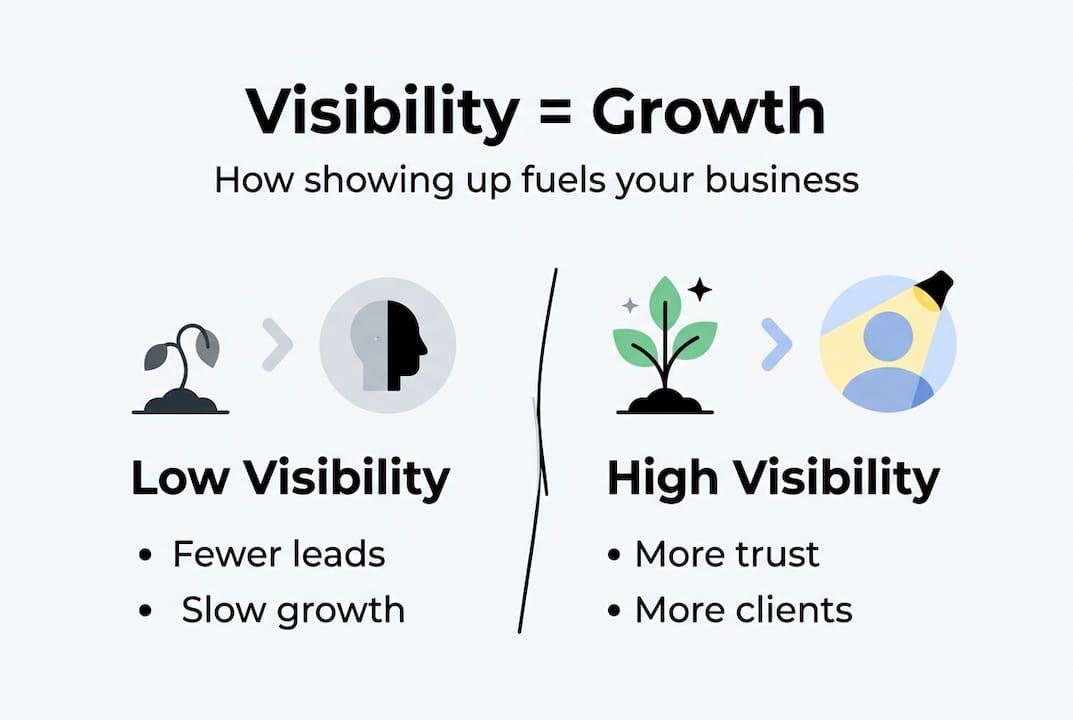
Consider a real-world example. A woman-owned consulting firm with strong results but minimal public presence decided to start sharing her frameworks on LinkedIn and speak at two industry events in one year. Within six months, she had three new enterprise clients, two speaking invitations, and a waiting list for her flagship program. Nothing changed about her expertise. What changed was who could find her and how they perceived her authority.
Visibility and self-esteem also reinforce each other in a powerful cycle. Each time you show up and the world does not end, your nervous system learns that it is safe. That safety creates more confidence, which creates more visibility, which creates more results. Self-leadership for founders is the internal work that makes this cycle sustainable rather than exhausting.

If you are building a service-based business, the connection is even more direct. Clients hire people they trust, and trust is built through consistent, visible presence. Whether you are growing a coaching business or scaling a consultancy, visibility is the engine that converts your expertise into revenue.
Reframing visibility: From self-promotion to service
Here is the mindset shift that changes everything: visibility is not about you. It is about the people who need what you offer and cannot find you because you are hiding.
When you stay invisible, you are not being humble. You are withholding value from people who are actively looking for your solution. That reframe is not just motivational. Visibility enables experimentation which benefits clients and communities, because feedback from a visible presence helps you build better offers, serve more people, and create real impact.
Let’s compare the two ways of thinking about promotion:
| Promotion as ego | Visibility as service |
|---|---|
| “Look at me and what I’ve done” | “Here is what I learned that could help you” |
| Focused on status | Focused on value |
| Triggers shame and resistance | Feels aligned and purposeful |
| Inconsistent and performative | Sustainable and authentic |
| Motivated by approval | Motivated by impact |
When you lead with service, the internal resistance drops significantly. You are not asking people to admire you. You are showing up to help.
Practical reframing statements that work:
- Instead of “I am bragging,” try “I am giving someone permission to believe this is possible for them too.”
- Instead of “Nobody wants to hear from me,” try “The right people are waiting for exactly this perspective.”
- Instead of “I need to be perfect before I share,” try “Done and visible creates more value than perfect and hidden.”
Pro Tip: Pick one platform where your ideal client already spends time and commit to showing up there consistently for 30 days. Not everywhere. Just one place. Consistency on one channel beats sporadic presence on five.
Leading with your values in your coaching business strategies also helps your visibility feel grounded rather than performative. When your message reflects what you actually believe, showing up gets easier every time.
Action steps to grow your visibility (without overwhelm)
Knowing visibility matters is not enough. You need a plan that fits your life, your bandwidth, and your nervous system. Here is a five-step approach that works for women entrepreneurs who are already busy running successful businesses.
-
Identify your visibility triggers. Notice which specific actions feel most threatening. Is it video? Speaking on panels? Sharing revenue milestones? Knowing your exact triggers lets you work with them strategically instead of avoiding everything.
-
Pick low-stress channels first. You do not have to start with live video or keynote stages. Written posts, podcast interviews as a guest, or a well-crafted email to your existing list are all legitimate visibility moves. Start where the fear is manageable.
-
Script your wins. Prepare two or three short stories about client results or business milestones you can share naturally. Having the words ready removes the in-the-moment pressure that causes most people to go silent.
-
Schedule regular visibility actions. Put them in your calendar like client calls. One post, one outreach email, one piece of content per week is enough to build momentum. Treat it as non-negotiable business activity, not optional marketing.
-
Measure and adjust. Track what you share and what response it generates. Not for validation, but for data. What resonates? What opens conversations? Use that information to refine your approach over the next quarter.
Pro Tip: Choose one small, visible action this week that feels slightly uncomfortable but not terrifying. That edge is exactly where growth happens.
Setting boundaries is also part of this. Visibility does not mean being available to everyone all the time. You can start a life coaching business or scale an existing one while being selective about where and how you show up. A decision making framework for coaches can help you evaluate which visibility opportunities align with your goals and which ones drain your energy without return.
Self-promotion is a practice — results come with consistency and self-awareness, not with one viral post or a single bold move.
A fresh perspective: Visibility is your business’s greatest growth multiplier — if you rewrite the rules
Most visibility advice tells women to “just put yourself out there” or “get comfortable being uncomfortable.” That advice is not wrong. It is just incomplete. And for women who have already built real businesses, it can feel patronizing.
Here is what most guides miss: forcing visibility before you have aligned it with your values creates a kind of performance that is exhausting and unsustainable. You can post every day and still feel invisible because what you are sharing does not reflect who you actually are or what you actually believe.
The counterintuitive truth is that some of your most powerful visibility moments will be the quieter ones. A deeply honest email to your list. A single post that names something your audience has been afraid to say out loud. A conversation at an event where you speak with full authority and zero apology. These moments build client trust and results faster than any high-volume content strategy.
Authenticity in visibility is not a marketing tactic. It is about agency. It is about deciding on your own terms how you show up, what you share, and who you invite into your world. When visibility is built on that foundation, it does not burn you out. It energizes you. And that energy is what your audience actually responds to.
Ready to unlock bold visibility in your business?
If this article gave you clarity on why visibility has felt so hard and what to do about it, the next step is putting that clarity into a real structure. At Freedom Sun, we work with women entrepreneurs who are already successful and ready to stop playing small. Our training, frameworks, and community are built specifically for women who want to grow their revenue, their reach, and their impact without burning out in the process. Whether you are working on your mindset, your messaging, or your business coaching for profit, we have the tools to help you move forward with confidence.
Frequently asked questions
What is the fear of visibility in business?
The fear of visibility is the hesitation to be seen or heard publicly as a business owner, often rooted in concerns about judgment, failure, or cultural messages about self-promotion. It is especially common among successful entrepreneurs who have internalized the idea that staying modest is safer than standing out.
How does greater visibility benefit my business?
Visibility increases client trust, inbound opportunities, and your ability to adapt your business model based on real market feedback, all of which drive higher growth and lasting impact.
What if I want to grow my visibility but avoid burnout?
Focus on one platform, set clear boundaries around your availability, and choose visibility actions that align with your values so that showing up feels sustainable rather than draining.
Can visibility help my business even if I’m already successful?
Absolutely. Even established businesses benefit from greater visibility through innovation and recognition — success does not eliminate the compounding advantages of being consistently seen and heard in your market.