Decision making framework for coaches: streamline 2026 success

Coaches who rely on gut instinct make 30% more costly operational errors than those using structured decision making frameworks. If you juggle client needs, marketing plans, and financial choices daily, chaotic decisions drain your energy and hurt outcomes. This guide reveals how structured frameworks transform your advisory practice and business systems, delivering financial clarity and repeatable success for coaches and consultants in 2026.
Table of Contents
- Introduction To Decision Making Frameworks
- Common Decision Making Challenges Faced By Coaches And Consultants
- Popular Decision Making Frameworks Suitable For Coaching And Consulting
- Stepwise Process To Implement A Decision Making Framework In Coaching Businesses
- Common Misconceptions About Decision Making In Coaching And Consulting
- Bridging Theory To Practice: Enhancing Financial Clarity And Operational Efficiency
- Unlock Coaching Success With Freedom Sun Business Training
- FAQ
Key takeaways
| Point | Details |
|---|---|
| Structured frameworks reduce errors | Decision making frameworks cut operational mistakes by up to 30% while boosting consistency. |
| Coaching businesses face unique decision fatigue | Multiple daily client and business choices overwhelm coaches without structured approaches. |
| Top frameworks fit different needs | OODA Loop, Weighted Pros and Cons, and Eisenhower Matrix each solve specific coaching challenges. |
| Implementation follows five clear steps | Diagnose bottlenecks, select frameworks, train teams, automate routines, and review results regularly. |
| Frameworks enhance financial clarity | Clear decision structures improve cash flow management and budgeting accuracy for coaching businesses. |
Introduction to decision making frameworks
Decision making frameworks are systematic approaches that guide you through choices using repeatable steps and clear criteria. For coaches and consultants, these structures replace reactive guesswork with intentional processes that improve both client advisory quality and internal business operations. When you face recurring decisions about client strategies, pricing models, or resource allocation, frameworks ensure consistency and reduce mental drain.
Starting a coaching business requires hundreds of decisions weekly. Frameworks deliver measurable benefits:
- Increased client trust through predictable, transparent recommendation processes
- Consistent service delivery that scales beyond your personal bandwidth
- Operational clarity that eliminates second guessing and rework
- Enhanced financial oversight by structuring budget and investment choices
- Reduced cognitive load, freeing mental energy for creative problem solving
Without frameworks, you bounce between intuition, external advice, and incomplete analysis. This inconsistency confuses clients and destabilizes your business foundation. Structured approaches align every choice with your strategic goals, creating a decision architecture that supports sustainable growth. Frameworks also enable consultative sales approaches by making your advisory process visible and trustworthy to clients.
Common decision making challenges faced by coaches and consultants
Decision fatigue hits coaches hard. You make constant micro choices about client communication, session content, marketing tactics, and administrative tasks. Research shows decision fatigue severely impacts consultants’ advisory ability, degrading judgment quality as the day progresses. By afternoon, even simple choices feel overwhelming, leading to avoidance or impulsive selections.
Relying solely on intuition creates hidden risks. Your gut instinct reflects past experiences but lacks systematic evaluation of new contexts. When you skip structured analysis, you miss crucial data points and overweight familiar patterns. This approach works occasionally but fails when complexity increases or stakes rise.
Unclear decisions corrode your coaching business in three ways:
- Financial chaos from inconsistent pricing, billing, and expense choices
- Operational inefficiency when processes change based on mood rather than strategy
- Client confusion when recommendations lack transparent reasoning
Without frameworks, you repeat the same decision processes but expect different outcomes. This wastes time and money while eroding your confidence. Starting your coaching business with clear decision structures prevents these problems from taking root.
Pro Tip: Track one week of decisions in a simple log. Note which choices felt draining or confusing. These patterns reveal where frameworks will deliver maximum relief and clarity.
Popular decision making frameworks suitable for coaching and consulting
Three proven frameworks address distinct coaching scenarios. The OODA Loop (Observe, Orient, Decide, Act) enables rapid client response cycles. Applying the OODA Loop in coaching improves real time adaptation when client situations shift unexpectedly. You observe new information, orient your understanding, decide on adjustments, and act immediately. This iterative approach keeps your advisory relevant during dynamic client journeys.

Weighted Pros and Cons balances multiple factors transparently. You list options, assign importance weights to criteria, score each option, and calculate totals. This framework shines for client facing decisions where you must justify recommendations clearly. Clients see your reasoning process, building trust in your guidance.
The Eisenhower Matrix prioritizes tasks by urgency and importance. You sort activities into four quadrants: urgent and important, important but not urgent, urgent but not important, neither urgent nor important. This visual framework clarifies where to focus energy, especially valuable for coaching business strategies that balance client delivery with business growth.
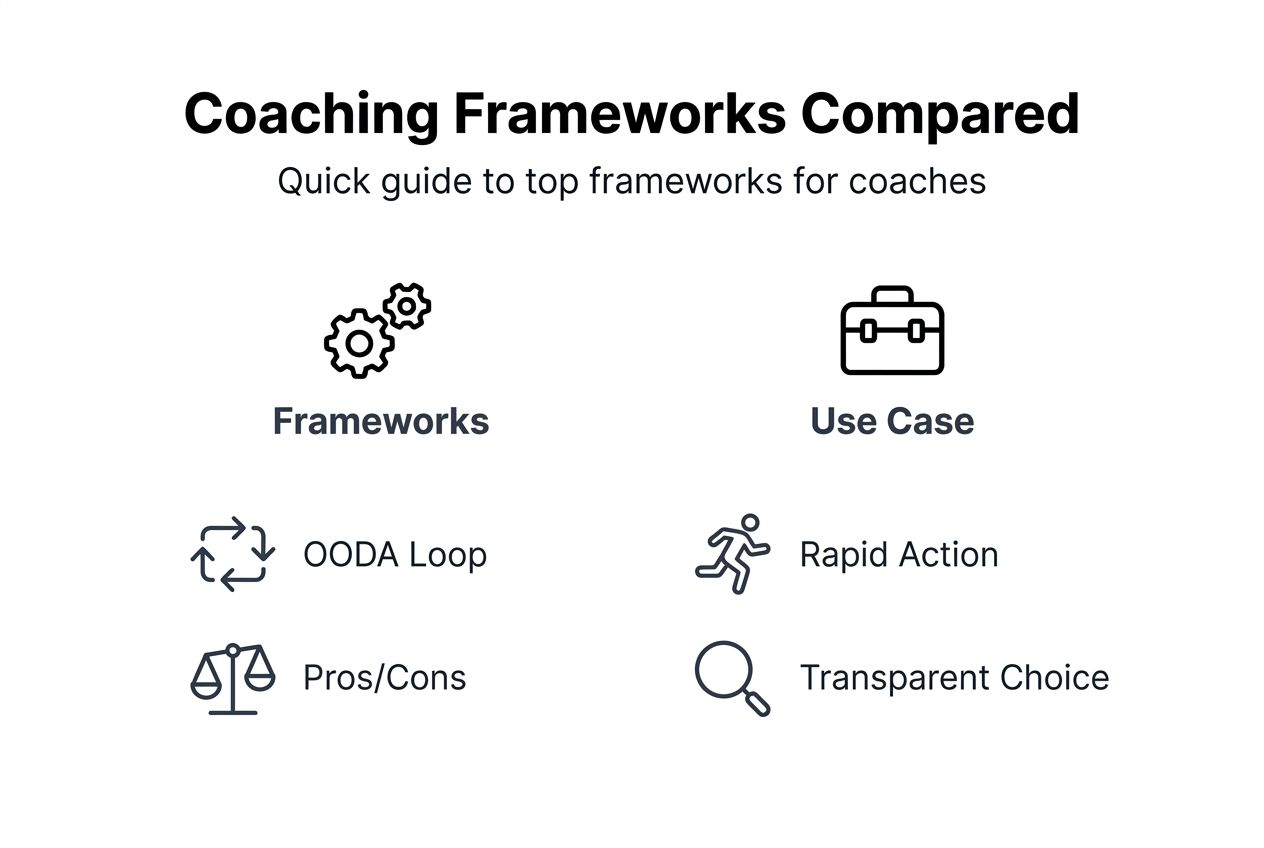
| Framework | Best Use Case | Key Benefit | Limitation |
|---|---|---|---|
| OODA Loop | Dynamic client situations requiring fast iteration | Rapid adaptation to changing conditions | Less useful for stable, predictable decisions |
| Weighted Pros and Cons | Complex choices with multiple competing factors | Transparent, defensible reasoning | Time intensive for simple decisions |
| Eisenhower Matrix | Task prioritization and time management | Visual clarity on where to focus effort | Does not address decision quality within quadrants |
Select frameworks based on your business model. If you work with service entrepreneurs using consultative sales, prioritize transparent frameworks like Weighted Pros and Cons that demonstrate value to clients. For internal operational decisions, the Eisenhower Matrix streamlines daily workflow.
Stepwise process to implement a decision making framework in coaching businesses
Implementing frameworks systematically transforms your decision culture. Follow these five steps to embed structured thinking into your coaching business operations.
-
Diagnose decision bottlenecks. Identify where decisions stall or produce poor outcomes. Look for patterns in client advisory, financial management, and operational processes. Ask yourself: which choices consume excessive time, create anxiety, or lead to frequent reversals?
-
Choose frameworks matching business needs. Match diagnosed problems to framework strengths. Use OODA Loop for client responsiveness, Weighted Pros and Cons for strategic choices, and Eisenhower Matrix for daily prioritization. Start with one framework in a high pain area rather than overhauling everything simultaneously.
-
Train yourself and any team members. Practice frameworks on low stakes decisions first. Document your process, noting what works and what feels clunky. Starting a coaching business requires building decision muscles gradually through repetition and reflection.
-
Automate routine decisions using rules or software. Once frameworks prove effective, automate recurring choices. Create decision trees for common client scenarios or pricing situations. Business process outsourcing can handle administrative decisions, freeing cognitive capacity for strategic thinking.
-
Review application results and iterate. Schedule monthly reviews to assess framework performance. Track decision time, outcome quality, and cognitive load. Adjust frameworks based on real results, not theoretical perfection.
Research confirms structured frameworks reduce decision fatigue and improve operational flow when implemented with training and automation. The key is consistency. Apply your chosen framework to every relevant decision for 30 days to establish neural pathways and cultural norms.
Pro Tip: Create a one page decision template for your primary framework. Laminate it or post digitally where you work. Physical reminders prevent reverting to old reactive patterns under stress.
Common misconceptions about decision making in coaching and consulting
Three myths block coaches from adopting structured frameworks. First, many believe frameworks slow agility. The opposite proves true. Frameworks like OODA Loop accelerate decisions by eliminating analysis paralysis. You follow clear steps rather than wandering through options randomly. Speed comes from structure, not chaos.
Second, coaches assume frameworks are too complex for small businesses. This misunderstands scalability. Simple frameworks start with basic versions and expand as needs grow. A solo consultant can use Weighted Pros and Cons with three criteria. A team of ten can apply the same framework with fifteen criteria. Frameworks adapt to your scale.
Third, the intuition myth persists. Coaches trained in empathy and interpersonal skills trust gut feelings deeply. While intuition offers value, research shows purely intuitive decisions produce costly errors. Structured approaches reduce mistakes by examining assumptions and data systematically. Combine intuition with frameworks for optimal results. Your gut provides hypotheses; frameworks test them rigorously.
Frameworks do not eliminate creativity or personal judgment. They channel these qualities productively by ensuring you consider all relevant factors before deciding. Think of frameworks as decision scaffolding. They support your thinking without dictating conclusions. Once frameworks become habitual, they feel natural rather than restrictive.
Bridging theory to practice: enhancing financial clarity and operational efficiency
Decision making frameworks deliver concrete business improvements. Quantified impacts include:
- 30% reduction in decision time for recurring business choices
- 25% fewer errors in client recommendations and internal processes
- 40% improvement in team alignment when multiple people make decisions
Financial clarity improves when frameworks structure cash flow and investment decisions. Instead of reactive spending based on immediate pressure, you evaluate expenses against strategic criteria. This discipline surfaces wasteful patterns and reallocates resources to high impact activities. Coaches using frameworks report better budgeting accuracy and reduced financial anxiety.
Operational efficiency gains come from automating routine decisions and standardizing processes. When you document framework applications, you create repeatable workflows. New team members follow established decision trees rather than reinventing approaches. This consistency enables delegation and scale. Financial clarity for founders depends on structured decision systems that work whether you are present or not.
Leadership scalability links directly to cognitive readiness. Research demonstrates integrating mental resilience training with frameworks improved leadership scalability by 25%. Frameworks reduce cognitive load, preserving mental energy for strategic thinking and relationship building. You stop micromanaging decisions and start architecting systems.
| Business Area | Framework Impact | Measurable Outcome |
|---|---|---|
| Client advisory | OODA Loop application | 20% faster client response time |
| Financial management | Weighted decision criteria | 15% reduction in budget variances |
| Task prioritization | Eisenhower Matrix use | 30% increase in high value activity time |
| Team coordination | Shared framework adoption | 40% improvement in decision alignment |
Pro Tip: Start tracking decision outcomes in a simple spreadsheet. Note the decision, framework used, time invested, and result quality. After 10 entries, patterns emerge showing which frameworks fit your style and business needs best.
“Structured decision making transformed my coaching practice. I went from drowning in daily choices to confidently scaling my client base while maintaining work life balance. Frameworks gave me back mental space I did not know I was losing.”
Unlock coaching success with Freedom Sun business training
Applying decision making frameworks requires more than reading about them. You need practical implementation support, diagnostic tools to identify bottlenecks, and community accountability. Freedom Sun provides interactive training specifically designed for coaches and consultants building systematic, scalable businesses. The platform teaches you to integrate frameworks into sales, financial management, and operational processes through hands on exercises and real world application. Freedom Sun’s approach moves you from hustle culture chaos to automated strategic management, emphasizing sovereignty over your business systems. Explore Freedom Sun’s training to transform decision making concepts into daily practices that enhance your coaching effectiveness and business health. Start building the structured foundation your 2026 success demands.
FAQ
What is a decision making framework and why is it important for coaches?
A decision making framework is a structured approach using repeatable steps to evaluate choices systematically. For coaches, frameworks improve advisory consistency, reduce cognitive fatigue, and enhance client trust through transparent reasoning. They transform reactive guesswork into strategic processes that scale beyond personal bandwidth.
How can a coaching business select the right decision making framework?
Start by diagnosing where decisions currently stall or produce poor outcomes in your practice. Match identified bottlenecks to framework strengths: use OODA Loop for dynamic client situations, Weighted Pros and Cons for complex strategic choices, and Eisenhower Matrix for daily task prioritization. Test one framework in a high pain area before expanding.
What are the biggest misconceptions about decision making frameworks in coaching?
Three myths persist. First, frameworks slow agility when they actually accelerate decisions by eliminating analysis paralysis. Second, frameworks are too complex for small businesses when they scale easily from solo practices to teams. Third, intuition alone is superior when research shows structured approaches reduce errors by 30% compared to pure gut decisions.
How do decision making frameworks improve financial clarity?
Frameworks structure cash flow, investment, and expense decisions using consistent criteria instead of reactive impulse. This discipline reveals wasteful spending patterns and reallocates resources strategically. Coaches using frameworks report 15% reductions in budget variances and significantly lower financial anxiety through transparent, repeatable financial decision processes.
Can decision making frameworks really reduce coaching decision fatigue?
Yes. Structured frameworks automate routine choices, reducing cognitive load by eliminating repeated mental processing of similar decisions. Research documents significant reductions in decision fatigue symptoms when frameworks handle recurring business and client choices. This preservation of mental energy allows coaches to focus on creative strategic thinking and deep client work.