Overcome subconscious money beliefs to grow your business

TL;DR:
- Subconscious money beliefs influence women entrepreneurs’ funding, pricing, and investment behaviors.
- Recognizing and rewiring these beliefs with practical strategies enables business growth and confidence.
- Structural change requires both inner mindset work and addressing external systemic barriers.
You can be generating consistent revenue, hitting new income milestones, and still feel a quiet pull toward playing smaller than you know you’re capable of. That pull isn’t a strategy problem. It’s a belief problem. Research shows that non-minority campaigns raise 23% more than those led by women and minority entrepreneurs, and that gap can’t be explained by business performance alone. Something deeper is at work. This guide will help you identify the subconscious beliefs quietly shaping your financial decisions and give you practical tools to shift them so your business can grow in proportion to your actual talent and effort.
Table of Contents
- What are subconscious beliefs about money?
- How subconscious money beliefs impact women entrepreneurs
- Common subconscious money beliefs and how to spot them
- Strategies to rewire subconscious beliefs for business growth
- Why traditional mindset advice often misses the mark
- Unlock your next level: Resources and support
- Frequently asked questions
Key Takeaways
| Point | Details |
|---|---|
| Subconscious beliefs shape results | Hidden money scripts can directly impact funding, pricing, and growth for women entrepreneurs. |
| Awareness is the first step | Recognizing your subconscious beliefs is required before you can change them. |
| Actionable strategies drive change | Applying evidence-based techniques can transform beliefs and unlock new business success. |
| External and internal biases exist | Systemic and subconscious biases both contribute to funding gaps. |
| Support accelerates progress | Community, mentorship, and ongoing education help reinforce lasting mindset change. |
What are subconscious beliefs about money?
Now that we’ve seen why mindset matters, let’s clarify exactly what subconscious money beliefs are and where they come from.
Subconscious beliefs about money are the deeply held, often unexamined assumptions you carry about what money means, who deserves it, and how it behaves. They operate below conscious awareness, which is exactly what makes them so powerful. You don’t decide to believe them. They were absorbed.
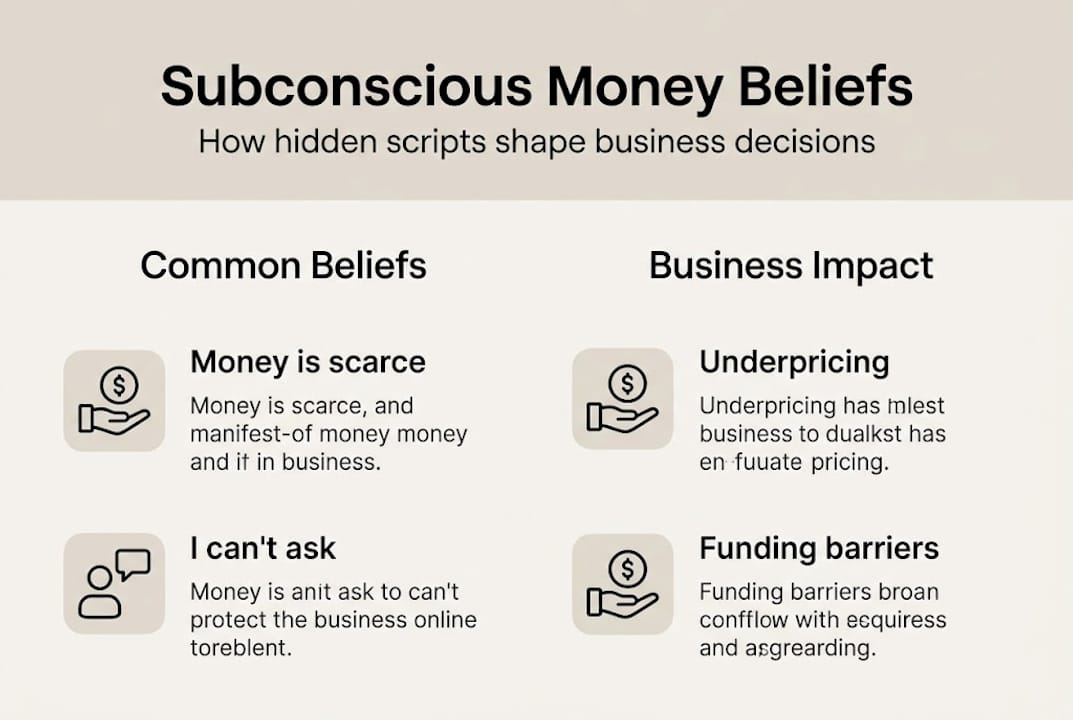
Most of these beliefs form early. They come from watching how your parents talked (or didn’t talk) about money, from family stories about wealth and struggle, from cultural messages about what women are supposed to want or ask for, and from early experiences of scarcity or abundance. By the time you’re running a business, these beliefs feel like facts.
Researchers call these patterns money scripts, and four core types show up repeatedly in studies on entrepreneurial behavior:
- Money avoidance: Believing money is bad, corrupt, or that you don’t deserve it
- Money worship: Thinking more money will solve all your problems, leading to overwork and burnout
- Money vigilance: Excessive secrecy and anxiety around finances, even when things are going well
- Money status: Tying your self-worth directly to your net worth or revenue numbers
Each of these scripts shows up in real business decisions. Money avoidance might look like undercharging. Money vigilance might look like refusing to invest in your business even when the ROI is clear. Understanding changing your money mindset starts with recognizing which script is running your financial choices.
The connection between money mindset and entrepreneurial wealth is not theoretical. It’s measurable in your pricing, your funding asks, and your willingness to grow.
Pro Tip: Keep a small notebook for one week and write down every time you hesitate around a financial decision. Patterns in those hesitations are often your money scripts speaking.
How subconscious money beliefs impact women entrepreneurs
With a firm grasp of what subconscious money beliefs are, let’s see how they shape the paths of women entrepreneurs in practice.
The effects are not abstract. They show up in the numbers you put on your invoices, the amount you request from investors, and whether you reinvest in your own business or hold back. Gender stereotypes lead investors to systematically undervalue women-led businesses, and when women have internalized beliefs that they shouldn’t ask for too much, those two forces compound each other.
Here’s a quick comparison of how subconscious beliefs play out differently depending on context:
| Factor | Women entrepreneurs | Non-minority entrepreneurs |
|---|---|---|
| Average funding ask | Lower, often significantly | Higher, closer to actual need |
| Investor perception | Frequently undervalued | Typically taken at face value |
| Funding success rate | 36% in 2024 | Consistently higher |
| Average funding amount | $67k, up 25% year over year | Higher baseline |
Progress is real. The average funding amount for women-owned businesses rose 25% recently, which matters. But the gap persists, and internal beliefs are part of why.
“The most dangerous funding gap isn’t the one investors create. It’s the one you create before you ever walk into the room.”
Here’s how these beliefs quietly influence your business moves, step by step:
- A limiting belief forms early (“asking for money is greedy”)
- It becomes a filter for how you interpret business situations
- You unconsciously adjust your behavior to match the belief (lower prices, smaller asks)
- External systems like investor bias reinforce the outcome
- You interpret the result as confirmation that the belief was true
Breaking this cycle is exactly what transforming your relationship with money is designed to do. The cycle is real, but it is not permanent.
Common subconscious money beliefs and how to spot them
Understanding the impact is crucial, but how do you know which beliefs might be holding you back? Let’s look closer at common patterns.
Five limiting beliefs show up most often among women entrepreneurs who are already generating revenue but feel stuck at a certain ceiling:
- “I don’t deserve to charge more.” You justify lower prices with logic, but the real driver is a belief that your value has a cap.
- “Wealthy people are greedy or selfish.” If you associate wealth with negative traits, your nervous system will resist building it.
- “Asking for money makes me look desperate.” This one silences funding conversations before they start.
- “I should be grateful for what I have.” Gratitude is healthy. Using it to suppress ambition is a belief in disguise.
- “I’m not good with money.” This identity-level belief keeps you from developing financial skills you absolutely have the capacity to build.
Research on fear of failure and capability perception shows these aren’t personality flaws. They are psychological patterns that shape entrepreneurial activity levels in measurable ways.
The funding data tells a parallel story. The 36% funding success rate for women in 2024, combined with a 25% increase in average funding amounts, shows movement. But the gap between what women ask for and what they actually need remains significant, and that gap lives partly in belief.

To master your financial mindset and strengthen self-leadership as a founder, you first need to recognize which belief is active.
Pro Tip: Notice when you think “I can’t” or “I shouldn’t” around money. These phrases are almost never about logic. They’re signals pointing directly to a hidden belief worth examining.
Strategies to rewire subconscious beliefs for business growth
Spotting old beliefs is empowering. Next, let’s break down research-backed methods that actually move the needle for business owners.
Rewiring is not about positive thinking. It’s about consistent, deliberate practice that creates new neural pathways over time. Here are four strategies that work:
- Awareness journaling. Write about your money experiences without editing. The goal is to surface patterns, not solve problems. Three to five minutes daily is enough to start revealing the beliefs running in the background.
- Cognitive reframing. When you catch a limiting thought, write it down and then write three pieces of evidence that contradict it. This is not toxic positivity. It’s training your brain to see a fuller picture.
- Success pattern recognition. Keep a running list of financial wins, no matter how small. Women who prioritize growth signals in how they present themselves to investors and in how they talk to themselves close the gap faster.
- Supportive community. Isolation reinforces old beliefs. Peer accountability and community exposure to women who charge more, ask for more, and invest more shifts your sense of what’s normal and possible.
Here’s a practical overview of each strategy:
| Strategy | Daily time needed | Expected shift |
|---|---|---|
| Awareness journaling | 5 minutes | Surface hidden patterns within 2 weeks |
| Cognitive reframing | 10 minutes | Reduced automatic negative responses in 30 days |
| Success pattern recognition | 5 minutes | Improved confidence in pricing and asks |
| Community accountability | Weekly | Expanded belief in what’s possible |
For additional perspective on mindset and leadership strategies that support this work, or to explore alternative leadership and funding support, there are resources built specifically for women in growth stages.
Pro Tip: Practice asking for more in low-stakes situations first. Negotiate a vendor rate, request a better seat, ask for an extended deadline. Each small ask builds the neural pathway for bigger ones.
Why traditional mindset advice often misses the mark
Most money mindset content is motivational. It feels good in the moment and fades by Tuesday. The problem is that surface-level advice, affirmations, vision boards, and “just believe in yourself” frameworks, treats a deeply conditioned belief system as if it’s a bad habit you can swap out over a weekend.
Here’s what nearly 20 years of working with women entrepreneurs across 30 countries has made clear: lasting financial transformation requires two things most quick-fix advice skips entirely. First, honest confrontation of where the belief came from and what it’s been protecting you from. Second, real structural change in behavior, not just thinking.
Subconscious beliefs about money are also not formed in a vacuum. They exist alongside real systemic barriers. Pretending that inner work alone will close a funding gap shaped by investor bias is naive. The most effective approach masters a financial mindset for business growth while simultaneously building the external evidence that challenges old narratives. Both tracks matter. Neither one alone is enough.
Unlock your next level: Resources and support
If you’ve recognized yourself in any of these patterns, that recognition is the beginning of real change. At Freedom Sun, we work with women entrepreneurs who are already generating revenue and are ready to stop leaving money on the table because of beliefs they didn’t consciously choose. Through the Women’s Wealth Collective academy, peer accountability groups, and expert-led exercises built around the nervous system of money, you get more than inspiration. You get a repeatable process. Explore personalized mindset resources and start with the deep-dive money mindset article to take the next concrete step toward financial confidence that holds.
Frequently asked questions
What are some examples of subconscious money beliefs?
Common examples include “I don’t deserve wealth,” “Money is scarce,” and “Asking for money is greedy.” These money script patterns drive avoidance and self-sabotage in ways that feel like rational decisions.
How do subconscious beliefs about money limit business growth?
They lead you to underprice, avoid funding conversations, or resist investing in your own growth. Gender stereotypes cause undervaluation externally, and limiting beliefs amplify that effect from the inside.
Can women entrepreneurs close the funding gap despite these beliefs?
Yes. The women-owned funding rate reached 36% in 2024 with average funding up 25%, and prioritizing growth signals helps women counter external bias while building internal confidence.
What’s the first step to shifting limiting money beliefs?
Begin with honest self-reflection through journaling or a structured assessment that surfaces your unconscious attitudes and financial triggers before trying to change anything.