How your nervous system shapes your money mindset in 2026

Your financial decisions happen before you consciously think about them. The nervous system processes money cues in milliseconds, triggering automatic responses rooted in survival patterns formed decades ago. This means every pricing conversation, every invoice you hesitate to send, and every time you undercharge isn’t a strategy problem. It’s a nervous system problem. Understanding this connection transforms how you build sustainable wealth, because you can’t think your way out of patterns your body believes keep you safe.
Table of Contents
- How Your Nervous System Influences Money Behaviors
- Unpacking Early Emotional Money Narratives
- Gender Nuances In Financial Decision-Making And Delay Discounting
- Practical Steps To Regulate Your Nervous System For Financial Empowerment
- Empower Your Financial Mindset With Freedom Sun
Key takeaways
| Point | Details |
|---|---|
| Nervous system states drive money behaviors | Your autonomic nervous system determines whether you make wise financial choices or react from fear and avoidance. |
| Early childhood creates money blueprints | Beliefs formed before age seven become subconscious safety cues that control adult financial decisions without your awareness. |
| Gender influences financial patience | Women show lower delay discounting rates, naturally favoring long-term rewards over immediate gratification in economic choices. |
| Regulation enables mindset transformation | Combining nervous system awareness with compassionate presence rewrites limiting money beliefs that logic alone cannot change. |
How your nervous system influences money behaviors
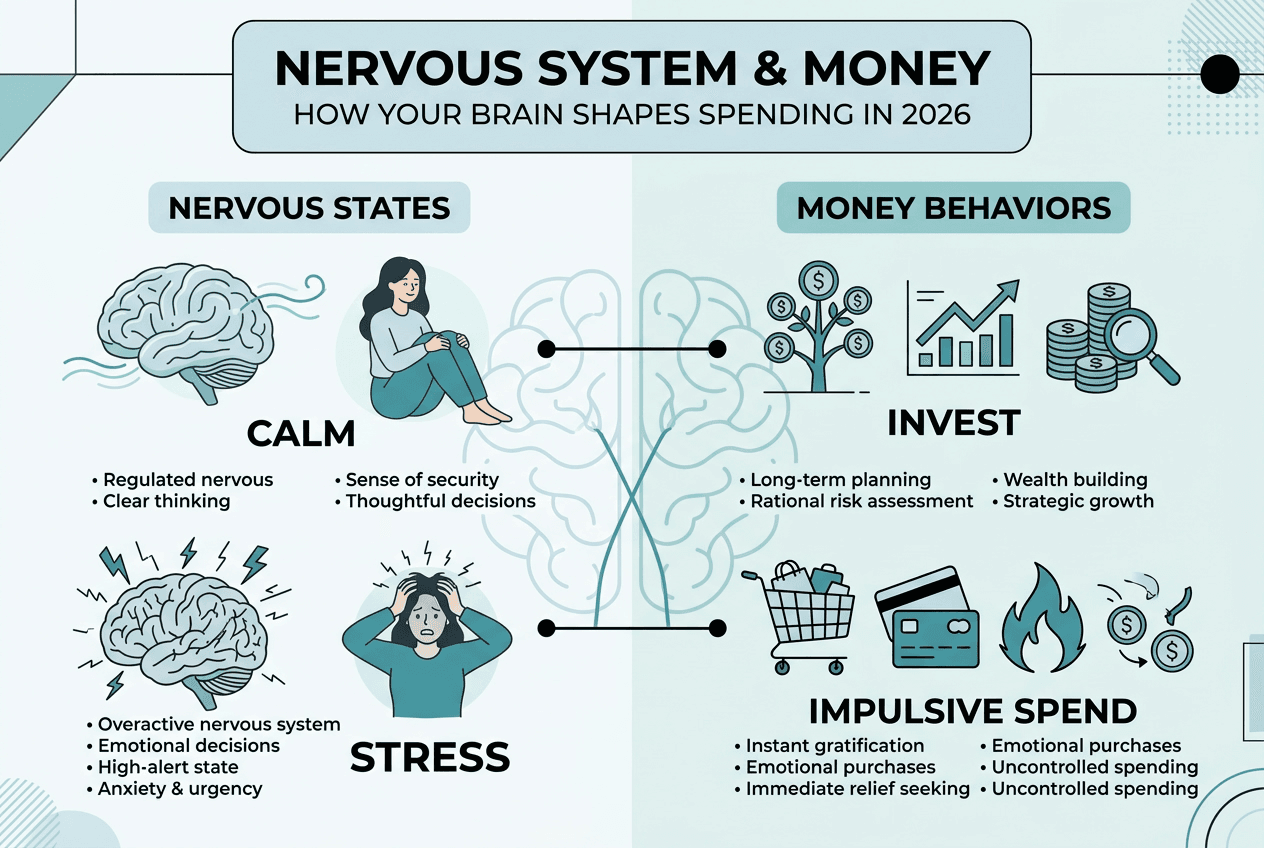
Your autonomic nervous system operates outside conscious control, managing heart rate, digestion, and stress responses. Polyvagal theory explains how this system creates three distinct states that profoundly shape your relationship with money. The sympathetic state activates fight or flight responses, flooding your body with cortisol when financial threats appear. The dorsal vagal state triggers freeze and shutdown, making you avoid bank accounts and difficult pricing conversations. The ventral vagal state promotes safety and social connection, enabling calm decision making and receptivity to abundance.
These states determine whether you can receive money gracefully or sabotage opportunities unconsciously. When individuals with a nervous system in fight or flight exhibit impulsive spending, they’re not being irresponsible. Their body perceives threat and seeks immediate relief through purchases that temporarily soothe activated stress responses. The freeze state manifests as procrastination on invoicing, inability to follow up on proposals, and chronic underpricing that keeps you small and seemingly safe.
Women entrepreneurs often experience sympathetic activation during sales conversations, leading to rushed discounts or apologetic pricing. Your nervous system reads the potential client’s hesitation as danger, triggering an urgent need to resolve tension by lowering your rate. The dorsal state appears when you ghost on financial planning, avoid reviewing profit margins, or refuse to look at what you actually earned last quarter. Neither response reflects your intelligence or business acumen.
The ventral vagal state changes everything. When regulated, you can hold pricing boundaries without panic, receive large payments without guilt, and make strategic financial decisions aligned with long-term wealth building. This state allows you to stay present during money conversations instead of dissociating or people-pleasing your way to smaller paychecks. Accessing this state consistently requires understanding what triggers your nervous system and developing practices that return you to regulation.
Pro Tip: Before any money conversation, spend two minutes doing slow exhale breathing to activate your ventral vagal state and prevent automatic stress responses from controlling your pricing decisions.
Building a sustainable money mindset unlocking entrepreneurial wealth requires recognizing which nervous system state you’re operating from when financial decisions arise. Your body’s survival responses will always prioritize immediate safety over long-term prosperity unless you consciously intervene.
Unpacking early emotional money narratives
The super-subconscious stores every emotional experience from conception through age seven, creating a database of safety and threat cues that operate below conscious awareness. During these formative years, your brain absorbs family money dynamics, parental stress around bills, and casual comments about wealth with perfect fidelity. These experiences become the lens through which your nervous system evaluates every financial opportunity decades later.
When a parent said “We can’t afford that” with anxiety in their voice, your developing nervous system recorded money as a source of threat. If you heard “Rich people are greedy” or “Money doesn’t grow on trees” repeatedly, those phrases became subconscious rules governing how much wealth you allow yourself to build. The super-subconscious doesn’t distinguish between past and present, so early emotional experiences and narratives around money within the first seven years create deep financial behavior associations that feel like unchangeable truth.

These narratives create invisible ceilings on your earning capacity. You might consciously want to charge premium rates, but if your super-subconscious associates high prices with being bad or unsafe, your nervous system will sabotage every attempt to raise them. The body interprets breaking these early rules as genuine danger, triggering stress responses that make sustainable growth feel threatening rather than exciting.
Common early money narratives that limit women entrepreneurs include:
- Money causes family conflict and relationship damage
- Asking for what you’re worth makes you selfish or demanding
- Financial success means working constantly without rest or joy
- Women who prioritize profit are cold, masculine, or unfeminine
- Visible wealth invites judgment, envy, and social rejection
Awareness creates the first opening for change. When you notice resistance to raising prices or discomfort receiving large payments, you’re observing your super-subconscious protective mechanisms in action. These responses aren’t character flaws requiring willpower to overcome. They’re outdated safety strategies your nervous system believes still apply.
“Becoming aware of early beliefs and regulating your nervous system with presence and compassion enables rewriting limiting money narratives, creating space for financial behaviors aligned with your current goals rather than childhood fears.”
Developing financial literacy for founders includes understanding the emotional infrastructure beneath the numbers. You can master profit margins and cash flow projections, but if your super-subconscious still runs childhood money rules, your business will plateau at the income level your nervous system deems safe.
Gender nuances in financial decision-making and delay discounting
Delay discounting measures how much people devalue future rewards compared to immediate ones, directly impacting savings behavior, investment decisions, and business growth strategies. Someone with high delay discounting chooses smaller immediate payouts over larger future returns, while low delay discounting indicates patience for long-term financial benefits. This psychological tendency shapes everything from retirement planning to whether you reinvest profits or extract them immediately.
Research reveals significant gender differences in this domain. Males show higher discounting rates for future rewards than females, with differences most pronounced in adults and notably among Asian participants. Women demonstrate greater willingness to delay gratification for superior long-term outcomes, a tendency that supports sustainable wealth building when properly leveraged.
| Group | Delay Discounting Rate | Financial Implication |
|---|---|---|
| Adult males | Higher rates | Preference for immediate returns, potentially limiting long-term wealth accumulation |
| Adult females | Lower rates | Natural inclination toward patient capital growth and strategic reinvestment |
| Asian females | Significantly lower rates | Strongest tendency to prioritize future financial security over present consumption |
These differences aren’t about intelligence or capability. They reflect how gender socialization and cultural context shape the nervous system’s evaluation of temporal rewards. Women often face greater financial precarity and longer lifespans, creating evolutionary pressure to value future security. Cultural factors amplify these patterns, with collectivist societies emphasizing long-term family welfare over individual immediate gratification.
For women entrepreneurs, lower delay discounting rates become a competitive advantage when consciously applied. Your natural tendency to consider long-term consequences supports decisions like reinvesting profits for growth rather than maximizing short-term draws. You’re neurologically wired to build businesses that generate wealth over decades, not just survive quarter to quarter. The challenge emerges when this same tendency combines with underpricing or underearning, creating patient accumulation of insufficient revenue.
Pro Tip: Leverage your natural future orientation by setting five-year wealth targets that make current pricing decisions obvious, using your strength for long-term thinking to justify premium rates today.
Understanding these gender nuances helps you recognize that your financial mindset for business growth operates within biological and cultural contexts that either support or constrain wealth building. Your nervous system’s approach to temporal rewards isn’t random; it’s shaped by forces you can now consciously direct toward sustainable prosperity.
Practical steps to regulate your nervous system for financial empowerment
Regulating your nervous system before making money decisions creates the physiological foundation for choices aligned with long-term wealth rather than short-term safety. Your body must feel safe enough to tolerate the vulnerability of charging appropriately, receiving abundantly, and building visibly. Without regulation, even perfect financial strategy collapses under the weight of unconscious protective mechanisms.
Follow these steps to increase awareness and cultivate ventral vagal engagement:
- Notice your physical state before money conversations by scanning for tension, shallow breathing, or urges to rush through pricing discussions.
- Name the nervous system state you’re experiencing without judgment, recognizing sympathetic activation or dorsal shutdown as information rather than failure.
- Use bilateral stimulation like alternate nostril breathing or tapping opposite shoulders to interrupt stress responses and restore regulation.
- Practice receiving small amounts of money with presence and gratitude to train your nervous system that financial abundance is safe.
- Review your early money narratives in writing, identifying which beliefs still drive current financial behaviors unconsciously.
- Establish a daily regulation practice that keeps your baseline nervous system state in ventral vagal territory, making financial decisions from groundedness rather than reactivity.
Becoming aware of early beliefs and regulating your nervous system with presence and compassion enables rewriting limiting money narratives that have controlled your earning capacity for decades. This process requires consistency and patience, as your super-subconscious won’t release protective patterns until it trusts new behaviors genuinely increase safety.
Practical tools for daily nervous system regulation include:
- Five minutes of morning breathwork focusing on extended exhales to activate parasympathetic responses
- Somatic tracking during financial tasks, noticing where money stress appears in your body
- Compassionate self-inquiry about pricing resistance, exploring the fears beneath undercharging
- Celebration practices that help your nervous system associate money with joy rather than threat
- Regular co-regulation with trusted peers who support your wealth building without judgment
Pro Tip: Combine logical financial planning with nervous system regulation by reviewing your numbers in a regulated state, ensuring your body feels safe enough to see and act on growth opportunities.
Integrating these practices into daily business routines creates lasting transformation. Changing your money mindset happens not through willpower or positive thinking, but through consistent nervous system regulation that rewrites the subconscious rules governing your financial behaviors. Building mental resilience for entrepreneurs includes developing capacity to stay present with money discomfort rather than avoiding or rushing through it.
Your nervous system learned its money patterns over decades. Give yourself permission to practice regulation consistently for months, trusting that small shifts in physiological state create compound effects on financial outcomes. The goal isn’t perfection but increasing your window of tolerance for financial growth, expansion, and visibility.
Empower your financial mindset with Freedom Sun
Transforming your relationship with money requires more than information. It demands integrated support that addresses both financial strategy and the nervous system patterns underneath your earning capacity. Freedom Sun business training combines nearly 20 years of Fortune 500 financial expertise with deep understanding of the psychological barriers that keep talented women entrepreneurs stuck at income levels below their capability. The platform teaches sustainable wealth building through four pillars: Profit, Sales, Communication, and Leadership, delivered through the Women’s Wealth Collective academy and live events. If you’re ready to stop undercharging and build a business that generates real wealth without burning you out, Freedom Sun offers the nervous system-informed approach that makes lasting change possible.
FAQ
How does nervous system regulation improve financial decisions?
Regulating your nervous system reduces stress-driven impulses that lead to underpricing, impulsive spending, or financial avoidance. When you operate from a ventral vagal state, you access clarity and calm that enable wise money choices aligned with long-term wealth building rather than immediate threat relief. Your body must feel safe before your brain can evaluate financial opportunities accurately.
Can early childhood money beliefs be changed?
Yes, limiting money beliefs formed in childhood can be transformed through awareness, compassionate presence, and consistent nervous system regulation. Logical understanding alone won’t create change because these beliefs live in your super-subconscious and body, not your rational mind. Combining emotional presence with practical regulation techniques rewrites the subconscious rules that have controlled your financial behaviors for decades.
Why do women generally value future rewards more than men?
Research shows women tend to discount future rewards less than men, demonstrating greater patience for long-term financial benefits over immediate payouts. This tendency likely reflects evolutionary pressures related to longer lifespans and greater financial precarity, combined with socialization emphasizing future planning and security. Women entrepreneurs can leverage this natural inclination toward sustainable growth strategies and patient wealth accumulation.
What’s a simple daily practice to improve my money mindset?
Daily mindfulness combined with breath awareness helps regulate your nervous system and reduce the stress responses that drive poor financial decisions. Spend five minutes each morning doing slow exhale breathing while setting an intention for how you want to feel about money that day. Regular compassionate reflection on your money beliefs, noticing resistance without judgment, supports gradual mindset shifts that logic alone cannot achieve.